
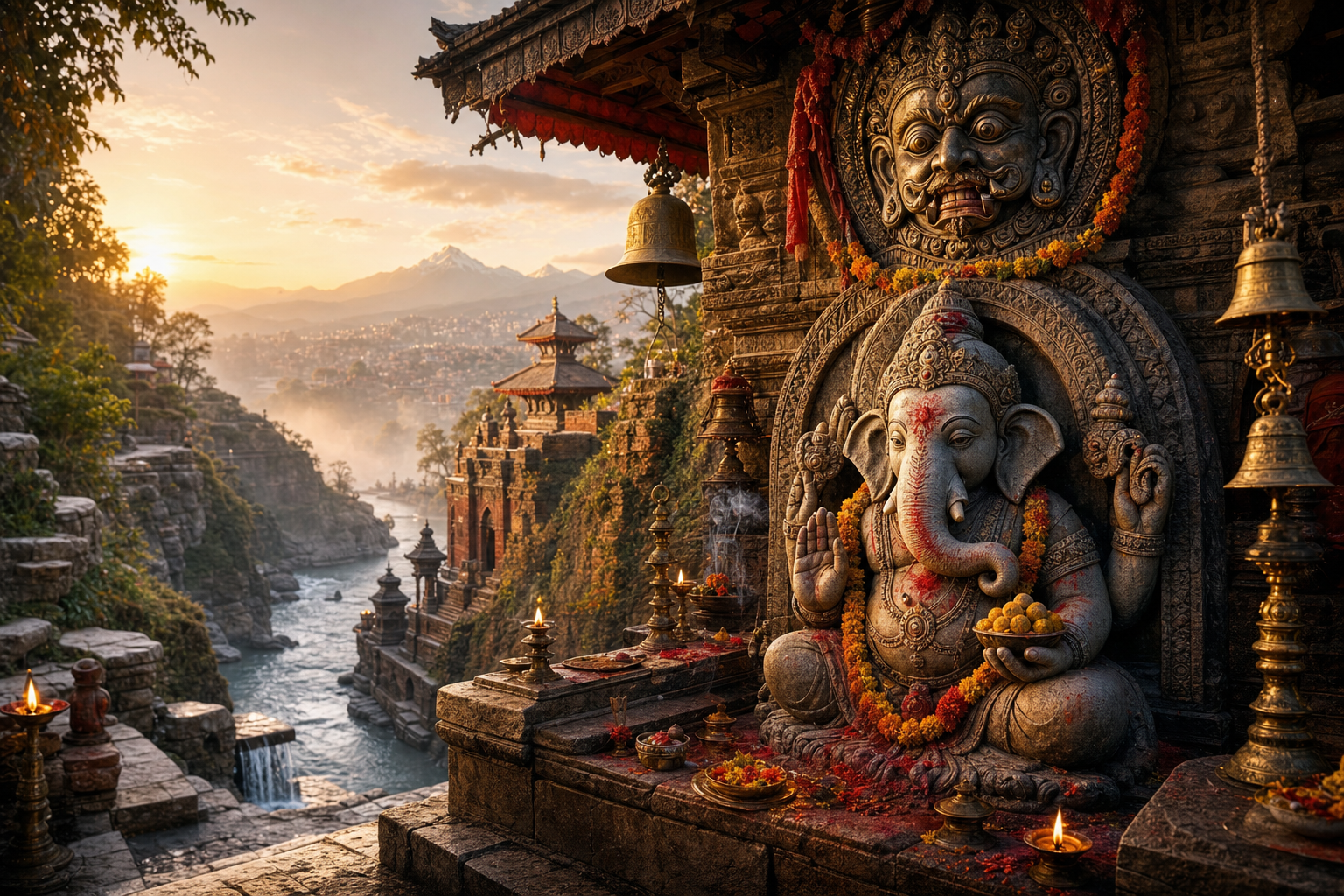
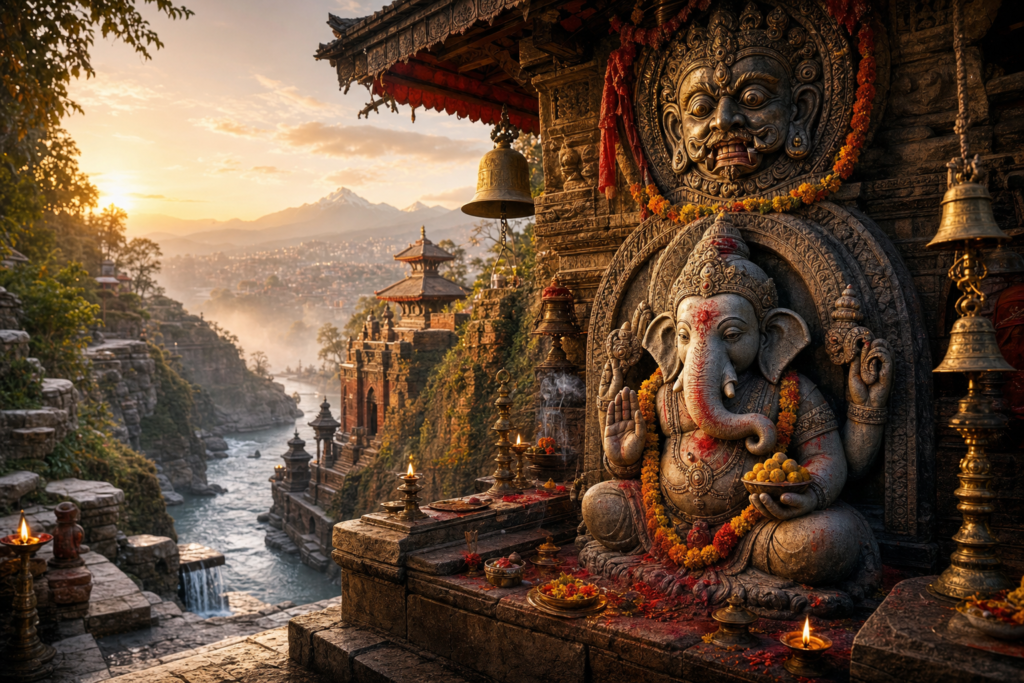
Kvena Ganesh and Vighnantaka Bhairava form one of the most intriguing sacred images associated with the Jal Vinayak Temple at Chobhar, on the southern edge of the ancient Kathmandu Valley in Nepal. The image is remembered through a layered sacred geography: a rocky gorge, the Bagmati River, a shrine of Ganesh, and a Bhairava presence that points toward the fierce protective dimension of Lord Shiva. In this tradition, the familiar remover of obstacles is not reduced to a gentle household deity alone; he is also placed within a larger Shaiva and Tantric world where obstacles, fear, thresholds, water, descent, and liberation are held together in a single field of meaning.
Jal Vinayak, also called Jal Binayak, is counted among the important Vinayak shrines of Kathmandu Valley. The valley’s Ganesh worship is not merely devotional in a narrow sense; it is civic, geographical, ritual, and protective. The four original Ganesh shrines traditionally associated with the valley include Jal Binayak of Chobhar, Chandra Binayak, Surya Binayak, and Ashok Binayak. Each shrine marks a sacred relationship between the deity and the valley’s inhabited world, reminding devotees that a settlement is not only built with stone, timber, trade, and kingship, but also with ritual protection and divine orientation.
The location of Jal Vinayak is central to its meaning. Chobhar is famous for the gorge through which the waters of the ancient valley lake are said to have drained. In the well-known sacred memory of Kathmandu Valley, the Bodhisattva Manjushri is associated with cutting the gorge and making the valley habitable. This mythic landscape is shared across Hindu and Buddhist imagination in Nepal, and it reflects the civilizational genius of the region: sacred narratives are not treated as hostile claims, but as complementary ways of remembering place, transformation, and human settlement.
Because of this location, Jal Vinayak is not simply a temple beside water. It is a shrine at a cosmological threshold. Water in Hindu and Buddhist sacred geography often represents both life and danger, purification and dissolution, fertility and the unknown. A gorge is likewise a passage between worlds: it cuts, opens, drains, releases, and exposes. When Ganesh is worshipped here, he is encountered as the lord who makes passage possible. He is not only invoked before a school examination, a wedding, a business venture, or a journey; he is also remembered as the deity who presides over the difficult opening through which chaos becomes inhabitable order.
The name Kvena or Kwenawasi Ganesh appears in local traditions connected with Shreekhandapur and Chobhar. According to oral accounts from Shreekhandapur, the Kwenawasi Ganesh Than is associated with a place where water is believed never to dry up and is described as a gateway to the underworld. A tantric practitioner from Chobhar is said to have tested the power of the deity and interpreted the idol’s dimensions in symbolic terms: the larger form represented the vastness of heaven and the underworld, while the smaller form suggested the infinitesimal subtlety of creation. The story then recounts that the idol was taken to Chobhar, where it became linked with the temple tradition there, while Shreekhandapur continued to honor Kwenawasi Ganesh in its own shrine.
This legend should not be read only as a dispute over an image. In the religious culture of Nepal Mandala, the movement of a deity often expresses the movement of power, kinship, obligation, and ritual memory between settlements. When people from Shreekhandapur continue to visit Chobhar for worship, the story becomes a bridge rather than a boundary. The deity belongs to devotion before he belongs to possession. Such traditions show how sacred memory can preserve local distinctiveness while still sustaining relationship, pilgrimage, and shared reverence.
The reference to Vighnantaka Bhairava deepens the theological character of the image. The Sanskrit element vighna means obstacle, hindrance, interruption, or impediment. Ganesh is widely known as Vighnaharta, Vighneshvara, and Vinayaka, the deity who removes obstacles and governs beginnings. Bhairava, a fierce manifestation of Shiva, is associated with protection, time, destruction of impurity, guardianship of sacred spaces, and the frightening but liberating power of truth. Vighnantaka Bhairava may therefore be understood as a Bhairava form connected with the destruction of obstacles, especially obstacles that are not merely external inconveniences but inner forms of fear, ignorance, arrogance, and spiritual inertia.
The phrase “when the remover carries the destroyer” captures the paradox at the heart of this sacred image. Ganesh removes obstacles through wisdom, auspiciousness, discrimination, and grace. Bhairava destroys obstacles through fierce clarity, rupture, and uncompromising protection. In ordinary devotional language these may appear to be different modes, but in Hindu philosophy they are not contradictory. The same dharmic universe recognizes both the soft hand that guides and the fierce power that cuts bondage. Kvena Ganesh and Vighnantaka Bhairava together teach that compassion and severity, when aligned with dharma, are not enemies.
Ganesh iconography is often approachable: the elephant head, the rounded belly, the modaka, the mouse vehicle, and the blessing hand communicate abundance, intelligence, and accessibility. Yet the deeper Ganapati traditions are not simplistic. Tantric Ganapati forms, regional Vinayak cults, and temple traditions across India and Nepal present Ganesh as a guardian of thresholds, a master of mantra, a deity of liminal spaces, and a power who can both grant worldly success and guide spiritual transformation. Jal Vinayak participates in this wider Indic pattern while expressing it in a distinctly Nepali ritual and artistic idiom.
Bhairava’s presence in this context also reflects the religious landscape of Kathmandu Valley. Bhairava temples, masks, processions, and guardian images are central to Newar religious culture. Bhairava is not merely an abstract theological idea; he is a living civic protector, a witness to vows, a guardian of settlements, and a presence invoked in festivals. His fierce face is not a celebration of violence but a symbolic language of protection. Where ordinary sentiment hesitates, Bhairava confronts disorder directly. In this sense, Vighnantaka Bhairava stands for the destruction of those forces that prevent spiritual and social harmony.
The union of Ganesh and Bhairava at a water-linked shrine also carries psychological meaning. Human beings often experience obstacles in two forms. Some obstacles require patience, intelligence, learning, and graceful adjustment; these belong naturally to Ganesh’s domain. Other obstacles require decisive severance: harmful habits, destructive pride, fear of truth, and attachment to confusion. These belong to the Bhairava dimension. The sacred image teaches that mature spiritual life requires both capacities. To begin well, one must be blessed by Ganesh; to continue honestly, one must be purified by Bhairava.
The Chobhar setting makes this lesson more vivid. A gorge is not a smooth road; it is a dramatic opening produced by force, descent, and release. The Bagmati does not politely decorate the landscape; it cuts through it and gives the valley an outlet. Likewise, spiritual growth is not always a gentle polishing of personality. At times it is a gorge cut through ego, fear, and inherited confusion. Kvena Ganesh and Vighnantaka Bhairava therefore offer a powerful meditation on transformation: the obstacle is removed not by denial, but by a sacred combination of wisdom and fierce purification.
The tradition also illustrates the unity among dharmic paths in Nepal. Kathmandu Valley has long been a meeting ground of Hinduism, Buddhism, Shaiva Tantra, Shakta worship, Vajrayana practice, local Newar ritual systems, and folk sacred geography. Manjushri’s valley-opening legend, Ganesh worship at Jal Vinayak, Bhairava guardianship, and the shared participation of communities show a religious world in which identities are deeply rooted yet mutually permeable. This is not a vague modern pluralism imposed from outside; it is an old civilizational habit of reverence, adaptation, and shared sacred space.
Such a tradition is especially important in contemporary discussions of Hindu heritage and dharmic unity. The goal of studying Kvena Ganesh and Vighnantaka Bhairava should not be to isolate one sect from another, or to claim superiority for one ritual vocabulary over another. The more accurate reading is integrative. Ganesh, Shiva as Bhairava, local village memory, sacred water, and Kathmandu Valley’s Hindu-Buddhist environment all work together. The tradition affirms that dharma is capable of holding many forms without losing philosophical depth.
From an art-historical perspective, the image is also significant because it challenges overly tidy categories. Modern readers often expect a deity to appear with a single fixed identity: Ganesh as remover, Shiva as destroyer, Vishnu as preserver, Devi as mother, Buddha as teacher. Traditional iconography is more subtle. Deities overlap, carry one another’s meanings, appear in fierce and gentle forms, and reveal theological relationships through posture, vehicle, placement, and ritual context. Kvena Ganesh associated with Vighnantaka Bhairava belongs to this sophisticated symbolic world.
The story from Shreekhandapur about the deity’s size is particularly rich. The large form representing heaven and the underworld, and the small form representing the minute, suggests a theology of scale. Ganesh is not confined to the visible idol; the idol is a doorway into a reality that spans the cosmic and the subtle. This is consistent with broader Hindu thought, where the divine may be encountered as larger than the universe and smaller than the smallest particle. The image becomes a teaching device: the sacred is not limited by physical measurement, even when it is lovingly approached through physical form.
The association with a spring that never dries up adds another layer. A perennial water source in a sacred place naturally becomes a symbol of continuity, blessing, and hidden abundance. In devotional experience, the most powerful shrines often feel less like monuments and more like living sources. People return to them because something in the place continues to flow: memory, protection, courage, gratitude, or the quiet certainty that life is supported by powers deeper than ordinary calculation.
There is also a social lesson in the continuing relationship between Shreekhandapur and Chobhar. Sacred traditions frequently preserve old tensions, but they also ritualize reconciliation. The account that devotees from Shreekhandapur visit the Chobhar temple before certain local practices proceed indicates that ritual order can acknowledge historical memory without allowing it to become permanent hostility. In dharmic culture, memory is not always erased; it is often transformed into obligation, pilgrimage, and shared participation.
For devotees, Ganesh remains the first deity of auspicious beginnings. Every new undertaking carries uncertainty, and the human heart naturally seeks blessing before stepping into the unknown. Yet the Kvena Ganesh tradition at Jal Vinayak gives this familiar devotion a deeper edge. Beginnings are not only cheerful moments; they can be frightening thresholds. A student beginning education, a family beginning a new life, a community rebuilding after disaster, or a seeker beginning inner discipline all require both Ganesh’s assurance and Bhairava’s courage.
This is why the title “remover carries the destroyer” is more than poetic language. It suggests a complete spiritual method. First, the mind must recognize the obstacle. Then it must seek wisdom. Then it must accept discipline. Then it must allow falsehood to be destroyed. Finally, it must move forward with humility. Ganesh without Bhairava may become mere comfort; Bhairava without Ganesh may become harshness. Together, they become a balanced path: auspiciousness joined with fearless purification.
Jal Vinayak Temple itself belongs to the long history of Malla-period religious patronage and Newar artistic culture. The temple’s pagoda form, its location, and its role among the valley’s Vinayak shrines show the integration of architecture, kingship, and devotion. In Nepal, temples are rarely only buildings. They are archives of community memory, ritual calendars, craft traditions, lineage rights, local economies, and sacred geography. A shrine such as Jal Vinayak therefore preserves not only a deity image but an entire way of understanding the relationship between land, society, and the divine.
Theologically, Kvena Ganesh and Vighnantaka Bhairava also invite reflection on the meaning of obstacles. In popular devotion, obstacles are often treated as external problems to be removed quickly. Classical dharmic thought is more demanding. Some obstacles protect a person from premature action. Some expose weakness. Some reveal attachment. Some are karmic lessons. Some arise from adharma and must be opposed. The remover of obstacles does not always remove difficulty in the way the ego expects; sometimes he removes ignorance by forcing a clearer encounter with reality.
Bhairava’s role intensifies this insight. The destroyer of obstacles does not merely clear a path for convenience. He destroys what obstructs truth. This may include fear, vanity, spiritual laziness, social disorder, and the misuse of sacred power. In this sense, Vighnantaka Bhairava should be understood not as a frightening figure outside morality, but as a guardian of moral and spiritual seriousness. His fierceness belongs to protection, not cruelty.
For modern readers, the story remains relevant because contemporary life is crowded with obstacles that are both practical and inward. There are obstacles of distraction, fragmented attention, cultural forgetfulness, alienation from sacred places, and shallow interpretations of tradition. Kvena Ganesh and Vighnantaka Bhairava offer an older grammar for confronting such conditions. They teach that wisdom must be embodied, sacred geography must be remembered, and inner transformation requires both tenderness and strength.
The image also cautions against reducing Hindu stories to entertainment or decorative mythology. A temple legend is often a compressed philosophical text. The Chobhar gorge speaks of opening; the water speaks of continuity; Ganesh speaks of auspicious intelligence; Bhairava speaks of fierce protection; Shreekhandapur’s memory speaks of community relationship; Kathmandu Valley’s wider sacred landscape speaks of dharmic coexistence. When these elements are read together, the story becomes a serious reflection on how a civilization encodes theology into place.
In the broader field of Hindu stories, the Kvena Ganesh and Vighnantaka Bhairava tradition deserves attention because it is not merely a popular tale but a layered example of Nepal’s sacred culture. It belongs to temple history, Shaiva traditions, Ganesh worship, iconography, symbolism, and the lived religious world of Kathmandu Valley. It shows how local legends can illuminate universal principles: obstacles must be faced, beginnings must be sanctified, hidden waters must be honored, and fierce truth must be integrated with compassionate wisdom.
Ultimately, the sacred secret of Kvena Ganesh and Vighnantaka Bhairava is that removal and destruction are not separate divine functions when they serve liberation. Ganesh removes the visible obstruction; Bhairava destroys the deeper bondage. Ganesh blesses the threshold; Bhairava guards it. Ganesh makes the path auspicious; Bhairava ensures that the path remains truthful. At Jal Vinayak of Chobhar, this union is remembered in a landscape shaped by water, stone, myth, and devotion, offering a profound lesson for anyone seeking to understand the living depth of Hindu spirituality in Nepal.
Inspired by this post on Hindu Blog.



Leave a Reply
You must be logged in to post a comment.