
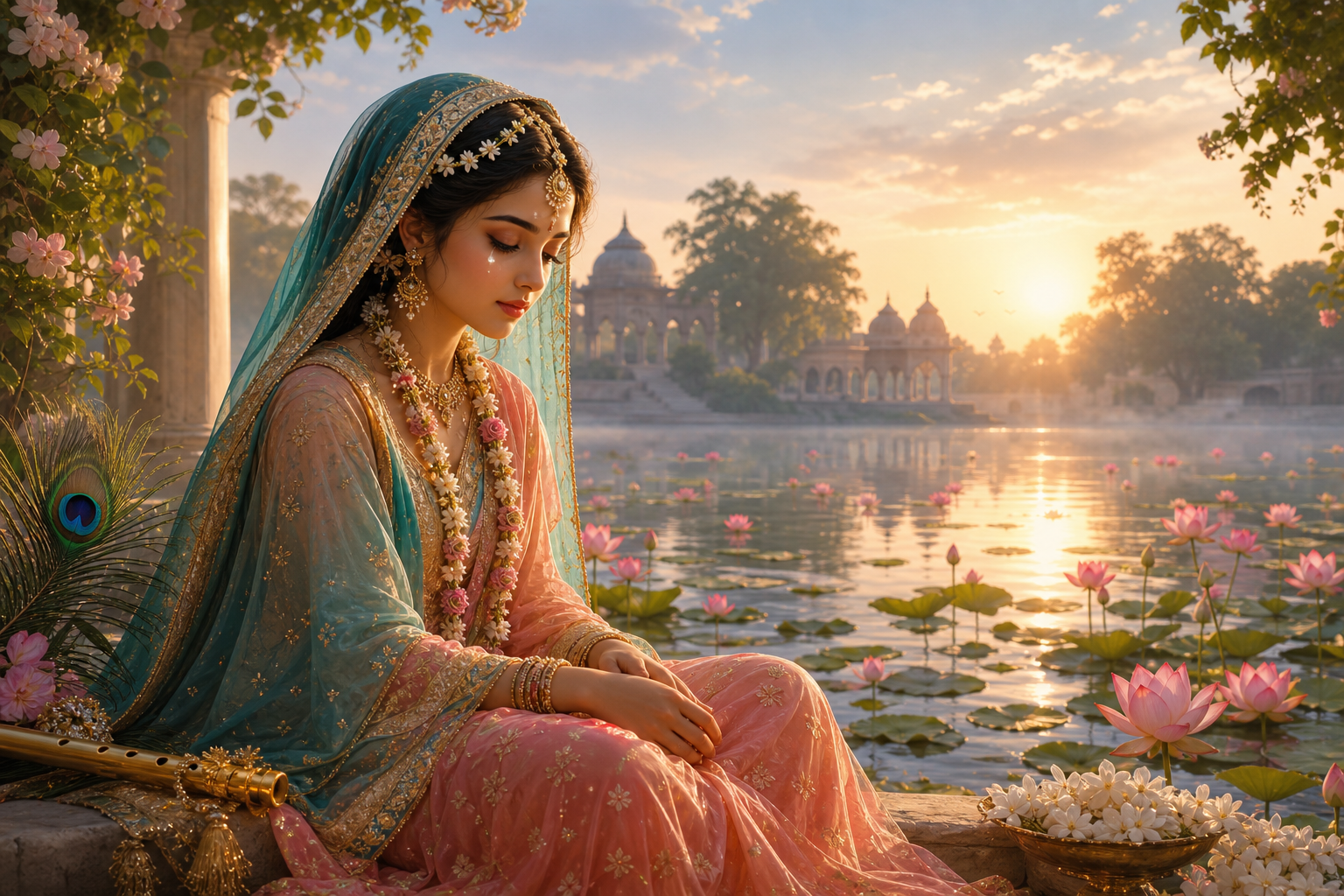
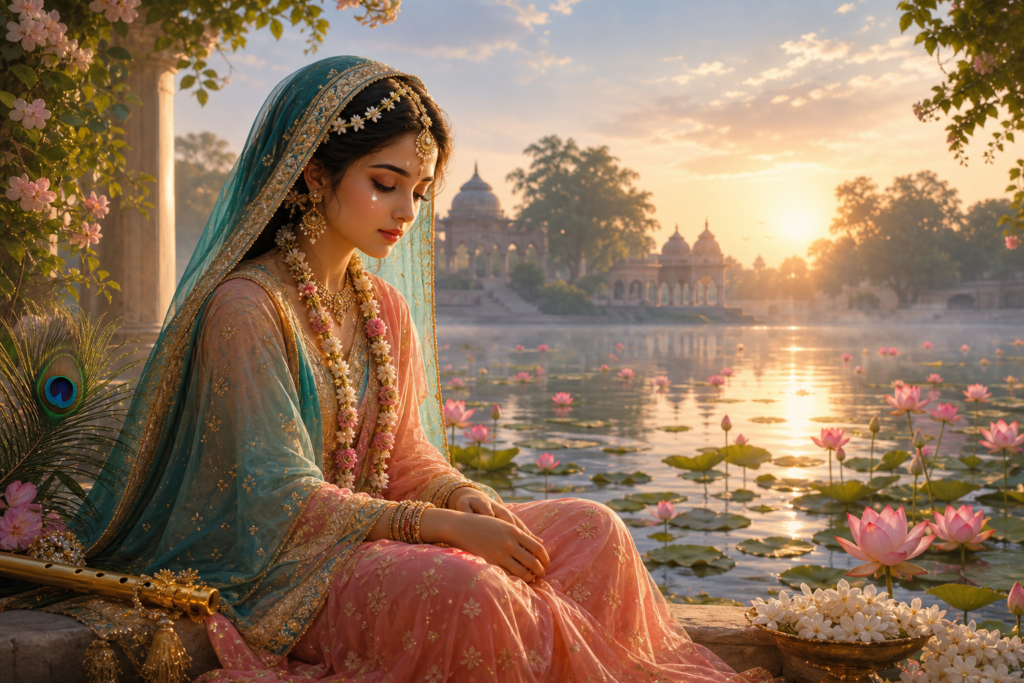
Sri Radha’s tears occupy a profound place in the devotional theology of the Bhakti Tradition, especially within Vaishnava reflections on Radha, Krishna, Divine Love, and the inner science of rasa. They are not treated as ordinary sorrow, emotional instability, or poetic exaggeration. In classical devotional understanding, these tears point toward prema, the highest refinement of love, where the soul’s longing for the Divine becomes so concentrated that the body itself begins to speak through trembling, tears, stillness, and absorption.
The phrase “Sri Radha’s Tears” therefore opens a subject that is at once theological, psychological, aesthetic, and deeply devotional. In the Radha-Krishna tradition, tears are not merely a sign of pain; they can become a sacred language. They express separation, remembrance, humility, surrender, tenderness, and the overwhelming intensity of spiritual connection. This makes the theme especially important for anyone seeking to understand Hindu spirituality beyond ritual action alone, because it reveals how bhakti views emotion as a disciplined and illumined path toward God-realisation.
In Vaishnava literature, Sri Radha represents the fullest embodiment of devotion to Sri Krishna. Her love is not transactional, possessive, or self-centered. It is described as complete self-offering, where every movement of thought, breath, memory, and feeling is directed toward Krishna. Her tears, in this framework, become evidence of a love so pure that the boundary between inner emotion and outer expression dissolves. The devotee does not simply think of the Divine; the whole being becomes responsive to the Divine presence and absence.
This is why the language of ecstatic love must be approached carefully. In ordinary usage, ecstasy may suggest excitement or sensory pleasure. In bhakti theology, however, ecstatic love refers to a spiritual condition in which devotion matures into refined absorption. It is cultivated through remembrance, chanting, hearing sacred narratives, worship, humility, ethical conduct, and association with spiritually serious practitioners. The emotional symptoms are not manufactured for display; they are traditionally understood as secondary signs that may arise when the heart is deeply transformed.
Classical rasa theory provides a technical vocabulary for this transformation. The term rasa refers to the distilled spiritual taste or relational mood experienced in connection with the Divine. Devotional traditions speak of moods such as reverence, friendship, parental affection, service, and intimate love. The Radha-Krishna tradition places particular emphasis on madhurya-rasa, the sweet and intimate mood of divine love, while also recognizing that all genuine devotional relationships have dignity when rooted in sincerity, dharma, and surrender.
Tears in this context may be understood through the language of bhava and prema. Bhava is often described as the initial awakening of deep devotional emotion, while prema is the fully ripened state of pure love. The visible signs associated with such states, including tears, are traditionally discussed as sattvika-bhavas, involuntary transformations arising from spiritual emotion. Their significance lies not in spectacle, but in their connection to purified consciousness. Without humility, discipline, and devotion, external imitation has no spiritual depth.
Sri Radha’s tears are especially associated with viraha, the pain of separation from Krishna. This separation is not merely absence; it intensifies remembrance. In devotional psychology, longing can become a form of presence because the beloved Divine occupies the heart so completely that every moment of separation deepens awareness. This paradox is central to many Vaishnava hymns and narratives: the pain of separation is not opposed to love, but becomes one of its most powerful forms.
The emotional force of this teaching remains relatable even for those approaching it academically. Human beings understand, at some level, how love can make absence feel present and how memory can shape the body. A name, a place, a melody, or a gesture can awaken tears long before the intellect explains why. Bhakti refines this universal experience and directs it toward the Divine, showing that the heart’s capacity for longing is not a weakness when purified by wisdom and dharma.
At the same time, the tradition does not reduce spiritual life to emotion alone. Authentic bhakti integrates feeling with character. Tears are meaningful only when accompanied by compassion, truthfulness, steadiness, service, respect for sacred traditions, and freedom from pride. This is an important corrective in modern spirituality, where intense experiences are sometimes mistaken for realization. The bhakti texts repeatedly indicate that the highest love softens the ego and expands reverence for all beings.
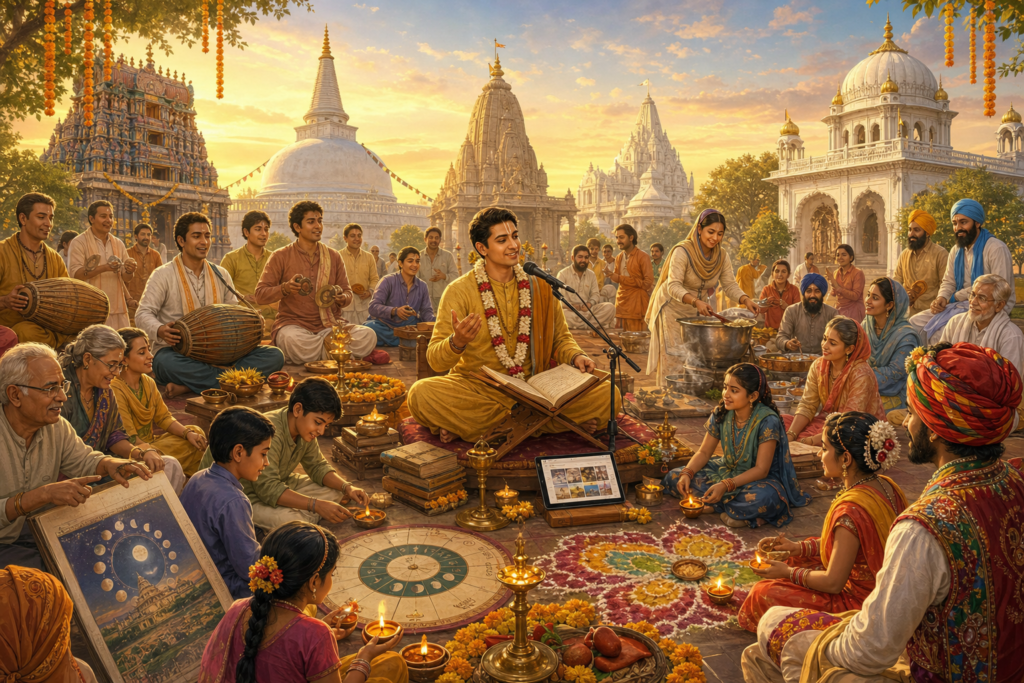
Sri Radha’s tears also illuminate the unity of dharmic traditions through a shared respect for inner transformation. Hinduism, Buddhism, Jainism, and Sikhism differ in theology, metaphysics, and practice, yet each recognizes that the untrained ego creates suffering and that disciplined spiritual life can purify perception. The Vaishnava meditation on divine longing can therefore be appreciated alongside Buddhist compassion, Jain self-restraint, and Sikh devotion to Naam and seva. The common thread is the refinement of the human being through truth, humility, and disciplined love.
Within Hindu spirituality, Radha’s tears preserve a particularly tender vision of the sacred feminine. Sri Radha is not peripheral to Krishna bhakti; she is central to its deepest emotional and theological vocabulary. Her devotion reveals the power of receptivity, surrender, courage, and unwavering love. This sacred feminine dimension challenges narrow readings of religion that focus only on law, authority, or metaphysical doctrine. It shows that the highest wisdom may appear as tenderness, longing, and tears.
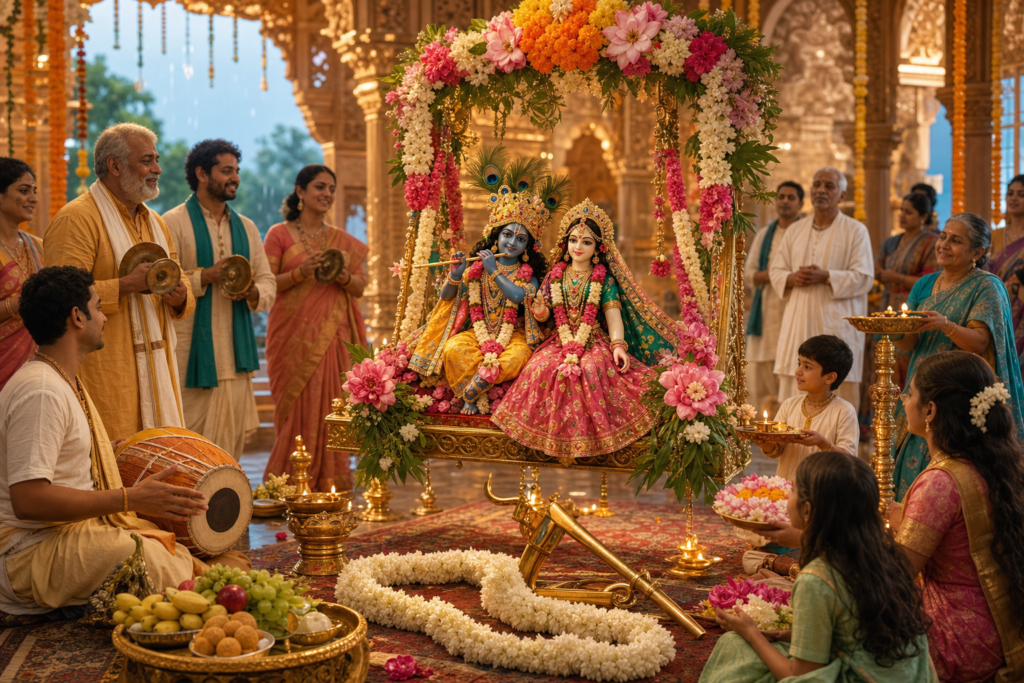
The image of tears also carries a disciplined aesthetic function. Devotional literature does not present sacred emotion randomly. It uses poetry, music, kirtan, memory, rhythm, and narrative structure to awaken contemplation. When devotees sing of Radha’s longing, the aim is not entertainment alone. The song becomes a vehicle for meditation, allowing the listener to move from surface emotion toward refined awareness of love, impermanence, dependence, and grace.
This makes the topic relevant for contemporary readers living amid distraction, performance, and emotional fragmentation. Modern life often trains people either to suppress feeling or to broadcast it. Bhakti offers a third possibility: emotion can be consecrated. Tears need not be shameful, manipulative, or chaotic when they arise from sincere remembrance and moral clarity. They can become part of an inward pilgrimage, guiding the heart away from self-importance and toward reverence.
For practitioners, Sri Radha’s tears invite a more mature understanding of devotion. The goal is not to force mystical symptoms, claim superiority, or imitate saints. The goal is to cultivate the conditions in which love becomes truthful. This includes regular sadhana, remembrance of Krishna, respect for guru and scripture, ethical restraint, service to others, and humility before the vastness of the Divine. In such a life, emotion becomes purified by practice rather than driven by impulse.
For scholars, the theme offers a rich field of analysis because it connects theology, embodiment, literature, gender, aesthetics, and religious experience. Sri Radha’s tears show how Hindu devotional traditions understand the body not as an obstacle alone, but as a possible instrument of sacred expression. The body weeps, trembles, sings, bows, and serves; through these actions, the inner life becomes visible. This embodied spirituality is one reason bhakti has remained accessible across regions, languages, castes, and social settings.
The continuing relevance of Sri Radha’s tears lies in their ability to restore seriousness to the language of love. Love is not presented as sentimentality or private preference. It is a force that disciplines, humbles, transforms, and reorients the whole person. In Radha’s longing for Krishna, the tradition sees the soul’s longing for its highest truth. In her tears, it sees the moment when devotion becomes too deep to remain abstract.
Thus, “Stimulation for Ecstatic Love” can be understood as an invitation to contemplate how sacred emotion is awakened and refined. Sri Radha’s tears are not an endpoint but a doorway into the theology of prema, the psychology of longing, and the practice of devotional remembrance. They remind the reader that spiritual life is not merely a matter of argument or identity. It is also the gradual purification of the heart until love becomes luminous, disciplined, and inseparable from the Divine.
Inspired by this post on Dandavats.



Leave a Reply
You must be logged in to post a comment.