
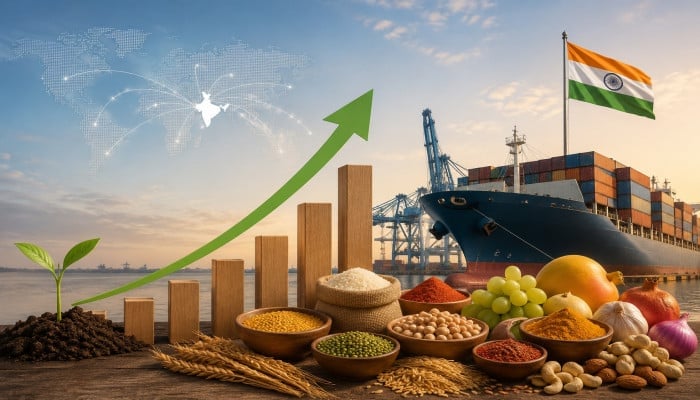
Bharat’s prospects in global food exports deserve careful attention because food is no longer only an agricultural commodity; it is increasingly a strategic asset, a source of rural prosperity, a test of logistics capacity, and a marker of national resilience. A country that can produce food at scale, process it efficiently, certify it reliably, and deliver it to distant markets with predictable quality gains more than export revenue. It gains credibility in a world where food security, climate uncertainty, energy shocks, and geopolitical disruptions have become central policy concerns.
The starting point is conceptual clarity. The Food and Agriculture Organisation of the United Nations treats agricultural exports as the monetary value or physical volume of primary and processed agricultural and livestock products produced in one country and sold in international markets. This broad category includes basic agricultural products such as grains, raw sugar, seeds, cotton, tobacco, and live animals; processed agricultural products such as vegetable oils, prepared meats, and dairy products; and food products intended for human consumption, whether basic, processed, packaged, or value-added. Food exports are therefore narrower than agricultural exports, but they are economically significant because they often capture higher margins, stronger branding potential, and greater downstream employment.
Global agricultural trade has moved steadily toward high-value and consumer-oriented products. Bulk commodities such as wheat, corn, rice, and other grains remain foundational because they anchor food security and price stability. Yet the larger gains in trade value increasingly come from processed foods, dairy, meats, marine products, edible oils, speciality crops, ready-to-consume products, and branded food categories. This distinction matters for Bharat because the country’s export opportunity is not limited to shipping more raw produce. The more consequential opportunity lies in building integrated food value chains: farm productivity, storage, testing, traceability, processing, packaging, branding, cold-chain movement, port handling, and market access.
In 2024, global agricultural trade was estimated to exceed USD 2 trillion. The leading food-exporting countries are not merely large producers; they are countries that combine production with infrastructure, standards, market intelligence, and policy coordination. The United States and Brazil occupy the top tier, with food exports of about USD 181 billion and USD 144 billion respectively in 2024. China, Canada, Mexico, and Indonesia form a second tier, while Bharat, Australia, and Thailand stand in the next group. Bharat’s food exports were around USD 46 billion in 2024, broadly comparable with Australia and ahead of several established European exporters in specific categories, while the country maintained a modest food trade surplus of about USD 11 billion.
This position is respectable, but it is not yet commensurate with Bharat’s civilisational agricultural depth, population scale, ecological diversity, or long-term economic ambition. The country is among the world’s largest producers of cereals, pulses, milk, fruits, vegetables, spices, fisheries products, and several plantation crops. It has coastal access, a large domestic market that can support scale, a growing base of entrepreneurs, and a policy environment increasingly focused on Atmanirbhar Bharat and Viksit Bharat. The question, therefore, is not whether Bharat can participate in global food trade. The real question is how quickly it can move from scale in production to scale in internationally trusted, value-added exports.
The economic context makes this question urgent. In 2025-26, Bharat’s exports of goods and services were about USD 0.86 trillion, while total international trade stood near USD 1.84 trillion. The national aspiration of reaching USD 2 trillion in exports over the medium term requires multiple sectors to expand simultaneously. Food and agriculture cannot remain peripheral in that journey. If handled with technical seriousness, the food sector can contribute to foreign exchange earnings, farmer incomes, rural employment, agro-industrial investment, and strategic supply partnerships with countries seeking dependable food sources.
There is also a geopolitical dimension. Energy market volatility, conflict in West Asia and other regions, disruptions in shipping routes, and climate-related uncertainty have made food security a greater priority for many governments. Countries that possess exportable food surpluses at scale can gain strategic leverage, especially when they are perceived as reliable, rules-based suppliers. Bharat’s approach to food exports must therefore be understood not only as an economic policy matter, but also as part of a wider national strategy involving diplomacy, supply-chain resilience, standards, and trusted partnerships across the Global South and beyond.
Several structural developments explain why Bharat’s prospects appear positive. The first is the growing alignment between national development priorities and the agricultural transformation of the Ganga River Valley, where a large share of Bharat’s population lives. This region has historically carried immense demographic and agricultural weight, but its full productive potential has often been constrained by fragmented infrastructure, uneven governance, low processing depth, and insufficient commercial orientation. Greater policy alignment between the Union government and major state governments in this belt can accelerate investment in irrigation efficiency, logistics, agro-processing, warehousing, farmer-producer organisations, and export corridors.
The second structural factor is the shift from subsistence-oriented agriculture toward technology-enabled, diversified, and commercially aware farming. The transformation is not only about higher yields. It involves better seed systems, precision agriculture, drone-based applications, digital advisory services, quality testing, crop diversification, water-use efficiency, climate-resilient practices, and data-linked supply-chain management. For ordinary farming families, these changes are not abstract. They determine whether a crop is sold locally at distress prices, processed into a higher-value product, or moved into a premium market with better returns.
Uttar Pradesh provides an important illustration because it contains roughly 17 per cent of Bharat’s population and has the scale to influence national agricultural outcomes. The state has announced plans to strengthen smart farming, promote export-oriented agricultural policies, increase productivity in food grains, pulses, and oilseeds, expand organic farming, reduce post-harvest losses below 4 per cent, and raise cropping intensity beyond 250 per cent by 2047. It has also set an ambition to increase its contribution to Bharat’s agricultural exports to more than 15 per cent over the coming decades. If implemented with discipline, such goals could materially alter Bharat’s food-export base.
The importance of post-harvest management cannot be overstated. Bharat has often produced abundantly but captured too little value because of losses in storage, weak grading systems, fragmented transport, insufficient cold-chain capacity, and uneven compliance with international phytosanitary standards. In global food trade, a product is not judged only at the farm gate. It is judged at every stage: residue levels, moisture control, packaging integrity, temperature management, documentation, traceability, port efficiency, and final consumer confidence. The emotional reality behind this technical chain is simple: when a farmer’s produce survives the journey from village to overseas shelf without quality loss, the value of rural labour is finally respected in the marketplace.
Bharat’s export diversification already shows signs of momentum. In FY26, new product-market combinations reportedly generated nearly USD 202 million in additional exports, with marine products, pulses, and agri-processing making notable contributions. This is a meaningful indicator because export growth becomes more durable when it is not dependent on one commodity or one destination. Diversification reduces vulnerability to price shocks, policy restrictions, disease outbreaks, crop failures, and changing consumer preferences in importing countries.
Specific examples show how the export map is widening. The Agricultural and Processed Food Products Export Development Authority has facilitated the first export of dried egg powder from Odisha to Austria. Litchi exports have opened new pathways, including shipments from Uttarakhand to Europe and GI-tagged Tezpur litchis from Assam to Singapore. Meghalaya has seen the establishment of a 10,000-ton organic spice processing facility aimed at value addition. Nagaland is cultivating premium arabica beans and encouraging young entrepreneurs to build brands around local coffee. Varanasi has exported biscuits to Oman, demonstrating how even traditional urban centres can enter processed food exports when logistics and certification systems are coordinated.
These examples matter because they move the discussion beyond the usual export centres. Bharat’s food-export future will not be built only in a few coastal or metropolitan regions. It will also emerge from Odisha, Assam, Meghalaya, Nagaland, Uttarakhand, Uttar Pradesh, the Deccan Plateau, and other regions where local crops, traditional knowledge, biodiversity, entrepreneurship, and modern processing can converge. Such a model aligns with inclusive growth because it allows smaller producers, tribal regions, hill economies, and young rural entrepreneurs to participate in global trade without erasing local identity.
The North-East is especially significant. The region has ecological diversity, horticultural potential, organic farming strengths, spices, tea, coffee, fruits, and border-linked trade possibilities. Its constraints are equally clear: terrain, transport costs, fragmented landholdings, limited processing, and weaker market connectivity. A serious export strategy for the North-East must therefore combine infrastructure with branding. Products from the region should not be treated merely as commodities; many can be positioned as high-quality, origin-linked, culturally distinctive foods for premium markets.
Marine products and aquaculture also represent a strong opportunity. Bharat is included among countries permitted to export aquaculture products, eggs, honey, and related products to the European Union beyond September 2026. This matters because the EU market has demanding quality and safety standards, and continued access signals confidence in compliance systems. Aquaculture products include farmed fish, molluscs, crustaceans, and aquatic plants raised in controlled environments such as ponds, tanks, coastal systems, or recirculating facilities. With better feed management, disease control, traceability, cold-chain investment, and sustainability certification, Bharat’s fisheries sector can become a major pillar of food exports.
Mango exports present another instructive case. Bharat exports mangoes to more than 40 countries, but wider global reach has been limited by perishability and shipping constraints. If technology makes sea shipment commercially viable while preserving quality, the economics of mango exports could change significantly. Air freight is expensive and limits market depth; sea freight can open larger volumes and more distant destinations. This is the kind of practical innovation that can turn a culturally beloved fruit into a stronger export category without weakening domestic availability.
Maize is another crop with strategic potential. Bharat’s maize production has been discussed in relation to a possible rise from about 42.3 million tons to 86 million tons by 2047. This expansion is linked not only to food and feed demand, but also to ethanol blending, industrial uses, and crop diversification away from water-intensive paddy in states such as Punjab and Haryana. The North-East also has scope for maize expansion. Globally, maize production reached about 1.22 billion tons in 2024, with exports worth around USD 45 billion and major contributions from the United States, Brazil, Argentina, and Ukraine. Bharat can participate more meaningfully in this market if productivity, procurement, processing, and export standards improve together.
Another emerging area is the development of agave-based spirits from Agave americana growing in parts of the Deccan Plateau. While still nascent and primarily domestic, this category reflects a broader trend: Bharat can identify underused botanical resources and build regulated, branded, exportable products around them. The lesson is not limited to spirits. It applies to spices, medicinal plants, millet-based foods, fermented foods, regional snacks, traditional beverages, and health-oriented products where Bharat has both cultural depth and raw material diversity.
For Bharat to improve its share in global food exports, scale must be matched with credibility. Importing countries care about consistency. A shipment rejected for pesticide residue, contamination, mislabelling, or poor documentation harms not only one exporter but the reputation of an entire category. Therefore, the country needs stronger farm-level extension, testing laboratories, residue monitoring, pack houses, certification systems, and digital traceability. Blockchain or advanced data systems are useful only when the underlying physical processes are reliable. Technology must serve discipline, not substitute for it.
Cold-chain infrastructure is equally decisive. Dairy, meat, seafood, fruits, vegetables, frozen foods, and processed products depend on temperature stability. A broken cold chain converts high-value goods into waste. Investment in refrigerated transport, pre-cooling centres, pack houses, reefer containers, modern warehouses, and port-side handling facilities should be treated as core export infrastructure. The same applies to roads, rail freight, inland waterways, and multimodal logistics corridors. Food exports are won not only in fields but also in warehouses, laboratories, trucks, ports, and digital platforms.
Processing is the bridge between agricultural abundance and export value. Raw produce often faces price volatility and lower margins. Processing can extend shelf life, create branded products, absorb seasonal surpluses, generate employment for women and youth, and support rural industrialisation. Bharat’s opportunity includes frozen foods, dehydrated products, spice blends, ready-to-cook meals, millet foods, nutraceutical ingredients, dairy products, marine preparations, fruit pulps, pickles, sauces, snacks, and culturally rooted vegetarian food categories. Given the global rise of interest in plant-based diets, wellness foods, and diverse cuisines, Bharat can position many products without imitating Western food models.
Millets deserve special mention because they combine nutrition, climate resilience, and civilisational continuity. Bharat’s traditional food systems have long included grains that are suited to dryland conditions and diverse regional diets. Export strategy should avoid reducing millets to a temporary trend. Instead, it should build sustained demand through product innovation, recipes adapted to global consumers, farmer support, quality grading, and nutrition-linked branding. This is where dharmic respect for nature, restraint, and sustainable living can quietly reinforce modern trade objectives without turning policy into sentimentality.
Sustainability will increasingly shape market access. Water use, soil health, pesticide levels, carbon footprint, biodiversity, animal welfare, and packaging waste are becoming part of consumer and regulatory expectations. Bharat’s export policy should therefore integrate sustainable agriculture, not as a slogan, but as a measurable system. Efficient irrigation, natural farming where appropriate, organic certification where commercially viable, integrated pest management, renewable energy in processing units, and reduced food loss can all strengthen competitiveness. A product that is affordable, traceable, safe, and environmentally responsible will be better placed in premium markets.
Market selection also requires sophistication. Bharat should not view all export destinations in the same way. The Gulf, Africa, Southeast Asia, Europe, North America, and East Asia each have different demand patterns, regulatory systems, diaspora-linked consumption habits, price sensitivities, and logistics requirements. The Indian diaspora can help introduce products, but long-term success depends on reaching mainstream consumers as well. That requires packaging, labelling, taste adaptation, compliance, storytelling, and reliable supply. In practical terms, a product must be Indian in authenticity and global in execution.
Trade diplomacy will be essential. Tariff barriers, sanitary and phytosanitary measures, quotas, maximum residue limits, labelling requirements, and certification norms can determine whether a product succeeds. Bharat’s negotiators, export promotion bodies, state governments, laboratories, and private exporters need constant coordination. When a market opens for litchi, marine products, honey, eggs, spices, or processed foods, the opening must be followed by reliable supply. Otherwise, a diplomatic success remains underused.
The role of states is central because agriculture is deeply local. Soil, water, crop patterns, farmer institutions, mandi systems, storage capacity, electricity reliability, extension services, and land-use choices vary widely across Bharat. Export growth will therefore require state-level agricultural export plans, district-level product mapping, GI-tag promotion, farmer-producer organisations, local testing capacity, and partnerships with processors. A national target can inspire action, but execution will be district by district, crop by crop, and supply chain by supply chain.
Farmer-producer organisations and cooperatives can help smallholders participate in export value chains. International buyers require volume, consistency, and documentation that individual small farmers often cannot provide alone. Aggregation institutions can support input quality, grading, common facilities, bargaining power, and direct linkage with processors or exporters. Bharat’s older cooperative traditions, when modernised with transparent governance and technology, can support both economic efficiency and community cohesion.
There is also a social dimension that should not be ignored. Food exports should not create a divide between global markets and domestic nutrition. Export orientation must be balanced with food security, price stability, and access for Indian consumers. A mature policy framework can do both: export surplus and high-value products while ensuring domestic affordability. The objective is not to turn agriculture away from the people of Bharat, but to give farmers and food entrepreneurs access to wider markets when domestic needs are secure.
Quality employment is another benefit. Food exports can generate work across farming, sorting, grading, processing, packaging, logistics, laboratory testing, marketing, equipment maintenance, digital services, and retail distribution. Women’s participation can rise significantly in processing, quality control, packaging, and micro-enterprises. Youth can enter through agri-tech, drones, logistics, cold-chain management, export documentation, branding, and food startups. The export story is therefore also a rural employment story.
Bharat’s dharmic traditions offer a useful cultural foundation for this transformation. Hindu, Buddhist, Jain, and Sikh perspectives have long valued food as more than consumption. Food is linked with seva, ahimsa, restraint, community kitchens, ethical conduct, gratitude toward nature, and respect for life. These traditions do not replace economics, but they can shape the ethics of growth. A food-export strategy grounded in fairness to farmers, ecological responsibility, honest measurement, and respect for consumers would reflect the best of Bharat’s civilisational values while remaining fully compatible with modern global trade.
The risks are real. Bharat must avoid complacency created by production scale. Competitors such as the United States, Brazil, Thailand, Australia, the Netherlands, Canada, and Indonesia possess strong logistics, branding, technology, and trade networks. Climate shocks can affect yields. Water stress can constrain crops. Export bans or sudden policy shifts can weaken buyer confidence. Fragmented regulation can slow shipments. Weak branding can leave Indian producers trapped in low-margin commodity markets. These risks make reform more urgent, not less promising.
The path forward requires a practical sequence. First, Bharat must identify priority products where it has production strength and global demand. Second, it must build region-specific clusters with testing, processing, packaging, and logistics. Third, it must improve compliance and traceability from farm to port. Fourth, it must support entrepreneurs and farmer groups with finance, training, and market intelligence. Fifth, it must use trade diplomacy to open and protect market access. Sixth, it must invest in branding that communicates safety, authenticity, sustainability, and quality.
If these steps are pursued consistently, the food and agriculture sector can become a major contributor to Viksit Bharat by 2047. The foundations are visible: rising policy attention, state-level ambition, export diversification, technology adoption, stronger logistics awareness, new regional products, marine export potential, and a global environment in which food security has become strategically important. Bharat has the land, farmers, biodiversity, culinary heritage, entrepreneurial energy, and demographic scale. The task now is to convert these strengths into trusted export systems.
The most compelling conclusion is that Bharat’s food-export opportunity is not merely about selling more. It is about building a disciplined national capability that links villages with global markets, preserves cultural confidence while adopting modern standards, and turns agricultural abundance into durable prosperity. In a world searching for reliable food partners, Bharat can improve its share in global food exports if it treats quality, sustainability, logistics, and trust as seriously as production itself.
Inspired by this post on Hindu Post.










Leave a Reply
You must be logged in to post a comment.