
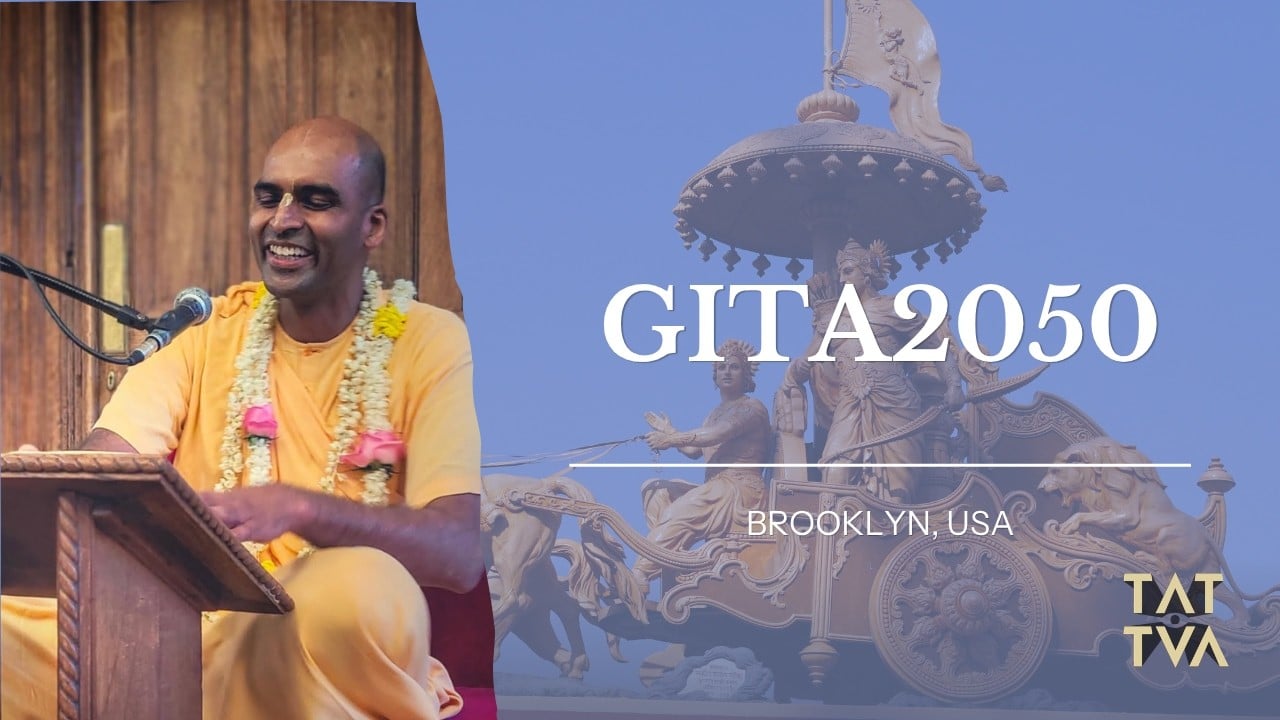
In May 2026, Svayam Bhagavan Keshava Maharaja delivered a session titled Gita2050 in Brooklyn, New York, USA. Presented through the channel Tattva by Keshava Maharaja, the session placed the Bhagavad Gita within a contemporary global setting, inviting listeners to consider how an ancient dharmic scripture can guide human beings toward clarity, responsibility, devotion, and inner steadiness in the decades ahead.
The title Gita2050 is significant because it points beyond nostalgia. It suggests that the Bhagavad Gita is not merely a revered text from the past, nor only a scripture for ritual recitation, but a living framework for ethical action, spiritual intelligence, and civilizational renewal. By placing the discussion in Brooklyn, a highly diverse and fast-moving urban environment, the session naturally connected Vedic wisdom with the challenges of modern society, diaspora identity, and the search for meaning in a technologically accelerated world.
The Bhagavad Gita occupies a unique place in Hindu Dharma and in the wider landscape of dharmic traditions. Set within the Mahabharata, it presents a dialogue between Arjuna and Sri Krishna on the battlefield of Kurukshetra. Its setting is dramatic, but its philosophical concerns are universal: duty, doubt, courage, self-knowledge, surrender, action, detachment, devotion, and liberation. For this reason, the Gita continues to speak to students, professionals, families, seekers, leaders, and communities navigating moral pressure and inner conflict.
A technical reading of the Gita begins with the crisis of Arjuna. Arjuna is not portrayed as careless or ignorant; he is thoughtful, morally sensitive, and emotionally overwhelmed. His paralysis arises because competing duties appear to collide. This makes the Gita deeply relevant for the modern age, where individuals often face conflict between career and conscience, personal ambition and social responsibility, inherited identity and global culture, material success and spiritual integrity.
Sri Krishna’s response does not dismiss Arjuna’s grief. Instead, Krishna expands Arjuna’s vision. The teaching moves from the immediate emotional crisis to the nature of the self, the structure of disciplined action, the psychology of attachment, the qualities of the mind, and the path of devotion. This layered method is one of the reasons the Bhagavad Gita remains a sophisticated philosophical text rather than a simple moral instruction manual.
The doctrine of atma, or the enduring self, forms one of the Gita’s foundational insights. The text distinguishes the temporary body and fluctuating mind from the deeper spiritual identity of the living being. This distinction does not encourage indifference to the world; rather, it provides the stability from which meaningful action becomes possible. When identity is reduced only to social status, wealth, emotion, ideology, or bodily condition, human life becomes vulnerable to fear and confusion. When identity is rooted in the spiritual self, action can be guided by steadiness and discernment.
The Gita’s teaching on karma-yoga is equally central. Karma-yoga does not mean passivity, fatalism, or mechanical performance of duty. It means disciplined action performed with responsibility, clarity, and non-attachment to selfish outcomes. In a society driven by visibility, metrics, competition, and constant comparison, this teaching has practical force. It asks whether work can be transformed from egoic striving into service, whether ambition can be purified by dharma, and whether success can be measured by integrity as much as by external achievement.
The relevance of Gita2050 also lies in its implied future orientation. By the year 2050, humanity will likely face intensified questions around artificial intelligence, ecological stress, social fragmentation, demographic change, economic disruption, and the psychological burden of hyperconnectivity. The Bhagavad Gita does not provide technical policy formulas for these issues, but it does provide an inner architecture: self-mastery, responsibility, discernment, compassion, disciplined action, and devotion to the Supreme.
In this sense, the Gita offers a spiritual technology of consciousness. It diagnoses the mind as both a friend and an obstacle, depending on whether it is trained or untrained. It recognizes the force of desire, anger, restlessness, and delusion. It also offers practices for refinement: remembrance, meditation, ethical restraint, selfless action, study, association with the wise, and devotion. These teachings remain relevant because modern life has multiplied stimulation without necessarily increasing wisdom.
The Brooklyn setting adds another dimension. Diaspora communities often live at the meeting point of inherited tradition and contemporary pluralism. For Hindu families and seekers in the United States, the Gita becomes not only a scripture but also a bridge: a way to transmit values across generations, explain dharma in a language intelligible to modern audiences, and cultivate confidence without hostility. This confidence is especially important for younger generations who may inherit cultural practices before fully understanding their philosophical depth.
A dharmic reading of the Gita should also support harmony among Hinduism, Buddhism, Jainism, and Sikhism. These traditions preserve distinct philosophies, practices, lineages, and sacred vocabularies, yet they share deep civilizational concerns: liberation from ignorance, ethical conduct, disciplined consciousness, compassion, self-restraint, reverence for truth, and the transformation of the human being. The Gita’s emphasis on sincere spiritual pursuit can therefore be appreciated as part of a broader dharmic ecology rather than as a tool for sectarian rivalry.
The concept of dharma is central to this shared framework. Dharma is not reducible to religion in the narrow modern sense. It includes duty, order, righteousness, moral law, spiritual responsibility, and the sustaining principle of life. In the Gita, dharma is both personal and universal. Arjuna must understand his own duty, but he must also act in alignment with a larger cosmic and ethical order. This balance between individual responsibility and universal principle is one of the text’s enduring contributions.
The Gita also provides a careful analysis of human motivation through the three gunas: sattva, rajas, and tamas. Sattva is associated with clarity, harmony, knowledge, and balance. Rajas is associated with passion, restlessness, desire, and constant activity. Tamas is associated with inertia, confusion, negligence, and darkness. This psychological model remains useful because it explains why the same action can carry different spiritual consequences depending on intention, consciousness, and attachment.
In contemporary life, the guna framework can illuminate everyday experience. A person may work with sattvic clarity, rajasic ambition, or tamasic avoidance. A community may organize itself around wisdom, competition, or confusion. A society may reward attention, consumption, and agitation while neglecting silence, reflection, and character. The Gita’s value lies in making these inner patterns visible so that transformation becomes deliberate rather than accidental.
Bhakti-yoga, the path of devotion, gives the Gita its devotional heart. The text does not present spiritual life as dry abstraction alone. It culminates in a relationship with the Divine, expressed through surrender, remembrance, love, and dedicated service. This devotional dimension has shaped many Vaishnava traditions and continues to inspire kirtan, japa, temple worship, scriptural study, and community service across the world.
At the same time, the Gita integrates multiple pathways. It speaks of knowledge, meditation, action, and devotion, not as disconnected compartments but as mutually reinforcing disciplines when properly understood. This integrative structure explains why the Gita has been studied by philosophers, saints, reformers, householders, renunciants, and public leaders. It does not demand that every seeker begin from the same temperament; it guides varied temperaments toward spiritual maturity.
For modern readers and listeners, one of the most relatable aspects of the Gita is its honesty about confusion. Arjuna begins with questions, not certainty. His vulnerability becomes the doorway to wisdom. This has emotional significance because many people approach spiritual life not from perfect faith but from exhaustion, doubt, grief, anxiety, or moral complexity. The Gita does not shame that condition. It shows that sincere questioning, when placed before authentic wisdom, can become transformative.
The session’s theme also encourages reflection on leadership. In the Gita, leadership is not merely command over others; it begins with command over oneself. A person who cannot govern the senses, ego, anger, and attachment cannot reliably serve society. This principle matters in families, institutions, public life, education, and spiritual communities. The future imagined by Gita2050 would require leaders who combine competence with humility, strength with restraint, and vision with devotion.
The Bhagavad Gita’s teaching on detachment is often misunderstood. Detachment does not mean emotional coldness or social withdrawal. It means freedom from possessiveness and ego-centered dependence on results. Such detachment makes compassion more stable because service is no longer controlled by praise, fear, resentment, or disappointment. In practical terms, the Gita teaches how to care deeply without becoming internally shattered by every fluctuation of circumstance.
This is especially important in a digital age. Social media often amplifies comparison, outrage, vanity, and fragmentation. The Gita’s discipline of inner steadiness offers a counterbalance. It invites a person to ask: What is the quality of consciousness behind this action? Is speech guided by truth and benefit, or by reaction and ego? Is knowledge being used for service, or for superiority? These questions are not abstract; they shape the moral atmosphere of everyday life.
The Gita also contributes to a healthier understanding of tradition. Tradition is not simply the preservation of external forms, although forms have value. Tradition becomes living when its principles are understood, practiced, and transmitted with intelligence. A session such as Gita2050 can help contemporary audiences see that Hindu scriptures are not frozen relics but dynamic sources of philosophical inquiry, ethical training, and spiritual renewal.
For the Hindu diaspora, this has educational importance. Children and young adults often encounter simplified or distorted descriptions of Hinduism in public culture. A clear presentation of the Bhagavad Gita can help them understand concepts such as dharma, karma, yoga, atma, bhakti, and moksha in their own intellectual depth. This does not require rejection of modern education; it requires the confidence to bring dharmic knowledge into conversation with modern life.
The Gita’s universality should not be confused with vagueness. It is deeply rooted in the Vaishnava revelation of Sri Krishna, yet its insights into human psychology, moral crisis, and spiritual discipline resonate widely. This rooted universality is one of its strengths. It allows the text to remain faithful to its own theological foundation while still offering wisdom to people across cultures and backgrounds.
Gita2050, therefore, can be understood as an invitation to future-read the Bhagavad Gita. The question is not only what the Gita meant historically, but what kind of human being it can help form today and tomorrow. Can it form people who are less reactive, more truthful, more disciplined, more compassionate, more devoted, and more courageous? Can it strengthen communities without producing arrogance? Can it deepen identity without creating hostility? These are among the serious questions that make the theme compelling.
The answer suggested by the Gita is that transformation begins with consciousness. Social systems matter, education matters, technology matters, and institutions matter; yet the quality of the human being operating within them matters profoundly. A future guided only by external innovation may become efficient but spiritually impoverished. A future guided by dharma can integrate innovation with wisdom, prosperity with restraint, and diversity with unity.
The enduring power of the Bhagavad Gita lies in its refusal to separate philosophy from life. It begins in crisis, speaks through dialogue, analyzes the self, disciplines action, purifies motivation, and culminates in devotion. A session on Gita2050 in Brooklyn therefore carries symbolic weight: ancient wisdom being discussed in a modern metropolis, not as an escape from the future but as preparation for it.
For seekers, families, and communities, the message remains practical. Study the Gita with seriousness. Reflect on its Sanskrit terms with care. Apply its teachings to work, relationships, speech, leadership, and service. Honor the diversity of dharmic traditions while remaining rooted in authentic practice. Above all, allow the text to move from information to transformation, because the Gita’s deepest purpose is not merely to be admired, but to be lived.
Inspired by this post on Dandavats.










Leave a Reply
You must be logged in to post a comment.