
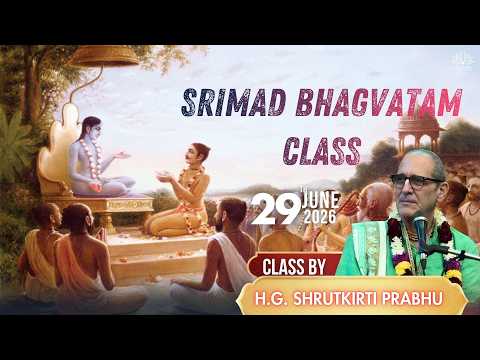

This featured Srimad-Bhagavatam class by Srutakirti Prabhu, dated 28-06-26, belongs to a living tradition in which scriptural study is not treated as an abstract intellectual exercise alone. Within the Vaishnava and wider Dharmic framework, śāstra is studied so that conduct, perception, humility, and devotion may be refined. The class therefore invites reflection not only on the words of the Srimad-Bhagavatam, but also on the practical discipline required to hear sacred wisdom with attention and sincerity.
Srimad-Bhagavatam, also known as the Bhagavata Purana, occupies a central place in Krishna consciousness and in the broader landscape of Hindu scriptures. It presents theology, cosmology, ethics, devotion, sacred history, and spiritual psychology through dialogue, narrative, prayer, and philosophical teaching. Its structure is not merely literary; it is pedagogical. Again and again, it places the listener before questions that concern the whole of human life: what is the purpose of birth, how should suffering be understood, what is the nature of the self, and how can devotion mature into steady spiritual awareness?
The importance of such a class lies in the way traditional knowledge is transmitted. In many Dharmic traditions, including Hinduism, Buddhism, Jainism, and Sikhism, wisdom is not preserved only through books. It is preserved through recitation, commentary, disciplined listening, ethical practice, and the guidance of realized or deeply trained teachers. A Srimad-Bhagavatam class continues this oral and interpretive culture, where sacred text becomes a mirror for contemporary life rather than a relic of the past.
Srutakirti Prabhu is widely remembered in ISKCON circles for his long association with Srila Prabhupada and for the lived observations he has shared from that service. This background gives his reflections a distinct devotional weight. The value of such testimony is not merely biographical; it shows how the principles of bhakti are embodied in ordinary actions, daily discipline, service, speech, remembrance, and the small decisions that reveal a person’s inner orientation.
The Srimad-Bhagavatam repeatedly emphasizes that knowledge must culminate in devotion and character. In this sense, scriptural learning is incomplete if it produces pride, sectarianism, or merely verbal mastery. Genuine study should soften the heart, sharpen discrimination, and increase respect for sincere seekers across Dharmic paths. This is especially relevant in a time when spiritual vocabulary is often consumed quickly, quoted selectively, and detached from practice.
A serious Bhagavatam class asks the listener to slow down. Modern attention is frequently fragmented by news cycles, social media, ideological conflict, and constant comparison. The discipline of hearing śāstra interrupts that pattern. It creates a space in which the mind can become receptive, the intellect can be purified by inquiry, and emotion can be redirected toward service rather than agitation. This is one reason traditional morning classes remain important in many temples and devotional communities.
In the Bhagavatam, hearing itself is a sacred act. Śravaṇam, or attentive listening, is one of the principal practices of bhakti. It is not passive consumption. It requires humility, concentration, patience, and a willingness to be corrected by wisdom greater than one’s immediate preferences. The listener does not approach the text as a consumer searching for agreeable ideas, but as a student willing to be transformed.
This point has significance beyond one sampradaya. Across Dharmic traditions, disciplined hearing and contemplation are essential. Buddhist traditions emphasize right listening and mindfulness; Jain traditions stress careful reflection on truth, non-violence, and restraint; Sikh tradition gives profound importance to listening to Gurbani with devotion and ethical seriousness. The shared principle is clear: sacred sound, when received properly, reshapes consciousness.
The devotional world of the Srimad-Bhagavatam is especially concerned with relationship. It teaches that the self is not isolated, self-made, or fulfilled by possession alone. The jiva is relational by nature, and that relationship finds its highest expression in loving service to Bhagavan. This theological vision has practical consequences. It encourages gratitude, humility, responsibility, compassion, and a steady awareness that life is not reducible to ambition or survival.
For many devotees, the emotional power of a Bhagavatam class comes from this convergence of doctrine and lived experience. A verse may begin as philosophy, but it soon enters memory, family life, work, conflict, grief, and hope. The teaching becomes relevant when patience is tested, when ego resists correction, when duty feels heavy, or when devotion must continue without immediate emotional reward. In that sense, scriptural study is not removed from life; it is training for life.
Srila Prabhupada’s presentation of the Bhagavatam placed strong emphasis on applying spiritual knowledge in the modern world. His commentaries consistently connect metaphysical truth with conduct, social responsibility, spiritual discipline, and compassion for all beings. The tradition he carried forward did not ask readers to abandon reason; it asked reason to become purified, disciplined, and directed toward the search for ultimate reality.
The relevance of Srutakirti Prabhu’s class can therefore be understood within this larger framework of guru-shishya tradition. The guru-shishya relationship is not a cult of personality when properly understood. It is a disciplined channel through which knowledge, example, correction, and spiritual responsibility are transmitted. Its health depends on humility from the student and integrity from the teacher. Its aim is not dependency, but awakening.
The Bhagavatam also offers a powerful critique of superficial religiosity. It does not praise ritual performed without transformation, nor learning used for social prestige. Instead, it repeatedly turns attention toward devotion free from selfish motive. This is where the text remains deeply challenging. It asks whether religious life is being used to strengthen ego or to surrender it; whether knowledge is making one kinder and clearer, or merely more argumentative.
Such questions matter for the unity of Dharmic traditions. Hinduism, Buddhism, Jainism, and Sikhism each possess distinct theological and philosophical structures, yet they share civilizational concerns with dharma, self-discipline, truthfulness, compassion, liberation, and the transformation of consciousness. A thoughtful engagement with the Srimad-Bhagavatam should therefore deepen respect for the wider Dharmic family rather than narrow it. The measure of study is not hostility toward others, but maturity in one’s own path.
The academic value of the Bhagavatam is also considerable. It is a work of Sanskrit literary refinement, theological depth, and cultural influence. Its narratives have shaped music, dance, temple worship, poetry, painting, pilgrimage, and public devotion across India and the global diaspora. To study it seriously is to enter a world where philosophy and aesthetics are inseparable, and where beauty becomes a mode of spiritual instruction.
Yet the Bhagavatam is not only a cultural artifact. For practitioners, it is a living scripture. Its authority is experienced through repeated hearing, chanting, discussion, and application. The text becomes more intelligible as the listener’s life becomes more disciplined. This is why devotional communities often return to the same verses again and again. Repetition is not redundancy; it is refinement.
A class such as this also highlights the importance of memory in devotional culture. Those who personally served great spiritual teachers often preserve details that formal history may overlook: the tone of instruction, the rhythm of daily practice, the simplicity of service, the seriousness behind compassion, and the humanity within saintliness. These recollections help later generations understand that spiritual greatness is not theatrical. It is often quiet, exacting, and consistent.
In practical terms, the listener can approach this class with three disciplines. The first is attentive hearing, without multitasking or reducing the talk to background sound. The second is reflective inquiry, asking how the teaching applies to conduct rather than merely collecting ideas. The third is application, even in a small form: a more thoughtful prayer, a restrained word, a sincere act of seva, or a renewed commitment to japa, study, and compassion.
The emotional connection of such study often arises slowly. A devotee may not immediately feel dramatic transformation after one class. However, the cumulative effect of regular hearing can be profound. The mind becomes less reactive, the heart becomes more receptive, and the intellect begins to recognize patterns of attachment and forgetfulness. In the Bhagavatam tradition, this gradual purification is not incidental; it is central to the path.
The featured video therefore deserves to be received not simply as a recording, but as an opportunity for disciplined spiritual engagement. Its subject, setting, and teacher point toward a larger culture of hearing Srimad-Bhagavatam with reverence, thoughtfulness, and practical seriousness. Whether one approaches as a practitioner, student of Hindu philosophy, researcher of Indian traditions, or sincere seeker, the class offers a doorway into the living practice of bhakti.
Ultimately, the enduring strength of Srimad-Bhagavatam lies in its ability to unite philosophy with devotion and devotion with ethical living. It teaches that the highest knowledge is not cold abstraction, and the deepest devotion is not sentimental escape. The two meet in transformed consciousness. A class by Srutakirti Prabhu, rooted in the lineage of Srila Prabhupada and the broader Vaishnava tradition, reminds listeners that sacred learning becomes meaningful when it is heard carefully, contemplated honestly, and lived with humility.
Inspired by this post on Dandavats.











Leave a Reply
You must be logged in to post a comment.