
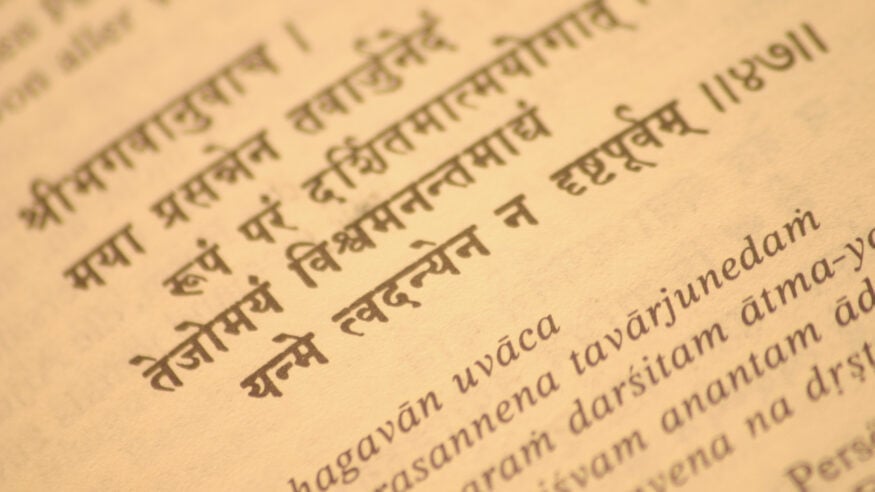
The claim that the Bhagavad Gītā and Patañjali’s Yoga Sūtra should not be called Hindu texts because the English word “Hinduism” became common in a later colonial period requires careful scholarly scrutiny. It is true that modern religious categories were shaped, standardized, and bureaucratized under colonial knowledge systems. Yet it does not follow that the civilizational, philosophical, ritual, and textual worlds now described as Hindu were invented by colonialism. Such a conclusion confuses the late stabilization of a term with the nonexistence of the living traditions, lineages, debates, and communities that preceded the term’s modern academic usage.
A more precise academic reading recognizes that “Hindu,” “Sanatana Dharma,” “Vaidika,” “Āstika,” “Śaiva,” “Vaiṣṇava,” “Śākta,” “Smārta,” “Vedānta,” “Sāṅkhya,” “Yoga,” and many other identifiers have existed within overlapping historical fields rather than in a single rigid box. The Bhagavad Gītā is embedded in the Mahābhārata, speaks in the idiom of dharma, ātman, karma, yajña, bhakti, jñāna, yoga, and moksha, and has been received for centuries through Hindu sampradāyas. Patañjali’s Yoga Sūtra, while terse and philosophically technical, belongs to the broader Indic world of Sāṅkhya-Yoga, discipline, liberation, and embodied practice, and has long been interpreted within Hindu philosophical and spiritual frameworks.
The central problem is not that scholars examine terminology historically. That is necessary. The problem arises when historical caution becomes selective denial. If Buddhism and Jainism may be named as coherent traditions despite the modern academic consolidation of those categories, then Hinduism cannot uniquely be treated as an invalid label for its own textual inheritance. A consistent method would acknowledge that all modern religious categories involve historical development while also recognizing the continuity of the communities, doctrines, practices, and lineages to which those categories refer.
Yoga cannot be reduced to a linear genealogy in which Buddhism, Jainism, or asceticism simply “precede” it as external sources. A more accurate account sees yoga as part of a dense civilizational conversation among Vedic, Upanishadic, Śramaṇa, Buddhist, Jain, Sāṅkhya, Vedānta, Śaiva, Śākta, and Tantric streams. These traditions debated, borrowed, refined, contested, and transformed one another. Their relationship is not best understood as a ladder of ownership but as a shared Indic intellectual ecology shaped by tapas, dhyāna, renunciation, discipline, liberation, compassion, and ethical self-mastery.
This distinction matters deeply for Dharmic unity. Hinduism, Buddhism, Jainism, and Sikhism each possess distinct histories, scriptures, metaphysical commitments, ritual cultures, and institutional forms. At the same time, they share a civilizational landscape in which dharma, karma, rebirth, liberation, disciplined conduct, guru-parampara, meditation, and ethical responsibility have been discussed in many forms. A constructive reading should not erase difference, but it should also avoid turning difference into hostility. The goal is not to subordinate one Dharmic tradition to another; it is to resist frameworks that fragment them through colonial habits of classification while ignoring their long history of dialogue.
Edward Said’s critique of Orientalism remains relevant because it showed how knowledge about the “Orient” was often produced through structures of power. Naming was not neutral. Classification could become control. A colonial archive could describe, rank, separate, and sometimes distort living traditions while claiming the authority of objectivity. In the case of Hindu texts and yoga, the power to declare what counts as Hindu, what counts as merely “Indic,” and what must be separated from Hindu memory continues to carry political and epistemic consequences.
Gayatri Spivak’s famous question, “Can the subaltern speak?”, also clarifies the stakes. The issue is not whether Hindu, Buddhist, Jain, Sikh, or broader Dharmic communities are silent. They have spoken through śāstra, commentary, pilgrimage, practice, oral tradition, temple culture, monastic lineages, philosophical debate, and lived memory. The issue is whether dominant academic institutions permit these communities to be heard on their own terms, or whether their speech must first be translated into categories approved by Western theory.
Walter Mignolo’s idea of “epistemic disobedience” is useful here because it calls for a deliberate refusal to treat colonial knowledge systems as the only valid measure of truth. For Dharmic traditions, this does not mean rejecting academic rigor. It means expanding rigor so that Sanskrit categories, indigenous hermeneutics, lived sampradāya, temple practice, oral commentary, and traditional pedagogy are treated as sources of knowledge rather than as raw material awaiting validation by external theory.
The language of “Global North” and “Global South” has replaced older East-West binaries in many academic spaces, but the hierarchy often remains intact. The Global North frequently retains the power to define universality, theory, method, and legitimacy, while the Global South is asked to provide data, spirituality, folklore, or case studies. This imbalance becomes especially visible when Hindu scholars, practitioners, or institutions name their inheritance and are then accused of being insufficiently historical, while external scholars freely rename the same inheritance through categories that appear more acceptable in Western academic discourse.
A historically grounded approach would make several distinctions at once. The term “Hinduism” as a modern English category has a particular history. The word “Hindu” has older geographic, cultural, and civilizational usages connected to Sindhu and later Persian, Arabic, and Indic contexts. The traditions now grouped under Hinduism have still older roots in Vedic, epic, Purāṇic, philosophical, devotional, ritual, and regional formations. Therefore, acknowledging the modernity of the category does not justify erasing the antiquity and continuity of the traditions it attempts to describe.
The Bhagavad Gītā illustrates this point with unusual clarity. It is not merely a philosophical poem floating outside tradition. It has been commented upon by Ādi Śaṅkara, Rāmānuja, Madhva, Abhinavagupta, Śrīdhara Svāmin, Bal Gangadhar Tilak, Mahatma Gandhi, Sri Aurobindo, and many others across theological and philosophical positions. Its teachings on karma yoga, bhakti yoga, jñāna yoga, svadharma, lokasangraha, and surrender to Śrī Krishna have shaped Hindu ethics, Hindu spirituality, Hindu nationalism, devotional practice, renunciatory discipline, and modern public life. To detach it from Hinduism entirely is not a neutral act of precision; it is a rupture from reception history.
The Yoga Sūtra requires the same care. Patañjali’s text is not identical to every form of modern postural yoga, nor is it reducible to sectarian practice. It is a disciplined philosophical manual concerned with citta-vṛtti-nirodha, kleśa, samādhi, abhyāsa, vairāgya, īśvara-praṇidhāna, and liberation. Its interpretive history intersects with Sāṅkhya metaphysics, Vedāntic debate, Hindu ascetic practice, and later yogic traditions. A serious account can acknowledge Buddhist and Jain parallels in meditation and ascetic discipline without denying the Yoga Sūtra’s deep place in Hindu intellectual history.
The question, then, is not whether scholarship should be critical. It must be critical. The question is whether criticism is applied evenly. When Hinduism alone is treated as an artificial colonial container while other traditions are permitted stable identity, the method becomes asymmetrical. When Hindu texts are mined for concepts such as Śiva, Śakti, svātantrya, the Gītā, and Yoga Sūtras, but the Hindu frameworks that preserved those concepts are denied legitimacy, the result is not decolonial scholarship. It is selective appropriation under academic language.
For practitioners and students, this debate is not abstract. Many encounter the Bhagavad Gītā in moments of ethical confusion, grief, duty, conflict, or self-examination. Many approach yoga not as a fitness trend but as a path of discipline, clarity, devotion, restraint, and inner transformation. When institutions imply that these texts are detached from Hindu heritage, it can feel like a second dispossession: first the practices are universalized, then the community that carried them is told it has no special claim to its own inheritance.
At the same time, Dharmic unity requires intellectual generosity. Buddhism and Jainism should not be portrayed as outsiders to Indic civilization, nor should Sikhism be flattened into categories that ignore its own revelation, history, and discipline. Each tradition deserves accurate representation. The stronger position is to affirm that yoga, dharma, meditation, liberation, ethics, and self-transformation emerged through a shared civilizational field in which Hindu, Buddhist, Jain, and later Sikh traditions contributed profound insights while maintaining distinct identities.
Academic responsibility therefore demands a balanced vocabulary. The Bhagavad Gītā may be described as a Hindu scripture, a Sanskrit philosophical text, a part of the Mahābhārata, a yoga text, a Vedāntic source, and a global classic. These descriptions are not mutually exclusive. The Yoga Sūtra may be called a foundational text of classical Yoga, a major work in Indian philosophy, and a text deeply received within Hindu tradition. Precision expands understanding; selective erasure narrows it.
The deeper issue is civilizational self-naming. Communities have the right to identify their own sacred texts, philosophical inheritances, and historical continuities. Scholars may analyze those claims, complicate them, and place them in historical context, but they should not replace living self-understanding with external authority masquerading as neutrality. Decolonization becomes meaningful only when indigenous categories are not treated as embarrassments to be corrected but as serious intellectual frameworks capable of producing theory.
A mature scholarship of Hinduism and yoga would therefore hold multiple truths together: colonial categories shaped modern religious studies; Hindu traditions long predate colonialism; Dharmic traditions interacted in complex ways; Buddhism and Jainism were not merely “precursors” but co-participants in Indic inquiry; and the Bhagavad Gītā and Yoga Sūtra cannot be responsibly severed from Hindu reception, practice, and memory. Such an approach is more historically accurate, more intellectually honest, and more conducive to Dharmic harmony.
The path forward is neither defensive isolation nor uncritical acceptance of inherited academic categories. It is a disciplined recovery of voice. Hindu Studies, Indology, Yoga philosophy, and Comparative Religion need methods that respect textual history, living practice, Sanskritic categories, regional traditions, and inter-Dharmic dialogue. Only then can scholarship move beyond the authority to name and un-name, and toward a more truthful account of how Hinduism, Buddhism, Jainism, Sikhism, and the wider Indic world have shaped humanity’s search for liberation, wisdom, and ethical life.
Inspired by this post on Hindu Post.







Leave a Reply
You must be logged in to post a comment.