
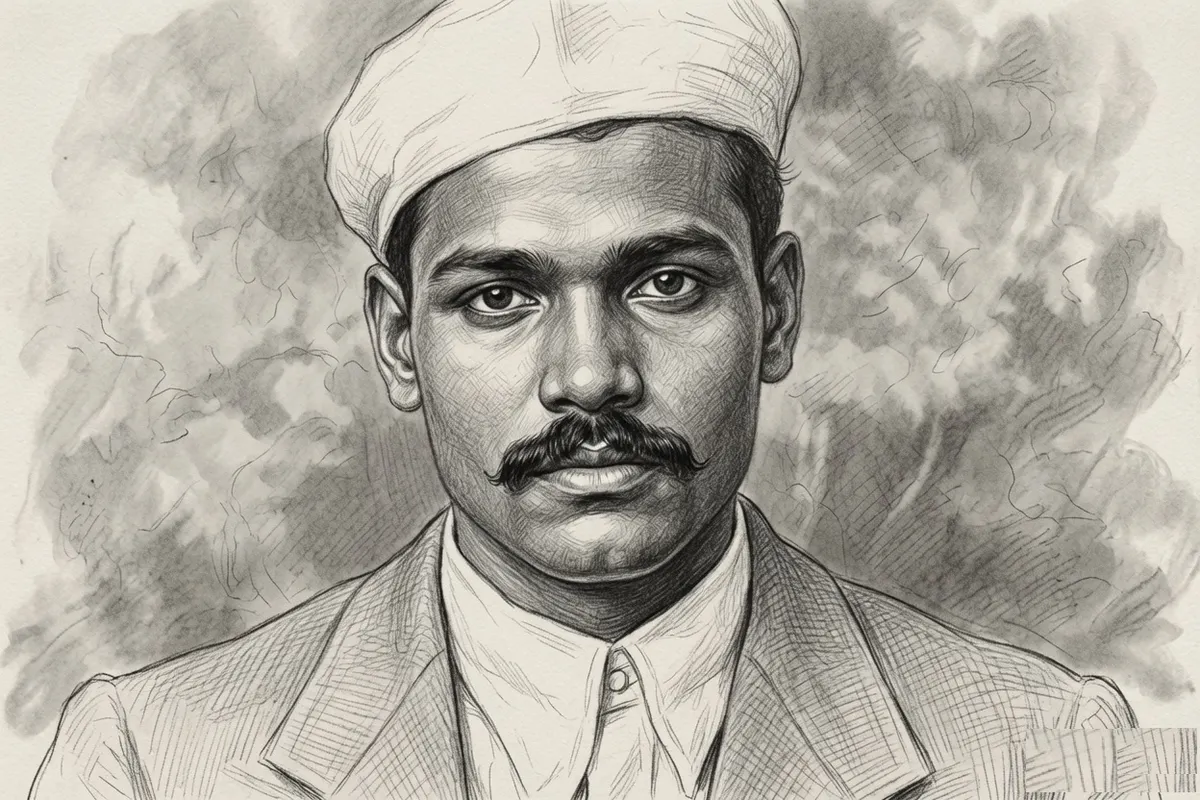
The 1975 Emergency remains one of the most consequential tests of India’s democratic institutions, and the confrontation between Ramnath Goenka and Indira Gandhi’s government offers a particularly revealing case study in press freedom, state power, political intimidation, and institutional resilience. The story is not merely about one newspaper proprietor resisting censorship. It is about the larger question of whether a democracy can retain its moral structure when dissent is treated as disloyalty, when newspapers are pressured into obedience, and when private citizens are forced to choose between personal safety and public duty.
Ramnath Goenka, the force behind The Indian Express, occupied an unusual place in modern Indian media history. He was not simply a businessman who happened to own newspapers. His career emerged from the freedom struggle, from a time when journalism in Bharat was understood by many nationalists as an instrument of public awakening and resistance to colonial authority. That older understanding of journalism shaped his later conduct during the Emergency, when the Indian state, now under elected leadership, deployed methods of coercion that resembled the very authoritarian habits the freedom movement had opposed.
The article being transformed frames Goenka as one of the central figures who resisted Indira Gandhi’s Emergency regime, especially after the proclamation of Emergency on 25 June 1975 and its practical enforcement through arrests, censorship, surveillance, bureaucratic pressure, and threats under laws such as MISA. The argument is that The Indian Express, despite being battered by state action, remained symbolically important because it represented a living institutional memory of dissent. When many newspapers surrendered through fear or self-censorship, Goenka’s newspaper retained a reputation for resistance, even when its operations were disrupted and its management structure was targeted.
To understand why this confrontation mattered, it is necessary to recall the structure of the Emergency itself. Civil liberties were suspended, opposition leaders were detained, press censorship became a routine instrument of governance, and the executive arm of the state became closely identified with the political interests of the ruling establishment. This was not only a legal event but also an ethical collapse. In ordinary democratic life, the state is expected to tolerate criticism because criticism allows society to correct errors before they become disasters. During the Emergency, criticism was recast as a threat to order, and order was increasingly defined by loyalty to one political family and its inner circle.
Goenka’s conflict with Indira Gandhi did not begin suddenly in June 1975. The source account traces its roots to the political realignments after the Congress split of 1969, when dissent within and around the Congress ecosystem began to be treated with sharper hostility. Goenka had once been associated with the Congress tradition before and after independence, but he later aligned himself with forces opposed to Indira Gandhi’s concentration of power. This shift made him politically suspect in the eyes of the ruling establishment. His newspaper’s independence, rather than being treated as a democratic asset, came to be treated as a problem to be solved.
One of the most important technical features of this episode is the use of administrative pressure as a political weapon. Authoritarianism rarely announces itself only through dramatic arrests. It often works through paperwork, tax inquiries, regulatory decisions, board appointments, official notices, power cuts, surveillance, and selective enforcement. The source account describes allegations of pressure through agencies such as the Income Tax Department and the Central Bureau of Investigation, along with attempts to interfere in the management of Express Newspapers. Such methods are especially dangerous because they preserve the appearance of legality while corroding the spirit of constitutional government.
This is where Goenka’s experience becomes relevant beyond the biography of one man. A free press depends not only on courageous editors and reporters but also on ownership structures that can withstand state pressure. If the proprietor of a newspaper can be financially strangled, criminally threatened, or forced to accept hostile directors, editorial independence can be weakened without a censor ever touching a news report. The Emergency demonstrated that media freedom is an ecosystem. It requires legal protection, financial autonomy, institutional courage, editorial integrity, and public support.
Goenka’s earlier career explains why he became a difficult target. After taking control of The Indian Express in 1936, he built the newspaper with a strong nationalist orientation. The paper had supported the freedom struggle and published material critical of British rule, including reports connected with the Quit India Movement. This history gave the newspaper credibility among readers who saw it as more than a commercial enterprise. It was regarded as a public platform with a tradition of confronting authority. That tradition became politically explosive when the authority being confronted was no longer colonial but post-independence and elected.
The source account emphasizes Goenka’s personality: fiercely independent, combative, strategic, and deeply attached to the newspaper he had built. It also records the paradox that he had once supported Indira Gandhi’s rise after Lal Bahadur Shastri’s death, reportedly sharing the view held by some political figures that she might be a manageable leader, the so-called Gungi Gudiya. The later confrontation showed how mistaken that assessment was. Indira Gandhi emerged as a centralizing political figure whose government treated institutional opposition as an obstacle to be neutralized.
The Emergency also created a culture of public conformity. Artists, cultural personalities, publishers, and officials often learned that proximity to power could bring rewards, while independence could bring punishment. This was not merely a matter of censorship; it was a broader social psychology of obedience. When political loyalty becomes a currency, public life loses its dignity. For readers today, this is perhaps the most uncomfortable lesson of the period: authoritarian systems do not survive by force alone. They also survive because enough people rationalize silence, careerism, and selective morality.
The pressure on Goenka reportedly took several forms. The source account refers to surveillance, telephone tapping, interference with communications, official raids, pressure on business interests, and threats to family members. The threat of detention under MISA was especially serious because preventive detention laws during the Emergency created an atmosphere in which personal liberty could be suspended by executive will. The possibility that Goenka’s son B.D. Goenka and his samdhi Shreyans Prasad Jain could be targeted placed the conflict in deeply personal territory. At that point, the battle was no longer only institutional; it entered the intimate space of family fear.
This dimension deserves careful attention. Democratic resistance is often narrated in heroic language, but those who resist authoritarian pressure rarely do so without cost. They must think about children, spouses, colleagues, employees, creditors, and vulnerable associates. Goenka’s eventual tactical retreat, as described in the source account, should therefore not be read simplistically as surrender. It reflected the hard calculation of an elderly man facing a state apparatus willing to use family pressure and corporate control to break him. Survival itself can be a strategy when the alternative is immediate destruction.
The government’s attempted control over Express Newspapers reportedly included pressure to alter the company’s board structure. Names associated with the proposed or imposed arrangement included K.K. Birla, P.R. Ramakrishnan, Vinay K. Shah, A.K. Antony, G.D. Kothari, and Kamal Nath. The purpose, as presented in the source account, was to convert management control into editorial and political control. This illustrates a crucial mechanism of media capture: one does not need to ban a newspaper if one can influence its board, weaken its owner, remove inconvenient editors, and install compliant personnel.
The role of V.C. Shukla, then associated with the Information and Broadcasting apparatus during the Emergency period, is central to the account. He is presented as the key political operator pressuring Goenka and attempting to force personnel and structural changes within the Express group. The source also recalls the broader censorship environment of the time, including the penalization of artists who refused to cooperate with official political messaging. Such examples indicate how cultural and media institutions were expected to align themselves with the ruling dispensation.
Yet Goenka’s response was not only emotional defiance. It was also legal and procedural intelligence. The most striking part of the account concerns the status of government-backed directors as Additional Directors. Under company procedure, such directors required formal approval at the next annual general meeting. The source explains that Goenka understood this requirement and used the time gained through apparent compliance to prevent the consolidation of hostile control. When the annual general meeting occurred, the directors were not re-elected, and the attempted capture failed. In this sense, the episode was not simply a moral victory but a technical victory through corporate law and procedural awareness.
This point is especially important for a modern reading of the Emergency. Constitutional democracy is defended not only in rallies, speeches, and courts, but also in bylaws, board meetings, statutory requirements, audit trails, and institutional procedures. Power often advances through technical loopholes; resistance must therefore understand technical safeguards. Goenka’s success lay partly in temperament, but it also lay in his ability to recognize that the government’s political pressure still had to pass through legal forms. Where those forms created openings, he used them.
The editorial side of the story is equally significant. Even when the government-backed arrangement created pressure within the institution, the paper reportedly did not become the obedient instrument the regime expected. The source account credits figures such as V.K. Narasimhan with maintaining editorial dignity under difficult circumstances. The larger lesson is that institutional resistance is rarely the work of one person alone. Goenka’s role was decisive, but the survival of The Indian Express as a symbol of press freedom depended on a network of editors, journalists, managers, shareholders, readers, and legal realities that did not fully submit.
The article also invokes L.K. Advani’s famous observation that when the press was asked to bend, it crawled. That phrase has endured because it captures the moral humiliation of the period. However, a serious historical reading must distinguish between fear, coercion, opportunism, and ideological collaboration. Some media actors capitulated because they feared imprisonment or financial ruin. Others adapted because obedience brought access and career advancement. Still others internalized the idea that a strong leader and a controlled press were necessary for national discipline. The Emergency fused these motives into a culture of compliance.
For dharmic society, the episode has a deeper ethical meaning. Dharma is not merely ritual observance or inherited identity; it also concerns truthfulness, restraint in power, protection of the vulnerable, and the duty to resist adharma when institutions are misused. The traditions of Hinduism, Buddhism, Jainism, and Sikhism differ in theology and practice, yet they share a profound concern for moral self-discipline, accountability, and the dangers of ego-driven power. The Emergency stands as a political example of what happens when restraint fails and authority begins to worship itself.
Goenka’s resistance also demonstrates that courage need not be loud at every moment. Sometimes it appears as refusal. Sometimes it appears as delay. Sometimes it appears as legal memory, corporate procedure, or a calculated decision to bend temporarily so that the institution does not break permanently. This is a more mature understanding of resistance than romantic martyrdom. It recognizes that the preservation of a newspaper, a family, and a public voice may require patience as much as open confrontation.
The post-Emergency aftermath complicates the story. The restoration of elections and the defeat of Indira Gandhi’s government in 1977 did not automatically purify public life. Many political figures associated with the Emergency later returned to influence, office, or respectability. This reveals another recurring weakness in democratic culture: collective memory fades quickly when political convenience demands it. Societies may celebrate freedom after danger passes, but they often fail to create durable consequences for those who normalized repression.
That failure of memory is relevant to contemporary Indian media. The invocation of Ramnath Goenka’s name in journalism awards, public debates, and institutional branding raises a serious question: what does it mean to honor a legacy if the underlying values are not preserved? Goenka’s legacy was not merely professional excellence. It was independence from political patronage, willingness to confront concentrated power, and refusal to reduce journalism to courtly service. Any institution using his name must be judged against those standards, not merely against ceremony, prestige, or networking value.
At the same time, a responsible discussion of media ethics should avoid reducing all disagreement to betrayal. A dharmic public culture requires sharp criticism, but it also requires fairness, intellectual discipline, and the ability to distinguish between ideological disagreement and malicious conduct. The Emergency should teach society to resist censorship and propaganda without reproducing the habits of dehumanization that make authoritarian politics possible. The goal is not to replace one ecosystem of intolerance with another, but to build institutions that can withstand every form of partisan capture.
Goenka’s confrontation with Indira Gandhi therefore remains valuable for three reasons. First, it shows how press freedom can be attacked through indirect instruments such as tax pressure, corporate control, censorship rules, and family intimidation. Second, it shows that institutional knowledge can become a form of resistance when law and procedure are used intelligently. Third, it shows that democratic courage is not abstract. It is embodied in decisions made under pressure, when the cost of speaking or resisting is immediate and personal.
The Emergency also reminds readers that democracy is not secured by elections alone. Elections can be suspended in spirit long before they are suspended in law, especially when fear silences opposition, when media institutions begin to self-censor, and when citizens accept the shrinking of liberty as a necessary price for order. A constitutional republic survives when citizens, courts, newspapers, associations, and cultural institutions retain enough inner strength to say no. Goenka’s example belongs to that larger story of institutional self-respect.
In the final analysis, Ramnath Goenka did not “break” Indira Gandhi in the simplistic sense of defeating a prime minister single-handedly. Rather, he exposed the limits of authoritarian pressure when it encountered memory, legal skill, personal courage, and public credibility. His victory was not absolute, and the damage caused by the Emergency did not vanish with one corporate maneuver or one election. Yet his stand preserved a vital lesson: even in a period of darkness, a newspaper with a spine can become a site of national resistance.
For present and future generations, the story is best read not as nostalgia but as instruction. Media freedom requires vigilance. Political power requires restraint. Citizens require memory. Dharmic public life requires truth without cruelty, courage without vanity, and unity without enforced silence. Ramnath Goenka’s struggle during the 1975 Emergency remains a powerful reminder that Bharat’s democratic life is protected not by slogans, but by people and institutions willing to bear the cost of integrity.
Inspired by this post on Hindu Post.


Leave a Reply
You must be logged in to post a comment.