
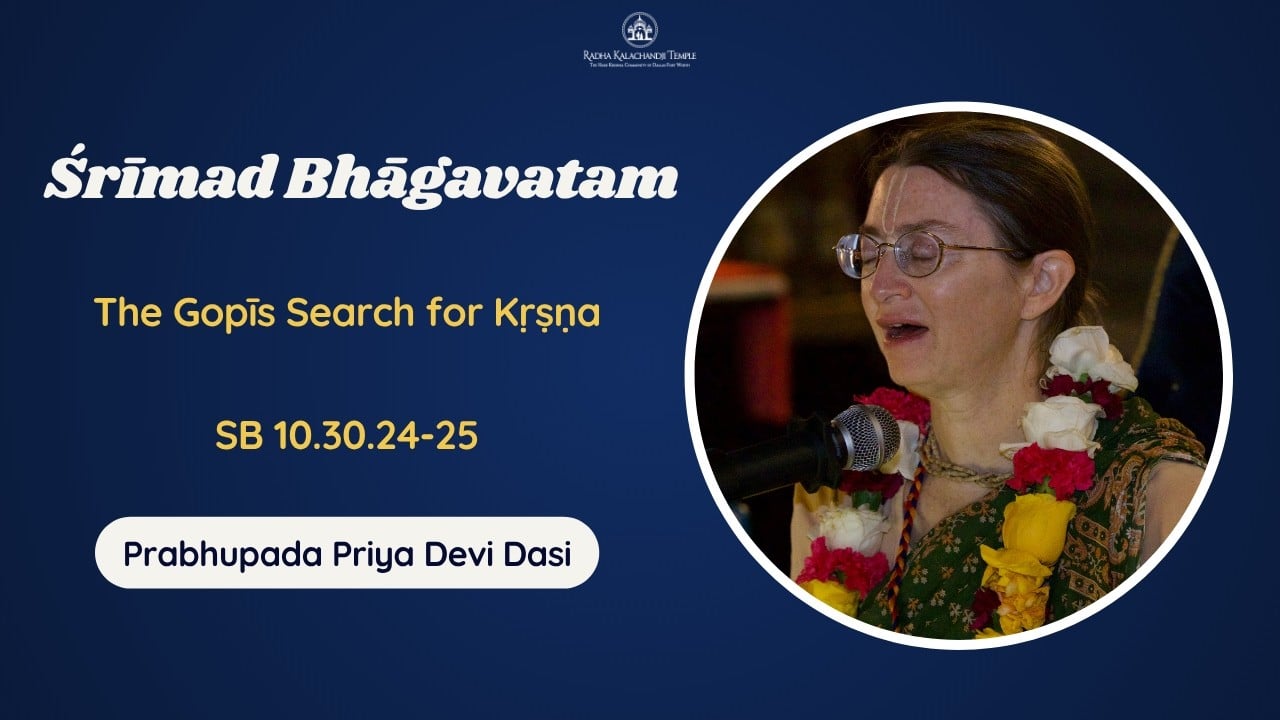
The June 29, 2026 Śrīmad-Bhāgavatam class by Prabhupada Priya Devi Dasi at ISKCON Dallas, Sri Sri Radha Kalachandji, focuses on two compact but spiritually rich verses from Canto 10, Chapter 30: verses 24 and 25. These verses appear in the celebrated section known as “The Gopīs Search for Kṛṣṇa,” where the cowherd women of Vṛndāvana, overwhelmed by separation from Śrī Kṛṣṇa, wander through the forest searching for Him. Their search is not presented as ordinary emotional distress. Within the Gauḍīya Vaiṣṇava tradition, it is understood as the highest expression of bhakti, a love so total that remembrance, speech, movement, perception, and identity all become centered on Kṛṣṇa.
Śrīmad-Bhāgavatam 10.30.24 describes the gopīs as they continue imitating Kṛṣṇa’s pastimes and asking the trees and creepers of Vṛndāvana where the Supreme Soul may be found. In the midst of this devotional search, they suddenly discover His footprints in a corner of the forest. Verse 25 then records their recognition of those footprints: the markings of the flag, lotus, thunderbolt, elephant goad, barleycorn, and other sacred symbols distinguish them as belonging to the great soul, the son of Nanda Mahārāja. These details are theologically important because the gopīs are not merely looking for a beloved person; they are reading the land of Vṛndāvana itself as a sacred text marked by the presence of the Divine.
The immediate setting is essential. In the preceding verses, the gopīs have become so absorbed in Kṛṣṇa that they enact His childhood līlās. One imitates Pūtanā, another infant Kṛṣṇa; another recalls the lifting of Govardhana; another reenacts the subduing of Kāliya. Their minds do not wander toward distraction. They wander only through Kṛṣṇa’s names, deeds, gestures, ornaments, gait, flute, compassion, and playful heroism. This is a technical feature of rāgānugā bhakti: remembrance is not mechanical recollection but loving participation. The devotee’s inner life becomes shaped by the beloved Lord’s qualities.
The gopīs then address the trees, creepers, tulasī, flowers, earth, and deer of Vṛndāvana. Their questions reveal a devotional cosmology in which nature is not inert matter. Trees bow, creepers tremble, flowers carry fragrance, earth displays ecstatic symptoms, and the forest seems to hold the trace of Kṛṣṇa’s movement. In a modern context, this vision has ethical force. It does not reduce nature to scenery or resource; it invites reverence. Vṛndāvana becomes a living witness to divine play, and the devotee learns to approach the natural world with humility, tenderness, and attention.
Verse 24 is especially striking because it refers to Kṛṣṇa as the Supreme Soul while simultaneously describing Him through the intimate search of the gopīs. This balance is central to the Bhāgavata Purāṇa. Kṛṣṇa is not only the cosmic Paramātmā, present within and beyond all beings; He is also Nanda’s son, the beloved of Vṛndāvana, the one whose footprints can be followed on forest soil. The text therefore refuses a cold abstraction of God. It presents the Supreme as both metaphysically ultimate and relationally accessible.
This theological union of majesty and intimacy is one reason Śrīmad-Bhāgavatam has occupied such a central place in Hindu devotional literature. The Supreme is not diminished by intimacy; rather, intimacy reveals a dimension of divine fullness that awe alone cannot reach. The gopīs do not conduct a philosophical debate in the forest, yet their longing carries profound metaphysics. Their love discloses that the highest knowledge is not merely the ability to define the Absolute, but the capacity to recognize, follow, and serve the traces of divine presence wherever they appear.
Verse 25 turns attention to the sacred symbols on Kṛṣṇa’s footprints. In Vaiṣṇava theology, the marks on the Lord’s lotus feet are not decorative details. They carry layered meanings. The flag suggests victory and shelter. The lotus evokes purity, beauty, and transcendence amid the world. The thunderbolt suggests the power to shatter ignorance. The elephant goad represents guidance and discipline. The barleycorn suggests nourishment, auspiciousness, and prosperity. These symbols together communicate that surrender to Kṛṣṇa’s feet is not escapism; it is orientation, protection, purification, nourishment, and spiritual direction.
The gopīs’ recognition of the footprints also reveals the discipline of devotional perception. They know what they are seeing because they have cultivated attention. In ordinary life, sacred signs are easily missed because the mind is restless, cynical, or absorbed in self-concern. The gopīs, however, have trained their entire being toward Kṛṣṇa. Their eyes become instruments of bhakti. Their perception is emotional, but it is not vague. It is precise enough to distinguish Kṛṣṇa’s footprints from all others.
This offers a practical insight for spiritual life. Devotion is often spoken of as feeling, but the Bhāgavatam presents it as disciplined awareness. The heart must be soft, yet the intelligence must be awake. A devotee learns to notice patterns: where the mind moves, what it seeks in distress, which memories nourish faith, and which habits obscure clarity. The gopīs’ search becomes a mirror for the reader’s own interior search. When something cherished seems absent, the question becomes whether one turns toward distraction or toward deeper remembrance.
The emotional dimension of these verses should not be flattened. The gopīs are in separation, and separation is painful. Yet within bhakti traditions, viraha, or divine separation, is not merely deprivation. It intensifies remembrance and reveals the depth of attachment to God. A person may recognize this on a smaller scale in ordinary life: absence can reveal the true weight of love, gratitude, dependence, and longing. The Bhāgavatam elevates this humanly recognizable experience into a theology of divine love, showing how longing for Kṛṣṇa can purify the heart rather than embitter it.
At the same time, these verses must be approached with theological maturity. The rāsa-līlā and the gopīs’ love are not models for mundane romantic imitation. Gauḍīya Vaiṣṇava teachers, including Śrīla Prabhupāda, repeatedly emphasize that Kṛṣṇa’s pastimes are transcendental and should be heard through authorized śāstra, guru, and sādhus. The language of longing, beauty, and intimacy points toward pure devotion, not ordinary sensuality. When read responsibly, the passage does not sentimentalize emotion; it sanctifies love by directing it toward the Supreme.
The gopīs’ dialogue with Vṛndāvana also demonstrates the communal nature of devotion. They search together, speak together, remember together, and interpret the signs together. Their grief does not isolate them into private despair. It becomes shared kīrtana, shared inquiry, and shared surrender. This remains one of the enduring strengths of dharmic traditions: spiritual life is nourished through community, recitation, pilgrimage, temple worship, study, service, and shared remembrance. A healthy devotional culture does not erase personal emotion; it gives that emotion a sacred structure.
This point is particularly relevant for unity among dharmic traditions. Hinduism, Buddhism, Jainism, and Sikhism preserve distinct doctrines, practices, and lineages, yet all recognize the transformative importance of disciplined attention, ethical refinement, humility, and liberation from ego-centered life. In the Vaiṣṇava setting of these verses, the focus is loving surrender to Kṛṣṇa. In a broader dharmic conversation, the passage also highlights reverence, self-transcendence, sacred memory, and the purification of desire. Such themes can be studied without collapsing differences or creating artificial sameness.
The discovery of Kṛṣṇa’s footprints can also be read as a lesson in spiritual evidence. The gopīs do not possess Kṛṣṇa directly at that moment, but they find traces that confirm His nearness. Many seekers experience spiritual life in a similar way. There are moments of vivid presence, and there are moments when only traces remain: a remembered mantra, a verse from scripture, the fragrance of prasādam, the sound of kīrtana, the sight of a temple, the words of a teacher, or the quiet strength that appears during hardship. The Bhāgavatam teaches that these traces matter. They are not insignificant consolations; they are invitations to keep walking.
In the broader architecture of Canto 10, these verses prepare the reader for a deeper revelation. The footprints are not the end of the search. They lead the gopīs further, eventually revealing that Kṛṣṇa has walked with one especially blessed gopī, understood in the tradition as Śrīmatī Rādhārāṇī. Thus verses 24 and 25 are a turning point. The search moves from general longing to specific recognition. The forest becomes mapped by divine movement, and the gopīs’ devotion becomes sharpened by each sign they encounter.
Śrīmatī Rādhārāṇī’s implied presence is significant for Gauḍīya Vaiṣṇava theology. Rādhā is understood as the highest embodiment of devotion to Kṛṣṇa, the fullest expression of mahābhāva. Although verse 25 itself identifies Kṛṣṇa’s footprints, the surrounding narrative soon reveals the footprints of His dearmost consort. This progression teaches that the path to Kṛṣṇa is inseparable from the mood of pure devotion. Kṛṣṇa is recognized by His marks, but He is approached through the devotion exemplified by Rādhā and the residents of Vṛndāvana.
The academic study of these verses benefits from attention to genre. The Bhāgavatam is Purāṇic literature, theological poetry, devotional philosophy, and sacred narrative at once. Its meaning cannot be exhausted by historical description, nor can it be reduced to allegory. The text works through image, sound, memory, symbol, and rasa. Its technical brilliance lies in the way concrete details, such as footprints in forest dust, carry metaphysical claims about the nature of God, the soul, love, memory, and liberation.
For contemporary readers, the most immediate lesson may be the disciplined tenderness of the gopīs’ search. They do not demand that Kṛṣṇa conform to their control. They search, remember, ask, interpret, and follow. This is devotion as active receptivity. It is not passivity, because they move with urgency. It is not control, because they remain dependent on grace. Their love is intense, but it is also surrendered. This balance is one of the most difficult and necessary lessons in spiritual practice.
The symbols on Kṛṣṇa’s feet therefore become a guide for the inner life. The flag calls the heart toward victory over forgetfulness. The lotus calls it toward purity. The thunderbolt calls it toward the destruction of ignorance. The elephant goad calls it toward discipline under divine guidance. The barleycorn calls it toward nourishment through sādhana, scripture, and service. In this way, Śrīmad-Bhāgavatam 10.30.24-25 offers not only a scene from Vṛndāvana but a complete devotional map.
The class associated with ISKCON Dallas and Prabhupada Priya Devi Dasi thus draws attention to a passage where bhakti becomes visible through movement, inquiry, symbol, and shared longing. The gopīs’ search for Kṛṣṇa is a search for the center of consciousness itself. Their discovery of His footprints reminds devotees that the Divine may appear first not as full possession, but as a trace that awakens faith. To follow that trace with humility, intelligence, and love is the enduring invitation of these verses.
Inspired by this post on Dandavats.









Leave a Reply
You must be logged in to post a comment.