
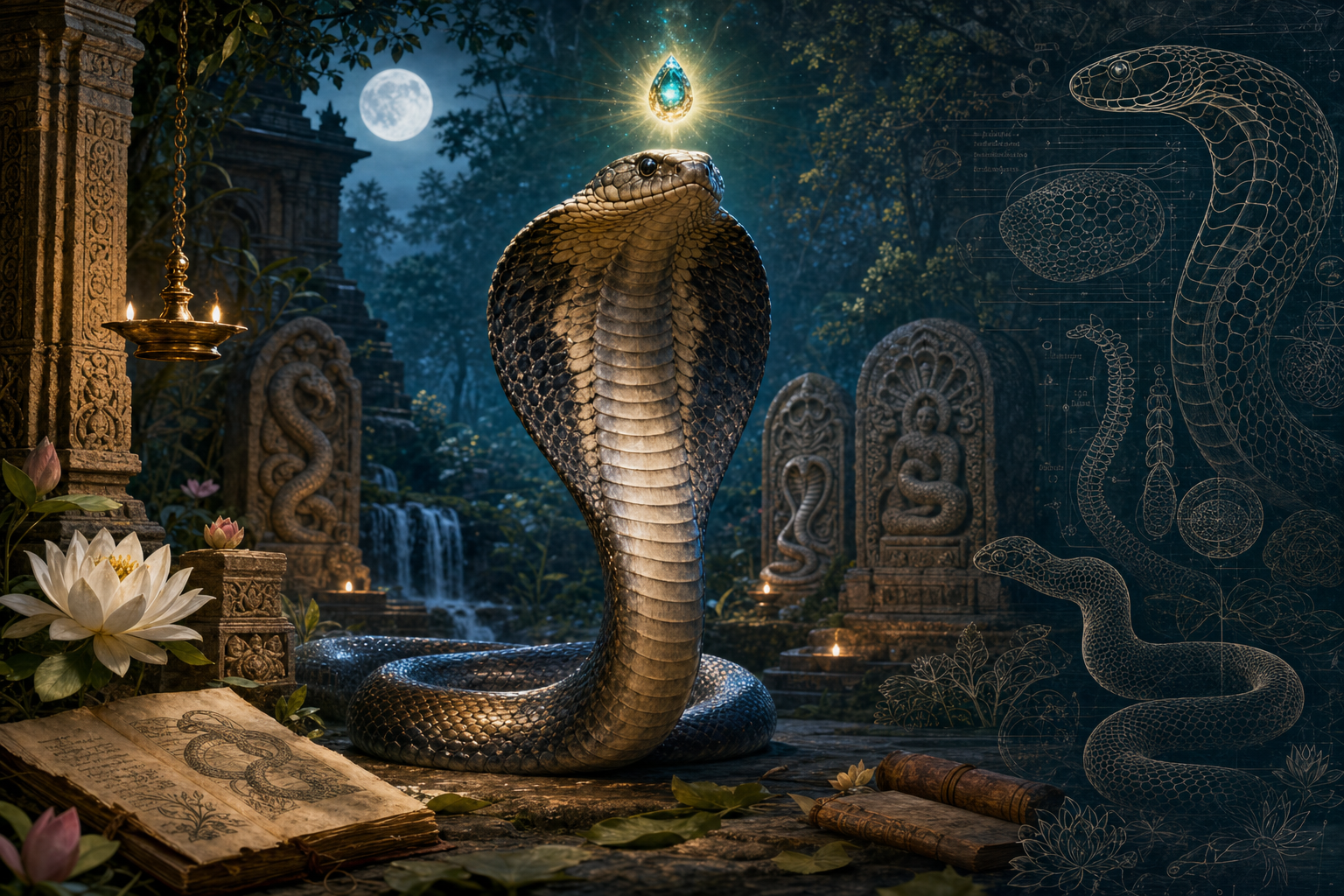
Nagamani, often translated as the “snake-stone” or “serpent jewel,” occupies a remarkable place in Indian folklore, Dharmic symbolism, and popular imagination. It is commonly described as a radiant jewel resting on the forehead or hood of a divine cobra, especially a king among serpents. The idea is powerful because it joins two enduring images: the serpent as a being of danger, wisdom, fertility, and hidden power, and the jewel as a symbol of light, prosperity, healing, and spiritual attainment.
In traditional stories, Nagamani is not merely a decorative gem. It is imagined as a rare, luminous object capable of attracting fortune, curing disease, protecting its possessor, and granting extraordinary influence. Such claims have made the Nagamani myth emotionally compelling across generations. Yet a careful academic and scientific reading requires a clear distinction between cultural meaning and physical fact. As a biological claim, there is no credible evidence that cobras, king cobras, or any other snakes produce a gemstone or pearl in the head, hood, mouth, or forehead.
This distinction matters because the Nagamani tradition sits at the meeting point of faith, folklore, natural observation, and public health. A myth can carry symbolic truth without being a literal object. In the same way, Dharmic traditions often use images of jewels, lotuses, serpents, mountains, rivers, and fire to communicate deeper meanings. The Nagamani can therefore be studied respectfully as a cultural and spiritual symbol while also being examined honestly through zoology, medicine, and critical inquiry.
The word itself combines “naga,” referring to serpents or serpent beings, with “mani,” meaning jewel. In Hindu, Buddhist, and Jain cultural worlds, nagas are not ordinary snakes alone. They are often portrayed as semi-divine beings associated with water, fertility, subterranean wealth, protection, and cosmic balance. Their imagery appears in temple sculpture, narrative literature, ritual practice, and sacred geography across South Asia and Southeast Asia.
Within Hindu traditions, nagas are linked with figures such as Shesha, Vasuki, and Takshaka. Shesha or Ananta is associated with cosmic support and is famously connected with Vishnu’s reclining form. Vasuki is associated with Shiva and with the Samudra Manthana, the churning of the ocean, where the serpent becomes part of a cosmic act of transformation. These images do not present the serpent only as a creature to fear. They present it as a guardian of thresholds, a participant in cosmic order, and a sign of restrained power.
Buddhist traditions also preserve important naga imagery. The well-known story of Mucalinda describes a naga king sheltering the Buddha during meditation after enlightenment. This image of a serpent canopy became one of the most visually powerful symbols of protection in Buddhist art. Jain traditions likewise preserve serpent symbolism, especially in depictions of Parshvanatha, the twenty-third Tirthankara, who is often shown beneath a canopy of serpent hoods. These shared images show how serpent symbolism has helped connect Hinduism, Buddhism, Jainism, and broader Dharmic culture through a language of protection, austerity, and sacred presence.
Against this background, the Nagamani becomes more understandable. A jewel on the head of a naga is not only a fantasy object. It is a symbolic concentration of wisdom, light, and hidden knowledge. In Indian thought, the head is often associated with consciousness and perception, while a jewel suggests purity, value, and radiance. A jewel-bearing serpent therefore becomes an image of dangerous energy transformed into spiritual illumination.
The myth may also reflect the older and wider Dharmic motif of the “mani” or wish-fulfilling jewel. Traditions surrounding Chintamani, Kaustubha, Syamantaka, and other sacred jewels suggest that gems were often used in narrative literature to express abundance, divine favor, inner clarity, or karmic consequence. In that sense, Nagamani belongs to a larger symbolic family rather than standing alone as an isolated superstition.
Modern zoology, however, offers a very different answer to the literal question: do snakes have Nagamani? Snakes do not produce pearls or gemstones. Cobras possess skull bones, venom glands, muscles, sensory organs, scales, and other anatomical features, but no biological structure is known to generate a jewel. A cobra’s hood is formed by elongated ribs and skin expansion, not by a hidden gemstone. The king cobra, despite its name and cultural awe, is also a biological animal, not a gem-producing organism.
Some beliefs about Nagamani may have arisen from visual misunderstanding. A snake’s scales can shine dramatically under moonlight, oil lamps, firelight, or wet conditions. The reflective quality of scales, combined with fear, distance, and storytelling, could easily become the basis for accounts of glowing serpent jewels. In rural and forest settings, where encounters with snakes are emotionally intense, even a brief glimpse can become a memorable tale.
Another source of confusion is the folk object known in many regions as a snake-stone or black stone. Such objects are sometimes claimed to draw venom from a snakebite wound. Scientific studies have not validated this as an effective treatment for envenomation. Experimental research on black stone has shown that direct contact with venom in a laboratory setting may adsorb some venom proteins, but application to a wound after venom injection is not reliable because venom rapidly diffuses into tissues and the bloodstream. This is why modern medicine treats snakebite as an emergency requiring evidence-based care, especially antivenom when clinically indicated.
The public health point cannot be overstated. Any belief that delays hospital treatment after a venomous snakebite can be dangerous. Traditional objects, mantras, stones, cutting, suction, and other folk interventions should never replace urgent medical care. Respect for tradition is strongest when it protects life. In this case, the responsible view is clear: Nagamani may be studied as myth and symbolism, but snakebite must be treated through modern medical protocols.
This does not reduce the cultural value of Nagamani. Myths are not valuable only when they are literal. They often endure because they organize human fears and hopes into memorable images. The serpent represents mortality, danger, renewal, hidden energy, and the forces of nature. The jewel represents insight, healing, abundance, and the light of consciousness. Together, they express a deeply human aspiration: that what is feared can become protective, and what is hidden can become luminous.
For many families, stories of Nagamani are part of childhood memory. They may appear in village tales, temple conversations, films, devotional discussions, or warnings told by elders. The emotional force of these stories comes from their atmosphere: darkness, forest, moonlight, a cobra rising, a mysterious glow, and the possibility that the natural world contains secrets beyond ordinary perception. Such storytelling shaped imagination long before scientific language became common in daily life.
An academic reading should therefore avoid two extremes. It should not endorse fraudulent claims that a physical Nagamani can be bought, sold, used to cure illness, or used to gain supernatural power. It should also not dismiss the entire tradition as meaningless. A balanced approach recognizes that Nagamani belongs to mythology, symbolism, and folklore, while the biological claims attached to it do not withstand scientific examination.
There is also an ethical dimension. Claims about rare snake jewels can encourage exploitation of snakes, illegal wildlife trade, and cruelty. Cobras and king cobras are ecologically significant animals. They help regulate prey populations and form part of delicate environmental systems. Dharmic reverence for nagas can be interpreted today as a call for ecological responsibility: protect habitats, avoid harming snakes unnecessarily, and rely on trained rescue services rather than fear-driven violence.
Naga Panchami and related serpent-veneration practices show how communities have historically negotiated fear and respect toward snakes. While ritual forms vary by region, the underlying idea often includes gratitude toward nature, protection from harm, and recognition of beings that share the landscape with human life. In a contemporary context, these observances can be strengthened by combining cultural reverence with scientific awareness, especially education about snakebite prevention and emergency response.
The Nagamani myth also reveals how Dharmic traditions preserve unity through shared symbols. Hindu, Buddhist, and Jain traditions may differ in doctrine, practice, and philosophical emphasis, yet serpent imagery appears across all three. The naga as protector, guardian, and bearer of hidden wisdom becomes a bridge among traditions rather than a point of division. This shared symbolic inheritance supports a broader civilizational understanding of Indian spirituality as diverse, layered, and interconnected.
In Hindu symbolism, the serpent near Shiva can suggest mastery over fear, poison, and death. In Vaishnava imagery, Shesha can symbolize cosmic continuity and divine repose. In Buddhist art, Mucalinda expresses protection during meditation and awakening. In Jain iconography, the serpent canopy over Parshvanatha conveys spiritual dignity and protection. The Nagamani, when understood symbolically, gathers these meanings into one image: awakened consciousness shining from the very place where fear is expected.
The most responsible conclusion is therefore both respectful and precise. Nagamani is not supported as a real gemstone produced by cobras or king cobras. No anatomical, zoological, or medical evidence confirms such an object. Claims of Nagamani sales, miracle cures, or supernatural guarantees should be treated with skepticism. At the same time, the Nagamani remains a powerful cultural symbol of hidden wisdom, divine protection, ecological reverence, and the transformation of fear into insight.
Seen in this way, Nagamani does not lose its beauty when science questions its literal existence. It becomes more meaningful. It teaches that tradition and reason need not be enemies. A community can honor ancient stories, protect Dharmic symbolism, reject harmful superstition, and uphold scientific medicine at the same time. That balanced approach preserves both cultural memory and human well-being.
The enduring appeal of Nagamani lies in this layered truth. As a physical object, it belongs to the realm of myth, not verified biology. As a symbol, it remains luminous. It points toward a vision found across Dharmic traditions: wisdom is often hidden beneath fear, power must be disciplined by dharma, and the natural world deserves reverence rather than exploitation.
Inspired by this post on Hindu Pad.









Leave a Reply
You must be logged in to post a comment.