
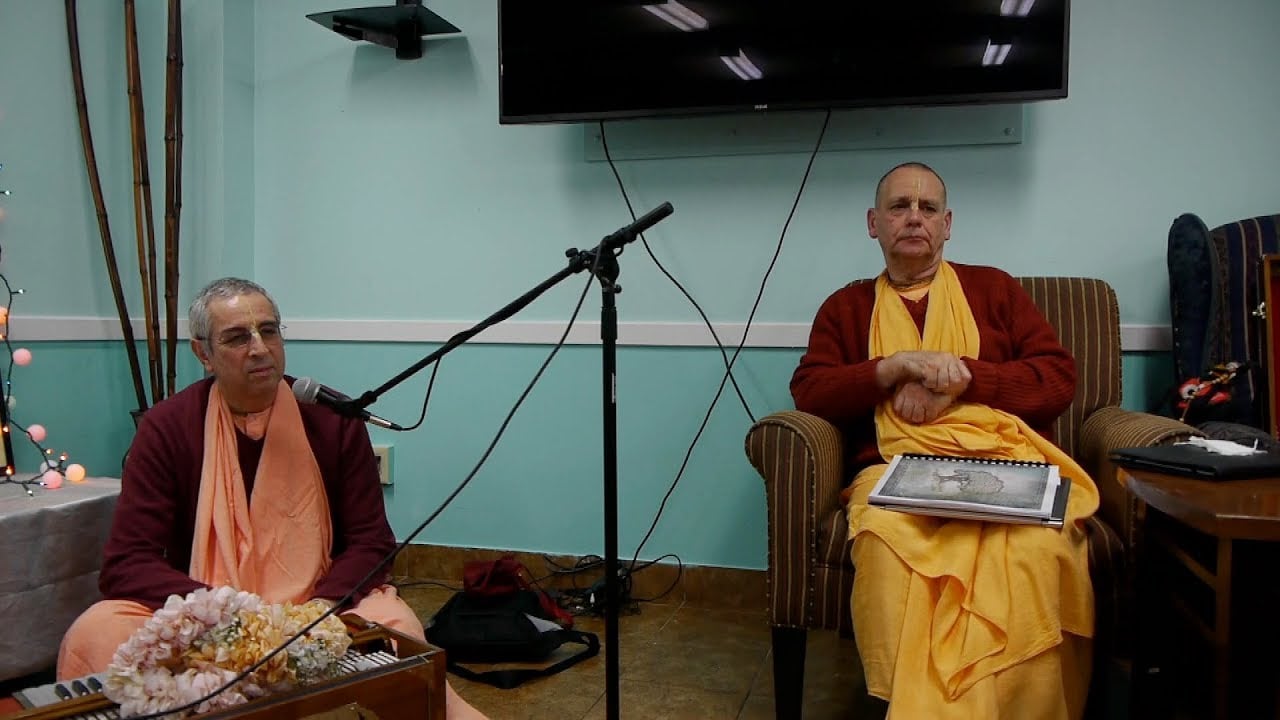
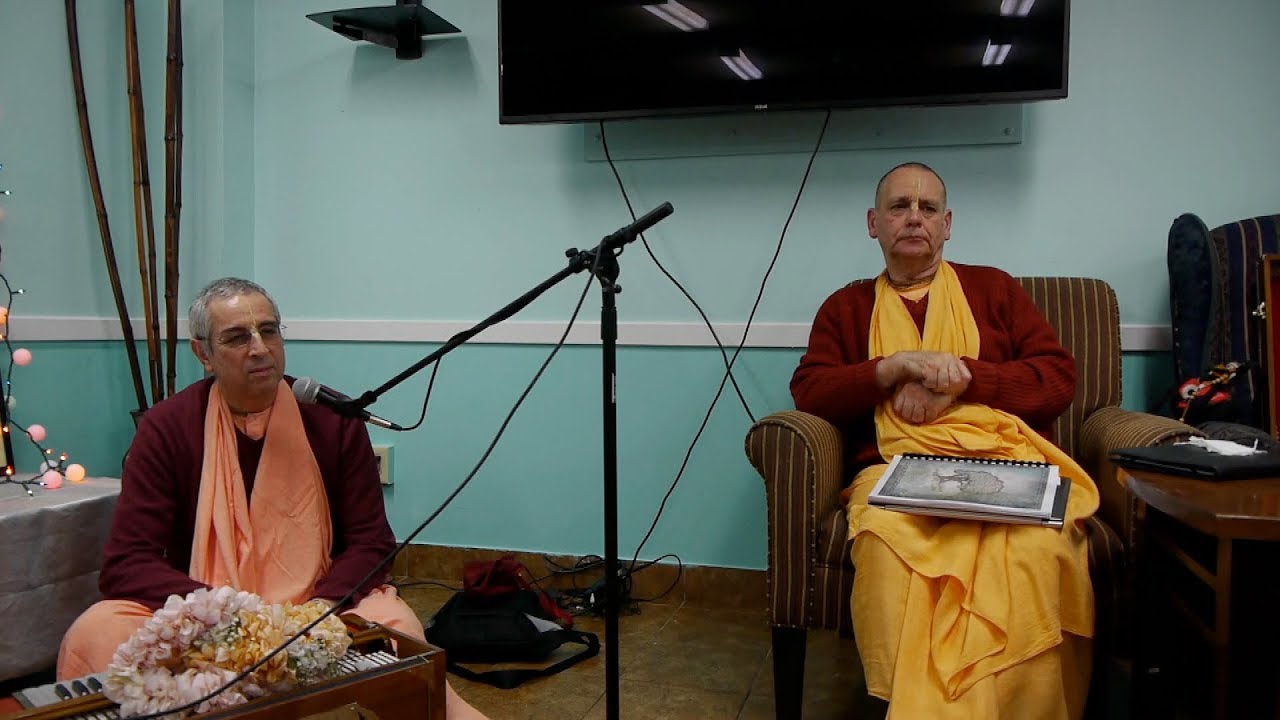
The remembrance of Dhīrāśānta Gosvāmī Mahārāja offers a profound study in devotional agency, spiritual maturity, and the distinction between religious action performed as obligation and devotion embraced as an inwardly desired way of life. In the final months of his earthly journey, his choices became more than biographical details. They became a lived commentary on bhakti, surrender, and the transformation of duty into love.
During a visit to Lithuania before initiation ceremonies, Niranjana Swami had spoken on a theme that is central to spiritual psychology: the difference between a life governed by “have-to-do” obligations and a life animated by activities one deeply “want to do.” This distinction is not merely linguistic. It reveals the inner condition of the practitioner. A person may chant, serve, worship, study, and care for others externally, yet the deeper question remains whether such activities arise from compulsion, social expectation, institutional routine, or genuine longing for Kṛṣṇa.
That same theme continued to develop in later talks in the United States, where it became increasingly clear that devotional life cannot be measured only by external compliance. In the bhakti tradition, the heart is not secondary to practice; it is the field in which practice takes root. Ritual, discipline, and regulated service have an important role, but they reach their true purpose when they awaken desire for divine service rather than merely sustaining a religious schedule.
After a memorial talk for Dhīrāśānta Gosvāmī Mahārāja, reflection naturally turned toward the final three months of his life, especially the period following a visit with him in April. Those months seemed to clarify the very principle under discussion. Dhīrāśānta Mahārāja appeared as a living illustration of what it means when “want to do” finally displaces “have to do.” His final decisions were not random acts of resignation, nor were they gestures of emotional withdrawal. They showed a disciplined spiritual orientation formed over a lifetime of sādhana, service, and fidelity to Śrīla Prabhupāda.
The medical diagnosis placed before him was framed in the language of necessity. Chemotherapy and radiation were presented as required treatment, and the doctor described them as the only available alternative. This was the language of the body, the language of survival, protocol, urgency, and institutional responsibility. In that world, the body generates obligations continuously: one must treat, one must comply, one must extend biological existence wherever possible. This logic has its place, and medical care can be an important instrument of compassion. Yet it is not the only framework through which a spiritual practitioner understands life, death, agency, and purpose.
Dhīrāśānta Mahārāja’s response was direct and theologically precise: “No, there is another alternative. It is to depend on God. And it seems that you do not see this alternative. And this is the best alternative.” This statement should not be read as ignorance of medicine or rejection born from despair. It was a conscious refusal to let the “have to” frame define the meaning of his final chapter. He was not arguing that bodily care is meaningless for everyone. Rather, he was identifying a higher alternative available to one whose inner life had been trained toward surrender.
In the theology of Krishna consciousness, the body is respected as an instrument of service, but it is not the self. The living being, the jiva, is understood as distinct from the temporary physical form. This distinction is foundational to the Bhagavad Gita and the broader Vedic understanding of spiritual identity. From that perspective, bodily preservation is not the ultimate good in itself. The decisive question is whether the body, mind, and remaining time can be offered in conscious remembrance of Kṛṣṇa.
Dhīrāśānta Mahārāja did not approach death as an unavoidable crisis that had to be endured mechanically. He chose to face it in a particular way. That choice is crucial. It reveals deliberate agency, not passivity. He did not merely accept an outcome; he selected the spiritual atmosphere in which he wanted to live his final days. The emphasis shifted from “I have to face death somehow” to “I want to face it in dependence on Kṛṣṇa.” This is the difference between external compulsion and interior devotion.
The hospital, in this account, functions as a symbol of institutionalized obligation. It represents the regimen the body is expected to follow in order to continue functioning: tests, treatments, schedules, documents, permissions, and procedures. Dhīrāśānta Mahārāja had to sign release documents, formally acknowledging that he was choosing to leave that setting. The act itself carried symbolic weight. He inscribed, in writing, that his final days would not be governed primarily by institutional necessity but by spiritual intention.
He returned to an apartment in Kaunas, surrounded by devotees and deities. The setting matters. In devotional life, environment shapes consciousness. A hospital room may offer treatment, monitoring, and technical care, but the apartment in Kaunas offered association, remembrance, worship, and the presence of those whose service was motivated by affection. For a Vaishnava, such association is not incidental comfort. It is a form of spiritual shelter.
This recalls the earlier discussion of the early āśrama devotees. What made their daily schedule transformative was not merely that they rose early, attended programs, performed service, and followed rules. The schedule became spiritually powerful when it was connected to inner desire. The same principle appeared in Dhīrāśānta Mahārāja’s final period. The Deities and the holy name were not items to be maintained as part of religious routine. They were wanted. They were the center around which his remaining strength, attention, and affection naturally gathered.
Modern life often trains people to experience existence as an expanding list of obligations: family responsibilities, financial pressure, medical decisions, social expectations, professional demands, and the persistent anxieties of bodily maintenance. The mind can become crowded with “I have to deal with my family, I have to pay bills, I have to…” Such concerns are not imaginary; they are part of embodied life. Yet spiritual traditions within dharmic civilization have repeatedly taught that the human being is not meant to be consumed entirely by these demands.
During the final visit with Dhīrāśānta Mahārāja, he reportedly waved aside the body’s demands with a single gesture. The gesture was not contempt for life. Rather, it showed a reordering of priorities. The body’s claims were placed in the background, while discussion of Kṛṣṇa, Śrīmatī Rādhārāṇī, and the internal potency occupied the foreground. His use of the word “life” was therefore exact. For him, life was not reducible to biological continuation. Life meant conscious relation with Kṛṣṇa.
This is where the notion of “higher taste” becomes essential. In bhakti, renunciation is not sustained merely by denial. A person cannot permanently transcend lower attachments by intellectual argument alone. The heart must become attracted to something higher. Dhīrāśānta Mahārāja’s final conduct suggested that the higher taste was no longer theoretical. The body belonged to the world of “have to,” while Kṛṣṇa was experienced as life itself.
The distinction between medical care and devotee care also reveals a subtle theological and relational insight. Medical care, at least within institutional settings, often operates through protocols, professional duties, liability structures, and necessary procedures. These are not inherently negative. They can be expressions of responsibility and competence. Yet they are still largely governed by obligation. Devotee care, as Dhīrāśānta Mahārāja used the term, is different in its inner motive. It is freely given and freely received, animated by love, service, and spiritual friendship.
When he said, “now I can see that you are a true friend,” and then identified that care as “this is devotee care,” he gave language to a difference many people recognize but rarely articulate. Relationship by obligation may sustain necessary functions, but relationship by love nourishes the person. In the Vaishnava understanding, care for the devotee is not sentimentality. It is seva, service offered to one who has dedicated life to Kṛṣṇa. Such care becomes spiritually meaningful because it is rooted in shared devotion rather than mere duty.
The Lithuania lecture had ended with aspiration: “I want to. I really want to.” That prayer expresses the central challenge of sādhana. A practitioner may begin by doing what is prescribed, even when the heart is divided. Over time, through association, chanting, worship, study, humility, and service, duty can mature into longing. The goal is not to abandon discipline but to allow discipline to awaken desire. Dhīrāśānta Mahārāja’s final months demonstrated what such cultivation can produce when it is extended across a lifetime.
His final period was marked by wanting in the deepest devotional sense: wanting to depend on Kṛṣṇa, wanting to be with devotees, wanting to discuss the spiritual world, and wanting to meditate on service to Śrī Śrī Rādhā-Śyāmasundara. These were not last-minute abstractions. They were the fruit of long practice. In dharmic traditions, the end of life is often understood as a revealing moment, not because it erases the past, but because it exposes what the heart has truly valued.
For contemporary readers, this remembrance also raises a practical question. How much of spiritual life is performed because it is expected, and how much is performed because the heart has begun to desire it? This question applies beyond one community. Hindu, Buddhist, Jain, and Sikh traditions all recognize, in distinct ways, the difference between external form and inward realization. Discipline matters, but discipline without inner transformation can become dry. Inner feeling matters, but feeling without discipline can remain unstable. The mature path harmonizes both.
Dhīrāśānta Mahārāja’s example does not require others to imitate the external details of his medical decision. Such matters are deeply personal and must be approached with seriousness, responsibility, and appropriate guidance. The instructive point lies in the consciousness behind the decision. He acted from dependence on God, not from fear. He sought devotional association, not isolation. He turned toward remembrance, not denial. He prioritized the eternal identity of the soul while still receiving the loving care of devotees around him.
In that sense, his life offers a disciplined critique of a culture that often treats bodily continuation as the highest value. Dharmic spirituality does not dismiss the body, but it refuses to absolutize it. The body is honored when used in service, cared for as a sacred trust, and accepted as temporary. The soul’s relationship with the Divine remains the deeper axis of meaning. Dhīrāśānta Mahārāja’s final months placed that principle into visible form.
The remembrance is therefore both tribute and instruction. It honors a Vaishnava whose devotion to Kṛṣṇa, service to Śrīla Prabhupāda, and affection for devotees shaped the final stage of his life. It also invites reflection on the transformation every spiritual practitioner seeks: the movement from obligation to desire, from religious routine to living devotion, from bodily anxiety to conscious dependence on the Divine.
In the lecture, the principle was described. In the final months of Dhīrāśānta Gosvāmī Mahārāja, the principle was enacted. The “have to” world, with its treatments, hospitals, and insistence on bodily continuation, could no longer claim the center. The center had already been given elsewhere. It belonged to Kṛṣṇa, to the devotees, to the holy name, and to the spiritual desire cultivated through a lifetime of sincere service.
Hare Kṛṣṇa
Inspired by this post on Dandavats.





Leave a Reply
You must be logged in to post a comment.