
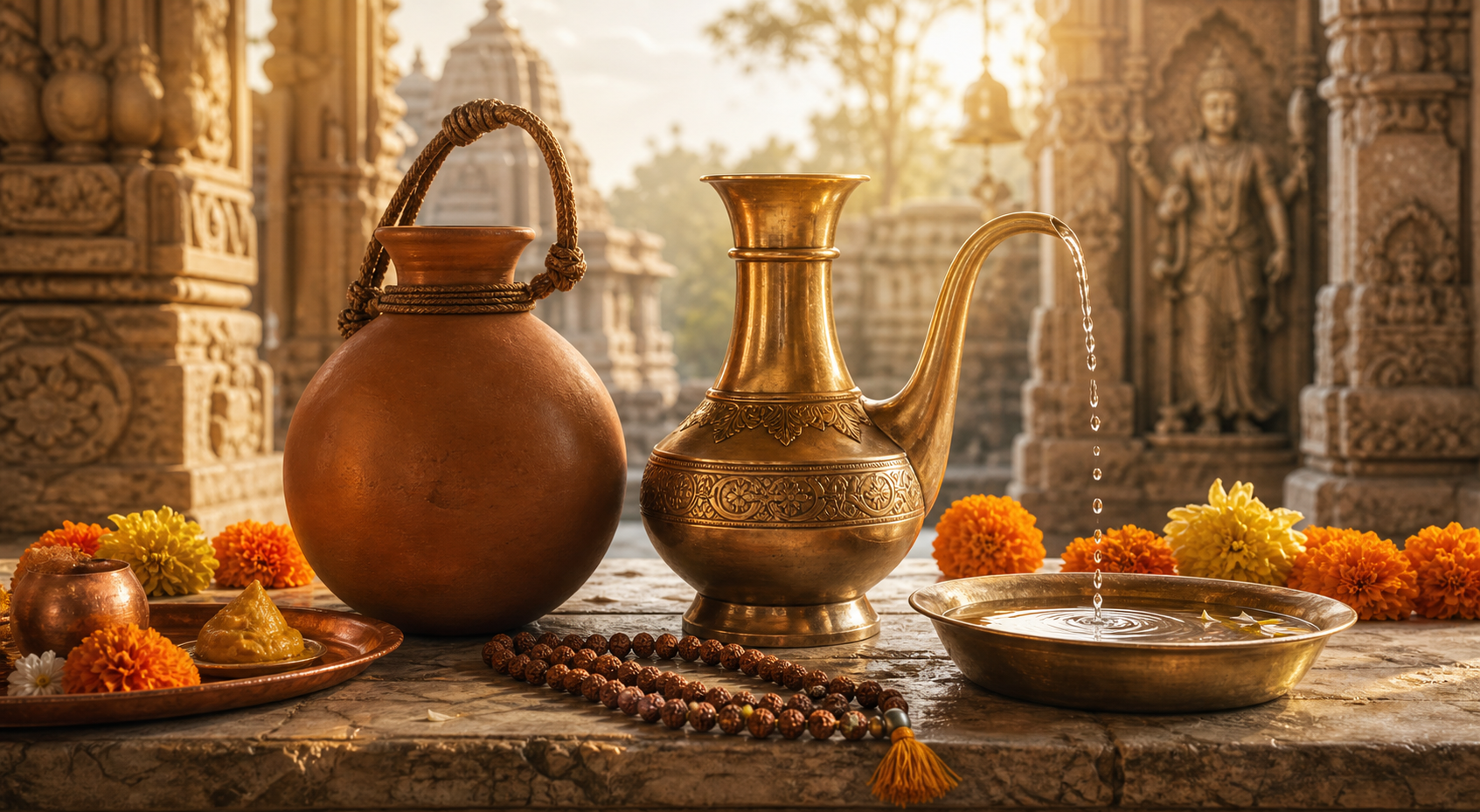
In Hindu ritual culture, the smallest object can carry a vast field of meaning. A water vessel is never merely a container when it appears in the hand of a rishi, beside a Shiva linga, near a yajna fire, or within the disciplined world of temple worship. The kamandalu and the kundika belong to this sacred vocabulary. Both are vessels for water, both are associated with purity, austerity, and ritual authority, and both appear across Hindu iconography and related Dharmic traditions. Yet they are not identical objects. Their difference lies in form, context, symbolism, and the kinds of sacred actions they serve.
The kamandalu is most widely recognized as the water pot of sages, ascetics, monks, and renouncers. In visual culture, it often appears in the hands of Brahma, Shiva as an ascetic, Dakshinamurti, Dattatreya, Agastya, Narada, and many rishis. It evokes tapas, restraint, simplicity, and spiritual independence. The kundika, by contrast, is usually understood as a more refined ritual water vessel, often with a spout or controlled pouring feature, used for libations, purification, consecration, and formal ceremonial acts. In sculpture, painting, and ritual manuals, the distinction is sometimes clear; in living practice, regional usage can blur the boundary.
The word kamandalu generally refers to a portable water pot carried by an ascetic or ritual specialist. Its cultural power comes from its association with renunciation. A person who has given up household comforts does not carry many possessions; the kamandalu becomes one of the few indispensable objects, along with the staff, mala, deer skin, or simple cloth depending on the tradition. It holds water for drinking, purification, achamana, and ritual sprinkling. In this sense, it is both practical and symbolic: it sustains the body while reminding the mind of restraint.
The kundika is more closely tied to deliberate ritual pouring. It is often described as a vessel with a neck, spout, or narrow opening that allows the priest, monk, or ritual practitioner to dispense water in a controlled way. This matters because Hindu ritual often depends on precision. Water is offered as arghya, used in abhishekam, sprinkled for purification, poured in sankalpa, and consecrated through mantra. A vessel designed for controlled flow naturally becomes important in ceremonies where the act of pouring itself carries sacred meaning.
The simplest distinction is therefore functional. A kamandalu is usually a portable ascetic water pot. A kundika is usually a ritual ewer or pouring vessel. The kamandalu emphasizes possessionlessness, yogic discipline, and the quiet authority of the renouncer. The kundika emphasizes liturgical order, purity of offering, and ceremonial action. Both hold water, but they frame water differently: one as the companion of tapas, the other as the instrument of consecration.
Material also helps explain their character. Traditional kamandalus may be made from dried gourd, coconut shell, wood, clay, brass, copper, or other metals. The gourd form is especially important because it conveys simplicity and closeness to nature. It suggests that the vessel need not be luxurious to be sacred. In many ascetic settings, a humble kamandalu is more spiritually expressive than an ornate object, because its value lies in function, discipline, and purity rather than ornamentation.
Kundikas are more commonly represented in metal, especially copper, brass, bronze, or silver in ritual contexts. Their shapes may be more engineered: a rounded body, a slender neck, a lip, a spout, or a nozzle. In temple practice, such design supports repeated and careful use. When water has to be poured over a murti, offered to a deity, or sprinkled in a sanctified space, control matters. The kundika therefore belongs naturally to the grammar of puja, homa, consecration, and priestly service.
Iconography makes the difference even more vivid. A kamandalu in the hand of a sage signals spiritual attainment, restraint, and inner fullness. It suggests that the bearer has reduced external needs and increased inward awareness. Brahma is often depicted with a kamandalu, linking the vessel to creation, sacred knowledge, and the waters from which life emerges. Shiva in ascetic form may hold or be associated with such a vessel, reminding devotees that the highest consciousness is not dependent on worldly abundance.
In the iconography of rishis and gurus, the kamandalu also marks authority of a special kind. This is not political authority or wealth-based authority. It is the authority of tapas, learning, and self-mastery. A viewer looking at a sculpture of a sage with a kamandalu immediately understands that the figure belongs to a disciplined spiritual world. The object communicates biography without words: the sage lives lightly, preserves purity, and carries sacred water as a sign of readiness for ritual and blessing.
The kundika appears in a different but related visual language. When a deity, priestly figure, bodhisattva, Jain monk, or ritual attendant holds a kundika-like vessel, the emphasis often falls on blessing, purification, and the transmission of sanctity. The vessel may suggest water used for cleansing, initiation, compassion, or ritual empowerment. This is one reason the kundika has a strong presence not only in Hindu contexts but also in Buddhist and Jain artistic traditions, where water vessels can represent purity, monastic discipline, and sacred service.
This shared presence across Dharmic traditions is significant. Hinduism, Buddhism, Jainism, and Sikh traditions do not use every object in the same way, yet they often share a reverence for purity, discipline, restraint, and sacred offering. A water vessel in these traditions is not a trivial household item. It belongs to a civilizational understanding in which water purifies, nourishes, receives mantra, and participates in transformation. The kamandalu and kundika therefore become useful symbols for unity within diversity.
Water is central to the symbolism of both vessels. In Hindu thought, water is associated with life, fertility, purification, memory, and sacred transition. Rivers such as Ganga, Yamuna, Saraswati, Godavari, Narmada, Kaveri, and Sindhu are not merely geographic bodies; they are sacred presences. Water is used before worship, during worship, and after worship. It cleanses the hands, lips, altar, murti, ritual implements, and the mental field of the devotee. A vessel that holds water therefore becomes a bearer of sacred potential.
The kamandalu carries this symbolism into the forest, the hermitage, and the path of renunciation. It represents the idea that sacredness need not be confined to the temple. The ascetic walking with a kamandalu carries a portable ritual world. With water, mantra, and discipline, the practitioner can perform purification, offer blessings, and sustain daily practice. The vessel becomes a quiet reminder that Dharma travels with the disciplined person.
The kundika carries the same symbolism into structured ritual. It belongs to the sanctified sequence of offering, pouring, sprinkling, invoking, and consecrating. In abhishekam, water is not just poured; it is offered with devotion and mantra. In purification rites, water is not just sprinkled; it becomes a medium through which sacred order is restored. The kundika’s form supports this precision, making it an ideal object for ritual environments where every gesture is meaningful.
The difference between kamandalu and kundika can also be understood through social location. The kamandalu is closely linked to the renouncer, the wandering monk, the forest sage, and the teacher who has stepped away from ordinary domestic life. The kundika is more commonly linked to the priest, temple ritual, monastic service, and formal worship. This does not mean the categories are rigid. A renouncer may use a vessel resembling a kundika, and a temple may keep vessels that resemble kamandalus. Still, the symbolic center of each object remains distinct.
Shape is another practical marker. A kamandalu often has a rounded belly, a handle or grip, and a simple opening. It is designed to be carried. A kundika often has a more defined neck or pouring arrangement. It is designed to dispense. The kamandalu gathers and preserves. The kundika directs and releases. This difference may appear small, but in ritual objects small design choices often reflect larger theological and practical concerns.
In sculpture, the challenge is that artists did not always follow one standardized form across every region and century. A vessel carved in a Pallava, Chola, Hoysala, Pala, Gupta, or later regional style may differ in proportion and detail. Some inscriptions and art historical descriptions may use terms according to local convention. As a result, a modern viewer should avoid overly rigid identification. The safest approach is to observe form, context, and figure together: who holds the vessel, how it is shaped, and what ritual or symbolic role the image suggests.
For example, a vessel held by a matted-haired ascetic seated in meditation is more likely to be interpreted as a kamandalu, especially if it has a simple pot-like form. A vessel held by a ritual attendant or used in a scene of consecration may be better understood as a kundika, especially if it has a spout or narrow pouring neck. When Brahma holds a water pot, many traditions identify it as a kamandalu because it is tied to creation, sacred knowledge, and the primordial waters. When a vessel is used for carefully pouring sanctified water, kundika becomes a more precise description.
The kamandalu’s association with Brahma deserves special attention. Brahma’s water pot is often interpreted as holding the waters of creation or the seed potential of life. In this context, water is not merely cleansing; it is generative. The vessel becomes a symbol of cosmic emergence. This is why the kamandalu can signify both renunciation and creation, two themes that may seem opposite but are deeply connected in Hindu philosophy. True creation arises from disciplined consciousness, not from chaos.
In Shaiva traditions, the kamandalu can also evoke the austerity of Shiva and the world of yogic detachment. Shiva’s sacred geography includes mountains, cremation grounds, rivers, forests, and spaces outside ordinary social comfort. A water vessel associated with such imagery reminds devotees that purity can exist even in places that society considers remote or unsettling. The ascetic vessel points toward the transformation of perception itself.
In Vaishnava, Shaiva, Shakta, Smarta, and other Hindu sampradayas, ritual vessels may vary in name and form, but the reverence for sanctified water remains constant. This is one of the quiet strengths of Hindu traditions: diversity of practice does not erase shared principles. Whether water is poured in abhishekam, offered in arghya, sipped in achamana, or preserved as tirtha, it carries the devotional intention of purification and alignment with Dharma.
A useful comparison may be made through daily experience. A person can understand the kamandalu as the vessel of inward discipline and the kundika as the vessel of outward ritual action. The first accompanies the seeker; the second serves the rite. The first asks how little is needed to live with clarity. The second asks how carefully sacred action should be performed. Together, they teach that spirituality requires both inner restraint and outer precision.
The difference also reflects two complementary dimensions of Hindu spirituality: tapas and shuddhi. Tapas is disciplined heat, effort, and self-transformation. Shuddhi is purity, cleansing, and refinement. The kamandalu belongs strongly to tapas because it travels with the disciplined seeker. The kundika belongs strongly to shuddhi because it supports purification and consecration. Yet each vessel participates in both. The ascetic needs purity, and the ritualist needs discipline.
Modern temple visitors and students of Hindu sculptures often encounter these vessels without knowing their names. Recognizing them changes the way sacred art is seen. A sculpture no longer appears as a figure holding an anonymous pot. The object becomes a clue to identity, role, and philosophy. In Hindu iconography, attributes are rarely decorative fillers. They are visual teachings. The trishula, chakra, shankha, damaru, lotus, mala, book, and water vessel all help the viewer understand the sacred personality represented.
For this reason, the study of kamandalu and kundika belongs not only to religious practice but also to art history, anthropology, Sanskritic studies, and temple architecture. These vessels reveal how material culture preserves theological ideas. They show how Hindu traditions transform ordinary actions into sacred disciplines. Carrying water, pouring water, sipping water, and sprinkling water become acts of remembrance, purification, and consecration.
The difference may be summarized in a concise way: the kamandalu is primarily the ascetic’s sacred water pot, while the kundika is primarily a ritual pouring vessel. The kamandalu is associated with sages, renunciation, Brahma, Shiva, and spiritual self-sufficiency. The kundika is associated with formal worship, libation, purification, and controlled ritual offering. The kamandalu is often simpler and more portable; the kundika is often more specialized for pouring. Both are sacred because both serve water in the context of Dharma.
At a deeper level, the two vessels should not be treated as rivals or as isolated technical labels. They represent two movements of the same sacred life. The kamandalu gathers water, preserving the inner resource of purity. The kundika releases water, allowing purity to flow into ritual space. One protects the contemplative journey; the other activates the ceremonial moment. Their shared purpose is to help human beings approach the sacred with cleanliness, humility, and attention.
This is why the distinction remains valuable today. In a fast-moving world, such objects teach a disciplined way of seeing. A simple pot can represent renunciation. A narrow spout can represent precision. A few drops of water can carry memory, mantra, and devotion. The kamandalu and kundika remind practitioners and observers alike that Hindu ritual culture does not separate beauty from function or symbolism from daily life. It turns the ordinary into a doorway toward the sacred.
Understanding these vessels also encourages respect across Dharmic traditions. Hindu, Buddhist, Jain, and Sikh communities have developed distinct practices, yet each preserves forms of reverence, discipline, purity, and service. Sacred vessels, like sacred words and sacred gestures, become bridges of recognition. They show that the Dharmic world is not built on uniformity but on meaningful diversity held together by shared ethical and spiritual concerns.
The kamandalu and kundika therefore deserve careful attention. They are not minor accessories in Hindu sculptures or ritual spaces. They are condensed symbols of water, purity, ascetic power, consecration, and sacred continuity. To recognize the difference between them is to read Hindu iconography with greater sensitivity. To recognize their shared purpose is to understand a larger truth of Dharma: the vessel matters, the water matters, and above all, the intention with which both are used matters.
Inspired by this post on Hindu Blog.







Leave a Reply
You must be logged in to post a comment.