
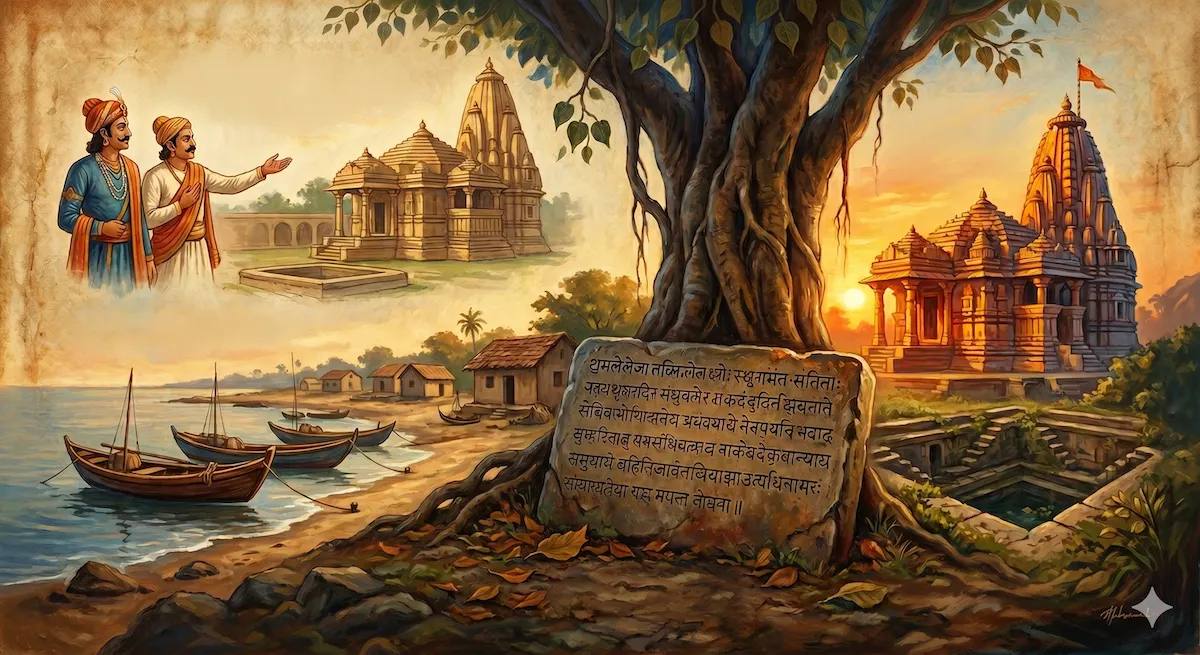
Dhamlej, a coastal village in Gujarat’s Saurashtra region, is usually introduced today in modest terms: a quiet settlement shaped by fishing, agriculture, and the rhythms of village life. Yet the historical record presented in the June 22, 2026 Dharma Dispatch study, “The Lost Heritage of Dhamlej: Uncovering Gujarat’s Erased Surya Temple”, points to a far older and more sacred identity. The village was once known in tradition as MŪLA-GAYĀ, located about 33 kms south of Sri Somanatha Kshetra, and remembered as a Surya Kshetra whose sanctity was compared with Modhera.
The case of Dhamlej is not merely the story of one temple. It is a study in how sacred geography, inscriptions, political upheaval, and public memory interact over centuries. A place can remain physically inhabited while its older religious identity fades from ordinary speech. Fields, fishing boats, roads, and tourist searches may continue, while the memory of a Surya Mandira, a sacred Kunda, and a medieval restoration effort becomes confined to inscriptions and specialist studies.
For students of Indian history, Dhamlej is especially important because it sits near one of the most symbolically charged sacred landscapes of western India: Prabhāsa and Somanatha. The coast of Saurashtra was not a peripheral zone. It was a corridor of pilgrimage, maritime movement, temple patronage, regional power, and cultural resilience. The rediscovery of inscriptions in this region therefore opens a window into the lived history of Hindu temples, Jain patrons, Brahmanical learning, local rulers, and communities that repeatedly rebuilt institutions under severe political pressure.
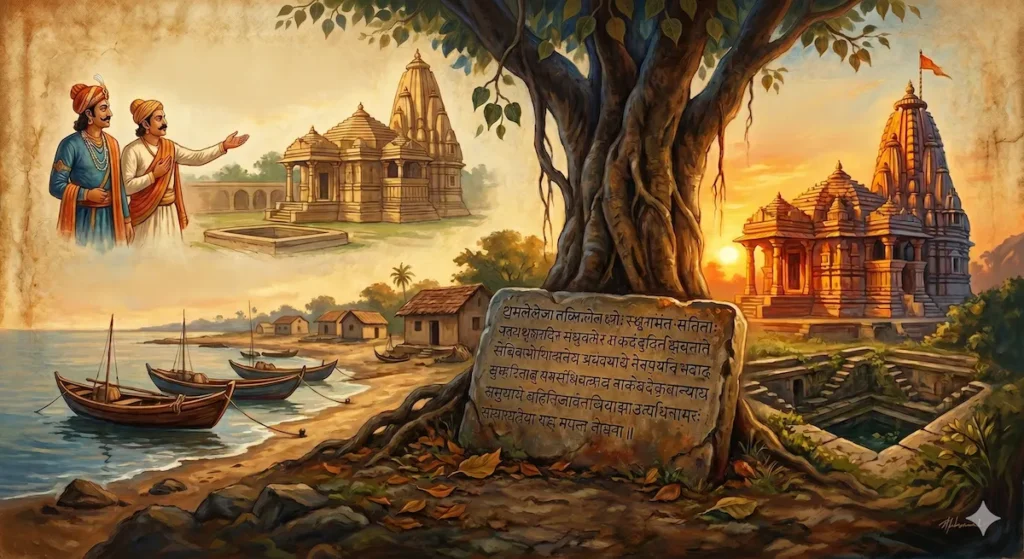
The article’s central historical anchor is the Dhamleja Inscription, numbered 39 and dated 23 June, 1380 CE. Such inscriptions are invaluable because they preserve information that later narrative histories often overlook. They identify patrons, rulers, places, ritual institutions, land grants, repairs, and acts of public welfare. In the case of Dhamlej, the inscription helps reconstruct a sacred complex associated with the Surya Mandira and a celebrated water body called Vishnu Gaya, also described as Cakra Tirtha.
The inscription’s importance was noticed in the colonial period by Major J.W. Watson, President of the Maharajasthanik Court of Kathiawar. During his tour of the Saurashtra coast in the 1870s, Watson encountered an extraordinary concentration of inscriptions and ancient temple remains. His reaction is significant: he regarded the region as worthy of serious archaeological scrutiny, not as an obscure local curiosity. This observation remains relevant because the coastal belt around Kadvar, Patan, Sutrapada, and Dhamleja appears to have contained an unusually dense record of sacred and historical sites.
In 1939, the epigraphist, archaeologist, and historian D.B. Diskalkar also visited Dhamleja and examined the inscription. His description places the village in the southern part of Junagadh State, about 11 miles southeast of Sutrapada. He recorded that to the west of the village stood the celebrated Kunda called Vishnu Gaya, also known as Cakra Tirtha, and that the inscription was lying there under a pipala tree. This detail is emotionally striking because a major historical document was not preserved in a formal archive or museum setting, but in the open sacred landscape to which it belonged.
The present uncertainty over Vishnu Gaya Kunda deepens the sense of loss. If the Kunda still exists, it deserves careful documentation, conservation, and respectful public recognition. If it has been altered, obscured, or absorbed into newer patterns of use, that fact too requires historical attention. The question is not only whether a water body survives; it is whether a sacred geography once known to pilgrims, patrons, and temple communities can still be identified through field research, oral memory, inscriptions, and local archives.
The historical setting of the inscription belongs to the late fourteenth century, a period of instability in Gurjara-Desha. Four centuries after Mahmud of Ghazni’s attack on Somanatha, Saurashtra again faced upheaval during the expansion of the Delhi Sultanate. The article places the Dhamleja episode after Ala-ud-din Khalji’s campaigns and during the reign of Firoz Shah Tughlaq, when Farhat-ul-Mulk was appointed Governor of Gujarat in 1377. Yet political authority in the region remained contested, and local Hindu rulers continued to exercise power in several areas.
This contested political landscape is essential to understanding the inscription. The Chudasamas remained influential in parts of Junagadh, and the Vājā Raja, Bharma, held suzerainty over Prabhāsa. Under such conditions, temple repair and sacred endowment were not merely devotional acts. They were also acts of cultural continuity, social organization, and institutional survival. Rebuilding a Surya Mandira or rejuvenating a Kunda meant restoring ritual life, supporting pilgrimage, and reasserting the sacred status of a place during a period of insecurity.
The most important individual in this restoration narrative is Karma Simha, the celebrated Mukhya-Sachiva, or chief minister, of Raja Bharma. The inscription identifies him as a devout Porwal Jaina, with Porwal understood as a later form of Prāgvāṭa. His role is especially significant for a blog committed to unity among dharmic traditions, because Dhamlej’s restoration history does not fit into narrow sectarian categories. A Jain minister helped repair a Surya Mandira, rejuvenate Vishnu Gaya Kunda, and support Brahmanas through an Agrahara grant. This is a vivid example of dharmic cooperation in practice.
Karma Simha’s work also included civic welfare. The account notes that he built a large trough at the city gate of Prabhāsa-Pattana so that cattle could drink water. Such details matter because medieval temple culture was not restricted to ritual worship inside a shrine. It extended into water management, feeding, education, animal care, land grants, and public infrastructure. The sacred and the civic were not separate domains; they often reinforced each other through institutions rooted in Dharma.

The inscription also preserves the memory of Karma Simha’s family. His father, Rāṇō or Rāṇa, is described as one who protected Brahmanas, safeguarded Dharma, and maintained prosperity during a time of severe turmoil. Karma Simha himself is described as a devout Bhakta who performed the afternoon Ārādhana of Somanatha, expressed in the inscription as Mādhyānhikīm anudinaṁ. These details offer a rare view of elite religious life in late medieval Saurashtra: devotion, governance, learning, and public responsibility were woven together.
One of the inscription’s most important acts was the grant of a village to Brahmanas as an Agrahara. The purpose was to allow sacred learning and teaching to continue with stability. This village was named Meghapura, or Mēghapurāgrahāram, in honour of Karma Simha’s elder brother Megha-Nripa, who had attained Svarga. The naming of the village shows how memory, lineage, scholarship, and piety were preserved through land, ritual, and inscriptional record.
The language of the medieval record includes terms such as Mleccha and Turushka, which appear in the context of political conflict, temple damage, and social distress. In a modern academic reading, such terms should be handled historically rather than used as present-day hostility toward communities. The evidence points to real episodes of temple destruction, disorder, and cultural disruption, but the ethical task today is to understand the historical record accurately while strengthening mutual respect among dharmic traditions and maintaining a disciplined distinction between medieval power struggles and contemporary social life.
Dhamlej’s comparison with Modhera is also important. Modhera is widely recognized for its magnificent Sun Temple and its place in Gujarat’s architectural heritage. Dhamlej, by contrast, survives in public awareness mostly as an ordinary village. The contrast reveals how heritage visibility depends on conservation, documentation, pilgrimage continuity, tourism policy, and public education. A site can be historically significant without being famous; it can be sacred without appearing in mainstream itineraries; it can be central to regional memory even when national memory has forgotten it.
The repeated rebuilding of the Surya Mandira, as described in the source account, should be understood as a pattern of resilience. Temples in medieval India often functioned as centers of ritual, learning, local economy, artistic patronage, and community identity. When such institutions were damaged, repair was not cosmetic. It was a civilizational response: worship had to resume, water bodies had to be restored, teachers had to be supported, and communities had to regain confidence in the sacred order of their world.
Dhamlej also raises a larger question about the erasure of sacred names. How did an evocative name like MŪLA-GAYĀ become Dhamlej in common memory? Place-name transformations can occur through linguistic change, administrative usage, migration, political rupture, or gradual loss of older ritual associations. A careful study would require epigraphy, local oral histories, revenue records, temple records, regional maps, and field visits. The question is not only philological; it is cultural. Names preserve memory, and when a sacred name disappears, an entire layer of meaning can become inaccessible.
The story of Dhamlej therefore belongs in the wider field of Indian temple history and heritage preservation. It calls for a method that combines archaeology, epigraphy, textual study, local interviews, and on-site documentation. The Vishnu Gaya Kunda, the Dhamleja Inscription, the memory of the Surya Mandira, and the Somanatha-Prabhāsa sacred landscape should be studied together. Fragmented evidence becomes more meaningful when placed within the network of pilgrimage, patronage, and political change that shaped Saurashtra.
There is also a deeply human dimension to this history. Anyone who has visited an old temple site, a neglected stepwell, or a weathered inscription knows the feeling of standing before a past that has not fully vanished but no longer speaks loudly. Such places do not always announce their importance. Sometimes they wait under a tree, beside a water body, or behind a village path, dependent on the attention of those willing to ask what the landscape once meant.
Dhamlej’s lost Surya heritage should not be treated as a closed chapter. It is an invitation to recover a layered sacred geography with academic seriousness and cultural sensitivity. The 1380 CE inscription records restoration, devotion, Jain-Hindu cooperation, and the protection of learning at a time of disorder. Its message remains powerful: civilizational memory survives when communities document, preserve, and transmit the stories embedded in their own land.
In that sense, Dhamlej is not simply a village near Somnath. It is a reminder that Gujarat’s sacred past extends beyond the monuments already known to tourists. It asks historians, devotees, archaeologists, and local communities to look again at the Saurashtra coast, to identify what still survives, and to preserve what remains before silence becomes permanent. || Om Sri Arkāya namaḥ ||
Inspired by this post on Hindu Post.






Leave a Reply
You must be logged in to post a comment.