
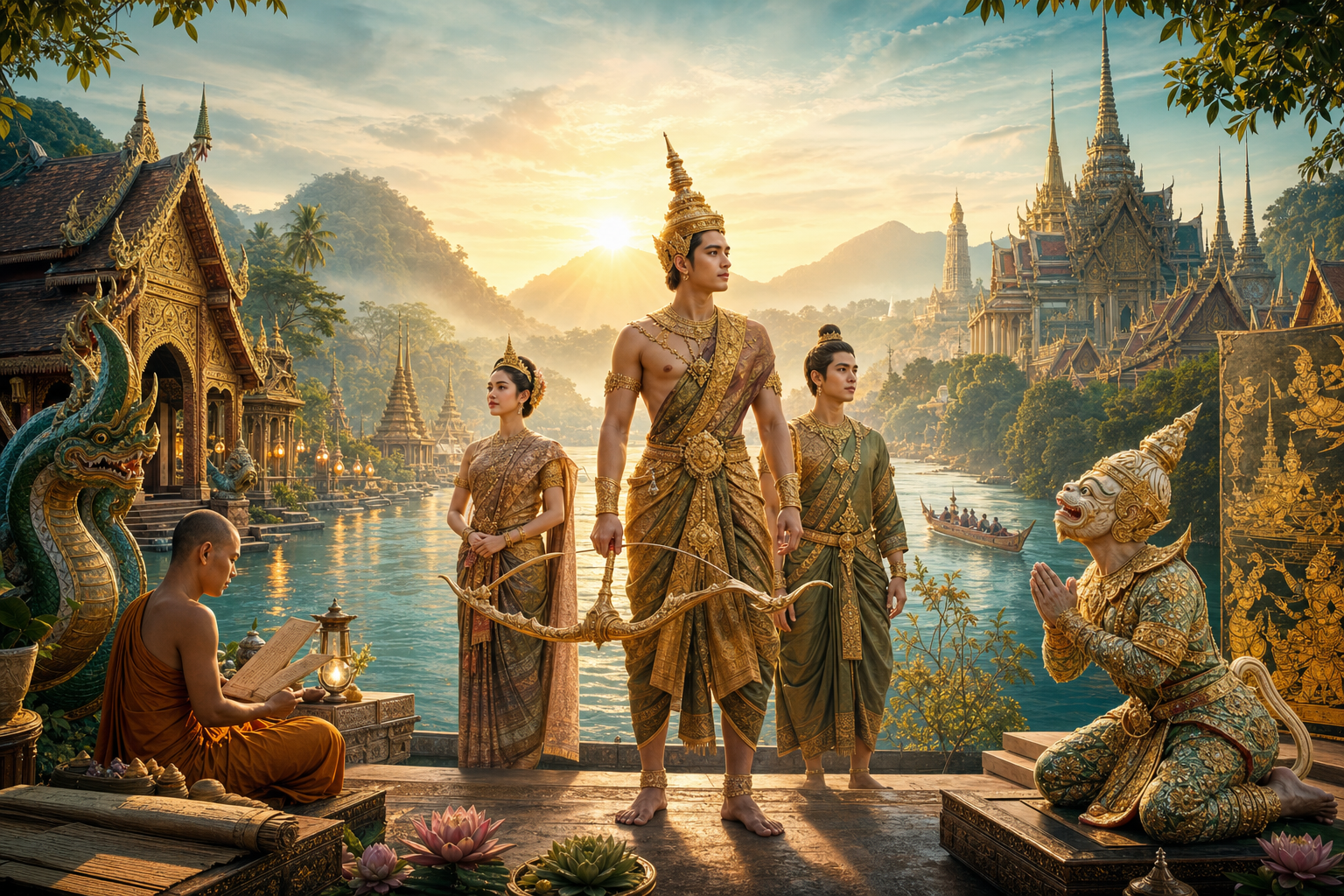
Rama Across The Mekong: One Epic, Two Cultural Worlds
Few sacred narratives demonstrate the civilizational reach of the Ramayana as vividly as the Lao Phra Lak Phra Lam and the Thai Ramakien. Both works descend from the wider Rama Katha tradition associated with Valmiki’s Sanskrit Ramayana, yet neither is a simple copy of the Indian epic. Each text shows how Southeast Asian societies received, translated, localized, performed, and spiritually reinterpreted the story of Rama according to their own historical memory, geography, court culture, Buddhist ethics, and artistic imagination.
The comparison matters because it reveals a deeper truth about dharmic traditions: transmission does not mean uniformity. Hindu, Buddhist, Jain, Sikh, and other dharmic cultures have long preserved unity through shared ethical questions rather than through rigid sameness. The Lao and Thai Ramayana traditions are therefore not merely literary adaptations; they are cultural commentaries on dharma, kingship, loyalty, self-restraint, devotion, karmic consequence, and the moral burden of power.
The Shared Ramayana Foundation
The broad narrative framework remains recognizable in both Laos and Thailand. A righteous prince is separated from his kingdom, the heroine is abducted by a powerful ruler, loyal allies assist in the search, an immense conflict follows, and the restoration of order becomes the moral climax of the story. The major figures also retain their ancestral identities: Rama becomes Phra Ram or Phra Lam, Lakshmana becomes Phra Lak, Sita remains the model of dignity and endurance, Hanuman appears as the extraordinary monkey-warrior, and Ravana appears in localized forms such as Thotsakan in Thailand and Raphanasuan in Lao tradition.
Yet the Ramayana was never a frozen text in Asia. It moved through merchants, monks, diplomats, poets, temple builders, royal courts, storytellers, and performers. In each region, it entered an existing world of local deities, ancestral memory, language, ritual, and political imagination. Laos and Thailand both absorbed the epic through layers of Indian, Khmer, Mon, Tai, Buddhist, and courtly influence. This layered transmission explains why the same story can feel intimate in both cultures while still carrying clear links to the Indian epic tradition.
Phra Lak Phra Lam: The Lao Ramayana
The Lao version is commonly known as Phra Lak Phra Lam, sometimes rendered as Phra Lak Phra Ram. Its title itself is revealing. Rather than foregrounding Rama alone, it places Phra Lak before Phra Lam, giving unusual prominence to the brother whose loyalty is voluntary, affectionate, and morally luminous. In many interpretations, this ordering reflects the Lao admiration for fraternal devotion, humility, service, and relational duty.
The Lao Ramayana is often understood through the lens of Theravada Buddhism, especially as a Jataka-like narrative connected to the idea of a previous birth of the Buddha. This does not erase its Ramayana inheritance; instead, it reframes that inheritance through Buddhist moral teaching. The story becomes a vehicle for reflecting on karma, restraint, generosity, patience, kingship, and the long discipline required on the path toward awakening.
Unlike versions that retain a strong Vaishnava theological emphasis, Phra Lak Phra Lam is deeply embedded in the Buddhist and local cultural world of Laos. Its landscape is not an abstract imitation of Ayodhya and Lanka. The Mekong River, Lao place-memory, Naga traditions, local political origin myths, and regional cosmology enter the narrative. The epic becomes a map of belonging. It explains not only what happened to Rama, Sita, Lakshmana, Hanuman, and Ravana, but also how Lao sacred geography, moral imagination, and collective identity came to be expressed through the Rama story.
In Laos, the text was preserved through manuscripts, temple culture, recitation, sermon, song, dance, and court performance. Monasteries were especially important in keeping the story alive. The fragile climate of mainland Southeast Asia meant that palm-leaf and manuscript traditions were vulnerable to decay, war, and loss, yet surviving Lao versions show how strongly the epic had taken root. The narrative was not confined to books; it lived in ritual space, performance, temple art, and seasonal celebration.
Ramakien: The Thai Ramayana
The Thai Ramakien, whose name may be understood as the glory of Rama, occupies a central place in Thai literary, artistic, and royal culture. It is one of Thailand’s national epics and is closely associated with court patronage, classical performance, temple murals, royal ideology, and the historical reconstruction of Thai culture after periods of political rupture.
Earlier Thai versions existed in the Ayutthaya period, but many literary works were lost when Ayutthaya was destroyed in 1767. The version most widely recognized today was compiled and shaped under King Rama I of the Chakri dynasty in the late eighteenth century, with further adaptation for performance under Rama II. This historical setting is important. The Ramakien was not merely a literary project; it participated in the restoration of cultural continuity, political order, and sacred kingship in the new Bangkok era.
The Thai version retains a clearer connection to Hindu cosmology while functioning within a Theravada Buddhist kingdom. Phra Ram is associated with Phra Narai, the Thai form of Vishnu or Narayana. At the same time, the story serves Buddhist-inflected ideas of righteous rule, merit, ethical discipline, and cosmic balance. This blend is characteristic of Thai religious history, where Brahmanical ritual, Buddhist kingship, and local sacred traditions often operate together rather than as isolated systems.
Visually, the Ramakien is most famously represented in the mural galleries of Wat Phra Kaew, the Temple of the Emerald Buddha, within Bangkok’s Grand Palace complex. These murals do more than decorate a sacred space. They place the Rama story inside the moral and political imagination of the Thai kingdom. The epic becomes a public theology of order, kingship, loyalty, courage, beauty, and disciplined power.
The Thai Ramakien also became central to khon, the masked dance-drama tradition. Through costume, gesture, music, stylized movement, and narration, the epic moved from manuscript and mural into embodied performance. Hanuman, in particular, receives an expanded and lively role in Thai tradition. He is not only a warrior and devotee but also a charismatic, witty, dramatic, and sometimes romantic figure. This gives the Thai version a theatrical energy distinct from many other Ramayana traditions.
Similarity One: Dharma As Moral Order
Both Phra Lak Phra Lam and the Ramakien preserve the Ramayana’s central concern with moral order. Rama is not merely a hero who wins a war. He represents the difficult discipline of rightful conduct under pressure. The epic asks what a ruler owes to his people, what a brother owes to a brother, what loyalty demands, how desire becomes destructive, and how power must be restrained by ethical obligation.
In both Laos and Thailand, the story therefore speaks to public life as well as private emotion. A reader or listener does not encounter only royal conflict; one encounters recognizable human struggles: exile, separation, temptation, grief, anger, duty, trust, and the longing for restoration. This emotional universality explains why the Ramayana could cross languages and kingdoms without losing its force.
Similarity Two: The Epic As Performance
Neither tradition is purely textual. The Lao and Thai Ramayana live through performance. In Laos, the story is associated with recitation, temple settings, local dramatic traditions, and the royal theatre of Luang Prabang. In Thailand, it is inseparable from khon, murals, court dance, and the visual splendor of royal and temple art. This performative life is essential because the Ramayana has always been more than a story to be read silently. It is a story to be seen, heard, sung, danced, remembered, and communally re-entered.
This point is often missed when epics are discussed only as literature. In Southeast Asia, the Ramayana became a complete cultural technology: a way to train memory, teach ethics, display kingship, refine aesthetic taste, preserve language, and transmit sacred values across generations. The body of the dancer, the voice of the reciter, the hand of the mural painter, and the devotion of the listener all become part of the epic’s life.
Similarity Three: Local Adaptation Without Civilizational Amnesia
Both versions show that cultural adaptation need not erase origins. The Lao and Thai traditions clearly remember the wider Rama Katha inheritance, yet they refuse to remain culturally passive. They translate the epic into their own landscapes, political concerns, ritual vocabulary, and artistic grammar. This is why the Ramayana in Southeast Asia should be understood as shared civilizational inheritance rather than as a single text replicated mechanically.
The result is a powerful model for dharmic unity. The same story can serve Hindu devotion, Buddhist moral instruction, royal ceremony, folk performance, and philosophical reflection. Diversity here is not a weakness. It is evidence of the epic’s depth. A shallow story breaks when translated; a profound story expands.
Difference One: Buddhist Jataka Framing In Laos
The most important difference is theological framing. In Laos, Phra Lak Phra Lam is often approached as a Buddhist moral narrative, linked to the Jataka tradition and the idea of Rama as a bodhisattva-like figure. The emphasis falls on karma, merit, ethical self-cultivation, and the moral formation of the ruler. The story becomes a lesson in the long journey toward wisdom rather than only a heroic account of divine kingship.
This gives the Lao version a contemplative and didactic character. Its purpose is not only to celebrate victory over evil but to reveal the consequences of actions, attachments, vows, and choices. In this sense, the Lao Ramayana harmonizes the Rama Katha with Theravada Buddhist pedagogy. It demonstrates how a Hindu-origin epic could be lovingly received within a Buddhist civilization without hostility toward its source tradition.
Difference Two: Royal And Courtly Emphasis In Thailand
The Thai Ramakien carries a stronger royal and courtly imprint. Its major recension under Rama I and its later development under Rama II place it within the project of cultural restoration and royal legitimacy. The epic’s language, performance style, visual form, and political symbolism are closely tied to the Thai court. It is not merely a story about kingship; it became one of the artistic languages through which kingship was imagined.
For this reason, the Ramakien has a grand ceremonial quality. Its murals, masked dance, elaborate costumes, and palace associations turn the epic into a statement of order after disruption. The destruction of Ayutthaya made cultural recovery urgent. Recasting the Ramayana in Thai form helped rebuild continuity with the past while also asserting a new sacred-political center in Bangkok.
Difference Three: Geography Of The Sacred Imagination
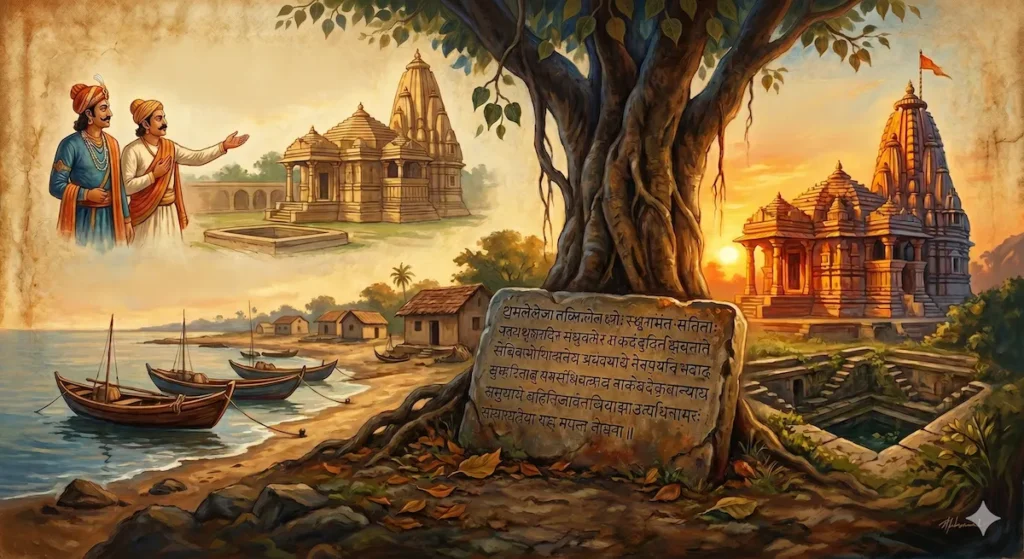
The Lao version places the epic imagination along the Mekong and within Lao cultural geography. Rivers, Nagas, local origin narratives, and regional memories shape the story’s atmosphere. The Mekong is not merely a background; it becomes a sacred axis of identity. Through this localization, the Ramayana becomes Lao without ceasing to be part of the broader Rama tradition.
The Thai version, by contrast, is strongly transposed into the cultural world of Ayutthaya and later Bangkok. Its landscapes, costumes, weapons, architecture, courtly codes, and visual motifs are Thai in style. Even when the narrative gestures toward the older epic geography, its artistic body is unmistakably shaped by Thai royal culture. This is why the Ramakien feels both pan-Asian and intensely Thai.
Difference Four: Character Emphasis
Character emphasis also differs. In the Lao Phra Lak Phra Lam, the very title gives Phra Lak unusual prominence. This signals a strong appreciation for brotherhood, assistance, and relational virtue. Some Lao traditions also give considerable attention to Ravana or Raphanasuan, making the antagonist more than a flat symbol of evil. The story can become a study of desire, power, and karmic consequence.
In the Thai Ramakien, Hanuman becomes especially prominent. His expanded role reflects the performative brilliance of Thai tradition, where agility, wit, romance, courage, and dramatic movement can be expressed through dance and theatre. Thai audiences often encounter Hanuman not only as Rama’s servant but as a dazzling dramatic personality. This shift changes the emotional rhythm of the epic and gives the Thai version much of its distinctive theatrical vitality.
Difference Five: Tone And Purpose
The Lao version often feels more monastic, moral, and community-centered. It teaches through the idiom of Buddhist ethics, local myth, and social memory. It is concerned with how people live, how rulers should act, how karma matures, and how sacred stories anchor a people to place.
The Thai version often feels more courtly, visual, and ceremonial. It teaches through beauty, hierarchy, royal symbolism, and disciplined performance. It is concerned with righteous kingship, cultural continuity, cosmic order, and the restoration of legitimacy. Both are ethical, but their emotional registers differ. Laos tends toward the sermonic and mythic; Thailand tends toward the royal and theatrical.
The Hindu-Buddhist Synthesis
The most valuable lesson from these two traditions is that Hindu and Buddhist inheritances in Southeast Asia are historically intertwined. The Lao and Thai Ramayana traditions do not support a simplistic division between Hindu and Buddhist culture. Instead, they show a shared dharmic vocabulary in which karma, kingship, merit, divine order, moral responsibility, and sacred storytelling flow across formal boundaries.
This synthesis should be approached with care. It is not accurate to say that the Lao or Thai versions are merely Indian texts in local costume. It is equally inaccurate to sever them from the Indian Ramayana tradition. They are both: rooted in the Rama Katha and reshaped by local genius. Their beauty lies precisely in this balance between inheritance and creativity.
Why These Versions Still Matter
In a modern world often anxious about identity, the Lao and Thai Ramayana traditions offer a more mature model of cultural confidence. They show that a civilization can receive influence without losing itself. They also show that a sacred story can travel without becoming empty. When rooted communities reinterpret a great narrative, they do not necessarily weaken it; they may reveal dimensions that were always latent within it.
For contemporary readers, the emotional power of these versions lies in their familiarity and difference. Rama’s exile still wounds the heart. Sita’s endurance still commands reverence. Lakshmana’s loyalty still inspires trust. Hanuman’s courage still awakens joy. Ravana’s fall still warns against unrestrained ego. Yet the Mekong, the murals of Wat Phra Kaew, the masked dance of khon, the Lao temple sermon, and the royal stage of Luang Prabang all give the story new textures of meaning.
A Comparative Summary
The Lao Phra Lak Phra Lam may be understood as a Buddhist-inflected, Mekong-centered, community-rooted Ramayana that emphasizes karma, brotherhood, moral instruction, and local sacred geography. The Thai Ramakien may be understood as a royal, courtly, visually magnificent Ramayana that emphasizes righteous kingship, cultural restoration, theatrical performance, and the sacred order of the kingdom.
Both preserve the central power of the Rama story. Both adapt names, places, characters, and theological emphases. Both transform the epic into a national and cultural treasure. Both prove that the Ramayana is not only a text from the past but a living civilizational conversation across Asia.
Conclusion: One Epic, Many Dharmic Pathways
The Lao and Thai Ramayana traditions are best understood not as rivals but as companion expressions of a shared sacred inheritance. Phra Lak Phra Lam and the Ramakien stand on different banks of the same civilizational river. One flows through the moral and monastic landscape of Laos; the other through the royal and theatrical imagination of Thailand. Together, they show how the Rama Katha became a bridge across India and Southeast Asia, across Hindu and Buddhist worlds, and across text, temple, performance, and memory.
The enduring lesson is clear: dharma survives not by refusing adaptation, but by guiding adaptation toward truth, beauty, responsibility, and harmony. In that sense, Rama’s journey across the Mekong is also the journey of a sacred story across human cultures, carrying with it the timeless call to live with courage, restraint, loyalty, and moral clarity.
Inspired by this post on Hindu Blog.



Leave a Reply
You must be logged in to post a comment.