
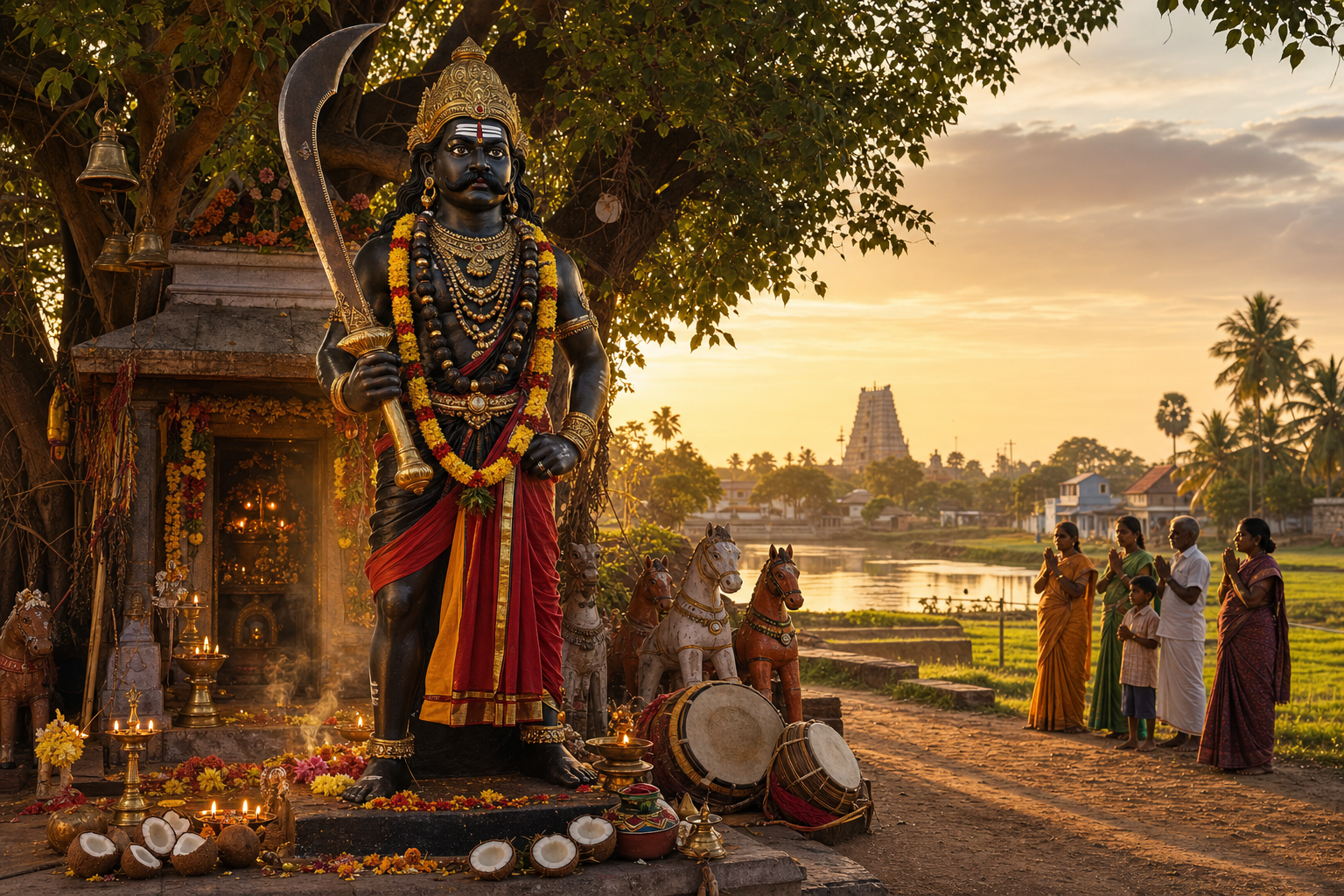
Chinna Karuppar, also known as Chinna Karuppasamy, occupies a distinctive place in the sacred geography of southern Tamil Nadu. Across Madurai, Sivagangai, Ramanathapuram, Dindigul, Theni, Tirunelveli, Pudukkottai, and parts of Tiruchirappalli, his name is not treated merely as a regional label for a deity, but as a living sign of protection, justice, ancestral continuity, and village responsibility. His worship belongs to the wide and complex tradition of Karuppar or Karuppasamy veneration, in which the divine is encountered not only in monumental temples, but also at thresholds, boundary shrines, family sanctuaries, and community spaces where everyday life meets sacred duty.
In Tamil religious life, Chinna Karuppar is best understood as a kaval deivam, a guardian deity entrusted with protection. The word guardian, however, should not be reduced to the idea of passive watchfulness. In the lived tradition, the guardian is one who stands at the edge of the village, observes moral conduct, responds to vows, protects devotees from visible and invisible dangers, and reminds the community that dharma is not an abstract concept. It must be practiced in land, family, speech, promise, memory, and shared obligation.
The title Chinna, meaning small or younger in Tamil usage, does not diminish his power. Within Tamil folk and temple traditions, names such as Periya, Chinna, Muthu, Sangili, Vettai, and Veera often indicate a form, role, lineage, location, or functional aspect of a deity rather than a hierarchy of spiritual worth. Chinna Karuppar is therefore not a lesser guardian, but a particular manifestation of Karuppar energy, locally honored according to inherited customs, family histories, oral narratives, and temple practice.
The religious world around Chinna Karuppar reflects the depth of Tamil Nadu heritage. It is a world where grand Agamic temples and village shrines coexist, where Sanskritic, Tamil, folk, Shaiva, Vaishnava, Shakta, and ancestral strands overlap without needing to erase one another. A devotee may worship Shiva, Vishnu, Murugan, Amman, Ganesha, Ayyanar, and Karuppar within the same religious life. This layered practice is not a contradiction. It is one of the defining strengths of Hindu traditions in Tamil society, where divine presence is approached through many names, forms, rituals, and relationships.
Chinna Karuppar is closely associated with the moral and protective dimensions of village religion. In many communities, Karuppar shrines are placed near entrances, outer roads, groves, fields, tanks, or transitional zones. Such placement is theologically meaningful. The boundary is never only a physical line. It marks the difference between cultivated order and uncertainty, between home and wilderness, between social responsibility and disorder. The deity at the boundary becomes a sacred sentinel who watches over these transitions and keeps the moral field of the community intact.
The iconography of Karuppar forms is usually direct, forceful, and unmistakably martial. He may be represented with a sword, staff, spear, sickle, or aruval, the curved billhook that carries both agrarian and protective meaning. The aruval belongs to the world of fields, labor, and survival, yet in divine hands it becomes a symbol of judgment, vigilance, and the cutting away of falsehood. The same object that serves agriculture can also signify the defense of moral order. This union of farming life and sacred protection gives Karuppar worship its intensely local and practical character.
His visual presence often includes a commanding posture, intense eyes, a strong moustache, and an alert bearing. These features are not ornamental additions. They communicate the deity’s role as one who cannot be deceived. In village imagination, Chinna Karuppar is the one before whom false testimony, broken vows, and hidden intentions cannot remain concealed. The emotional force of this belief is visible in the seriousness with which devotees approach his shrine. The encounter is devotional, but it is also ethical.
Scholarly studies of South Indian village deities often note that guardian gods such as Karuppar preserve memories of deified protectors, warriors, watchmen, ancestors, and local heroes. Their histories are not always preserved in written texts, but in oral tradition, ritual performance, family memory, local songs, festival dramas, and inherited temple practice. This does not make the tradition less significant. It shows that sacred history in Tamil society has often been carried by communities through embodied practice rather than only through manuscript culture.
Chinna Karuppar’s worship also reveals the importance of kuladeivam traditions. For many families, a guardian deity is not selected through personal preference alone. The relationship is inherited through lineage, migration, marriage, memory, and vows made by earlier generations. A family may live in Chennai, Bengaluru, Mumbai, Singapore, Dubai, London, Toronto, or New Jersey, yet continue to return to a village shrine in Tamil Nadu because that sacred bond is part of its identity. In such journeys, Chinna Karuppar becomes more than a deity of a place. He becomes a keeper of belonging.
This is why pilgrimage to a Karuppar shrine often carries a deeply emotional charge. The road to the temple may pass through fields, tanks, neem trees, dusty pathways, market streets, and ancestral homes. For elders, the shrine may awaken memories of parents, grandparents, vows, harvests, marriages, disputes resolved, illnesses survived, and children named in gratitude. For younger generations, the visit may become an initiation into family history. The deity silently gathers these layers into a shared sacred memory.
Ritual practice for Chinna Karuppar varies from region to region, and this variation must be treated with respect. Some shrines follow simple forms of worship with lamps, flowers, coconuts, camphor, vibhuti, and prayers. Others preserve older village customs involving vows, offerings, festival processions, drums, oracular speech, and collective participation. The diversity of practice reflects the diversity of Tamil society itself. A factual account should avoid forcing all shrines into one uniform model, because local tradition is central to the identity of each deity.
One of the most important aspects of Karuppar worship is the connection between vow and fulfillment. Devotees may approach Chinna Karuppar during moments of distress, uncertainty, illness, family conflict, financial hardship, legal anxiety, or fear of injustice. The vow is not simply a transaction. It is a disciplined declaration that the devotee recognizes divine oversight and accepts moral accountability. When a prayer is fulfilled, the return to the shrine becomes an act of gratitude and public remembrance.
In many communities, Chinna Karuppar is invoked in relation to truth and justice. The deity’s presence is believed to strengthen honest speech and restrain wrongdoing. This function is especially significant in village society, where formal institutions were historically distant and local reconciliation mattered deeply. Guardian deities helped create a sacred framework for resolving tensions, affirming promises, and restoring social balance. The shrine was not only a place of worship; it was also part of the moral architecture of the community.
The role of the oracle in some Karuppar traditions must be approached carefully and academically. In certain festivals, selected individuals may enter a state understood by devotees as divine possession or inspired speech. Through this ritual role, community concerns are addressed, warnings are delivered, and guidance is received. From an anthropological perspective, such practices provide a structured form through which collective anxiety, moral conflict, and devotional expectation are expressed. From the devotee’s perspective, they are moments when the deity’s living presence becomes immediate.
The soundscape of Chinna Karuppar worship is equally important. Drums, bells, folk songs, and call-and-response devotion can transform a shrine into a field of sacred intensity. Tamil religious culture has always given sound a powerful place, from Vedic recitation and Tevaram hymns to village songs and festival drums. In the Karuppar tradition, music often carries memory. It tells stories, announces presence, gathers the community, and prepares the mind to encounter the guardian not as a distant abstraction but as a living force.
Chinna Karuppar also belongs to a broader network of Tamil guardian deities such as Ayyanar, Madurai Veeran, Muneeswarar, Sudalai Madan, Pechi Amman, and other local forms. These deities are often connected in shrine layouts, festival sequences, oral legends, or ritual hierarchy. The relationship between them shows that Tamil village religion is not random or unstructured. It possesses its own grammar, one based on protection, kinship, territory, oath, fertility, justice, and ancestral memory.
The connection with Ayyanar is especially notable in many regions. Ayyanar is frequently imagined as a guardian of the village, often associated with horses, watchfulness, and night patrol. Karuppar may appear as an attendant, commander, guardian, or independent protective force depending on local tradition. This flexible relationship demonstrates the plural and relational character of Tamil worship. Deities are not always isolated figures. They operate within sacred networks that mirror social, ecological, and moral relationships.
The worship of Chinna Karuppar should also be read through the lens of sacred geography. Tamil Nadu’s southern districts are not merely administrative regions. Madurai, Sivagangai, Ramanathapuram, Dindigul, Theni, Tirunelveli, Pudukkottai, and Tiruchirappalli contain old trade routes, agrarian settlements, clan histories, temple networks, riverine cultures, and memory landscapes. A guardian deity rooted in this geography carries the imprint of these local worlds. His sacredness is inseparable from soil, road, field, family, and settlement.
Madurai’s ritual environment offers an especially useful context. The region is famous for Meenakshi Amman, Kallalagar, Murugan shrines, and many village deities whose worship shapes everyday religiosity. In such a landscape, Chinna Karuppar represents the protective dimension of dharma. The divine is not only worshipped in the sanctum of a major temple. It is also encountered where roads cross, where fields begin, where disputes arise, where vows are made, and where families seek protection before entering new phases of life.
The symbolism of blackness associated with Karuppar is also significant. In Tamil usage, Karuppu can mean black or dark, but its religious meaning is not reducible to color. It may suggest intensity, mystery, protective fierceness, and the ability to absorb danger. Across many Hindu traditions, fierce forms of the divine are not considered negative. They are necessary expressions of compassion when protection requires strength. Chinna Karuppar’s fierce presence therefore belongs within the wider dharmic understanding that benevolence and power are not opposites.
This point is essential for interpreting fierce deities accurately. Modern readers sometimes mistake weapons, stern faces, or boundary shrines as signs of fear-based religion. Tamil devotional practice offers a more nuanced view. A guardian may appear fierce because the world contains vulnerability, injustice, disease, conflict, and uncertainty. The deity’s intensity reassures devotees that protection is active. Compassion may console, but it may also guard, warn, discipline, and defend.
Chinna Karuppar’s relevance continues in contemporary life because the anxieties he addresses have not disappeared. Families still worry about safety, fairness, health, livelihood, migration, property, marriage, children, and social trust. In a rapidly changing world, the shrine offers a language through which these concerns can be placed before the sacred. The practice may be ancient, but the emotional need is current. The devotee standing before Chinna Karuppar is often asking for the same thing communities have always sought: protection with justice.
The tradition also offers a powerful lesson about dharmic inclusivity. Hinduism has historically held space for Vedic ritual, temple worship, bhakti poetry, folk practice, philosophical inquiry, yoga, tantra, household devotion, and ancestral reverence. Chinna Karuppar stands within this broad sacred ecology. His worship should not be dismissed as peripheral simply because it does not always conform to textual or urban expectations. The dharmic world is not sustained by one mode alone. It is sustained by many streams flowing toward the same civilizational ocean.
This inclusive understanding also supports unity among dharmic traditions. Hinduism, Buddhism, Jainism, and Sikhism differ in theology, practice, and historical development, yet they share civilizational concerns for ethical discipline, self-restraint, truthfulness, compassion, community duty, and liberation from lower tendencies. The worship of Chinna Karuppar is specifically Hindu and Tamil, but its ethical emphasis on truth, protection, and responsibility can be appreciated within the larger dharmic family. Such appreciation does not erase difference. It encourages respectful understanding.
For scholars, Chinna Karuppar provides a case study in how religion operates beyond formal doctrine. His worship shows how communities sacralize space, remember ancestors, enforce moral expectations, and process crisis. It also shows how oral tradition remains intellectually important. A ritual song, a shrine location, a festival route, a family vow, or a priestly lineage may preserve historical information that is not available in conventional archives. Academic seriousness requires attention to these forms of knowledge.
For devotees, however, Chinna Karuppar is not primarily an object of study. He is a presence. The difference matters. Academic description can explain the structure of belief, but the lived relationship includes reverence, fear, gratitude, affection, memory, and trust. A grandmother tying a vow, a farmer praying before sowing, a migrant returning after years abroad, or a family offering thanks after hardship does not experience the shrine as folklore alone. The deity is woven into the moral and emotional fabric of life.
The continued vitality of Chinna Karuppar worship also challenges simplistic ideas about modernity. Modern life does not necessarily eliminate traditional devotion. In many cases, it intensifies the need for rootedness. As families move away from ancestral villages, the kuladeivam shrine becomes a point of return. As occupations change, the old deity of fields and boundaries becomes a guardian of identity. As social life becomes more fragmented, collective festivals renew community bonds.
There is also an ecological dimension to the tradition. Many guardian shrines are historically linked with groves, trees, ponds, fields, and village edges. Such places remind devotees that sacred protection includes the protection of land and community resources. Even when ritual forms change, the older association between deity, environment, and settlement remains meaningful. Chinna Karuppar’s guardianship can therefore be read as a spiritual language of ecological responsibility, not only personal safety.
The ethical core of Chinna Karuppar worship lies in accountability. The deity is approached for help, but he is also remembered as one who expects truthfulness. This balance prevents devotion from becoming mere demand. A guardian deity asks the devotee to live with discipline, honor vows, respect community bonds, and avoid injustice. In this sense, Chinna Karuppar is not only a protector from external danger. He is also a protector against moral carelessness.
His symbolism remains powerful because it is concrete. The sword, the boundary, the shrine, the vow, the festival drum, the family journey, and the remembered ancestor all speak in forms ordinary people can understand. This concreteness is one reason village deities remain enduring. They bring metaphysical ideas into the texture of daily life. Dharma becomes not only something debated in philosophy, but something enacted in conduct, promise, gratitude, and courage.
Chinna Karuppar therefore deserves recognition as a sacred sentinel of Tamil Nadu’s living Hindu heritage. His worship preserves a form of spirituality that is local without being narrow, fierce without being cruel, ancestral without being stagnant, and devotional without being detached from social ethics. He stands at the threshold of village and wilderness, past and present, fear and faith, human need and divine protection.
To understand Chinna Karuppar is to understand a vital dimension of Tamil culture: the belief that sacred power must guard life where life is actually lived. It must stand beside families, fields, roads, memories, disputes, vows, and vulnerable hopes. In that role, Chinna Karuppar remains not only a deity of southern Tamil Nadu, but a living expression of dharma as protection, justice, continuity, and presence.
Inspired by this post on Hindu Blog.
