
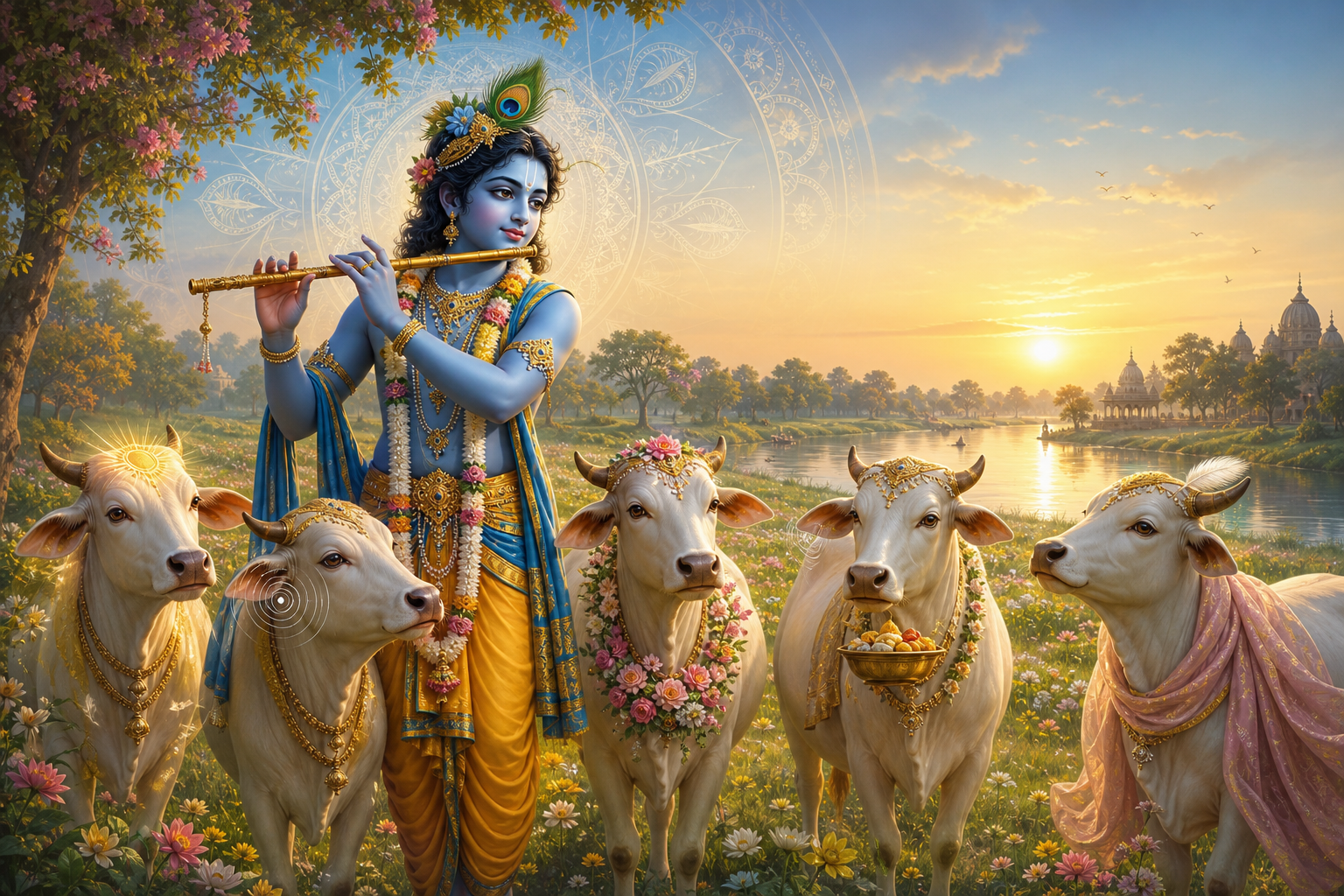
Krishna as Goswami: the ruler of the senses
In the symbolic vocabulary of Hinduism, few images are as layered as the relationship between go, the cow, the senses, and Krishna. The Sanskrit word go, often rendered as cow, carries a wider field of meanings in traditional usage, including sense organs, rays of light, speech, and the earth. This range of meanings allows Hindu thought to speak through one image on several levels at once: agricultural, ethical, psychological, cosmological, and devotional. When Krishna is called Gopala, Govinda, or Goswami, the words do not merely identify him as the beloved cowherd of Vrindavan. They also reveal him as the one who protects, guides, nourishes, and governs the roaming faculties of human experience.
The term Goswami is commonly understood as go plus svami, meaning master, lord, or controller. In a literal devotional setting, it may suggest the master of cows. In a deeper philosophical sense, it refers to one who has become master of the senses, the indriyas. The related form Gosain, used in many North Indian traditions, carries a similar spiritual association. It points toward a disciplined person whose relationship with the sensory world is not one of repression, denial, or hostility, but of intelligent governance. This is why the title is so suitable for Krishna, who stands in Hindu scripture and bhakti literature as both playful cowherd and supreme teacher of inner mastery.
The metaphor becomes especially powerful when the nature of the senses is considered carefully. A cow wanders toward grass, water, shade, and open space. It follows appetite, sound, smell, habit, and movement. In the same way, the senses move outward toward form, taste, touch, sound, and fragrance. The eyes pursue attractive shapes, the ears lean toward pleasing or disturbing words, the tongue seeks flavor, the skin seeks comfort, and the mind gathers these impressions into desire, fear, memory, and judgment. The comparison is not accidental. It reflects a refined psychological insight: the senses are not evil, but they are mobile, impressionable, and easily scattered when left without guidance.
Krishna’s cowherd identity therefore becomes a teaching about consciousness. In the pastoral world of Vrindavan, he gathers the cows, calls them by name, leads them to nourishment, protects them from danger, and brings them safely home. In the inward world of spiritual practice, the same image describes the ideal relationship between awareness and the senses. The senses must be cared for, not despised. They must be guided, not violently suppressed. They must be brought into harmony with dharma, devotion, and clear understanding. This is the subtle discipline implied in the word Goswami.
The Bhagavad Gita develops this teaching with remarkable precision. Krishna explains that the senses are powerful enough to carry away even the mind of a thoughtful person if they are not disciplined. Yet the Gita does not teach a life-denying spirituality. It does not ask the seeker to reject the world as meaningless. Instead, it teaches alignment. Senses become unstable when they are governed by craving, aversion, and ego. They become instruments of knowledge, service, and liberation when they are connected to a higher aim. This is why Krishna is also known as Hrishikesha, a name traditionally understood as the Lord of the senses.
The name Hrishikesha is central to understanding Krishna as master of the inner field. Hrishika refers to the senses, while isha means lord or ruler. The name suggests that Krishna is not only a divine figure outside the seeker but also the governing intelligence within. When Arjuna is overwhelmed on the battlefield of Kurukshetra, his senses, emotions, and judgment are in conflict. His eyes see relatives and teachers before him. His body trembles. His mouth dries. His mind recoils from action. In that moment, Krishna as Hrishikesha becomes the guide who restores order to perception, emotion, ethics, and duty.
This makes the symbolism deeply practical. The human problem is often not a lack of information but a lack of mastery over attention. A person may know what is right and still be pulled away by impulse. One may understand the value of restraint and still be carried by anger, distraction, envy, consumption, or speech that wounds others. The image of Krishna as Goswami addresses this familiar inner conflict with tenderness and discipline. The senses are like a herd: valuable, living, useful, and capable of nourishment, but requiring guidance from a conscious center.
In Vaishnava theology, the cow is also a sacred symbol of abundance, gentleness, and mutual dependence. The cow gives milk, supports ritual life, sustains agrarian society, and represents a relationship with nature based on gratitude rather than exploitation. When the cow is linked with the senses, the teaching becomes even more expansive. The senses too can nourish life when used rightly. Sight can become reverence. Hearing can become listening to wisdom, mantra, kirtan, and truthful speech. Taste can become gratitude through prasadam. Touch can become service. Smell can become awareness of sacred offerings, earth, flowers, and the environment. The same senses that bind can also liberate when turned toward dharma.
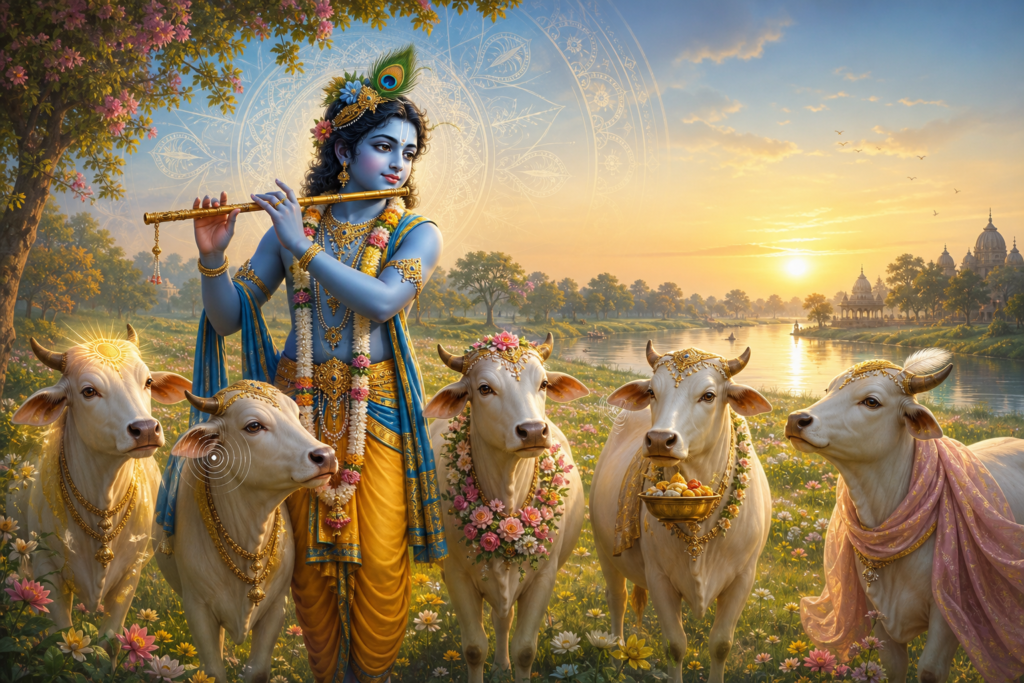
This is why Krishna’s flute is not merely a charming poetic detail. The flute organizes the scattered movement of Vrindavan. Cows, gopas, gopis, forests, rivers, and hearts respond to its sound. Symbolically, the flute represents the call of the divine that gathers the senses from dispersion into harmony. The uncontrolled senses run outward in many directions. The senses touched by Krishna’s presence become unified around love, beauty, and remembrance. The pastoral scene is therefore not only mythology in the narrow sense; it is a map of inner life.
The title Govinda adds another dimension. It is often interpreted as one who gives pleasure to the cows, one who protects the cows, or one who is known through the senses and the Vedas. In many devotional traditions, Govinda is the Krishna who gives joy to the senses by purifying their direction. This does not mean indulgence. It means the transformation of sensory life into sacred experience. Beauty is not rejected; it is spiritualized. Music is not rejected; it becomes kirtan. Food is not rejected; it becomes offering. Speech is not rejected; it becomes praise, truth, and compassionate counsel.
The discipline of sense mastery has parallels across the broader dharmic world. In Buddhist practice, restraint and mindfulness of the sense doors are essential for reducing craving and suffering. In Jain thought, careful discipline of the senses supports non-violence, self-restraint, and purification of karma. In Sikh tradition, remembrance of the Divine Name, ethical conduct, and mastery over ego help turn the mind away from restless attachment. Hinduism, Buddhism, Jainism, and Sikhism differ in theology and metaphysics, yet they share a civilizational insight: human freedom requires disciplined perception, ethical action, and a consciousness that is not enslaved by impulse.
This shared dharmic insight is important because sense control is sometimes misunderstood as harsh asceticism. In its mature form, it is not hatred of the body. It is not fear of beauty. It is not withdrawal from responsibility. It is the art of using the body, senses, speech, and mind as instruments of clarity. Krishna’s example is especially significant because he does not appear only as a forest renunciate. He is child, friend, cowherd, musician, statesman, charioteer, philosopher, and divine guide. His mastery is not sterile or lifeless. It is luminous, relational, and active in the world.
The cowherd imagery also teaches responsibility. A careless herder loses the herd to danger, hunger, or confusion. A careless mind loses the senses to restlessness, addiction, anger, and forgetfulness. A wise herder knows each cow, observes the terrain, anticipates risk, and leads with patience. Similarly, a wise practitioner observes the senses without panic or pride. The eyes are noticed. The tongue is noticed. The ears are noticed. The impulses of comparison, craving, irritation, and distraction are noticed. Mastery begins with observation, not force.
This principle has direct relevance in modern life. The contemporary world is engineered to capture attention. Images, notifications, advertising, political provocation, entertainment, and endless streams of opinion constantly pull the senses outward. The ancient metaphor of the roaming cow becomes unexpectedly modern. It describes the psychology of distraction with great accuracy. Without an inner Goswami, the senses move from one stimulus to another, often leaving the person tired, reactive, and fragmented. Krishna’s symbolism offers a counter-principle: gather the senses, orient them toward the highest good, and return them to the heart’s true center.
In this light, devotional practices such as japa, kirtan, darshan, puja, scriptural study, and mindful service are not merely ritual acts. They are technologies of attention. Japa disciplines speech and hearing. Darshan sanctifies sight. Prasadam transforms taste. Puja coordinates touch, fragrance, form, mantra, and intention. Kirtan channels emotion through sound. Seva turns bodily action into service. These practices do not erase the senses; they educate them. They gradually train the senses to recognize sacredness rather than chase stimulation alone.
The symbolism of Krishna as master of the senses also reshapes the meaning of freedom. In many modern assumptions, freedom is equated with doing whatever desire demands. Dharmic thought offers a more demanding and more liberating definition. Freedom is not slavery to every impulse. Freedom is the ability to choose wisely, act ethically, love deeply, and remain inwardly steady. A person ruled by anger is not free. A person ruled by craving is not free. A person ruled by social approval is not free. The Goswami is free because the senses serve consciousness rather than dominate it.
This does not mean that sense mastery is achieved instantly. The Gita recognizes gradual discipline, repeated effort, devotion, knowledge, and the transformation of desire. Krishna does not dismiss Arjuna’s confusion; he teaches through it. That pedagogical compassion is central. The seeker does not become a master of the senses through shame. The seeker grows through discernment, practice, humility, and surrender to a higher reality. In bhakti, that surrender is not a defeat of individuality but a refinement of it. The senses become more alive because they are no longer scattered.
Krishna’s life in Vrindavan reveals this refined aliveness. The forests, rivers, cows, music, friendships, and love of the devotees are not treated as obstacles to spirituality. They are filled with spiritual meaning. This is a distinctive strength of Krishna bhakti. It does not require the world to be emptied of beauty in order to become sacred. Instead, it reveals that beauty becomes dangerous only when separated from wisdom and divine remembrance. Under Krishna’s guidance, the world becomes a field of devotion.
The term Gosain therefore deserves more than a casual translation. It carries the memory of a disciplined spiritual ideal: one who belongs to the lineage of inner mastery, one who has placed the senses under the guidance of dharma, and one who seeks not domination of others but governance of the self. In many traditional communities, such titles were not merely social labels. They indicated responsibility, learning, restraint, and service. When connected with Krishna, the word points to the divine model of mastery that is firm without harshness and loving without indulgence.
The cow-and-senses symbolism also guards against a shallow reading of Hindu imagery. Sacred symbols in Hinduism often operate on multiple planes at once. A cow is an animal deserving care. It is also a sign of nourishment, ecological balance, maternal generosity, ritual purity, and civilizational memory. The senses are biological faculties. They are also doors of knowledge, temptation, devotion, and liberation. Krishna is a historical and theological figure within living tradition. He is also the inner guide who calls wandering awareness back to its source. The richness lies in holding these meanings together rather than reducing one to another.
Such layered symbolism has educational value for contemporary Hindu spirituality. It helps explain why stories of Krishna remain philosophically serious even when they appear simple, playful, or pastoral. The child with cows in Vrindavan and the charioteer of the Bhagavad Gita are not separate teachings. The same Krishna who gathers cows also gathers the mind. The same Krishna who protects Vrindavan also protects the seeker from inner disorder. The same Krishna who plays the flute also tunes the human personality toward harmony.
For this reason, the symbolism of go and Goswami remains enduring. It speaks to devotion, psychology, ethics, and spiritual practice in one compact image. The senses are powerful, but they need not be enemies. The world is attractive, but it need not become a prison. Desire is forceful, but it can be purified. Krishna as Goswami, Gopala, Govinda, and Hrishikesha reveals the highest possibility of embodied life: to live in the world with senses awakened, disciplined, sanctified, and guided by the Divine.
The hidden symbolism is therefore not hidden because it is obscure; it is hidden because it requires contemplative attention. The cowherd of Vrindavan is also the master of perception. The protector of cows is also the guardian of the senses. The playful Krishna is also the profound teacher of self-control. In that synthesis, Hindu thought presents a vision of spiritual maturity that is neither dry asceticism nor uncontrolled enjoyment, but a harmonized life in which every sense can become an offering.
Inspired by this post on Hindu Blog.










Leave a Reply
You must be logged in to post a comment.