
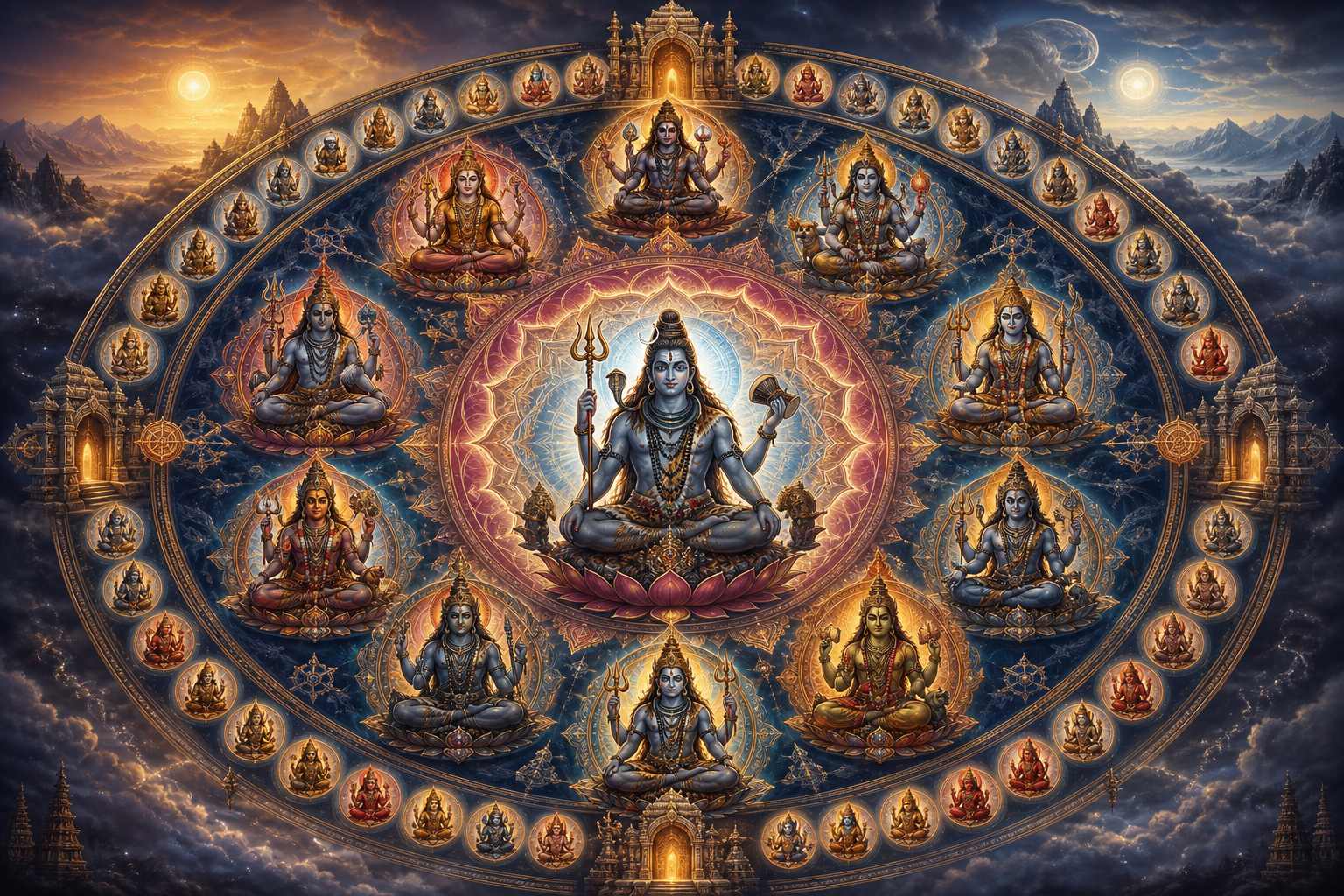
The 64 Faces of the Formless: Ashtashta Bhairavas and the Tantric Mandala of Divine Protection
Within the vast sacred landscape of Shaiva and Shakta Tantra, Bhairava stands as one of the most powerful and intellectually demanding forms of Lord Shiva. He is not merely a deity of fear, destruction, cremation grounds, or esoteric ritual; he is the fierce radiance of consciousness that destroys ignorance, dissolves false identity, protects sacred order, and opens the path toward liberation. The name Bhairava is traditionally understood in several ways: as the one who terrifies the ego, the one who bears and sustains the universe, and the one who removes fear by revealing the truth that lies beyond time and death.
In Shakta-Shaiva traditions, Bhairava is inseparable from Shakti. His fierceness is not opposed to compassion; rather, it is compassion in its most uncompromising form. A gentle teaching may console the mind, but Bhairava confronts the roots of bondage directly. He appears where ordinary religious language becomes insufficient: at the limits of mortality, moral confusion, cosmic dissolution, and spiritual transformation. For practitioners and students of Hindu spirituality, this makes Bhairava one of the most profound symbols of the inner journey from fear to freedom.
Bhairava as the Supreme Terrible One Who Liberates
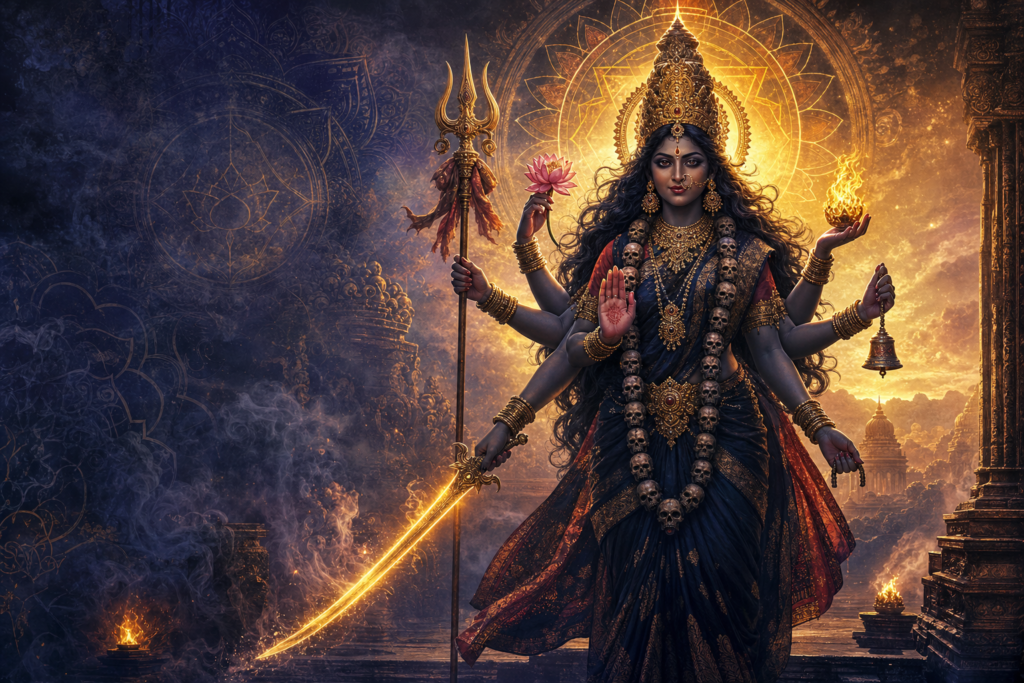
The terrifying imagery of Bhairava is often misunderstood when read only at the surface level. His fangs, skull garland, trident, drum, sword, noose, and presence in cremation grounds are not signs of mere violence. They are symbolic instruments of philosophical instruction. The skull represents the impermanence of the body and the collapse of egoic pride. The trident points toward mastery over the threefold conditions of existence: creation, preservation, and dissolution; or, in yogic interpretation, the piercing of the three knots that bind consciousness. The damaru, the sacred drum of Shiva, suggests vibration, mantra, and the rhythmic pulse from which the universe emerges.
Bhairava is therefore both destructive and protective. He destroys what imprisons the soul and protects what leads toward awakening. In many Shaiva communities, especially in Kashmir Shaivism, Bhairava is not a subordinate deity but the supreme state of consciousness itself. The term Bhairava can signify the absolute, luminous awareness that is beyond limitation, beyond fear, and beyond the duality of pure and impure. The fierce iconography is a theological method: it compels the mind to look beyond appearances and enter a more demanding form of spiritual reflection.
From Ashta Bhairava to Ashtashta Bhairava
The doctrine of the Ashtashta Bhairavas, or the sixty-four Bhairavas, develops from the better-known framework of the Ashta Bhairavas, the eight principal manifestations of Bhairava. These eight are commonly named Asitanga Bhairava, Ruru Bhairava, Chanda Bhairava, Krodha Bhairava, Unmatta Bhairava, Kapala Bhairava, Bhishana Bhairava, and Samhara Bhairava. Each principal Bhairava presides over a direction, a form of energy, a mode of protection, and a layer of spiritual transformation. In tantric mandala systems, each of these eight is further expanded into eight emanations, producing a complete cycle of sixty-four.
This structure is not a random multiplication of divine forms. It reflects the sacred geometry of Tantra, where the cosmos is understood through ordered fields of energy, direction, sound, mantra, deity, and consciousness. The number sixty-four appears frequently in Hindu, Buddhist, and wider Indic sacred traditions: sixty-four yoginis, sixty-four kalas or arts, sixty-four tantric seats in certain traditions, and sixty-four modes of divine expression. In the Bhairava mandala, sixty-four suggests totality: the fierce divine presence extended into every direction, every threshold, and every condition of existence.
The Eight Principal Bhairavas
Asitanga Bhairava is often associated with the eastern direction and the power of spiritual emergence. His name suggests a form marked by a dark or ash-colored body, evoking the sacred ash of Shiva and the recognition that all embodied forms eventually return to the elements. Asitanga teaches detachment without despair. He invites the practitioner to begin the path with humility, discipline, and awareness of impermanence.
Ruru Bhairava is often interpreted as a refined and knowledge-bearing form. Unlike the more openly wrathful manifestations, Ruru carries the force of instruction, inner mastery, and disciplined learning. In a symbolic reading, Ruru Bhairava protects sacred knowledge from misuse and reminds seekers that esoteric power without wisdom becomes spiritually dangerous. His presence connects Bhairava worship with the broader Hindu reverence for guru, mantra, scripture, and ethical preparation.
Chanda Bhairava represents intense force, righteous severity, and the power to confront adharma. The Sanskrit term chanda carries the sense of fierceness or impetuous energy. In spiritual psychology, this form may be read as the power required to cut through inertia, denial, and inner corruption. Chanda does not merely punish; he awakens the courage required to live truthfully.
Krodha Bhairava embodies sacred anger, not uncontrolled rage. This distinction is essential. In dharmic traditions, anger is generally treated with caution because it can cloud judgment and generate harm. Yet there is also a disciplined, dharmic force that resists injustice, protects the vulnerable, and refuses spiritual laziness. Krodha Bhairava symbolizes this transformed energy: anger purified into clarity, strength, and protection.
Unmatta Bhairava, whose name suggests divine madness or ecstatic transcendence, challenges ordinary social and mental boundaries. This does not encourage irresponsibility; rather, it points to a state beyond the narrow calculations of ego. Mystical traditions across Hinduism, Buddhism, Jainism, and Sikhism have recognized that spiritual realization often appears paradoxical to conventional perception. Unmatta Bhairava expresses that paradox in a Shaiva-tantric form.
Kapala Bhairava is associated with the skull, cremation-ground symbolism, and the direct contemplation of death. His imagery is severe because the lesson is severe: all worldly identities are temporary. The skull bowl, or kapala, is not a morbid ornament but a ritual sign of radical non-attachment. Kapala Bhairava instructs the practitioner to transform the fear of death into the knowledge of the deathless Self.
Bhishana Bhairava is the terrifying guardian whose presence overwhelms hostile forces. The terror he inspires is directed toward ignorance, arrogance, and forces that obstruct dharma. In devotional practice, such forms often give psychological strength to devotees facing uncertainty, grief, or danger. The fierce deity becomes a protector precisely because he is not sentimental about illusion.
Samhara Bhairava represents dissolution. The word samhara refers to withdrawal, destruction, or cosmic reabsorption. In Shaiva philosophy, dissolution is not an error in the universe but part of its sacred rhythm. What is born must dissolve; what dissolves returns to source. Samhara Bhairava therefore points beyond fear into metaphysical trust: destruction, when understood spiritually, can be the clearing through which liberation becomes possible.
The Sixty-Four Bhairavas as a Mandala of Consciousness
The sixty-four Bhairavas are best understood as a mandala rather than a simple catalogue. A mandala is not merely a diagram; it is a disciplined arrangement of sacred presence. It maps the relationship between the individual body, the subtle body, the cosmos, and the supreme reality. In Shakta-Shaiva Tantra, the mandala allows the practitioner to encounter divinity as structured energy. Each direction, petal, enclosure, deity, mantra, and weapon expresses a specific mode of consciousness.
Different tantric texts, regional traditions, and temple practices preserve different lists of the sixty-four Bhairavas. This variation should not be seen as contradiction in a simplistic sense. Hindu sacred traditions often preserve knowledge through layered transmission, where names, iconographic details, mantras, and ritual applications differ according to lineage. The theological principle remains consistent: the one Bhairava manifests in many forms in order to guard, energize, and transform the entire field of existence.
In many interpretive systems, the eight principal Bhairavas function as the central guardians, while the remaining fifty-six extend their powers into more specific domains. The result is a complete protective geometry. The mandala becomes a cosmic fortress, but not in a narrow militaristic sense. It is a field of awakened awareness that surrounds the practitioner, the sacred space, and the subtle universe. The true protection offered by Bhairava is protection from forgetfulness of the divine nature.
Sacred Geometry and the Logic of Eight
The number eight carries deep symbolic importance in Indic thought. It corresponds to the eight directions: east, southeast, south, southwest, west, northwest, north, and northeast. It also resonates with the eight forms of Shiva, the eight siddhis in yogic literature, the eight limbs of Yoga, and the eightfold patterns that appear across dharmic contemplative traditions. When eight is multiplied by itself, the resulting sixty-four represents an expanded wholeness: order radiating through every dimension of space and experience.
The Ashtashta Bhairava system therefore expresses a cosmology in which no direction is spiritually empty. Every threshold is guarded. Every fear can become a doorway. Every destructive force can be reabsorbed into consciousness. This is why Bhairava is so important in temple architecture, pilgrimage traditions, and tantric ritual. He is often placed at boundaries, entrances, cremation grounds, city limits, and sacred perimeters because he governs liminality: the zone between the known and the unknown.
Bhairava, Time, and Death
One of the most revered forms of Bhairava is Kala Bhairava, the lord of time. Kala means time, but it also evokes death, destiny, and the devouring movement through which all finite things pass away. In the sacred city of Kashi, Kala Bhairava is venerated as the guardian of the city, and traditional belief holds that no pilgrimage to Kashi is complete without his darshan. This reflects a profound theological insight: liberation cannot be approached honestly without confronting time.
Bhairava teaches that time is not merely a calendar or sequence of events. Time is the field in which karma ripens, bodies age, civilizations rise and fall, and spiritual urgency becomes unavoidable. The devotee who contemplates Kala Bhairava is reminded that life is precious precisely because it is finite. This insight is not pessimistic. It intensifies responsibility, devotion, ethical action, and the pursuit of moksha.
The Shakta Dimension: Bhairava and Bhairavi
No serious account of Bhairava in Tantra can separate him from Bhairavi. In Shakta-Shaiva theology, Shiva without Shakti is pure stillness; Shakti is the dynamic power through which consciousness manifests, acts, creates, and liberates. Bhairava and Bhairavi together express the union of awareness and energy. Their fierce forms do not reject the world; they reveal the divine intensity hidden within it.
This is especially important when considering the relationship between the sixty-four Bhairavas and the sixty-four Yoginis. Yogini traditions, found in several parts of India, preserve powerful forms of goddess worship connected with circular temples, open-sky ritual spaces, mantra, and esoteric symbolism. The Bhairava-Yogini relationship reflects a tantric vision in which masculine and feminine divinity are mutually sustaining. The goal is not domination of one by the other, but awakened integration.
Inner Meaning: The Psychology of the Fierce Divine
For modern readers, the most accessible way to approach Bhairava may be through the psychology of transformation. Human beings often seek comfort from religion, and that comfort has genuine value. Yet spiritual life also requires confrontation: with fear, attachment, pride, grief, anger, mortality, and self-deception. Bhairava is the form of the divine that does not allow these forces to remain hidden.
The sixty-four Bhairavas may be read as sixty-four modes of inner vigilance. One form guards discipline, another knowledge, another courage, another non-attachment, another humility, another righteous action, another surrender, and another final dissolution. Such an interpretation does not replace traditional worship; it helps contemporary seekers understand why fierce deities remain spiritually relevant. Bhairava is not a relic of ancient fear. He is a living symbol of the courage required for inner freedom.
Bhairava in Dharmic Harmony
The study of Bhairava also contributes to a broader understanding of unity among dharmic traditions. Hindu Tantra, Buddhist Vajrayana, Jain disciplines of fearlessness and non-attachment, and Sikh emphasis on courage, devotion, and remembrance all engage, in different ways, the transformation of fear into spiritual strength. These traditions are not identical, and their differences deserve respect. Yet they share a civilizational vocabulary in which discipline, liberation, compassion, and truth are treated as higher than egoic comfort.
In this wider dharmic context, Bhairava should not be reduced to sectarian identity. He belongs deeply to Shaiva and Shakta worship, but the philosophical questions he raises are universal: What is fear? What survives death? What must be destroyed for wisdom to arise? How does one protect sacred life without becoming consumed by aggression? These questions make Bhairava a bridge between ritual, philosophy, ethics, and contemplative psychology.
Ritual Caution and Spiritual Responsibility
Because Bhairava is central to tantric traditions, his worship is sometimes surrounded by secrecy, exaggeration, or sensationalism. A responsible academic and devotional approach must distinguish between public forms of reverence and lineage-specific practices. Simple devotion to Bhairava, recitation of widely known stotras, temple worship, and meditation on his protective nature are part of living Hindu practice. More technical mantra, yantra, nyasa, and ritual procedures traditionally require guidance from a qualified guru and a proper sampradaya.
This caution is not meant to create fear. It preserves respect. Tantra is not casual experimentation with power; it is a disciplined path of purification, responsibility, and realization. Bhairava, as guardian of thresholds, demands sincerity. The seeker who approaches him merely for control, spectacle, or egoic ambition misses the essence of the tradition. The seeker who approaches with humility encounters a profound teaching: true power begins where selfishness ends.
Why the Ashtashta Bhairavas Matter Today
The Ashtashta Bhairavas remain relevant because modern life has not eliminated fear; it has multiplied its forms. Anxiety about death, identity, social disorder, cultural loss, moral confusion, and spiritual emptiness continues to shape human experience. Bhairava addresses these anxieties without denial. He does not promise that everything fragile will remain intact. Instead, he points toward that which cannot be destroyed: awakened consciousness, dharma, and the liberating presence of Shiva.
For communities committed to Hindu spirituality and dharmic unity, Bhairava also offers a model of protection without hatred. His fierce form is not a license for cruelty; it is a reminder that sacred traditions require courage, clarity, and self-mastery. To protect dharma is also to protect wisdom, compassion, temples, scriptures, ethical memory, and the dignity of diverse spiritual paths. In that sense, Bhairava is not only a guardian of the cosmos but also a guardian of inner civilization.
Conclusion: The Fierce Grace of Shiva
The sixty-four Bhairavas of the Ashtashta Bhairava mandala reveal a vision of divine reality that is vast, ordered, protective, and transformative. They show that the formless can assume countless faces, that wrath can become compassion when directed against ignorance, and that death itself can become a teacher of liberation. In the sacred geometry of Shakta-Shaiva Tantra, Bhairava stands at every gate, not to frighten the sincere seeker away, but to strip away illusion before entry into deeper truth.
To contemplate Bhairava is to contemplate the courage to see clearly. The Ashtashta Bhairavas are not merely sixty-four names in a ritual list; they are a complete map of spiritual protection, cosmic order, and inner awakening. Their enduring power lies in this paradox: the deity who appears terrifying to the ego becomes profoundly compassionate to the soul. In Bhairava, the destructive and the liberating are not two separate forces. They are the fierce grace of Shiva, working through time, death, mantra, Shakti, and consciousness to guide the seeker toward freedom.
Inspired by this post on Hindu Blog.





Leave a Reply
You must be logged in to post a comment.