
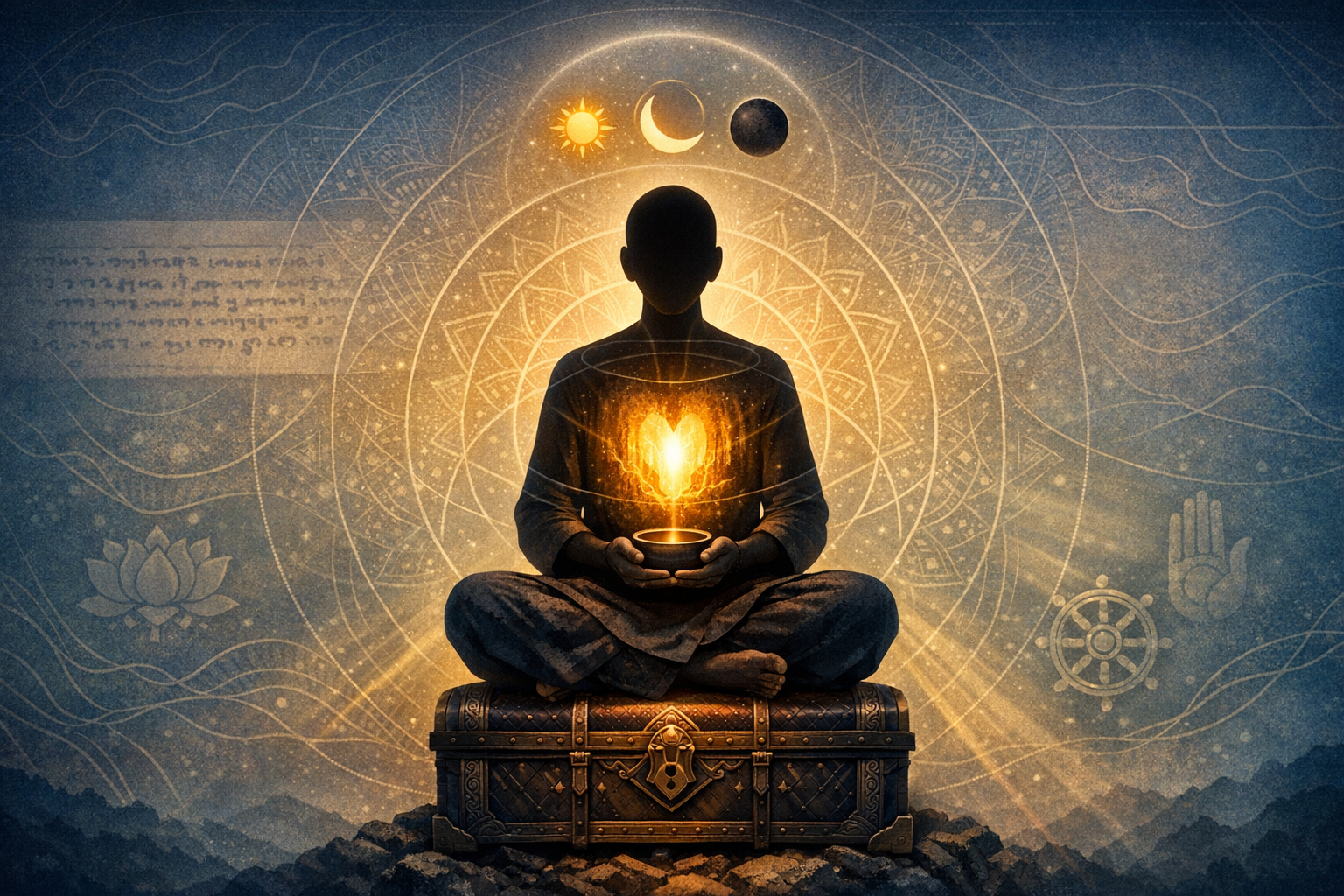
A vivid image drawn from the Chandogya Upanishad frames a perennial human predicament: a person, seated unknowingly upon a hidden cache of gold, nevertheless wanders about begging. The allegory signals a decisive spiritual diagnosis. That for which people search outsidelasting happiness, security, and meaningalready shines as the inner Self, yet goes unrecognized because attention is captivated by surface appearances. The Upanishadic teaching urges recognition rather than acquisition: discover what is always present, not something newly produced.
In doctrinal terms, the image distills a core insight of Vedanta: the identity of ātman and brahman, encapsulated in Tat tvam asi (Chandogya Upanishad 6.8–6.16). The Upanishads repeatedly describe brahman as ‘seated in the cave of the heart’ (nihitaṁ guhāyām; cf. Muṇḍaka Upanishad 3.1.1), an ever-free, ever-luminous presence masked by misidentification (adhyāsa) and ignorance (avidyā). What is missing is not the reality itself but the clear seeing that ends superimposition.
Why is the treasure overlooked? Classical analysis locates the error in habitual conflation of the Self with body, senses, and thought. The mind (antaḥkaraṇa) reflexively attaches ‘I’ to changing attributeshealth, mood, success, social imageand then chases their stabilization. This binding habit is strengthened by deep-seated impressions (saṁskāra) and the guṇas of the mind (sattva, rajas, tamas), producing the restless search that the parable dramatizes.
Vedanta sharpens discernment through the pañca-kośa model (Taittirīya Upanishad): annamayā (physical), prāṇamayā (vital), manomayā (mental), vijñānamayā (intellect), and ānandamayā (bliss) sheaths. Each sheath is observable and changeful, hence an object to awareness, not the aware subject itself. Through inquiry (viveka), one recognizes the Self as the witness of all five and thereby loosens identification with what is transient.
Complementing the sheaths is the “three-bodies” analysis: sthūla (gross), sūkṣma (subtle), and kāraṇa (causal) śarīra. The gross body acts in the world, the subtle body processes sensation and thought, and the causal body holds latent tendencies. The Self is none of these upādhis (limiting adjuncts) but their illumining basis. This clarification helps explain why external gains cannot deliver non-contingent fulfillment: the seeker mistakes instruments for essence.
The Mandūkya Upanishad adds a phenomenological lens via the triad of waking, dream, and deep sleep, and the nondual ‘fourth’ (turīya) underlying them. Across all states, the fact of awareness persists; only its modalities vary. Recognizing turīya as one’s invariable identity reorients life from acquisition to abidance, from restlessness to stable clarity.
When the Upanishads speak of brahman as Sat–Cit–Ānanda (being–consciousness–bliss), ‘ānanda’ does not denote a passing euphoria. Taittirīya Upanishad (2.7) explores degrees of happiness and points beyond them to the Self that is fullness itself (Raso vai saḥ). The ‘beggar’ thus ceases begging not by amassing more delightful experiences but by recognizing the source from which all experiences borrow their light.
This inner ‘treasure’ teaching is not restricted to Hinduism alone; it resonates across dharmic traditions in language proper to each path. Such resonances matter for contemporary spiritual harmony and the ethos of Unity in spiritual diversity. While doctrinal nuances differ, a shared orientation toward inward discovery, ethical refinement, and contemplative clarity is unmistakable.
Within Hindu thought, pluralism is grounded scripturally: Ekam sat vipra bahudha vadanti. The Ishta philosophy affirms that varied temperaments call for varied methodsdevotion, knowledge, action, meditationwithout erasing the nondual horizon. This is a civilizational endorsement of spiritual inclusivity rather than a mandate for a singular approach.
In Buddhism, later Mahāyāna texts articulate Tathāgatagarbha (Buddha-nature), while early Nikāya sources speak of the ‘luminous mind’ (pabhassara citta). Although Buddhism does not posit a permanent ātman, the practical arc is strikingly convergent: ethics (sīla), concentration (samādhi), and wisdom (prajñā) reveal a freedom not contingent on circumstance. Here, too, the habit of ‘begging’ from the world quiets as reactivity subsides.
Jainism describes jīva as inherently pure consciousness veiled by karmic matter; through right faith, right knowledge, and right conduct, these veils attenuate until kevalajñāna (omniscience) shines. The doctrine of Anekantavada encourages humility about partial viewpoints, nurturing an atmosphere in which multiple soteriological methods can be honored.
Sikh teachings echo the inner-light motif with luminous simplicity: Mann tu jot saroop hai, apna mool pachhan. Rooted in Ik Onkar, the path of nām-simran, ethical living, and seva integrates devotion and action, dissolving the felt split between sacred insight and social responsibility. The result is grounded interiority coupled with compassionate engagement.
Taken together, these dharmic perspectives show how ethical formation and contemplative refinement cooperate. Yama–niyama in Yoga, sīla in Buddhism, anuvrata in Jainism, and seva in Sikhism are not peripheral rules but structural supports; they steady attention, reduce agitation, and make realization livable. Without this ethical backbone, contemplative practice often reverts to episodic relief rather than abiding clarity.
Within Advaita Vedanta, a classical progression unfolds as śravaṇa (systematic study of the mahāvākyas), manana (resolving doubt through reason), and nididhyāsana (deep contemplative assimilation). Properly oriented, meditation is not an attempt to manufacture the Self but to relax misidentification so that the already-present light of awareness is recognized as one’s very nature.
Mantra-japa stabilizes attention through rhythmic, meaningful sound; Oṁ functions as a sonic pointer to the Self described in the Upanishads. Prāṇāyāma balances the nervous system, preparing the mind for sustained inquiry. Dhyāna then becomes less about ‘holding’ a state and more about discerning the witness distinct from all passing content.
Parallel processes exist across traditions. Vipassanā observes sensations and thoughts with non-clinging clarity, disclosing impermanence and non-ownership. In Jain samayika, equanimity is cultivated to attenuate passions and karmic influx. In Sikh nām-simran, remembrance refines attention and saturates experience with the presence of Ik Onkar. Each discipline, in its own idiom, returns attention from the periphery to the center.
Common obstacles recur: distraction, craving, aversion, and conceit. Vedantic language names these as rajas and tamas; Buddhist psychology parses them as the five hindrances; Jain thought frames them as passions that bond karmic matter; Sikh wisdom warns against haumai (ego-centeredness). Across frameworks, two remedies are universal: persistent practice (abhyāsa) and discernment (viveka/prajñā) applied with patience and humility.
Progress admits markers that are qualitative rather than spectacular: reduced compulsive reactivity, steadier attention, spontaneous compassion, and a growing ease with uncertainty. The ‘bliss’ the Upanishads indicate matures as quiet sufficiency, not emotional excess. It shows up in ordinary days as freedom to respond rather than reflexively react.
In a contemporary setting of hyper-stimulation and comparison-driven anxiety, the ‘beggar’ metaphor acquires renewed relevance. Consumer culture trains attention outward; contemplative culture invites a homecoming. Without negating worldly responsibilities, dharmic disciplines reorient aspiration: success remains meaningful, but identity no longer dangles from outcomes.
Practical integration can be straightforward. Begin each morning with a few minutes of breath awareness and mantra-japa; study a short passage from the Upanishads or Guru Granth Sahib; keep an equanimity check-in (samayika-like) mid-day; close the day with reflective recall and gratitude. The content may differ by tradition, but the trajectoryfrom dispersion to centerednessis shared.
Importantly, civilizational wisdom insists that multiple valid approaches can coexist. Ishta in Hinduism and Anekantavada in Jainism explicitly affirm many-sided truth; Buddhist skillful means (upāya) adapts practice to context; Sikh tradition integrates devotion and service seamlessly. Such pluralism is not relativism but a disciplined respect for diversity under a unifying horizon.
The social implication is profound. As people discover the ‘treasure within,’ insecurity-driven rivalry softens, enabling genuine cooperation. The dharmic ideal Vasudhaiva Kutumbakam becomes practicable when identity rests in the inner light rather than in embattled ego-images. Unity in spiritual diversity ceases to be a slogan and becomes lived culture.
Read this way, the Chandogya image is less a reproach than an invitation. The begging stops not by shunning the world but by outgrowing the compulsion to extract from it a permanence it cannot supply. Realization does not add anything new; it subtracts confusion. What remains is what has always beenthe undivided light of awareness, quietly sufficient, available to Hindu, Buddhist, Jain, and Sikh aspirants alike.
To sit on gold and beg is a poignant mistake, but a correctable one. Through ethical living, contemplative steadiness, and intellectually honest inquiry, the inner treasure is recognized as one’s own Self. When that recognition stabilizes, life in the world continueswith clarity, compassion, and freedomand the search outside relaxes into the fullness within.
Inspired by this post on Hindu Blog.
