
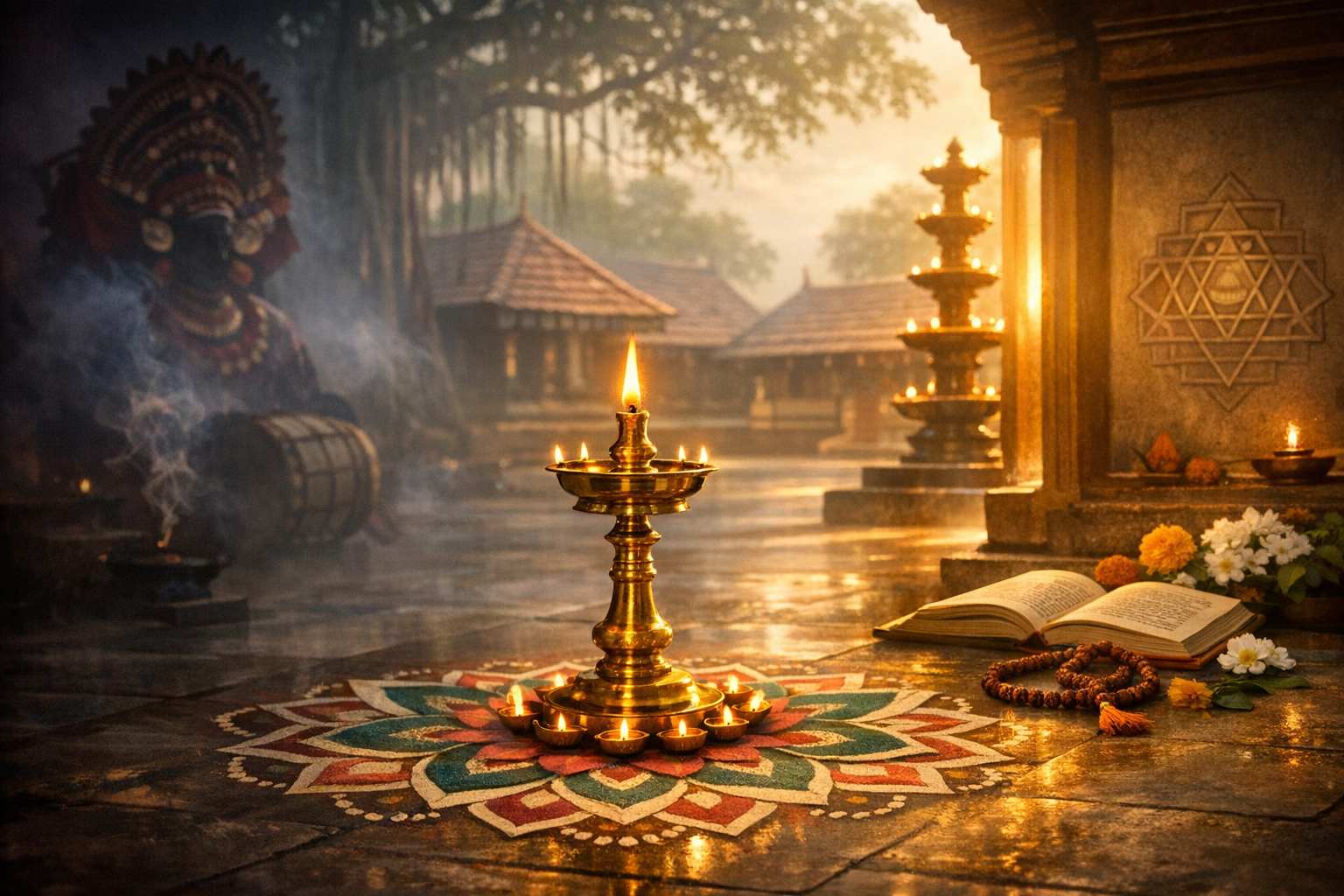
Within the richly layered ritual landscape of Kerala Tantric practice and broader Shakta Hinduism, Kuttichathan occupies a distinctive and often misunderstood place. Frequently situated in the liminal category of bhuta or daiva within folk and Tantric taxonomies, Kuttichathan is associated with fierce, transgressive energies that demand careful discernment. The question of whether Kuttichathan should be worshipped in Kali Yuga is not merely devotional; it is a matter of dharmic ethics, psychological well-being, and scriptural alignment. A balanced, respectful, and unifying approach—concerned with the welfare of individuals and communities across all dharmic traditions—therefore recommends caution and redirection toward sattvic paths that fortify inner peace and social harmony.
Regional lore presents Kuttichathan in multiple, sometimes conflicting registers. In aspects of Kerala’s Theyyam and village traditions (Kaliyattam), Kuttichathan appears as a potent chthonic presence negotiated through performance and propitiation. In other strands, Kuttichathan is conflated with or subsumed under Vishnumaya, wherein the energy is framed as protective when integrated with Agamic liturgy, temple discipline, and ethical restraints. These variations illustrate a crucial point: what is labeled “Kuttichathan” may range from spirit-propitiation practices to a lineage-sanctioned devata upasana. The prudential stance in Kali Yuga distinguishes between these contexts and guides adherents toward sattvic, scripturally consonant worship that uplifts rather than destabilizes.
Classical Hindu thought classifies beings and ritual orientations according to the three gunas—sattva, rajas, and tamas. Canonical discussions (for example, the Bhagavad Gita’s delineation of guna-conditioned food, faith, and worship) suggest that what one venerates shapes one’s inner constitution. Practices centered on fierce, tamasic entities and offerings historically associated with fear, coercion, or transactional bargaining tend to reinforce restlessness or inertia rather than clarity and compassion. For the householder in Kali Yuga—an age that Hindu texts describe as saturated with distraction and vulnerability—sattvic upasana is emphasized for its stabilizing, purifying effects on mind and conduct.
A pivotal scriptural cue comes from the Bhagavata Purana’s guidance that the dharma of Kali Yuga is best served by nama-sankirtana and devotion directed to Ishvara in accessible, non-harmful forms. This does not deny the historical presence of Tantric rituals or local deities; rather, it prioritizes a path that reliably fosters chitta-shuddhi (purification of mind), ahimsa (non-injury), and trust in the Divine without dependence on fear-based exchanges. When worship is chosen to maximize sattva, the fruits—tranquility, ethical clarity, and enduring devotion—tend to arise organically.
Tantric manuals consistently insist on adhikara (eligibility), diksha (initiation), and strict yama-niyama (ethical restraints) as non-negotiable prerequisites for working with fierce energies. Absent these, interactions with volatile forces may amplify inner conflict, intensify anxiety, and entangle the practitioner in escalating cycles of ritual obligation. In numerous reported community cases across Malabar and adjoining regions, families drawn into “Chathan seva” through promises of quick relief later described recurring demands for costly rituals, deepening fear, and a progressive loss of agency—patterns also documented by counselors and priests tasked with pastoral care.
Ethically, worship that relies on intimidation, transactional bargaining with spirits, or harmful offerings stands at odds with ahimsa and the broader dharmic goal of universal welfare. In the household context, the effects can manifest as chronic tension, interpersonal rifts, and susceptibility to manipulation by unaccountable ritual brokers. Such dynamics do not strengthen the bonds of family or society; they erode them. A unifying dharmic ethos—shared, in spirit, across Hinduism, Buddhism, Jainism, and Sikhism—places compassion, truthfulness, and self-mastery at the center of spiritual life.
This unifying thread appears in parallel advisories across dharmic traditions. Buddhist teaching emphasizes Right View and Right Intention over spirit appeasement; Jain discipline grounds itself in nonviolence and restraint, avoiding practices that inflame passions or harm; Sikh Gurus and the Rehat Maryada discourage superstition and occult reliance, urging Naam Simran and righteous living instead. Converging across traditions is a shared prudence: inner transformation and ethical living outweigh attempts to negotiate with capricious forces.
Anthropologically, Theyyam and Bhuta Kola function as culturally vital performance-rituals mediating between community memory, ecology, and metaphysical anxieties. These forms deserve preservation and respectful study. Yet, their performative negotiation with fierce entities does not automatically recommend personal devotional adoption, especially for householders seeking spiritual progress in Kali Yuga. Cultural appreciation and artistic heritage can coexist with a spiritual regimen that remains firmly sattvic and Ishvara-centered.
It is equally important to honor nuanced local theologies. Where Kuttichathan is presented as Vishnumaya within a consecrated temple tradition that follows Agamic vidhi under a bona fide lineage, the framework, discipline, and ethical commitments differ markedly from freelance spirit-propitiation. In such institutional settings, emphasis on seva, dana, satya, and ahimsa realigns practice toward sattva. The caution in Kali Yuga, therefore, is not a blanket condemnation; it is a discernment principle: prioritize worship that demonstrably purifies character, lessens fear, and unites families and communities in dharma.
From a psychological perspective, practices that promise quick control over outcomes by leveraging unseen entities can create dependency loops. Individuals may externalize agency, attributing every misfortune to displeased spirits and every success to appeasement rituals, thereby weakening resilience, accountability, and clear decision-making. Sattvic bhakti, by contrast, cultivates inner steadiness, gratitude, and constructive action—qualities repeatedly associated with better mental health and social cohesion.
Scriptural and smriti traditions repeatedly counsel that the fruits of worship indicate its quality. Where practices consistently yield agitation, compulsion, secrecy, and exploitation, the gunas involved are evident. Where they generate compassion, truthfulness, self-restraint, and fearless devotion, sattva is in ascendance. This pragmatic, results-aware hermeneutic allows householders to evaluate any path—including those associated with Kuttichathan—without disparaging communities or erasing cultural memory.
In practical terms, householders in Kali Yuga benefit from orienting worship to clear, widely attested sattvic forms: Vishnu, Shiva, Shakti in their benevolent aspects, Ganesha, Subrahmanya, Hanuman, and the Navagrahas under proper vidhi. Regular nama-japa, parayana of texts such as the Bhagavad Gita and Srimad Bhagavatam, and community-oriented seva channel spiritual aspiration into constructive, fear-free habits. These avenues have the additional advantage of being accessible, ethically transparent, and communally supportive.
For those who find themselves already involved in spirit-propitiation cycles, a gentle transition is both possible and advisable. Consultation with a qualified acharya in a recognized sampradaya can help frame appropriate prayaschitta, sankalpa, and protective practices such as Maha Mrityunjaya japa, Vishnu-sahasranama parayana, or Bhagavati seva conducted in dakshinachara modes. The goal is not rupture or fear, but a supported reorientation toward paths that demonstrably nurture clarity, kindness, and long-term stability.
Kerala’s ritual ecology itself provides sattvic alternatives: Bhagavati seva, vilakku puja, and Sri Chakra puja (when undertaken under competent guidance) can be integrated into household or temple contexts without recourse to coercive or transgressive elements. Vratas such as Ayyappa vratham, observed with yama-niyama and community discipline, have historically strengthened character and social bonds. Such practices keep the cultural matrix alive while safeguarding psychological well-being.
Where claims of “black magic,” “instant solutions,” or “guaranteed subjugation” surface, householders should exercise heightened caution. Hallmarks of unhealthy dependence include secrecy, shifting demands, threats of misfortune upon non-compliance, and the absence of transparent lineage or scriptural accountability. In contrast, dharmic practice welcomes questions, encourages ethical growth, and situates ritual within a framework of learning, service, and humility.
A helpful diagnostic for any prospective worship in Kali Yuga is the triad of pramana endorsed in many traditional teachings: shastra-pramana (is the practice consonant with scripture and the dharmic aim of chitta-shuddhi?), sampradaya-pramana (is there a recognized lineage ensuring transmission, supervision, and accountability?), and phala-pramana (do the observable fruits include lessening of fear, increased compassion, and stable ethical conduct?). If the answer trends negative, the practice warrants reconsideration.
A unifying commitment across Hinduism, Buddhism, Jainism, and Sikhism is the refusal to instrumentalize the unseen for domination or fear. Where folk and Tantric traditions engage fierce energies as part of cultural heritage, the path of household sadhana in Kali Yuga still benefits from emphasizing sattva, devotion, and service. In this way, cultural respect and spiritual safety align without stigmatizing communities or erasing living traditions.
Respectful scholarship also notes that the language around Kuttichathan—“small ghost,” “boy spirit,” or guardian—varies by locale and lineage. This plurality helps explain why blanket statements often fail. The prudential stance is not an attack on identity; it is a care-centered pathway that asks: what reliably heals the mind, harmonizes families, and deepens dharmic virtue in the present age?
In community vignettes collected by priests, counselors, and social workers, families report a notable drop in tension when they move from coercive, fear-based propitiation to daily nama-japa, satvika puja, and practical seva. Sleeping patterns improve, interpersonal trust recovers, and financial outflows toward serial “appeasements” cease. While such reports are anecdotal rather than clinical trials, their consistency across diverse settings merits attention from both spiritual guides and community leaders.
At the level of soteriology, the purpose of dharma is not merely problem-solving but the gradual unveiling of Self-knowledge through purified living. Bargaining with fierce entities, even when it appears to deliver short-term relief, often defers the deeper work of inner transformation. By orienting worship toward Ishvara with love, trust, and ethical restraint, the aspirant aligns with a current that supports both worldly stability and spiritual ascent.
The preference for sattvic practice in Kali Yuga should not be misread as cultural amnesia. Kerala’s Theyyam, Bhuta Kola, and other ritual arts are precious archives of memory and meaning. Preserving them as heritage, studying them with empathy, and situating them within an ethical frame that prioritizes non-harm and communal well-being allows tradition and transformation to coexist productively.
In light of these considerations, the guiding answer to “Why Kuttichathan should not be worshipped in Kali Yuga” is measured and compassionate: because worship that leans on fear, coercion, or volatile propitiation is misaligned with the needs of an already challenging age. Sattvic devotion, by contrast, safeguards mental health, fosters family unity, and advances the dharmic aim of inner clarity. This counsel respects regional diversity while affirming a shared dharmic commitment to kindness, truth, and restraint.
For practitioners who hold Kuttichathan as Vishnumaya within recognized temple lineages, the emphasis remains on Agamic compliance, ethical commitments, and service that uplifts community life. Where such integration demonstrably increases sattva, reduces fear, and cultivates virtue, it stands apart from coercive spirit-bargaining. Even here, transparent guidance, scriptural literacy, and accountability are essential safeguards.
Ultimately, the future of dharmic life in Kali Yuga is secured not by multiplying negotiations with the unseen, but by deepening the visible bonds of compassion, discipline, wisdom, and shared celebration. The many paths within Hinduism—and the sister traditions of Buddhism, Jainism, and Sikhism—converge in this vision. By prioritizing sattvic worship and unity-minded ethics, devotees honor both the ancients and the yet unborn.
A succinct principle helps anchor this orientation: Guru–Shastra–Sadachara. Receive guidance from qualified teachers, confirm it in scripture, and live it through ethical conduct. Applied to the question of Kuttichathan in Kali Yuga, this triad tilts clearly toward worship practices that lessen fear, deepen love of the Divine, and harmonize home and society.
In conclusion, caution regarding Kuttichathan worship in Kali Yuga is not an indictment of culture; it is an invitation to a safer, kinder, and more luminous practice. It encourages households to embrace the many sattvic avenues open to them—nama-japa, scriptural study, temple worship, and seva—so that the timeless promise of dharma remains a living reality: inner peace, mutual respect, and shared flourishing.
Inspired by this post on Hindu Blog.





Leave a Reply
You must be logged in to post a comment.