
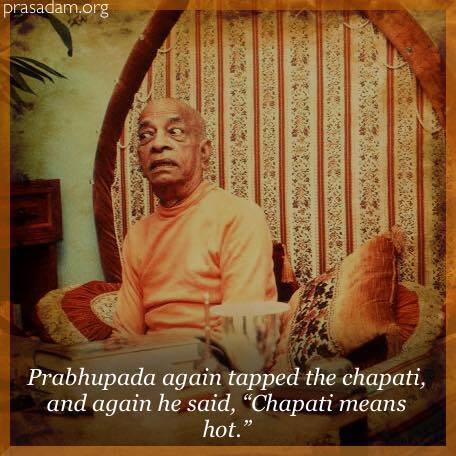
During a visit to Madras (Chennai), a simple kitchen exchange crystallized a precise standard for both culinary craft and devotional service. Srila Prabhupada, spending nights at a life member’s home and days at the temple, was to be served a meal prepared by the local devotees. Sravanananda das, who had not previously cooked for Srila Prabhupada, deferred to Harikesh to manage the stove while he managed the service. What followed became a concise instruction in technique, timing, and the ethics of offering: when the first roti was presented, Srila Prabhupada touched it and stated, “Chapati means hot.”
In the effort to meet that exacting standard, Sravanananda das repeatedly traversed the marble floor—nearly sliding in urgency—between the tawa and Srila Prabhupada’s seat. Each time the chapati was served, Srila Prabhupada tapped it and reiterated, “Chapati means hot.” On the next attempt, Harikesh produced a fully puffed chapati—“like a puri”—and as it was placed on the plate and gently pressed, steam visibly escaped. Srila Prabhupada responded, “Ahhh, that is chapati.” The episode is remembered precisely for its clarity: temperature, texture, and immediacy are not incidental; they define the offering.
The instruction “Chapati means hot” carries layered significance in Indian culinary practice and devotional etiquette. In household and temple kitchens alike, chapati (roti) is considered optimal at the moment it leaves the tawa or direct flame, when latent steam keeps the crumb tender and the surface supple. Temperature is not merely a sensory preference but a quality parameter that correlates with internal moisture distribution, softness, and flavor release. In the context of seva, serving food at its peak—fresh, appropriately hot, and promptly—is an expression of care, discipline, and respect for the person being served and, in devotional settings, for the sanctity of the offering itself.
From a technical standpoint, the puffing of chapati is a predictable steam-driven phenomenon that indicates correct dough development and heat management. Properly milled whole-wheat atta (with medium-fine granulation) is hydrated in the typical range of approximately 58–62 percent by weight, then kneaded to develop a cohesive gluten matrix without overworking. After a rest of 20–30 minutes, evenly rolled discs—neither too thin at the edges nor thick at the center—are placed on a preheated tawa. The first side sets in roughly 20–30 seconds, the second side completes partial gelatinization and protein coagulation in another 30–45 seconds, after which brief exposure to direct flame or a hotter zone of the pan creates a rapid temperature gradient. The expanding water vapor separates the top and bottom sheets, yielding a ballooned chapati. When the bread is gently pressed, the escaping steam confirms ideal internal doneness. This is why a properly puffed chapati—served immediately—presents both softness and a delicate, fragrant wheat aroma.
Heat, in this context, is also a proxy for timing and hygiene. Serving chapati while hot limits staling by retarding starch retrogradation in the critical first minutes post-cooking and preserves pliability. It also aligns with long-standing norms in Indian kitchens emphasizing immediacy and freshness for staple breads. The brief window in which chapati is at its peak is precisely when devotional service asks for attentiveness: the interval between tawa and plate should be minimized so that the recipient experiences the bread as intended—“hot,” alive with aroma, and texturally complete.
These details of technique and timing resonate across dharmic traditions. In Vaishnava practice, sattvic cooking and the timely offering of prasadam underscore purity, intention, and care. In Sikh langar, the continuous preparation of hot rotis ensures that every guest, irrespective of background, receives fresh food as an act of equality and service. In many Jain households, the emphasis on daytime preparation and freshness intertwines with ahimsa-informed discipline around food. In Buddhist monastic settings, meals are offered and received with similar mindfulness for timing, simplicity, and respect. The common thread is clear: warmth and freshness express dignity, hospitality, and devotion.
Consistent results in chapati rely on a few keystone practices. Hydrate and knead the atta until smooth and elastic, then rest the dough to relax gluten so rolling remains uniform. Roll with even pressure to avoid thin rims that resist puffing. Cook on a sufficiently hot tawa; a pan that is too cool dries the surface without setting structure, while a pan that is excessively hot scorches before the crumb develops. Flip promptly to prevent moisture loss, then finish with direct flame or an intensified heat zone for rapid expansion. If desired, a light brush of ghee immediately after puffing enhances aroma and mouthfeel while preserving softness. Most critically, serve without delay, allowing the guest to experience the gentle pressure, faint hiss of steam, and singular tenderness that define a correctly made chapati.
The comparison “like a puri” in this anecdote highlights visual puff rather than method. A puri is deep-fried and structurally distinct due to oil-mediated heat transfer and crust formation; a chapati is dry-cooked and puffs primarily through steam separation within a lean, unleavened dough. Although both can appear inflated, chapati should settle into a soft, flexible round once steam releases, whereas puri holds a crisper, oil-fortified shell. Understanding this distinction clarifies why visible puff and escaping steam are diagnostic of chapati quality without implying any need for frying.
The phrase “Chapati means hot” has long functioned in Indian households as a concise standard of care—akin to the everyday refrain “garam garam roti.” It encodes both science and sentiment: the physics of steam, gluten, and heat gradients; the sensory ideal of aroma, pliability, and warmth; and the ethics of timely, respectful service. In this ISKCON episode from Madras, the lesson reads as a compact syllabus in culinary precision and devotional mindfulness. A single tap on a chapati, a wisp of escaping steam, and a brief, approving remark—“Ahhh, that is chapati”—together convey the union of craft and consciousness that dharmic traditions, in their diversity, consistently uphold.
Inspired by this post on Dandavats.









Leave a Reply
You must be logged in to post a comment.