
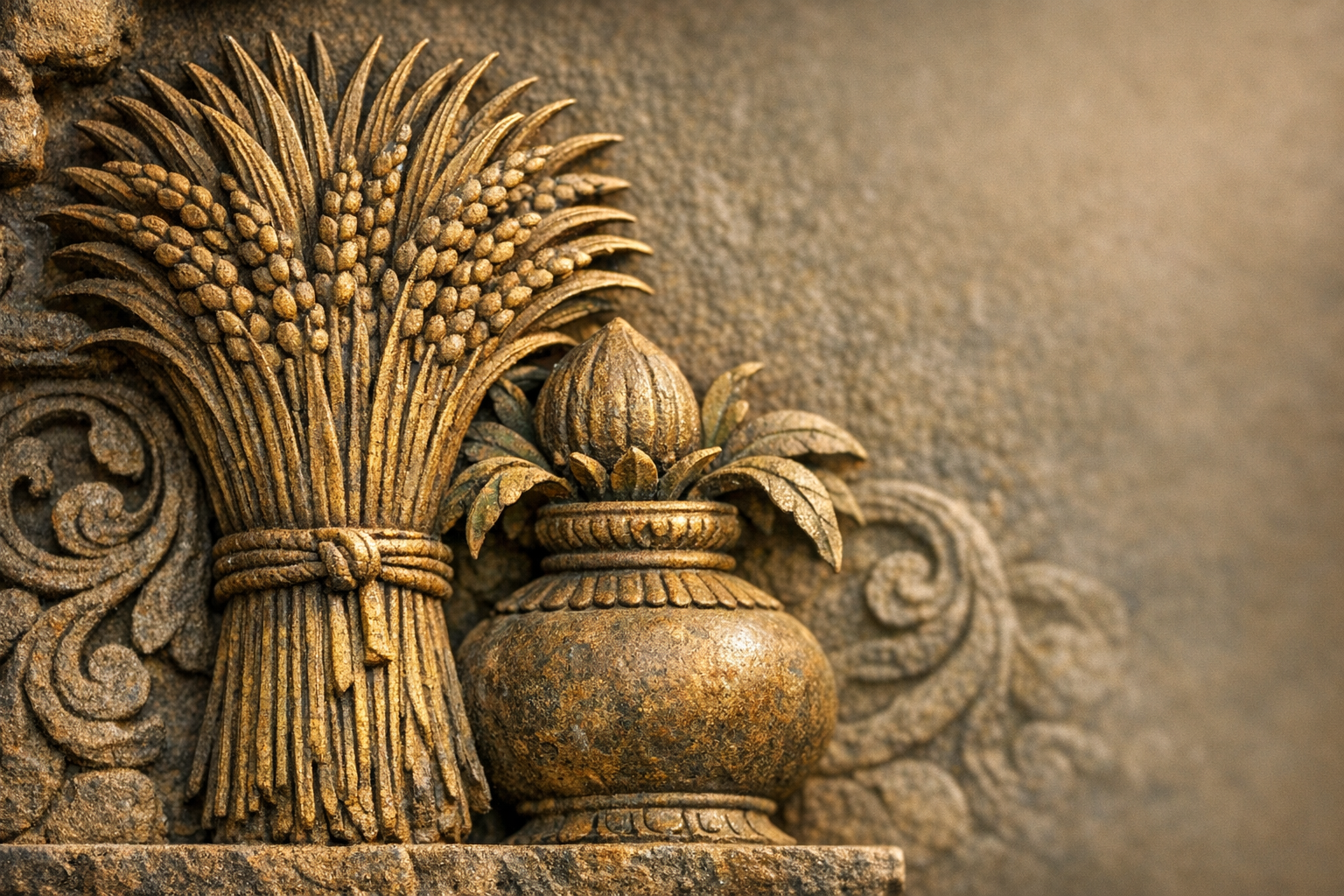
Among the quiet yet resonant emblems of Hindu iconography, the patra—rendered as a bound sheaf of leaves, grass, or paddy—embodies nourishment, purity, and auspicious plenty. Often appearing in temple sculpture and ritual art, this modest bundle distills a complex visual theology into a single, graspable form: the lived experience of agrarian abundance sanctified as spiritual grace.
Defined most clearly as a tied sheaf (patra sheaf), the motif is sometimes glossed in textual and craft lineages alongside terms such as patra-puṭa, where patra denotes leaf and puṭa a packet or wrap. While patra can also signify a vessel (pātra) or even a palm-leaf letter in Sanskrit usage, sculptural contexts privilege the vegetal sense: leaf, blade, or stalk gathered and bound. The result is an iconographic shorthand for “gifts of the earth” that are ritually pure (śuddha) and life-sustaining.
The patra sheaf is widely read as a sāttvika sign. In the triadic language of guṇas, sattva signals clarity, balance, and luminance. A sheaf of dhānya (grain), fresh leaves, or consecrated grasses naturally encodes these qualities: it nourishes without violence, renews with every season, and invites stillness through ritual intention. In sculpture, the bound bundle thus becomes an emblem of spiritual economy—abundance aligned to restraint, wealth tempered by reverence.
Texts and ritual manuals supply the semantic scaffolding for this reading. The śrauta and gṛhya sūtras carefully prescribe kuśa (darbha) grass for seating, cordoning, and sanctifying space; the practice persists wherever Vedic homa and saṁskāras endure. The Bhagavad-Gītā crystallizes the offering logic—“patram puṣpam phalam toyaṁ yo me bhaktyā prayacchati”—linking the simplest vegetal gifts to the highest devotion. In every case, vegetal purity and intentionality bind the act, much as the cord binds the patra bundle.
Across the pantheon, the sheaf converges most clearly with deities of earth, sustenance, and fortune. Regional Lakṣmī images—especially Dhānya-Lakṣmī—display grain or stylized paddy as a visual thesis on prosperity. Bhūdevī, as earth herself, is frequently paired with agrarian symbols, while Annapūrṇā’s iconography orbits the alchemical equation of food and freedom from fear. In these settings, the patra sheaf functions as a compact, tactile sign of auspicious yield.
Two ritual grasses deepen the motif’s theological range. Durvā (Cynodon dactylon), offered to Gaṇeśa, is famed for resilience and quick regeneration—qualities that suit the remover of obstacles. Kuśa (Desmostachya bipinnata), prescribed for vows and rites, marks purity and thresholding; it literally insulates sacred time from the mundane. When sculptors bind such forms into a sheaf, they stage the meeting point of rite, ecology, and icon.
Eastern Indic traditions contribute distinctive harvest grammars to the sculptural record. In Bengal and Odisha, Lakṣmī’s seasonal worship and domestic rites (e.g., Manabasa Gurubara in Odisha) emphasize paddy as the quintessence of dhānya. The Shākta festival cycle, with practices such as Navapatrikā, binds multiple plants into a single deity-directed presence; though liturgical, the practice also informs local visual culture, encouraging artisans to model bundled vegetal forms as carriers of śrī (radiant prosperity).
Parallel resonances surface in cognate Dharmic streams. In Buddhism, the Bodhisattva’s acceptance of kuśa grass from a cutter before enlightenment sacralizes grass as both seat and sanctuary; this sensibility informs Buddhist art, where vegetal purity frames the Buddha’s awakening. In Jain contexts, the ubiquitous pūrṇa-ghaṭa (full vase) with sprouting foliage—often flanking Jina imagery—stands as a non-violent emblem of fullness and ethical prosperity. Sikh traditions celebrate Vaiśākhī as the turn of the agrarian year, affirming the dignity of labor and harvest; while aniconic in theology, the lived aesthetics of grain-laden celebration speak to the same civilizational intuition honored by the patra motif: that the earth’s yield, honored ethically, is a pathway to the divine. Together, these convergences secure the patra sheaf as a unifying agrarian-sacred symbol across Hinduism, Buddhism, Jainism, and Sikhism.
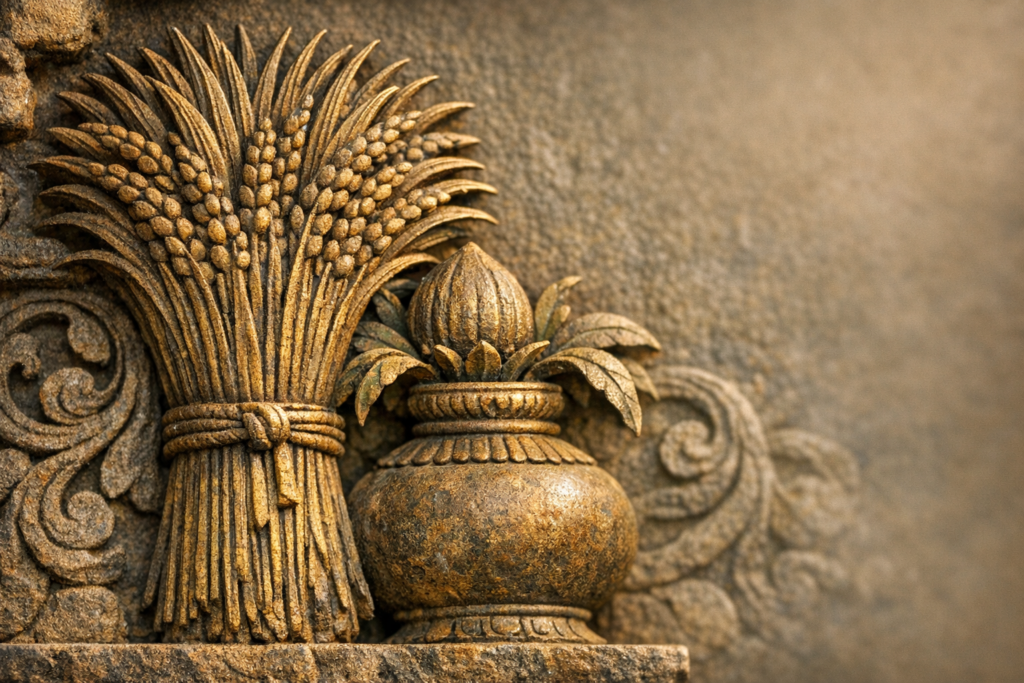
For connoisseurs and museum-goers, the sculptural “diagnostics” of a patra sheaf are consistent. Look for a cluster of parallel, tapering elements (grass blades or paddy stalks) cinched by a visible band near the grip or midpoint. In stone, artisans incise shallow grooves to suggest individual stalks; in bronze, they vary thickness to convey natural irregularity. Where the subject is paddy, granular nodal beading may indicate rice kernels along the rachis; grass sheaves tend to appear sleeker, with a pronounced bound waist and flaring tips.
The patra often appears in three placements: as a held attribute (hasta) in a deity or attendant’s hand; as an offering bundle on a pedestal or threshold panel near a pūrṇa‑ghaṭa; or as a border or frieze motif interleaved with vines, parrots, and kalāśas. In paired compositions—Gaja‑Lakṣmī, for example—elephants flank the goddess while vegetal plenitude pools below her, sometimes stylized into compressed sheaves or sprouting vessels.
Sculptural schools interpret the sheaf in line with medium and milieu. Chola and post‑Chola bronzes emphasize rhythmic flow—the sheaf reads as a lyrical counterpoint to arm and drapery. Western Deccan stones tend toward denser, beadlike paddy rendering embedded in kalāśa ensembles. Eastern Indian reliefs give the grain fuller architectural presence, aligning the sheaf with thresholds and door guardians. In every case, artisans translate agriculture’s physics—weight, strand, bind—into a liturgy of line.
Ritual practice sustains the motif’s semantic depth. Harvest festivals—Pongal in Tamil Nadu, Onam in Kerala, and regional autumnal rites in the east—elevate new grain, decorate thresholds, and bless tools. Sculptural sheaves mirror these ground-level acts, preserving in stone and bronze what households enact in clay and straw: gratitude disciplined through rite, and plenty tempered by humility.
A philological note clarifies adjacent terminologies often met in art-historical catalogs. Patra (leaf) differs from pātra (vessel), yet sculptural programs commonly stage them together: the patra sheaf lies beside or rises from the pātra-kalāśa. In technical literature (rasa and āyurveda), patra‑puṭa denotes a leaf-packet technique for heating or processing—a reminder that the civilizational value of bound leaves encompasses ritual fire, medicinal transmutation, and artistic signification alike.
Philosophically, the sheaf transposes the ethics of stewardship into a visual vow. Binding multiplies into one without erasing the many—an imagistic lesson in loka‑saṅgraha (holding the world together). The patra sheaf is thus less an “object” than a condensed ethic: gather carefully, bind responsibly, offer gratefully.
A curatorial checklist helps distinguish the patra from look‑alikes. When compared to a lotus bouquet, the sheaf lacks the terminal blooms or seed pods; when adjacent to floral scrolls, it shows a cinched waist rather than continuous vine. Against martial attributes (e.g., triśūla), the sheaf exhibits parallel organic strands rather than symmetric weapon geometry. And when paired with pūrṇa‑ghaṭa motifs, the sheaf reads as harvested, not merely sprouting.
Conservation and documentation benefit from attention to micro-details. On weathered sandstone, the binding band often survives as a shallow ridge even when stalk incisions are lost; on bronze, patina variation between “cord” and “stalk” can index handling patterns from ritual processions. Photographic raking light can recover faint grooves that confirm a patra identification where frontal lighting fails.
The motif also mediates threshold symbolism. Household doorways across regions display mango‑leaf toranas for auspiciousness; in parallel, sculpted patra bundles at temple thresholds ideate the same liminal blessing for communities at scale. Passing beneath a stone sheaf reiterates an old compact: enter with reverence, depart with restraint.
Regionally inflected meanings add nuance without fracturing unity. In the Tamil country, Agrarian plenty threads into goddess cults and Murugan’s hill‑temple ecologies; in Odisha, lakṣmī‑dhānya linkages suffuse domestic and royal ritual; in Bengal, paddy’s golden hue colors Shākta seasonal rites; in Maharashtra and Gujarat, kalāśa‑centric ensembles fold sheaves into a denser auspicious grammar. The shared substratum is unmistakable: vegetal plenitude sanctified through dharma.
In pedagogical and comparative frames, the patra sheaf provides a lucid bridge across Dharmic traditions. It never compels uniformity; rather, it recognizes diversity of practice—Hindu pūjā with durvā and kuśa, Buddhist memory of the kuśa seat, Jain non-violent abundance in the pūrṇa‑ghaṭa, Sikh celebration of agrarian cycles—and reads them as consonant articulations of a single civilizational ethic: reverence for life-sustaining grain and plant.
For students of Hindu sculpture and temple architecture, the patra sheaf rewards close looking. It invites attention not only to what deities hold but to what communities value; not only to stylistic schools but to seasonal economies; not only to aesthetics but to ethics. In this sense, the sheaf is both icon and index—of a society that bound its prosperity to its conscience.
Ultimately, the patra in Hindu art is a small, steadfast teacher. It counsels that plenitude is most beautiful when gathered without greed, bound without violence, and offered without pride. To recognize this bundle in stone or bronze is to overhear a civilizational whisper: holiness often arrives as a handful of grass, a fist of paddy, a leaf held lightly—and shared.
Inspired by this post on Hindu Blog.









Leave a Reply
You must be logged in to post a comment.