
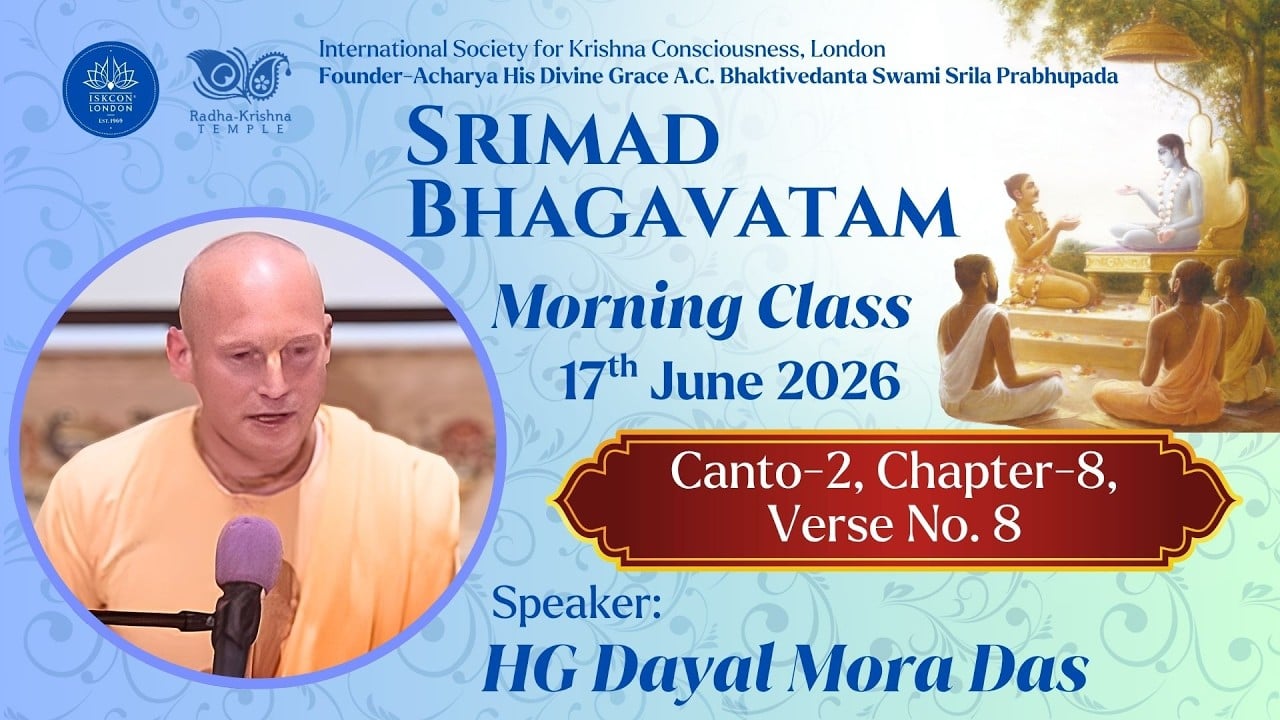
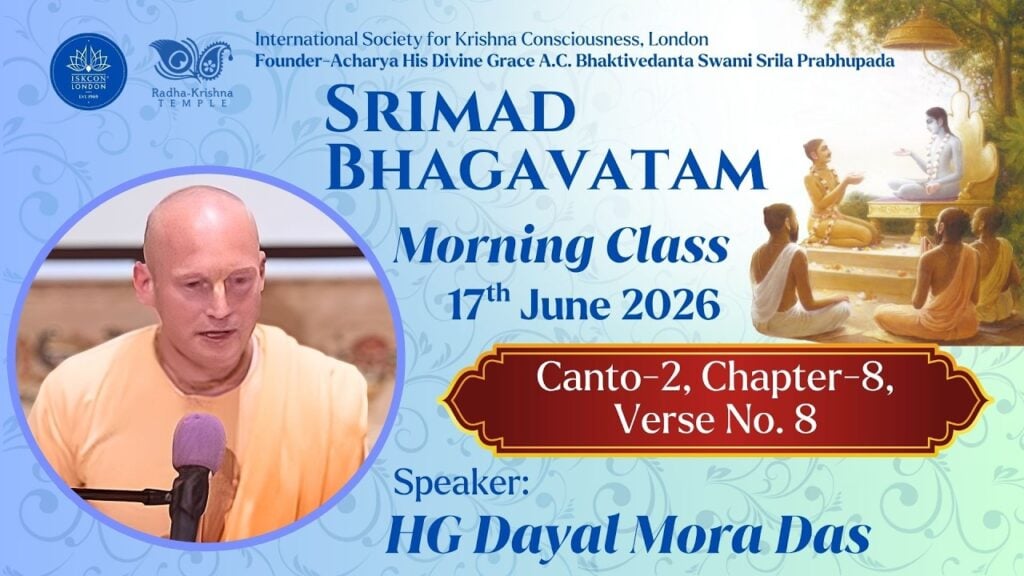
On Wednesday, 17 June 2026, the ISKCON London Radha-Krishna Temple hosted a focused exposition on Srimad Bhagavatam 2.8.8 delivered by HG Dayal Mora Das. Anchored in the living tradition of the Bhagavata Purana, the session situated a single verse within the conceptual architecture of Canto 2, Chapter 8 (“Questions by King Parikshit”), drawing out how disciplined inquiry prepares consciousness for bhakti-yoga and end-of-life remembrance of Sri Krishna.
In Canto 2, Chapter 8, Maharaja Parikshit organizes a comprehensive syllabus for knowledge at the threshold of death. The chapter’s sequence gathers cosmology, theology, and practice into a single arc: the universal form (virat-rupa), the divisions of time (kala), the structure of planetary systems (lokas), the processes of creation (sarga and visarga), the cycles of stewardship (manvantaras), and the Lord’s manifestations (avataras). Within this scaffold, Srimad Bhagavatam 2.8.8 functions as a node that directs the listener toward method—systematic hearing (sravana), contemplation (manana), and remembrance (smarana)—so that knowledge culminates in devotion rather than abstraction.
Drawing from Gaudiya Vaishnava commentarial method, the class highlighted the pedagogy of questions. Pariprashna—well-formed, coherent questioning—structures revelation. As in Bhagavad-gita 4.34, inquiry under guidance transforms uncertainty into clear practice. King Parikshit’s questions do not wander; they progressively narrow the field from the vast to the actionable, ensuring that metaphysical vision becomes a practical map for daily sadhana.
The soteriological center of the discussion was bhakti as a hearing-led path. Sravanam-kirtanam visnoh smaranam—hearing, glorifying, and remembering Visnu—organize consciousness around what is permanent. The emphasis on attentive hearing was presented not merely as sentiment but as a cognitive discipline that reconditions attention, reduces ruminative loops, and stabilizes affect. In this respect, the Bhagavata’s praxis resonates with cross-dharmic patterns: Buddhist sati and maranasati (mindfulness and mindfulness of death), Jain samayika (equanimity practice) and pratikramana (ethical recollection), and Sikh simran (remembrance of the Divine Name) all exemplify how recollection reframes the horizon of meaning.
Epistemologically, the Bhagavata integrates pratyaksha (direct perception), anumana (inference), and above all sabda (authoritative testimony). The parampara principle—knowledge transmitted through guru, sadhu, and sastra—anchors interpretation so that devotion avoids vagueness. The class described how sabda does not cancel empiricism; rather, it orients empirical and inferential efforts within a value-laden cosmos where consciousness is primary and the telos of inquiry is transformation.
On cosmology, the lecture situated sarga (primary creation) and visarga (secondary creation) as explanatory categories rather than mere chronology. The multi-tiered lokas were read as a sacred cosmography that doubles as moral psychology: vertical gradations educate desire and responsibility, while horizontal cycles (yugas, manvantaras, kalpas) teach humility about civilizational rise and fall. Such frames are pedagogical, inviting readers to correlate inner ecology with cosmic order.
Avatar-tattva—understanding the Lord’s descents—was presented as a practical theodicy. By narrating avatara functions—protection, restoration of dharma, pedagogic revelation—the Bhagavata connects historical memory with ethical confidence. Hearing avatara-katha thus purifies cognition (citta-suddhi), strengthens trust (sraddha), and generates a resilient orientation to service amid contingency.
With end-of-life practice in view, the class distilled a four-part protocol for marana-smarana aligned with Srimad Bhagavatam 2.8.8’s methodological thrust: stabilize the breath and posture (asana and mindful respiration), anchor attention in sabda via nama-japa and kirtan, contemplate the Lord’s form, qualities, and pastimes (rupa-guna-lila dhyana), and express surrender through service intention (seva-sankalpa) directed to all beings. This sequence reframes dying as the consummation of a lifetime of practice rather than a final emergency.
Translating principle into routine, the discourse mapped a daily sadhana blueprint: a fixed hearing window for Bhagavata Purana recitation; reflective journaling to consolidate insights; kirtan to entrain breath, voice, and affect; seva that aligns knowledge with compassion; and a brief end-of-day recollection rehearsing the end-of-life protocol. The aim is not intensity for its own sake but steadiness (nistha) that allows grace to reshape character.
The unifying spirit of Sanatana Dharma was carefully affirmed. While centered on Srimad Bhagavatam 2.8.8, the class drew respectful parallels across Hinduism, Buddhism, Jainism, and Sikhism, underscoring unity in spiritual diversity. Shared commitments to ethical discipline, mindful recollection, and compassionate service indicate a family resemblance among dharmic paths. Such recognition strengthens intertradition harmony without diluting the distinct gifts of each lineage.
Several technical terms were clarified to support accurate reading: virat-rupa (universal form perceived through the macrocosm), kala (hierarchies of time from ksana to kalpa), sarga and visarga (primary and secondary creation), manvantara (epochs under Manus), and loka (planes of existence). Precision in terminology prevents category errors and allows a coherent dialogue between Puranic thought and contemporary philosophy of science.
Hermeneutically, the class favored a both-and approach over literal-vs-symbolic binaries. Puranic narrative carries multiple registers—historical memory, metaphysical instruction, ethical pedagogy, and aesthetic rasa. A reader trained to ask Parikshit-like questions can move among these registers without confusion, letting each enrich practice and insight.
Situated within the Bhagavata’s lineage of transmission—from Veda Vyasa to Sukadeva Gosvami to Suta and onwards—the session acknowledged the Gaudiya Vaishnava contribution to making the text globally accessible. That accessibility, however, was framed not as triumphalism but as stewardship: to hear responsibly, live gently, and serve inclusively.
In the cosmopolitan setting of London, the ISKCON Radha-Krishna Temple offers a locus for community learning where diaspora Hindus and friends of the tradition can engage scripture academically and devotionally. Such classes cultivate shared vocabulary, deepen cultural literacy, and create a compassionate commons attentive to the plural dharmic landscape of contemporary life.
In sum, the Srimad Bhagavatam 2.8.8 class by HG Dayal Mora Das combined textual rigor with contemplative clarity. By locating a single verse within a grand architecture of questions and practices, the discourse offered timeless answers and clear methods, inviting seekers across dharmic traditions to remember the Divine with steadiness, serve with humility, and live with unshakable hope.
Inspired by this post on Dandavats.







Leave a Reply
You must be logged in to post a comment.