
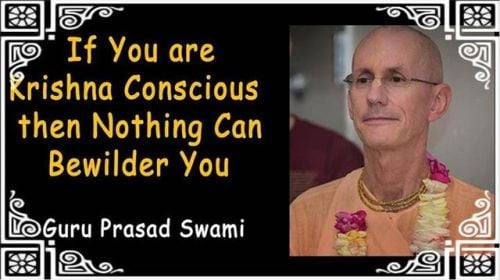
Guru Prasad Swami's succinct assertion—"If you are Krishna conscious then nothing can bewilder you"—captures a central promise of the bhakti tradition: a consciousness anchored in Krishna provides unshakable clarity amidst life's volatility. Presented in the context of a Srimad Bhagavatam class within the ISKCON community, the message aligns with a classical Vaishnava thesis that spiritual remembrance (smarana) stabilizes cognition and emotion, thereby transforming confusion (moha) into discernment (viveka). This exploration distills that thesis into a practical, scriptural, and cross-traditional framework designed to illuminate how Krishna consciousness fosters resilient, ethical, and compassionate living.
In Gaudiya Vaishnavism and the wider Vaishnava tradition, Krishna consciousness is not a transient mood but a sustained orientation of the mind, intellect, and will toward Krishna. It synthesizes philosophical insight (tattva-jñana), devotional practice (sadhana-bhakti), and daily conduct (ācāra) into a cohesive way of life. The state is not mere belief; it is a cultivated awareness that pervades perception, decision-making, and relationships. In classical terms, the heart (citta) becomes progressively purified (śuddhi) when the mind is redirected from sensory turbulence to the divine center, enabling a stable form of attention and purpose.
The Bhagavatam analyzes bewilderment (moha) as a function of misidentification—confusing the temporary for the permanent, the peripheral for the essential. In that analysis, maya is not simply illusion but a misalignment of priorities and perception. Krishna-centered awareness recalibrates this hierarchy: the eternal becomes the reference point by which the fleeting is understood and ethically integrated. This does not negate worldly responsibilities; rather, it clarifies them through buddhi-yoga—the disciplined use of intelligence in harmony with devotion—so that choices reflect long-term well-being and dharmic responsibility.
Operationally, the tradition identifies nine interrelated practices that cultivate and maintain Krishna consciousness: hearing about Krishna (śravaṇam), chanting and recitation (kīrtanam and japa), remembrance (smaraṇam), worship (arcana), prayer (vandana), service (dāsya), friendship (sakhya), and self-offering (ātma-nivedana). Each practice trains a distinct psychological capacity—sustained attention, affect regulation, value alignment, and moral courage. When coordinated, these disciplines produce a robust internal architecture that resists confusion by continuously realigning thought and conduct with a theistic telos.
Daily sadhana translates theology into lived clarity. A representative regimen in ISKCON settings includes regulated mantra meditation (japa of the Hare Krishna maha-mantra), congregational kirtana, study of Bhagavad-gita and Srimad Bhagavatam, taking sanctified food (prasadam), and seeking guidance from a bona fide guru within a community of practice (satsanga). The method is cumulative: repetition strengthens neural and behavioral pathways, scripture refines the interpretive lens, prasadam sanctifies consumption, and community feedback prevents blind spots. Over time, the result is not rigidity but responsive steadiness—flexibility with a center.
Canonical texts consistently associate Krishna consciousness with equanimity and fearlessness. The Bhagavad-gita emphasizes acting from a centered state rather than from agitation; it teaches even-mindedness amid dualities, purposeful engagement without attachment to results, and the repeated redirection of the wandering mind back to a divine anchor. The Srimad Bhagavatam extends this by depicting exemplars who, remembering Krishna, remain lucid in crisis. The shared conclusion is empirical and verifiable: remembrance reorganizes attention, modulates reactivity, and clarifies ethical priorities.
This clarity is not sectarian. Dharmic traditions converge on the insight that unconfused awareness arises by consistent remembrance of the ultimate and the practice of compassion. Buddhist mindfulness disciplines attention and reveals the impermanence of mental states; Jain samyak-darśana and ahiṁsā cultivate right vision and non-harming; Sikh Naam Simran centers life on the Divine Name and service (seva). Krishna consciousness, with its stress on loving remembrance and service, moves in the same moral and contemplative current. The shared ethos—discipline, compassion, truthfulness, and non-violence—underscores a unity of purpose across Hinduism, Buddhism, Jainism, and Sikhism, even where metaphysical vocabularies differ.
Contemporary research in contemplative science lends additional texture to this classical map without substituting for it. Regular mantra practice has been associated with enhanced attentional control and reduced mind-wandering; breath-synchronized recitation can downshift sympathetic arousal and promote parasympathetic tone; devotional affect may recruit pro-social motivation and resilience under stress. While the language of neuroscience is descriptive rather than normative, its observations harmonize with bhakti-yoga’s long-standing claim: structured remembrance changes how the brain prioritizes signals, enabling wiser choices under pressure.
Common obstacles are well known and addressable. Inattentive chanting disperses the intended focus; mechanical ritual reduces living practice to routine; intellectual pride resists correction; excessive isolation deprives one of the balancing effect of community feedback. Tradition-specific correctives include mindful articulation during japa, study that links doctrine to application, vigilant avoidance of offenses (aparādha) in speech and conduct, and regular association with advanced practitioners who model humility and steadiness. The goal is quality over mere quantity: fewer well-focused rounds of japa can transform the day more than many distracted ones.
Ethically, Krishna consciousness expresses itself as service-centered living. When the self is situated in remembrance, empathy becomes the natural posture rather than a sporadic effort. Family life, professional responsibilities, and civic duties are then approached as arenas of seva. Decisions emphasize fairness, non-harm, and truthfulness; consumption patterns become simpler and more sustainable; speech becomes more careful and compassionate. In this way, inner non-bewilderment manifests externally as coherent, values-aligned action.
Consider a relatable scenario: under abrupt workplace pressure, reactive habits typically trigger anxiety, blame, or hasty decisions. A practitioner grounded in remembrance pauses, chants softly or mentally, recalls scriptural guidance on duty and even-mindedness, and consults a trusted mentor if time allows. Within minutes, the mind shifts from turbulence to task clarity, recalibrating action to principles rather than panic. The outcome is not only better performance but also a preserved conscience and healthier relationships.
For those seeking a practical blueprint, a five-pillar framework can be effective: (1) Hearing and study: designate a daily window for Srimad Bhagavatam and Bhagavad-gita study with note-taking to convert insight into intention; (2) Chanting discipline: fix a japa quota and quality metric (audibility, posture, attention); (3) Association: schedule weekly satsanga, including kirtana and discussion, to strengthen accountability; (4) Service alignment: match personal skills to concrete seva at home, work, and community; (5) Reflection and course-correction: maintain a weekly review to observe triggers, celebrate wins, and refine the coming week’s practices. This structure translates high ideals into measurable habits.
Importantly, Krishna consciousness is not emotional suppression. The tradition encourages fully felt experience guided by remembrance. Grief, joy, frustration, and hope are honored as human realities, but none is allowed to hijack discernment. The anchor is devotion; the process is disciplined remembrance; the fruit is a luminous steadiness that can meet complex realities without denial or despair.
In synthesis, Guru Prasad Swami’s statement reflects a testable path rather than a slogan. When consciousness is centered on Krishna through the integrated disciplines of bhakti-yoga—hearing, chanting, remembrance, worship, prayer, service, friendship, and surrender—bewilderment yields to clarity. The promise stands in harmony with the wider dharmic consensus that disciplined remembrance and compassion transform perception and conduct. In a fragmented world, such God-centered steadiness does not withdraw from responsibility; it refines it, turning every circumstance into an opportunity for lucid, loving action.
Inspired by this post on Dandavats.









Leave a Reply
You must be logged in to post a comment.