
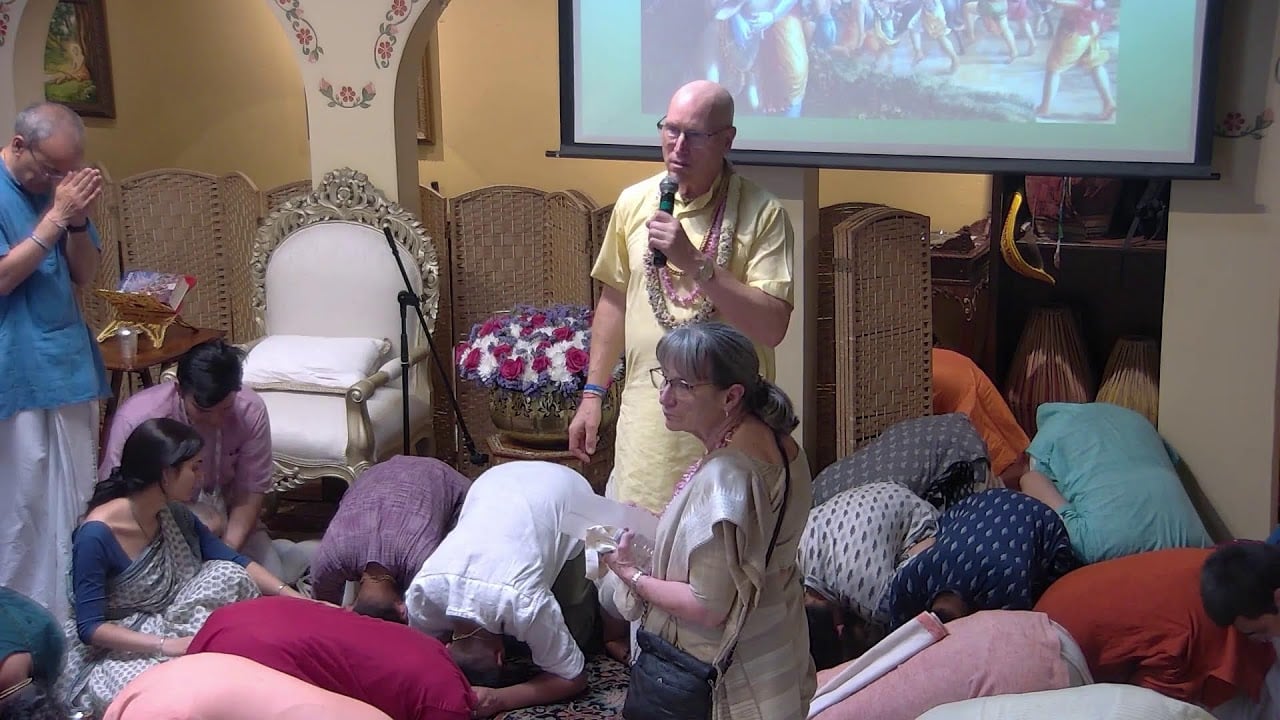
On 31 May 2026, ISKCON Silicon Valley (ISV) hosted a Krishna Katha by H.H. Radhanath Swami that examined, with doctrinal clarity and pastoral sensitivity, why hearing (śravaṇa) and chanting (kīrtana) of Krishna’s names, instructions, and pastimes form the mainstay of devotional service (bhakti-yoga). Set against the demanding rhythms of Silicon Valley, the presentation located bhakti as a precise, repeatable, and community-sustaining practice that cultivates serene attention, ethical purpose, and spiritual belonging.
Krishna Katha, in the Gaudiya Vaishnava tradition, is not merely storytelling; it is a rigorous method of theological remembrance (smaraṇa) in which narrative, mantra, and instruction converge to shape consciousness. Drawing from the Bhagavad-Gita and the Srimad Bhagavatham, the discourse underscored how sacred sound functions as a disciplined pathway of devotion, inviting sustained engagement rather than occasional inspiration. In this lens, words, melodies, and communal participation operate as instruments that refine perception and stabilize intention.
The scriptural foundations are unambiguous. Bhagavad-Gita 9.14 depicts practitioners as “always chanting My glories,” and 9.34–18.65 consolidates remembrance and loving devotion as the heart of yoga. The Srimad Bhagavatham (1.2.6–7) articulates the telos of the path—steady devotion to the transcendent Lord and the swift growth of causeless knowledge and detachment through bhakti. The nine processes of devotion (navadhā-bhakti) enumerated in the Bhagavata tradition—śravaṇa, kīrtana, smaraṇa, pāda-sevana, arcana, vandana, dāsya, sakhya, and ātma-nivedana—establish hearing and chanting as first principles that inform and animate all others.
Within this framework, śravaṇa and kīrtana are not optional embellishments but the methodological core. Hearing stabilizes attention in revealed wisdom; chanting externalizes devotion and aligns breath, voice, and intention. Together, they form a self-reinforcing loop: attentive hearing refines the quality of chanting, and heartfelt chanting deepens the receptivity of hearing. The session emphasized that when these practices are pursued consistently and humbly, they restructure daily life around remembrance rather than distraction.
Nama-sankirtana centers on the maha-mantra—Hare Krishna Hare Krishna Krishna Krishna Hare Hare Hare Rama Hare Rama Rama Rama Hare Hare—which Gaudiya Vaishnavas revere as both prayer and presence. Practically, japa employs a mālā of 108 beads to organize repetition and sustain concentration, while congregational kīrtana introduces musical call-and-response that invites shared rhythm, emotional resonance, and service (seva) to others through sound. The devotional mood is paramount; efficacy is located in sincerity, humility, and consistency rather than mere quantity of recitation.
Classical Gaudiya texts (e.g., Rūpa Goswāmī’s Bhakti-rasāmṛta-sindhu) describe a developmental arc—from śraddhā (initial faith) to sādhu-saṅga (association), bhajana-kriyā (regulated practice), anartha-nivṛtti (clearing of hindrances), niṣṭhā (steadiness), ruci (taste), āsakti (attachment), bhāva (emotionally realized devotion), and prema (pure love). The Katha situated hearing and chanting as catalysts for this trajectory, incrementally replacing agitation with clarity and softening the heart for service-centered relationships.
Insights from contemporary research on repetitive sacred sound across traditions align with long-observed devotional outcomes: studies indicate reductions in mind-wandering, improvements in attentional control, and markers consistent with parasympathetic activation during mantra practice. While such findings do not exhaust the theistic meaning of nāma, they illuminate how a practice refined over centuries coheres with what is known about breath, rhythm, and focused repetition in shaping mental states toward calm alertness.
Musically, kīrtana integrates melody, tempo, and instrumentation (mṛdaṅga and karatālas are common in the Hare Krishna movement) to translate philosophy into felt experience. As the assembly alternates response with lead, the room becomes an ecosystem of support, where the courage to focus is socially amplified. Listeners frequently describe a gentle shift from fragmentation to coherence, as if attention, breath, and intention relearn how to move together.
Epistemically, the Gaudiya Vaishnava path orients itself through guru, sādhu, and śāstra. Guidance received from a qualified teacher (guru) is harmonized with the realizations of saintly practitioners (sādhu) and grounded in scriptural testimony (śāstra). The Katha highlighted a practical ethic—humility, gratitude, and service—that H.H. Radhanath Swami routinely emphasizes in public teachings. Such virtues are not rhetorical accessories; they are the safeguards that keep technique from overpowering purpose.
Importantly, this presentation resonated with a broader dharmic unity. The centrality of the Divine Name in Sikh “Naam Simran” and kīrtan, the role of mantra recitation in Buddhist and Jain traditions (e.g., the Namokar Mantra), and the plural pathways affirmed within Sanatana Dharma collectively demonstrate that sacred sound is a shared civilizational technology of remembrance. The Katha’s spirit therefore aligns with interfaith respect and the blog’s objective: unity among Hinduism, Buddhism, Jainism, and Sikhism without erasing their distinctive insights.
Practical integration was framed in accessible terms: designate a consistent time (brahma-muhūrta if possible), adopt a simple posture that allows unforced breathing, begin with attentive japa before transitioning to singing, and close with quiet listening to internalize meaning. Even brief, regular sessions can anchor a day otherwise shaped by rapid switching and digital noise. In family or community settings, short kīrtanas followed by a few sentences from Bhagavad-Gita or Srimad Bhagavatham help couples, children, and elders share a common center of gravity.
In Silicon Valley’s high-cognition, high-velocity environment, participants often report a relatable arc: restlessness gives way to steady breath, which yields to a felt clarity about priorities and relationships. The devotional idiom names this reordering as remembrance—a shift from self-preoccupation to service, from control to trust, and from isolation to community. Such experiential accounts, while personal, cohere with the theological claim that sacred sound re-educates attention toward the Divine and, by extension, toward compassionate action in society.
Krishna Katha at ISV thus illuminated an elegant synthesis: narrative theology, sacred sound, and communal practice working together to produce inner resilience and outward empathy. By offering śravaṇa and kīrtana as disciplined, inclusive, and scripturally grounded practices, the session affirmed a vision in which diverse dharmic traditions find common cause in remembrance, ethical service, and the cultivation of peace.
Inspired by this post on Dandavats.








Leave a Reply
You must be logged in to post a comment.