
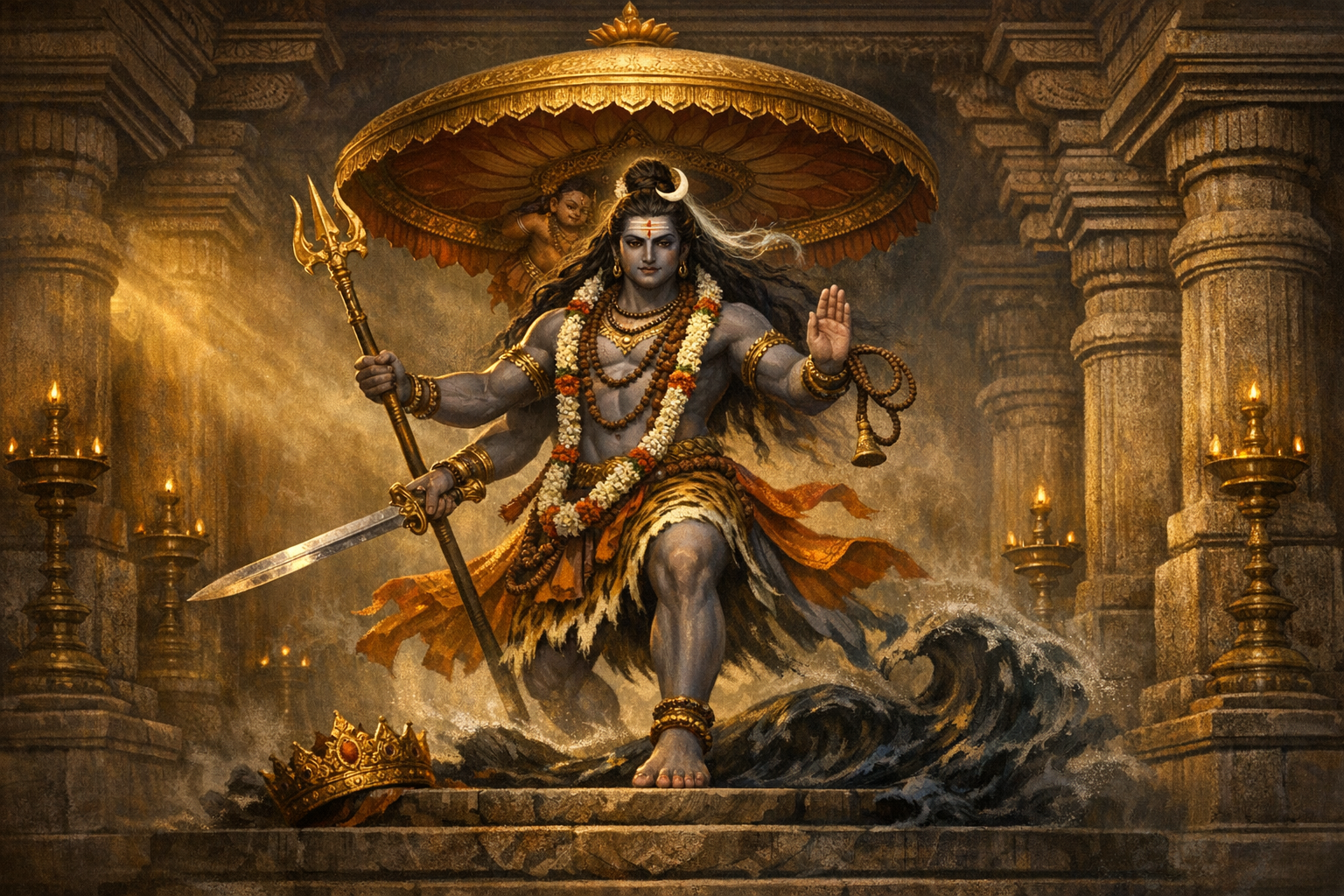
Among South Indian Temples and the wider Shaiva canon, one of the most arresting yet seldom-seen manifestations is the Jalandhara Samhara form of Shiva, occasionally associated with a regal chatra (parasol). This rare iconography compresses theology, royal symbolism, and ritual memory into a single, compact image that departs markedly from the familiar Nataraja, Lingodbhava, and Dakshinamurti forms.
Textual memory situates Jalandhara Samhara within the Puranas, notably the Shiva Purana and allied narratives, where Jalandhara (Jalandharāsura) arises as a formidable asura whose power is sustained by the ascetic fidelity of his consort Vrinda. The episode culminates in Shiva’s victory once that protective merit is dissolved, underscoring a recurrent Puranic motif: cosmic order (dharma) reasserts itself when unbalanced might is divested of its ill-gotten supports.
Theologically, Jalandhara Samhara renders Shiva as the sovereign who restores equilibrium. The form brings together kshatra-dharma (righteous protection), raudra (the fierce mode as a function of compassion), and anugraha (grace) into a single frame. When a chatra is included, it marks not only triumph but also ethical sovereigntyvictory as stewardship rather than dominance.
Agamic and Shilpa Shastra prescriptions (such as those found across the Shaiva Agamas and texts like the Mayamata, Manasara, and Shilparatna) attest that Samhara murtis of Shiva are dynamic: the body may be set in a forceful stance, the visage composed yet intense, and the hands equipped with weapons like the trishula (trident), khadga (sword), pasha (noose), or parashu (axe). In Jalandhara Samhara, the composition often implies confrontation and resolution; the asura’s defeat is conveyed through motion, gesture, and the arrangement of attributes rather than overt gore or hyperbole. When a chatra appears, it may be held by Shiva, depicted above as a canopy, or borne by a ganaeach variant signaling the same theological point: the Lord’s victorious, sheltering presence.
The chatra (parasol) itself is a potent pan-Indic emblem. In classical Indian regalia, the chatra denotes vijaya-lakshanaroyal triumph and protection. In visual-semiotic terms, its curving canopy doubles as a micro-architecture of grace, a sky-like vault offering shade that metaphorically cools the heat of adharma. As such, when aligned with a Samhara murti, the chatra recodes ferocity as guardianship: might is yoked to responsibility.
Cross-dharmic resonances reinforce this meaning. In Buddhism, the parasol is one of the aṣṭamaṅgala signifying the royal protection of the Dharma; in Jainism, Tirthankara images frequently receive a multi-tiered umbrella that marks reverence and transcendence; in Sikh tradition, ceremonial honor to the Guru Granth Sahib includes regalia with cognate functions of veneration and protection. Within Hinduism, therefore, Shiva’s chatra can be read as a shared civilizational language of ethical sovereignty and shelteran image that nurtures unity across the dharmic family of traditions.
As a cultic presence, Jalandhara Samhara is rare on sanctum pedestals but may appear as a utsava or festival image, or as a narrativized panel in temple sculpture cycles. In South India, where Shaiva Siddhanta and Agama-based worship are deeply rooted, this form is thematically compatible with festivals that foreground protection, victory, and the renewal of cosmic order. Processional contextsBrahmotsavams, specific alankara days, or themed samhara representationsare the most likely moments to encounter the parasol-bearing variant.
In material culture, securely identified Jalandhara Samhara icons with an explicit chatra are scarce, reflecting both their theological specialization and the selectivity of temple commissions. South Indian bronze and stone ateliersespecially those influenced by Chola, Pandya, and Hoysala traditionsdeveloped sophisticated Samhara idioms, yet the parasol-bearing specification appears infrequently. Museum catalogues sometimes subsume such images under broader labels like “Combat Shiva” or “Samharamurti,” contributing to their under-recognition in secondary literature.
Identification in the field benefits from a careful iconographic checklist. Elements to watch for include: a dynamic martial stance; the presence of primary Shaiva weapons; a subordinate, vanquished antagonist or implied adversary; and the unmistakable inclusion of a chatra either held, canopied overhead, or carried by an attendant. Even where the asura is not rendered explicitly, the cumulative cues of motion, weaponry, and the parasol’s royal register strongly indicate Jalandhara Samhara with Chatra.
Comparative analysis clarifies its distinctiveness. Nataraja celebrates cyclical creation, preservation, and dissolution through dance; Lingodbhava articulates Shiva’s unboundedness as the axis of reality; Dakshinamurti embodies silent instruction beneath the sacred banyan. Jalandhara Samhara with Chatra, by contrast, is a triumphant field-image: the Lord as restorer of order after a specific moral and cosmic challenge, crowned by the emblem of protective sovereignty.
Ritual hermeneutics amplifies this reading. Abhishekam and alankaram accentuate the transition from conflict to calm: fierce attributes are balanced by cooling unguents, white garlands, and the dignifying canopy of the chatra. In this choreography of worship, the parasol serves as a liturgical instrument, symbolically shading the community beneath Shiva’s grace even as it proclaims victory over disorder.
For many visitors and devotees, the experience of this form is affectively immediate. The umbrella evokes shelter on a scorching day; the victorious stance communicates safety after uncertainty. Seen together, these signals invite contemplative trust: power tempered by compassion, motion stilled into peace, and personal anxieties reframed under a larger arc of dharma. Such responses illustrate how iconography accomplishes what texts describe, translating theology into a felt sense of assurance.
From a Shilpa Shastra perspective, the chatra also operates as a compositional device. It anchors verticality, draws the gaze to the upper register, and creates a ceremonial axis above the crowned head. In doing so, it echoes the temple vimana’s superstructure at micro-scale, reinforcing the notion that the deity is enthroned beneath a cosmic canopy, and the devotee stands within a nested architecture of protection: sanctum, hall, temple-town, and sacred landscape.
Scholarly caution is warranted when mapping textual prescriptions to surviving images. Agamic families differ, regional workshops innovate, and sthala-puranas (local temple legends) sometimes guide specific attributes. Where catalogues are ambiguous, triangulation is useful: compare weapons and posture with Samharamurti norms, check for narrative markers of Jalandhara, and assess whether a chatra is integral (not merely a generic canopy). Cross-reading Puranas, Agamas, and workshop conventions typically yields the most reliable identifications.
This form’s relevance extends beyond art history. As a symbol-set, Jalandhara Samhara with Chatra speaks to ethical leadership, protective strength, and community resiliencevalues celebrated across Hinduism, Buddhism, Jainism, and Sikhism. The parasol’s shared language of shelter invites a capacious understanding of sovereignty: guardianship of people, places, and practices, in which victory is measured by the flourishing of all under its shade.
For those exploring South Indian Temples, practical steps support meaningful encounters with such rare icons. Inquire whether the temple maintains a Samharamurti among its utsava murthis; observe festival schedules where narrative alankaras rotate; and consult priestly or sthala-purana notes that may record local traditions around Jalandhara Samhara. Small sub-shrines, sculpted temple plinths, and processional pavilions often preserve iconographies that are not on daily view.
The research horizon remains open. Despite references in Puranas and Agama literature, few comprehensive surveys focus on Jalandhara Samhara with Chatra specifically. Collaborative documentationepigraphic study, high-resolution imaging, and comparative cataloguing across temple sites and museumswould aid conservation and interpretation. Such work strengthens cultural heritage stewardship while deepening understanding of Shaiva iconography’s internal diversity.
In sum, the Victorious Lord with the ChatraShiva in the Jalandhara Samhara formoffers a compact theology of protection: fierce in response to disorder, yet crowned by the emblem of shade and grace. It is rare precisely because it is exacting: a precise answer to a precise challenge. Where it appears, the image crystallizes a remarkably inclusive message drawn from the dharmic tradition’s shared vocabularypower pledged to compassion, sovereignty pledged to shelter, and victory pledged to the well-being of all who live beneath its canopy.
Inspired by this post on Hindu Blog.
