
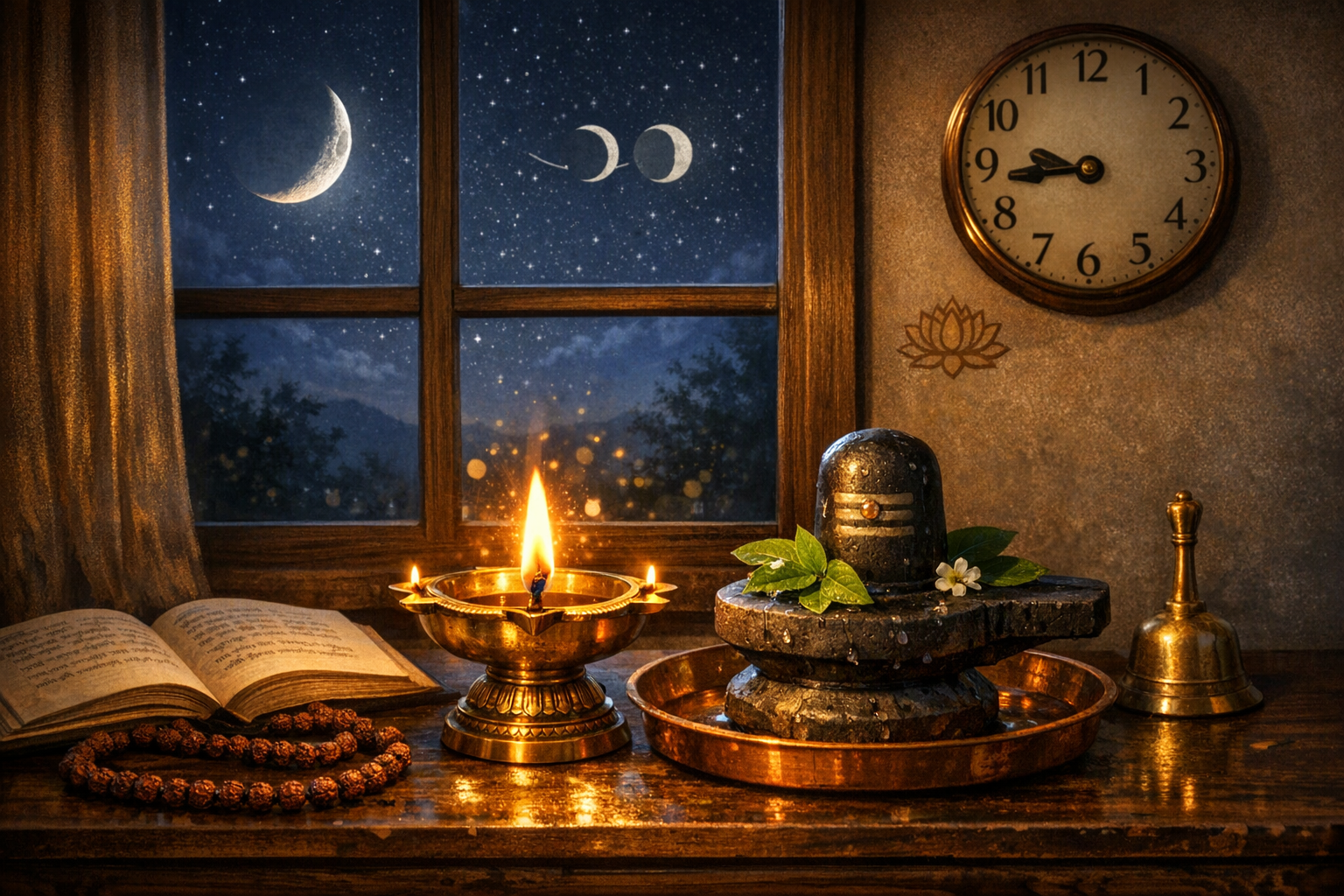
On Monday, June 8, 2026, the Panchang notes Krishna Paksha Ashtamithe eighth lunar day of the waning phaseprevailing until approximately 9:48 PM in most regions. After this time, the lunar day transitions to Krishna Paksha Navami (the ninth tithi of the dark fortnight). Regional almanacs may show minor variations due to longitude, latitude, and calculation method, but the Ashtami-to-Navami shift late in the evening is the broadly attested framework in the Hindu calendar.
Reading this date through the classical Panchang lens involves five core elements: Tithi (lunar day), Nakshatra (lunar mansion), Yoga (a specific angular sum of Sun and Moon), Karana (half-tithi segment), and Vāra (weekday). The weekday here is Somavāra (Monday), traditionally associated with Soma/Chandra (the Moon), which lends a contemplative, mind-centered quality to practice and decision-making. While this overview focuses on the confirmed tithi sequence, Nakshatra and Rashi for the Moon are location- and time-sensitive and should be verified with a trusted regional Panchang for precision.
The spiritual tenor of Krishna Paksha Ashtami is frequently described as inward-facing. Many householders and practitioners experience the waning fortnight as supportive of reflection, forgiveness, and resolution of lingering tasks. Monthly observances such as Masik Kalashtamivows associated with reverence to Bhairavaare often aligned with this tithi, and the coincidence with Somavāra can deepen Shaiva-oriented worship (e.g., Abhishekam to Shiva, japa of the Mahamrityunjaya Mantra, and silent meditation).
As the evening approaches and the tithi changes to Krishna Paksha Navami after about 9:48 PM, many ritual decisions follow standard Dharmaśāstra principles regarding Udaya-tithi (the tithi present at sunrise) versus special-kāla observances. In general, vows and fasts anchored in the daytime often privilege the sunrise tithi, whereas certain nighttime observances look to the Nishita or tithi present at the relevant night segment. For this date, those observing a monthly Ashtami vrata would ordinarily complete primary daytime worship before the tithi shifts, while general daily sādhanā may continue seamlessly after Navami commences.
Within the wider Dharmic family, cyclical lunar observances emphasize shared rhythms of restraint, mindfulness, and ethical commitment. In Buddhist practice, the Uposatha tradition anchors observance to the four phase-points of the lunar month (new moon, first quarter, full moon, last quarter), which broadly resonate with Ashtami and other tithis. In Jain traditions, fasting on the eighth lunar day (Aatham) is widespread among many communities as a monthly discipline of purity and self-restraint. Sikh households, while primarily following the Nanakshahi calendar, frequently emphasize daily Simran, Paath, and Seva; these practices harmonize naturally with the contemplative ethos of a waning-moon Monday. Such convergences model unity in diversity across Hinduism, Buddhism, Jainism, and Sikhism.
For planning “Good Time” windows, two practical tools are both rigorous and accessible: the midday Abhijit Muhurat and pre-dawn Brahma Muhurta. Abhijit Muhurat is centered on the local solar noon; a widely used convention takes a 48-minute span straddling the exact midpoint of daylight (approximately 24 minutes on either side), suitable for tasks requiring clarity and resolve. Brahma Muhurta, beginning roughly 1 hour 36 minutes before sunrise, is prized for meditation, japa, and study; its quietude is particularly consonant with the introspective tone of the waning fortnight.
When evaluating avoidance periods, traditional practice references Rahu Kalam, Yamaganda, and Gulikai. The daylight interval from sunrise to sunset is divided into eight equal parts; Rahu Kalam occupies a weekday-specific segment (on Mondays, it commonly falls in the second division). Because the actual clock times depend on local sunrise and sunset, computations should be performed for one’s exact location and season. The same proportional approach applies to Yamaganda and Gulikai, which are likewise derived from equal daylight divisions and mapped by weekday.
Nakshatra and lunar Rashi (Chandra Rashi) on June 8, 2026, will vary with time and place. The Moon’s sign is central to many personal rituals: if the transit Moon coincides with a person’s natal Moon sign (Janma Rashi), traditions recommend heightened steadiness in speech and mind, emphasis on mantra, and avoiding overextension. Those engaged in regular japa may find Somavāra especially conducive for Om Namah Shivaya or the Chandra Beeja sound to stabilize the mind’s reflective qualities.
Practical home worship on Krishna Paksha Ashtami commonly includes a simple deepa offering, water oblation, and quiet reading from the Bhagavad-Gita, Shiva Purana, or Bhagavata Purana. Many households choose satvik meals, reduce sensory overload (noise, screens), and schedule essential decisions in alignment with known auspicious windows. Charity (dāna)for example, food or essentials to the needyharmonizes well with the waning phase’s ethic of letting go and service.
Those seeking a methodical approach to the day’s timing can follow a straightforward sequence: (1) obtain precise local sunrise and sunset, (2) compute total daylight and divide into eight equal segments for Rahu Kalam, Yamaganda, and Gulikai, (3) locate solar noon for the 48-minute Abhijit Muhurat, and (4) identify the pre-dawn Brahma Muhurta for contemplative practice. The same discipline can be paired with reputable ephemerides for Nakshatra, Yoga, Karana, and Moon’s Rashi, which refine personal and household decisions.
An academic note on calculation traditions is useful for context. Panchang data today may be generated by classical Surya Siddhānta parameters or by modern (drik) astronomical solutions; for most devotional purposes, the minor differencestypically minutesdo not impede practice. What matters most is internal consistency: consult one reliable system for a given location and follow it steadily, especially for vrata start/end (parāṇa) determinations.
From a household perspective, Somavāra lends itself to mental clarity and gentle discipline. Many find that a short period of mindful breathwork at dawn, a mid-day check-in to honor Abhijit Muhurat, and a screen-light evening meal prior to the tithi shift support the day’s rhythm. After the transition to Krishna Paksha Navami, light reading or mantra recitation sustains continuity without overexertion.
If a vrata is observed on Ashtami, end-of-fast guidelines should follow the rule traditionally prescribed for that specific vow, with parāṇa typically scheduled after sunrise when the next tithi is in effect, unless the vrata explicitly requires night-based completion. When in doubt, practitioners are encouraged to consult their family tradition, community elders, or an authoritative regional Panchang.
For those who track Rashi-specific devotional acts, Somavāra’s lunar association suggests soothing, cooling, and stabilizing themes: donation of white foods (rice, milk), offering bilva leaves or water to a Shiva linga, and cultivating compassionate speech. These simple practices align with the moon-governed mind and the waning fortnight’s ethic of quiet refinement.
In the spirit of unity across the Dharmic traditions, the shared lunar cadence on this date can be honored through common threads: ethical restraint, mindful consumption, study of wisdom texts, and remembrance of the sacred. Whether the discipline takes the form of puja, japa, Uposatha precepts, Jain fasting on Aatham, or Sikh Simran and Seva, the outcome is a coherent practice ecosystem that respects diversity while celebrating a common quest for inner steadiness.
Summary for planning: June 8, 2026 observes Krishna Paksha Ashtami until about 9:48 PM, then shifts to Krishna Paksha Navami. Align significant daytime tasks with known auspicious windows like Abhijit Muhurat, and compute local avoidance periods (Rahu Kalam, etc.) from actual sunrise and sunset. Emphasize reflection and restraint, deepen daily practice, and let the evening transition mark a gentle pivot from completion to renewal.
Inspired by this post on Hindu Blog.
