Sardula Samhara Murti presents Shiva in a formidable yet profoundly instructive form: the Tiger‑Slayer of Darukavana. As one of the Samhara Murtis of Mahakala, this icon does not celebrate destruction for its own sake; rather, it embodies the dissolution of falsehood, rigidity, and the egoic crust that can form around ritual pride. In this vision of Shiva, the act of “slaying” is a theological and psychological unbindingan event aimed at avidyā (ignorance) and ahaṅkāra (ego), not at living beings.
The name itself encodes the teaching. Śārdūla (tiger) evokes unregulated instinct and ferocity; Saṁhāra denotes dissolution; and Mūrti signifies a visualized, pedagogical presence. In both textual memory and temple art, Sardula Samhara is carefully distinguished from Gaja Samhara Murti (the elephant‑hide bearer) and from sectarian polemics associated with “Sarabha Samhara.” Here, the narrative and iconography focus on Shiva’s subjugation of the tiger sent by the ritualist sages of Darukavana, a scene that culminates in wearing the tiger skin as a sign of mastery over the inner beast.
The Darukāvana episode, preserved across Purāṇic and Āgamic retellings as well as regional temple lore, recounts how ascetics in a sacred forest, renowned for their tapas and yajña, drifted into ritual self‑importance. Shiva appeared among themoften as Bhikṣāṭana, the mendicantaccompanied by Uma, to expose the brittleness of piety without humility. Provoked, the sages conjured a tiger; Shiva subdued it effortlessly, flaying the apparition and adopting its hide. They sent serpents; he made them ornaments. They raised Apasmāra, the dwarf of forgetfulness; he pressed it beneath his dancing foot. Through this sequence, the myth’s target becomes unmistakable: not living beings, but the mind’s delusions and the arrogance attached to outward observance.
Within this narrative, the “ego of ritual pride” emerges as the core antagonist. The episode does not reject ritual; it critiques ritualism emptied of inner transformation. This emphasis resonates across dharmic traditionsHinduism, Buddhism, Jainism, and Sikhismeach of which recognizes that form must serve realization. Where rites align with compassion, insight, and truth, they uplift; where they harden into status or power, they obscure the very goal they were meant to reveal.
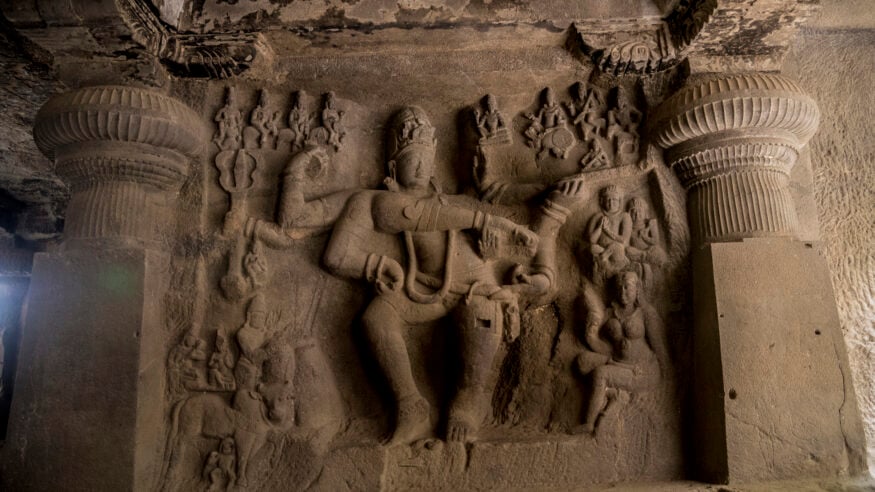
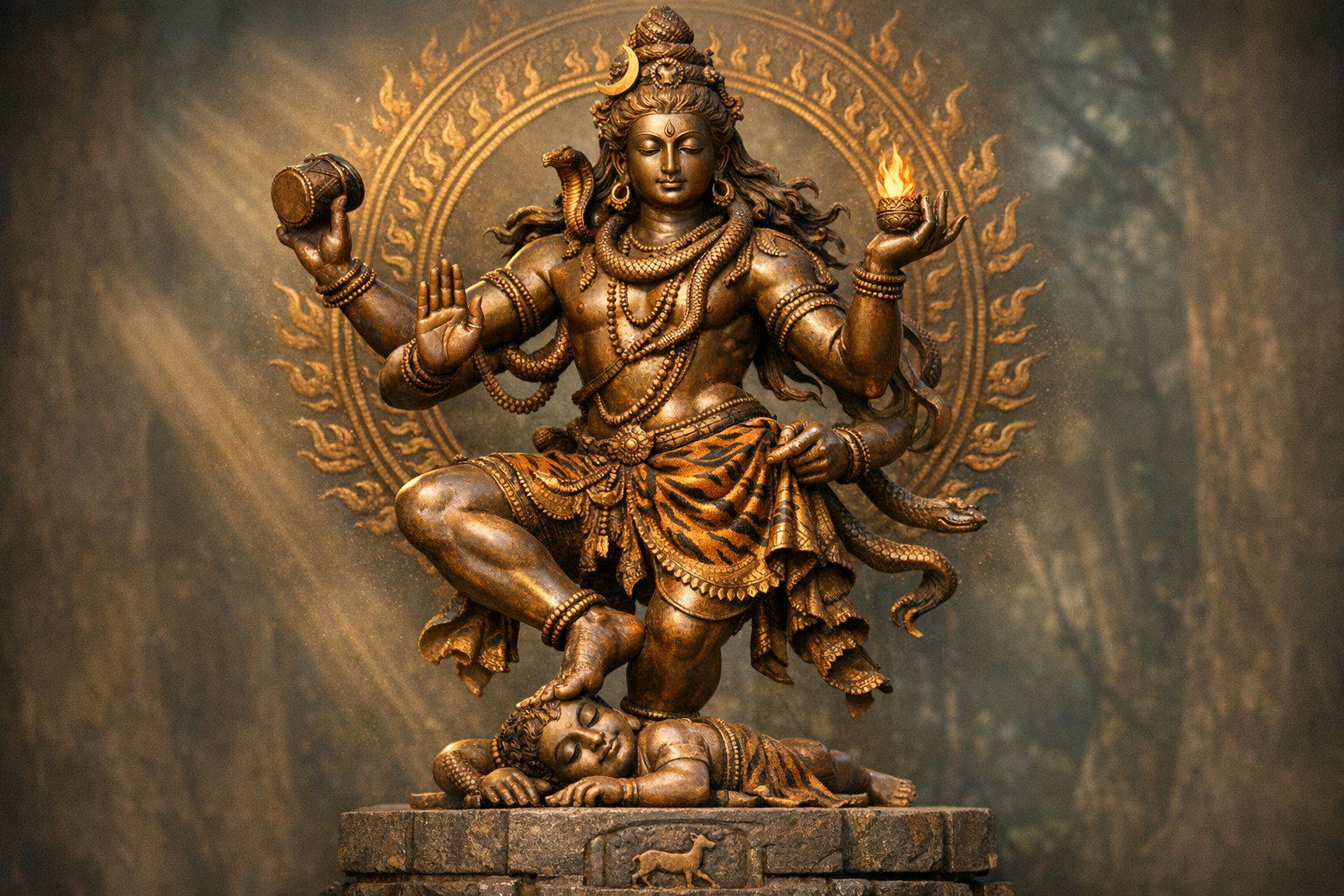
Iconographically, Sardula Samhara Murti draws on the visual grammar also seen in Shiva Nataraja. Regional canons (Śaiva Āgamas and Śilpa Śāstras) allow multiple variants: two to eight arms are attested across media; the stance may be dynamic, evoking tāṇḍava, or poised in a balanced tribhaṅga. Common attributes include the ḍamaru (cosmic rhythm), agni (transformative fire), and the abhaya gesture (fearlessness). The tiger hide may be clasped, draped, or spread as an āsana; serpents appear as ornaments or as the sacred yajnopavīta; the dwarf Apasmāra can be shown beneath the foot, emphasizing knowledge’s triumph over nescience.
Each element carries a distinct semiotics. The tiger signifies untamed instinct and the conceit that power or ritual prowess guarantees liberation; its hide on Shiva’s body proclaims those forces mastered and sublimated. The serpents index prāṇa, time, and awakened vigilance. The ḍamaru articulates the pulse of sṛṣṭi and saṁhāracreation and dissolutionwhile agni is the clarity that consumes dross. The restrained deer (mṛga) in allied forms allegorizes the mind’s skittish attention, steadied by yogic insight. Apasmāra, literally “forgetfulness,” marks the amnesia of first principles; under Shiva’s foot, it becomes a reminder that ignorance is displaced not by brute force but by luminous awareness.
Philosophically, Sardula Samhara Murti exemplifies one strand of Shiva’s pañcakṛtyathe five cosmic functions: sṛṣṭi (emanation), sthiti (sustenance), saṁhāra (dissolution), tirobhāva (concealment), and anugraha (grace). Saṁhāra in this key is not annihilation; it is the precise removal of obstructions to truth. That is why the scene so often coexists with the bliss‑dance, Ānanda Tāṇḍava: when the false falls away, the Real shines without impediment.
Textual and ritual frameworks in the Śaiva Āgamas guide consecration and worship of such murtis through upacāras that parallel Nataraja liturgies: abhiṣeka, alaṅkāra, dīpa, and the cyclical emphasis on rhythm and light. While early descriptions speak of vyāghra‑carma (tiger‑skin) seats in ascetic settings, contemporary practice ethically employs cloth representations, affirming ahiṁsā. The continuity of form coexists with the evolution of means, allowing symbolism to retain integrity while honoring compassion.
Historically, the icon’s language appears in early cave reliefs, Pallava and Chola bronzes, and later South Indian temple sculpturecontexts in which the Darukavana cycle, Bhikṣāṭana, and Nataraja motifs interweave. Across the Tamil region in particular, the narrative furnished artists with an opportunity to depict swift, rhythmic movement, complex drapery, and the dramatic contrast between feral energy and yogic poise. Beyond the subcontinent, allied Shiva imagery at Angkor and related sites preserves the same grammar of dissolution as renewal.
For devotees and visitors, the darśan of Sardula Samhara Murti often evokes an immediate affective arc: awe at the ferocity of the scene resolves into relief at its meaning. Many temple‑goers describe a palpable stillness the moment the symbols are “read.” The mind recognizes that the slaying is inwardof vanity, aggression, and spiritual posturingand that the triumphant trophy is humility worn as natural raiment.
As a focus for dhāraṇā, this murti lends itself to stepwise contemplation. Practitioners trace the ḍamaru to feel breath and rhythm, meditate on agni to kindle discernment, and visualize the tiger‑skin as the mind’s unrefined energies resting, finally quiet, upon the ground of awareness. Such meditation echoes Yogic and Vedāntic insights and aligns with the ethical core shared across dharmic traditions: mastery of the self precedes any claim to mastery of truth.
Cross‑tradition resonances reinforce this unity. In Buddhist idioms, Mahākāla functions as a compassionate, protective dissolution of obstacles to awakening; in Jain thought, triumph over kṣāyas (anger, pride, deceit, greed) parallels the tiger’s subjugation; in Sikh teachings, overcoming haumai (ego‑selfing) aligns with the fall of ritual conceit. Read this way, Sardula Samhara Murti illuminates a shared civilizational message: the path to freedom is the relinquishment of inner violence, not the projection of force outward.
Clarity also demands precise distinctions. Gaja Samhara Murti dramatizes the flayed elephant hide and emphasizes a different narrative complex; Sardula Samhara recognizes the tiger of Darukavana and the critique of ritual arrogance. Both forms are Samhara expressions and both terminate in anugrahagracesince the removal of impediments is incomplete without the bestowal of insight.
In contemporary life, the “tiger” may appear as status seeking in spiritual spaces, the urge to display learning, or a dependence on form without inquiry. Sardula Samhara Murti offers a corrective pedagogy: rigorous practice joined to humility, learning anchored in experience, and community devoted to truth over display. It invites individuals and institutions alike to revisit the intention behind rite, rule, and routine.
Museums, classrooms, and study circles find in this icon an interdisciplinary bridge. Art history, textual studies, philosophy, and lived practice converge in a single, legible image. Students can map attributes to meanings, trace regional styles, and relate the message to everyday ethicsan approach that respects plurality while drawing out a coherent, dharmic core.
Ultimately, Sardula Samhara Murti is an image of interior freedom. By showing the fall of ritual ego and the sublimation of raw force, it points toward the undramatic triumph of clarity. In that sense, Shiva as the Tiger‑Slayer of Darukavana is not a tale of violence but a choreography of releasethe moment when the mind, no longer clothed in pride, discovers that awareness itself is the only garment required.
Inspired by this post on Hindu Blog.