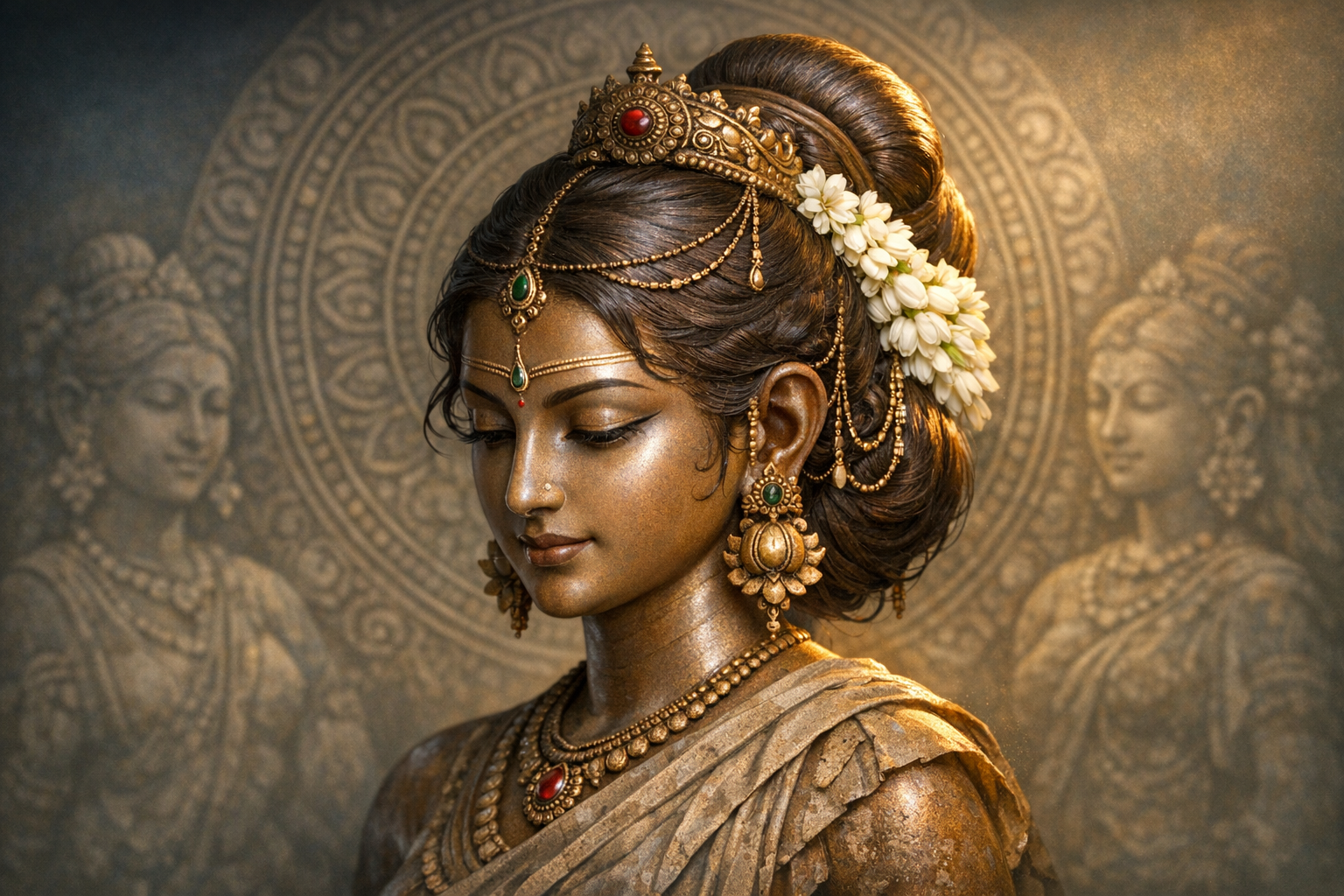
In Hindu sacred art, hair is not a mere embellishment; it is a visual grammar. Posture, gesture, ornament, and coiffure together transmit theological nuance and aesthetic intent. Within this system, the dhammillaoften rendered as a compact, elegantly coiled chignonstands out as a primary signifier of the auspicious, benevolent, and sovereign modes of the Divine Feminine across the subcontinent. The same language of hair appears, with meaningful variations, in Buddhist and Jain imagery, underscoring shared dharmic sensibilities and a common artistic vocabulary.
Dhammilla (also encountered as dammilla or dhamila in regional and textual traditions) broadly denotes a tied, coiled hair-knot. It is typically formed from hair parted at the center, swept back, and gathered into a firm bun at the occiput or slightly elevated behind the crown. In Tamil regions, related forms are described as kondai, including Andal Kondai, which accentuates a side-placed floral bun. Despite regional names and minor technical differences, the core aesthetic of a contained, auspicious knot remains consistent.
Classical shilpa traditionsgrouped under the Shilpa Shastra and Agama corpuscodify coiffure as part of pratima-lakshana (canonical iconographic features). While specific passages and nomenclature vary across schools, sculptors are guided by a clear taxonomy that distinguishes hair arranged as kesa-bandha (tied hair), muktakeshi (free-flowing hair), and combinations integrated with crowns (mukuta) and head-ornaments. The Natya Shastra’s attention to hair in dramatic characterization also informed the broader aesthetic, shaping how grace, temperament, and rasa are communicated in sculpture and temple bronzes.
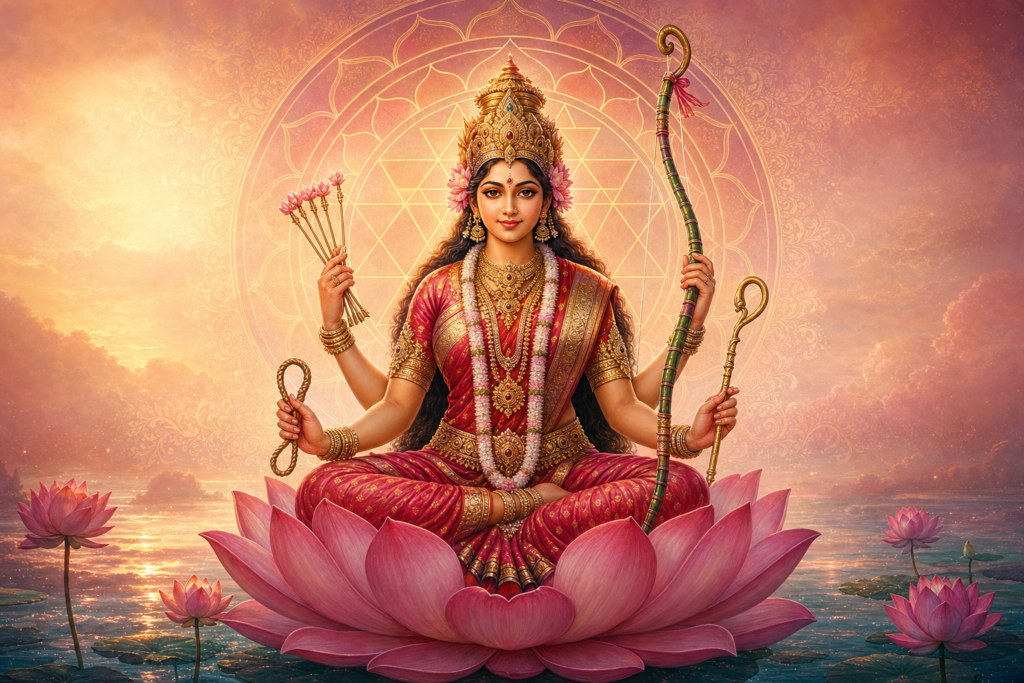
As a form, the dhammilla reads immediately as ordered, contained, and serene. Artists render the bun with incised coils, a shallow spiral, or a rounded mass with a delicate surface pattern of waves. The frontal hairline is often uninterrupted and calm, with soft alaka curls playing at the temples. The knot itself may be ringed by flowers, frequently jasmine, and held by a jeweled clasp or circlet. The visual effect is intimate and harmonized, a still point around which the rest of the head-ornamentation resolves.
Iconographically, dhammilla aligns with saumya (benign) rasas and the householder virtues associated with Lakshmi, Parvati in her gentle forms, and numerous yakshi and devi figures. In this register, restraint communicates auspicious power: prana is gathered, not dispersed; beauty is structured, not turbulent. In contrast, fierce goddesses such as Kali are often shown muktakeshi, hair loosened and dynamic, telegraphing the unbounded, world-shaking energy of dissolution and protection. Read together, dhammilla and muktakeshi supply a lucid binary for understanding mood and metaphysics in sculpted divinity.
Early historic imagery in the Mathura and Bharhut/Sanchi orbit supplies foundational exemplars. Yakshis and female donors appear with refined buns that art historians routinely identify as precursors or cognates of the dhammilla. The knot, though sometimes more voluminous in these early contexts, is already performing the semantic work of auspicious presence, fertility, and cultural refinement. The Kushan-era preference for luxuriant hair, delicately organized, further cemented this visual code.
Gupta and post-Gupta sculpture deepened the synthesis of clarity and grace that the dhammilla embodies. In goddess reliefs and free-standing icons, hair is centrally parted, tightly drawn back, and concluded in a compact bun whose finish reads as a micro-architecture of order. The hairline is straight and luminous, and the alaka curls, when present, are minimized and balanced. This coherent vocabulary traveled widely and inflected later regional idioms, including Pala-Sena, Paramara, and Chandella ateliers.
In South India, the Chola and later Nayaka bronze traditions refined tied coiffures to a breathtaking technical standard. Saumya Parvati forms, Shivakami images, and other utsava-murti deities often present the dhammilla as a compact, floral-garlanded bun that integrates seamlessly with jewels and a delicate netri-pattai at the forehead. The living tradition remembers and ritualizes these arrangements under names such as kondai; Andal Kondai in particular preserves a side-bun profile that devotees instantly recognize from both iconography and classical dance costuming.
Hoysala soapstone sculpture, known for its high-fidelity carving and layered ornament, treats the hair as finely striated, almost textile-like. Madanika and devangana figures that adorn eaves and pillars showcase side or rear buns that read as dhammilla variants. Here the knot’s edge is crisply chamfered, its surface subtly ridged, conveying the material intelligence of hair as a sculptural substance while preserving its iconographic clarity.
Across Vijayanagara and Nayaka temples, goddess imagery shows an expanded jewelry repertoirerakodi discs, hair-chains, and floral crescentsthat frame and secure the bun. The dhammilla remains the compositional anchor amid increased ornamentation, ensuring that despite visual opulence, the sign of contained auspiciousness remains legible to devotees and viewers.
Parallel developments are evident in related dharmic traditions. In Buddhist art, Tara and other female bodhisattva figures frequently adopt tied coiffures that operate conceptually like dhammillaopen to regional stylization yet stable in signification. In Jain art, yakshinis such as Ambika display centrally parted hair gathered into a bun, underscoring auspicious maternity and serene presence. These cross-tradition affinities are not incidental; they attest to a shared aesthetic-literary ecosystem in which hair functions as an ethical and spiritual marker.
The regional vocabulary that accompanies tied coiffures reveals the continuum between sculpture and lived culture. In Tamil and Telugu regions, kondai arrangements, rakodi back-plates, and hair-jewels such as jadanagam (serpentine hair ornament for plaits) circulate between temple festival images and women’s ceremonial adornment. In Kerala and coastal Karnataka, related forms appear in Theyyam and Yakshagana costuming, preserving the same grammar of auspicious containment in performance and ritual.
Temple praxis continually renews the language of hair. During alankara for Navaratri or special utsavams, priests and hereditary artisans reenact dhammilla through fresh flowers, fragrant pastes, and gold or silver hair-ornaments. The act is not mere decoration; it reaffirms the icon’s theological mode for that daysaumya or raudraand communicates the temple’s devotional stance to the community. Many visitors, even without formal training, sense the shift intuitively: a tied, floral bun invites repose and intimacy; loosened or expansive hair signals awe and energized reverence.
Material technique intensifies these meanings. In stone, hair is modeled through parallel striations, shallow drilling at coil centers, or finely pecked textures that catch raking light. In bronze, the lost-wax (cire perdue) process allows subtle spirals and relief contours, completed through post-casting chasing to crisp the hairline and bun edge. Such techniques are not purely technicalthey are pedagogical, guiding the eye to read dhammilla as gathered power.
For iconographic diagnosis, hair assists in distinguishing closely related goddess types. Lakshmi and benign Parvati forms are predisposed to dhammilla or related tied coiffures; Matrikas alternate between tied and semi-loosened depending on the narrative scene; fierce deities trend toward muktakeshi or jata-based configurations. Crowns (mukuta) can overlay or integrate with the bun, but trained viewers learn to separate crown architecture from the underlying hair arrangement to avoid misattribution.
Interpretive caution remains essential because vocabulary, style, and period convention intersect. A side-bun in a Hoysala panel and a rear bun in a Chola bronze both read as dhammilla but are calibrated to different workshop traditions. Textual prescriptions are similarly plural: Shilpa Shastra and Agama references differ in detail while agreeing on the broader principle that hair must express the deity’s mood and function. This plurality aligns with the dharmic ethos of unity-in-diversity rather than contradiction.
For museum-goers and temple pilgrims, a simple viewing protocol clarifies readings. First, register the hairline and parting. Second, locate the knot relative to the crown and nape. Third, observe whether the bun’s rim is floral, jeweled, or simple. Finally, consider the wider iconographic contexthand gestures, attendant figures, and ornamentsbefore drawing conclusions. Many visitors report a quiet recognition that once dhammilla is seen, the sculptures begin to speak an intelligible, compassionate language.
Conservation choices can protect or obscure this nuance. Over-polishing stone can flatten striations and erase the bun’s edge; aggressive cleaning of bronzes may dull chased lines or detach historical hair-jewels. Best practice favors minimal intervention, stable environmental control, and reversible mounting of festival ornaments. High-resolution imagery, raking-light photography, and condition mapping help preserve the dhammilla’s micro-topography for future study.
Because dhammilla circulates across Hindu, Buddhist, and Jain arts, it offers a ready bridge for inter-tradition appreciation. The coiffure’s serene containment speaks of restraint, ethical centeredness, and the cultivated channeling of energyvalues honored across the dharmic spectrum. Recognizing this shared grammar fosters empathy and unity, allowing communities to celebrate distinctive expressions while acknowledging a common aesthetic and spiritual inheritance.
Ultimately, the dhammilla is a quiet masterstroke in the semiotics of sacred sculpture. It holds the gaze without ostentation, gathers movement into form, and discloses the goddess as luminous order rather than unbridled force. To learn its language is to read divinity with greater subtletyin temples, in museums, and in the living rituals that continue to bind art, devotion, and everyday life across Bharatavarsha and beyond.
Inspired by this post on Hindu Blog.