Among the classic ayudhas that structure Hindu iconography and theological imagination, the parashu (paraśu) the sacred battle axe concentrates in one compact form a complete discourse on force, restraint, and renewal. Unlike the linear thrust of the spear or the whirling sovereignty of the discus, the axe clarifies an older truth carried from forest-clearing and craft to ritual and scripture: when wielded by wisdom, cutting becomes a way to protect, to purify, and to begin again.
In textual usage, paraśu denotes a martial axe and stands alongside related terms such as kuthāra in Vedic and epic literature. References span the Ramayana, the Mahabharata, and the Puranas where the axe appears as both weapon and symbol. Within the broader philosophy of Kshatra and the “War in Hinduism” discourse, the parashu functions as a calibrated instrument, legitimized not by rage but by dharma, restraint, and the ethics of righteous conflict (dharma-yuddha).
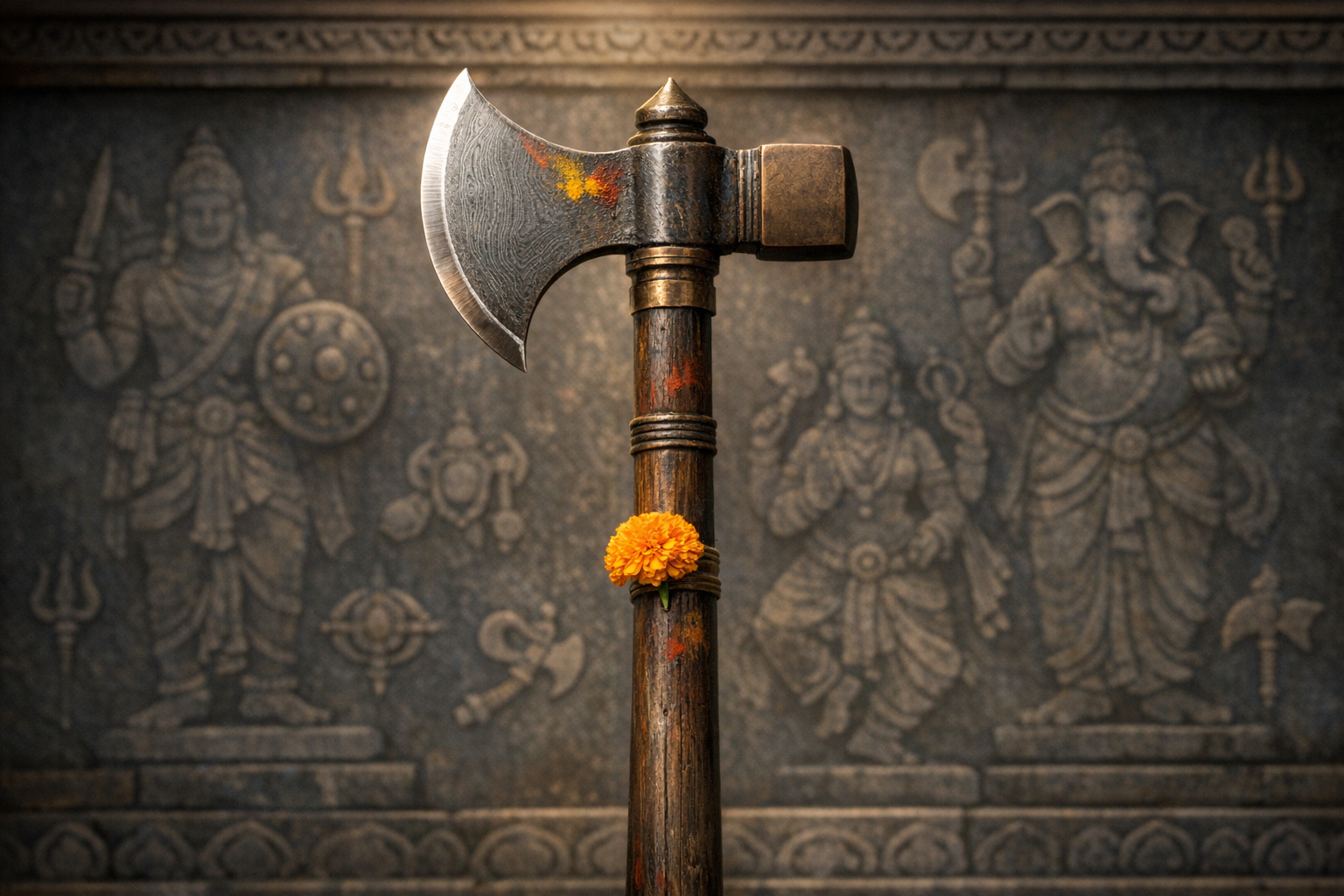
As an object, the parashu typically presents a short to mid-length haft with a single or double-edged head. In sculpture and painting, the most common heads are crescentic (ardha-chandra) or bearded, with a compact butt or counterweight opposite the blade. Metal axes in historical collections show iron or steel heads with pattern-welded bodies, sockets, and langets, while wooden hafts sometimes bear simple bindings. These physical features translate into visual shorthand in Hindu Sculptures, allowing the attribute to be recognized even at small scale.
In iconography, the parashu is read by its distinctive crescent or bearded profile, usually grasped at mid-haft. It is frequently tucked behind other attributes in crowded compositions, so identification benefits from looking for the arc of the blade peeking past hands or bangles, or for a flattened counterweight aligned opposite the cutting edge. In bronzes, the axe is often forged or cast separate and then attached; in stone, it is integral to the hand and rendered with incised grooves that mark the edge.
Shiva’s association with the parashu is ancient and layered. While the trishula remains the most recognized emblem, Shaiva forms such as Virabhadra and some Bhairava aspects hold the axe to signify decisive, protective force under the decree of dharma. In these contexts, the parashu complements the trident: where the trident symbolizes tripartite knowledge and cosmic order, the axe marks the power to sever decay, ego, and entrenched adharma swiftly and cleanly.
Vishnu’s sixth avatara, Parashurama, embodies the parashu so completely that the weapon becomes an epithet and identity. Parashurama’s narratives penance before Shiva, the gift of the axe, the confrontation with Kartavirya Arjuna (Sahasrabahu), and the redress of injustice against his parents anchor the parashu in the Ramayana, Mahabharata, and Puranic lore. The well-known meeting of Parashurama and Rama in the Ramayana’s Bala Kanda reframes the axe not as perpetual violence but as a test of rightful succession and the cession of martial ascendancy to Maryada Purushottama.
Folklore in western and southern India extends this theology into landscape: Parashurama’s thrown axe symbolically “reclaims” coastline from the sea, memorialized in traditions connected to the Konkan and Kerala regions. The theological reading is transparent the parashu clears space for life and law and its cultural afterlife has shaped regional identity, pilgrimage memory, and temple narrative.
Ganesha’s relationship with the parashu further refines its meaning. In many chaturbhuja and ashtabhuja depictions, Ganesha carries a small axe alongside the ankusha (elephant goad), pasha (noose), and modaka. Here the axe symbolizes the cutting of obstacles and obsolete habits, while the goad guides and the noose gathers. In visual terms, the parashu’s crescent blade distinguishes it from the straight-pointed ankusha; the two together capture a pedagogy of firmness and compassion in one glance.
The Devi tradition also receives the axe as a gift-weapon in the Devi Mahatmya cycle, where each god contributes an ayudha to the Goddess. When Durga or her forms such as Katyayani or Bhairavi grasp the parashu, it registers as the precision of protection not indiscriminate harm but the measured excision of a threat to collective well-being. The same symbolism carries into Veerabhadra iconography, where the axe’s presence signals steadfast defense of sacred order.
Agamic and Shilpa Shastra canons such as Manasara, Mayamata, and Shilparatna preserve practical rules for rendering attributes. While prescriptions vary by school and region, depictions consistently keep the parashu compact relative to the figure’s forearm, with a blade arc that reads clearly from medium distance. The hand pose is typically dola-hasta or kati-hasta adapted to weapon grip, and the axe often occupies an upper hand to avoid occluding the face.
Regional idioms shape the parashu’s silhouette. Chola bronzes frequently show a lean crescent blade with a smooth counterweight; Hoysala soapstone images feature deeper relief and architectural chiseling along the edge; Pala-Sena works from eastern India sometimes expand the beard of the blade and compress the haft; Odisha’s Kalinga idiom favors expressive curvature along the spine. Across Southeast Asia, Khmer sculptural programs at Angkor Wat and related sites depict Ganesha with a neat parashu that follows local aesthetics, confirming the attribute’s diffusion with the deity’s cult.
Hero stones (viragal) and memorial reliefs across peninsular India frequently include axes among the weapons of record, linking martial memory to the same attribute one encounters in sanctums. The continuity is not accidental: the parashu bridges agrarian labor, community defense, and sacral symbolism, consolidating a single cultural memory of protection and order.
Scripturally, the parashu punctuates turning points. In Mahabharata episodes touching Udyoga Parva and later narratives, Parashurama functions as both guru and examiner of ksatriya virtue training Bhishma, testing Karna, and delimiting the ethics of combat. The axe in these stories is not a fetish of violence; it is an exam of readiness, humility, and fidelity to dharma under pressure.
Philosophically, the parashu’s blade is the clarity to sever untruth; its haft is the steadiness to hold that clarity without tremor. Many teachers gloss its symbolism as the cutting away of avidya (ignorance), ahamkara (ego), and asakti (clinging), while leaving intact the living tissue of duties, relationships, and compassion. In this sense the axe aligns with classical soteriology: real destruction is always a prelude to higher integration.
Within the Philosophy of Kshatra, the parashu encodes the discipline to act with proportionality. “War in Hinduism” does not valorize indiscriminate force; it sets a grammar for necessity, last resort, and restoration. The axe, unlike the projectile or the long-reach spear, visualizes moral proximity: the wielder must step close enough to recognize the other, and thus holds responsibility for restraint.
Read across dharmic traditions, the axe-family forms a shared language of discernment. In Vajrayana Buddhism, the kartika (chopper) symbolically cuts through attachment; in Jain practice, while ahimsa remains supreme, the metaphor of severance endures as inner austerity that cuts karmic bondage; in Sikh martial heritage, the tabar (battle-axe) appears in Nihang arsenals as an emblem of protecting the weak during dharam yudh. Differences in doctrine are real, yet the core intuition is convergent: cutting as a sacred act is justified only when it restores balance, safeguards dignity, and opens a path to peace.
Ritually, the parashu appears in Ayudha Puja during Navaratri and in Vishwakarma Puja alongside tools of craft and learning. Temples sometimes place small ritual axes among consecrated implements; households may adorn tools with turmeric, kumkum, and flowers, reaffirming the ethic that power even in its humblest forms is to be honored and restrained by dharma.
For students of Hindu iconography working in museums and field sites, basic diagnostics make identification reliable. First, scan for a crescent or bearded cutting edge with a flattened butt opposite; second, check the handgrip true axes sit along the palm or between thumb and forefinger, not hooked like a goad; third, read context: with Ganesha, the parashu is typically compact; with Virabhadra or Parashurama, it enlarges and becomes more assertive in profile. These cues support accurate cataloging, conservation, and interpretive labels in galleries.
In practical viewing, temple visitors often report an immediate, visceral assurance when encountering the parashu in sanctum light a sense that danger is noticed and boundaries are guarded. Elders retelling Parashurama’s stories to younger listeners commonly use the axe as a teaching image: remove the dead wood and the grove will flourish again. Such living pedagogy preserves the parashu’s meaning as an instrument of renewal rather than an idol of fear.
Modern reflection can extend the symbol without diluting it. Social life benefits from a figurative parashu that cuts falsehood, predation, and apathy always under the checks of law, compassion, and accountability. In private life, it can be read as disciplined clarity: trimming habits that do not serve growth, while refining courage to act when conscience demands.
Taken together, the parashu’s form, scripture, and sculpture align into a coherent iconographic grammar. It is the visible sign of Kshatra yoked to wisdom, a promise that protective force remains bound to moral purpose. In Hindu iconography and resonating across the allied currents of Buddhism, Jainism, and Sikhism the sacred axe stands as a reminder that cutting, when sanctified by dharma, is a gateway to healing, order, and collective flourishing.
Inspired by this post on Hindu Blog.