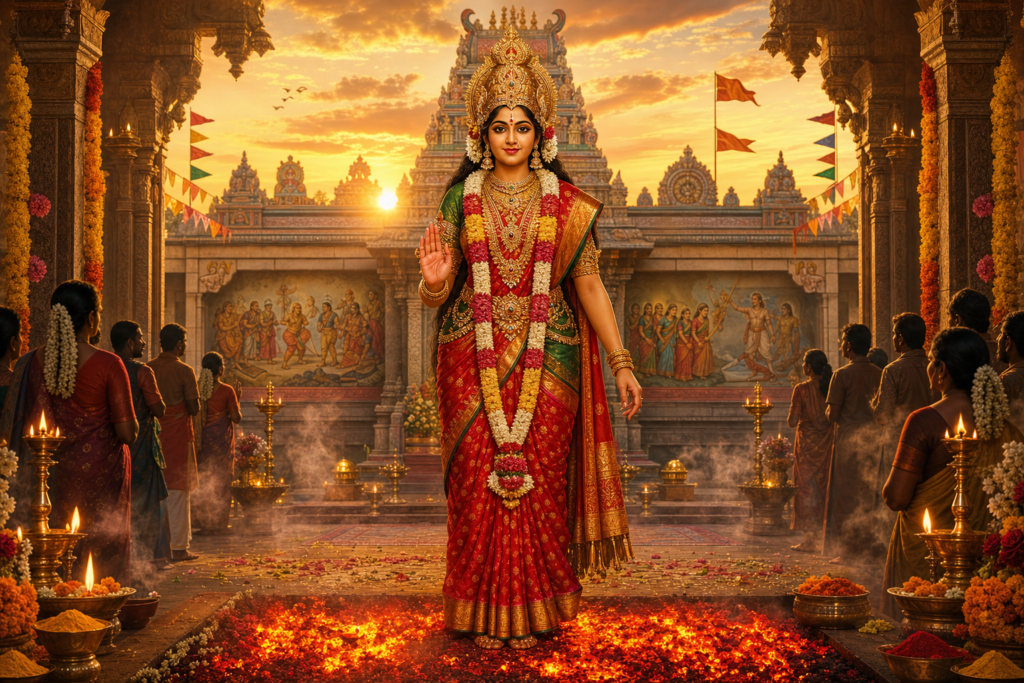
Few scenes in Hindu Stories capture dread as palpably as the bridal procession of Devakī and Vasudeva in Mathurā. As the chariot rolled, an aśarīrī-vāṇī announced that Devakī’s eighth son would be the destroyer of Kamsa. Textual sources such as the Bhagavata Purana (Skandha 10, adhyāyas 1–2) narrate that Kamsa, startled and enraged, drew his sword to kill his own sister then and there. In that crisis, Vasudeva intervened with a solemn pledge: each child born to Devakī would be surrendered to Kamsa. This vow averted an immediate murder, setting in motion a calculated, morally fraught strategy that would define the tyrant’s rule and, ultimately, his downfall.
The canonical arc is well known. Kamsa initially relented, only to later imprison the couple and slay their newborns one by one. The first six infants were killed; the seventh embryo, Saṅkarṣaṇa (Balarāma), was mystically transferred to Rohiṇī through the agency of Yogamāyā; and the eighth, Śrī Krishna, was born under divine protection and secretly conveyed to Gokula. The question that lingers in many retellings is deceptively simple yet analytically rich: if the prophecy targeted the offspring, why did Kamsa keep Devakī and Vasudeva together rather than separate themor end the marriageso that no child could be conceived?
Multiple layers of reasoning, drawing from scripture, Dharma and Adharma, and political prudence, illuminate this choice. First is the prophecy-targeting logic visible in the Bhagavata Purana and allied texts (e.g., Viṣṇu Purana 5.1; Harivaṁśa traditions). The threat was specified as the “eighth child,” not the sister or her husband. In the exegetical frame of such narratives, tyrants are often literalists who imagine they can outmaneuver fate by containing its predicted locus. For Kamsa, the “eighth child” appeared procedurally manageable: confine the couple, monitor every birth, and eliminate the risk at its moment of emergence.
Second is the calculus of sin and social opprobrium in Dharmashastras. Even despots in Purāṇic narratives measure certain acts on a recognizable moral ledger. Dharmashastra literature (for example, Manusmṛti XI; Yājñavalkya Smṛti III with Mitākṣarā) identifies jñāti-vadha (kinslaying) and strī-vadha (killing a woman) as grave sins attracting severe prāyaścitta. Publicly killing a sister on her wedding day would constitute not only a heinous transgression, but a dramatic breach of rājadharma that could fracture political legitimacy among the Yādava clans. By contrast, surveillance and later infanticidehowever abhorrentoccupied, in Kamsa’s twisted reasoning, a different juridico-ritual register he believed he could bear or atone for if necessary.
At this point, a concept frequently raised in later exegetical and regional kathā traditions becomes relevant: Pitru Dosha (pitṛ-doṣa). In classical Jyotisha, especially in texts attributed to Parāśara and Mantreśvara (Bṛhat Parāśara Horā Śāstra; Phaladīpikā), ancestral debts and afflictions are interpreted through the ninth house, the Sun, and nodes such as Rāhu and Ketu. Pitru Dosha broadly signifies ancestral displeasure or unresolved ancestral karma manifesting as obstacles in progeny, longevity, or fortune. Within that interpretive horizon, the deliberate extinction of a lineagemore so by slaying close kininvites pitṛ-roṣa (wrath of the ancestors), a potent affliction with reputational, ritual, and existential consequences.
Placed against this backdrop, the thesis that Kamsa feared Pitru Dosha is not a primary-layer claim of the earliest Purāṇic narrations but a later, meaningful hermeneutic that aligns with the civilizational logic of tri-ṛṇathe three debts to devas, ṛṣis, and pitṛsarticulated in Vedic philosophy and Dharmashastras. Preventing Devakī and Vasudeva from fulfilling the gṛhastha-dharma of continuing the family line could be construed as a direct provocation of ancestral displeasure. Keeping them togetherwhile exercising brutal control over the birthswould, in this view, preserve a semblance of lineage continuity and mitigate a deeper ancestral curse.
The political context complements this ritual-moral dimension. Kamsa’s throne in Mathurā rested on the acquiescence (or intimidation) of powerful Yādava clansVr̥ṣṇis, Andhakas, and others. Vasudeva’s lineage and alliances mattered. Executing or sundering the marriage of such a prominent kinsman at a highly visible public moment risked rebellion. Imprisonment, by contrast, concentrated risk management within the palace, making every pregnancy and delivery observable and controllable while avoiding the immediate spirals of clan vengeance that a public honor-killing would unleash.
Operationally, separation posed hidden risks. If Devakī and Vasudeva were dispersed, pregnancy could occur beyond the regime’s surveillance, or an infant might be smuggled beyond Mathurā’s reach. Keeping them confined together ensured a single, monitored locus for conception, gestation, and birth. From the tyrant’s perspective, proximity under guard reduced the tactical uncertainty that separation would introduce.
Yet, in a motif deeply characteristic of Hindu Stories and the Bhagavata Purana, the very mechanism designed to avert fate becomes the instrument of its fulfillment. Nārada’s counsel to Kamsarecorded in Purāṇic traditionsheightened the despot’s paranoia by highlighting the ambiguity in counting (who determines which is the “eighth,” by what reckoning, and after what divinely induced rearrangements?). Yogamāyā’s intervention foiled the tyrant’s accounting entirely: Saṅkarṣaṇa was relocated to Rohiṇī, and Krishna’s birth unfolded under cosmic protection in the guarded heart of the prison itself.
From a Dharmashastra standpoint, the story dramatizes a classical tension: ritualized attempts to balance sin-avoidance, fear of cosmic censure (including ancestral), and the pursuit of political stability. Kamsa’s initial restraint in killing his sister, his choice to keep the couple together, and his later atrocities belong to one continuous, if internally contradictory, moral arithmeticone that prioritizes control and optics over righteousness. In this sense, the Pitru Dosha lenswhether or not explicit in the earliest recensionfaithfully mirrors the civilizational conviction that violating lineage duties and showing contempt for ancestors corrodes kingship and karmic standing alike.
It is also difficult not to feel the human weight of the scene. A weddingordinarily a moment that seals the gṛhastha āśrama with hopeturns into a calculus of dread. Many readers who have navigated complicated family obligations will recognize the quiet terror of promises extracted under duress. The narrative’s force lies partly in this emotional realism: even the most elaborate schemes to neutralize a foretold danger are confronted by the unpredictable agency of Dharma, the compassion of deities, and the unintended consequences of cruelty.
Symbolically, “keeping Devakī and Vasudeva together” acknowledges marriage and lineage as vehicles of Dharma, even in captivity. The tyrant attempts to weaponize that Dharmareducing marriage to a conduit for infanticideonly to be undone by the very cosmic order he tries to game. This paradox resonates with a broader Vedic philosophy: one cannot instrumentalize Dharma without incurring Dharma’s correction, often through precisely those relationships and rites one tries to control.
Comparative reflections across dharmic traditions reinforce this insight. In Jain retellings of Kṛṣṇa narratives (e.g., Harivaṁśa Purāṇa), the karmic architecture ensures that violent intent ripens into downfall despite strategic cunning. Buddhist Jātaka materials frequently portray rulers who attempt to circumvent karmic outcomes, only to be corrected by the inexorable law of cause and effect. Sikh thought, centered on hukam (divine order), similarly affirms that attempts to subvert righteous order culminate in moral and political failure. Across Hinduism, Buddhism, Jainism, and Sikhism, the narrative grammar is consistent: adharma may calculate, but Dharma corrects.
A philological aside enriches the analysis. The prophecy’s specificity“the eighth child”invites multiple modes of counting, a characteristic narrative device in Hindu epics and Purāṇas. Whether one counts living births, conceptions, or viable transferences (as in Saṅkarṣaṇa’s relocation) is left strategically open, allowing Yogamāyā’s intervention to operate lawfully within the story’s own logic while exposing the futility of the tyrant’s literalism.
Technically, the Pitru Dosha interpretive layer sits at the confluence of Dharmashastra and Jyotiṣa. While the earliest Purāṇic accounts do not explicitly state that Kamsa articulated a fear of pitṛ-doṣa, later exegesissensitive to ancestral duties (śrāddha, tarpaṇa, pitṛ-pakṣa)maps his choices onto a framework in which obstructing lineage and committing kinslaying would invoke severe ancestral displeasure. This reading does not replace the canonical narrative; it deepens it by aligning the plot with a broader civilizational ethic of honoring ancestors as a dimension of Dharma.
In practical moral terms, the narrative cautions against the illusion of control that justifies incremental wrongdoing. Kamsa’s preference for imprisonment over immediate murder seems, at first glance, to defer the gravest sin. Yet, by trying to micromanage fate, he habituates himself to cruelty, normalizes atrocity, and finally collapses under the accumulated weight of adharma. The story thereby preserves an essential teaching: ethical erosion rarely arrives in a single act; it is often the sum of many “reasonable” compromises with unrighteousness.
Read as Scripture and as ethical philosophy, the account of Kamsa, Devakī, and Vasudeva interweaves prophecy, Dharma, and political realism with ancestral ethics. Keeping the couple together made sense to the tyrant’s mind on legalistic, ritual, and strategic grounds. Yet the same decision became the conduit for Krishna’s adventa turning point that restores cosmic balance and affirms the unity of dharmic wisdom: fate may test, but Dharma prevails, and ancestors are honored when lineage becomes a channel for righteousness rather than domination.
In sum, the fear of Pitru Dosha explains one meaningful strand of why Devakī and Vasudeva were not torn apart: annihilating a living lineage risks ancestral wrath, social revolt, and deeper karmic liability than tyrants are ready to bear publicly. Combined with the prophecy’s wording, Dharmashastra’s hierarchy of transgressions, and the politics of Yādava solidarity, Kamsa’s choice to keep them together becomes legibleonly to be transcended by the very Dharma he sought to manipulate.
Inspired by this post on Hindu Blog.