
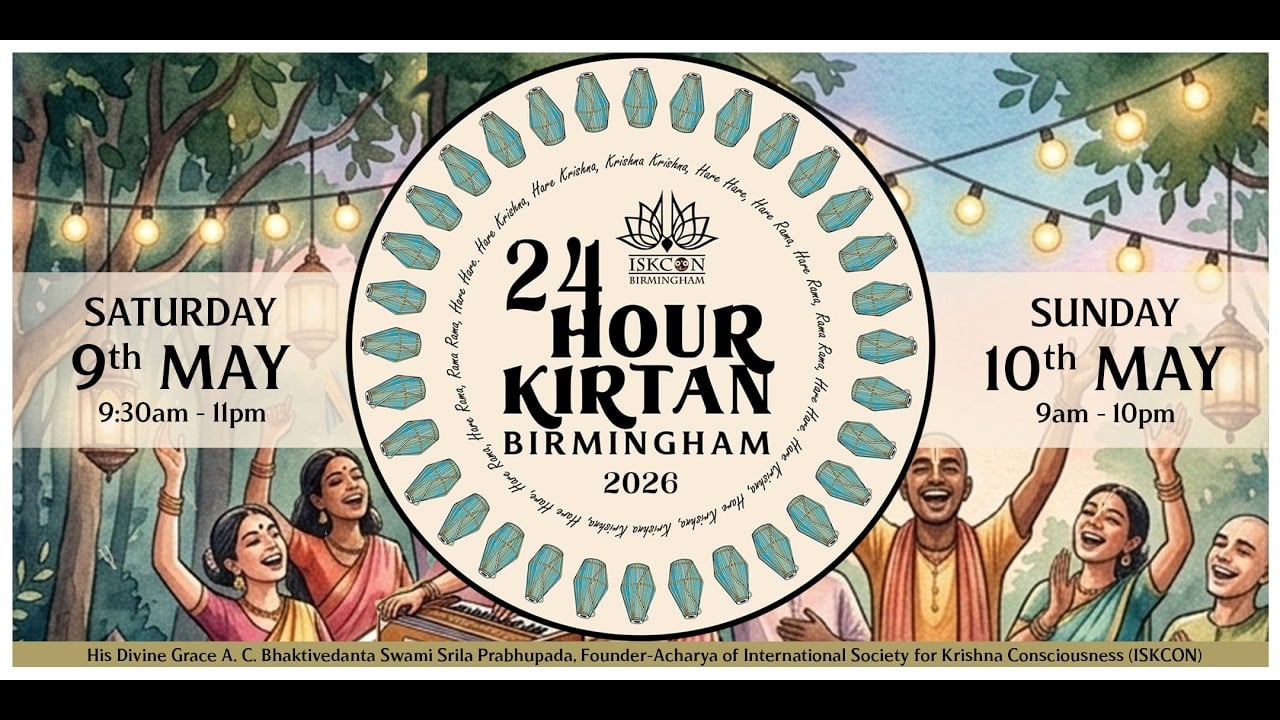
In the program titled ISKCON Birmingham 24 Hour Kirtan 2026 – Day 1 (Part 1), the opening hours of continuous nāma‑saṅkīrtana are anchored in the Gaudiya Vaishnava bhakti‑yoga tradition and the living practice of communal chanting in the Hare Krishna Movement. The discussion here situates this segment within musicology, devotional theology, event design, and the broader dharmic ethos of unity and mutual respect.
Central to the experience is the solemn repetition of the maha‑mantra: “Hare Krishna, Hare Krishna, Krishna Krishna, Hare Hare, Hare Rama, Hare Rama, Rama Rama, Hare Hare.” In Gaudiya Vaishnavism, the holy name (nāma) is understood as non‑different from the named (nāmī), so kirtan functions not merely as musical praise but as direct encounter with divinity through sacred sound (śabda).
Historically, congregational kirtan was revitalized in 16th‑century Bengal through Sri Chaitanya’s saṅkīrtana movement, which emphasized accessible devotion (bhakti) over ritual exclusivity. ISKCON globalized this practice in the late 20th century, creating a transnational repertoire that allows diasporic communities, including those in the United Kingdom, to sustain devotional identity within plural civic settings. Public nagara‑saṅkīrtana laid the foundation for today’s extended in‑temple and venue‑based kirtan marathons.
Musicologically, Day 1 often opens with moderate tempos and singable melodic contours that encourage full participation. Common rhythmic cycles include keherwa (8‑beat), dadra (6‑beat), and bhajani variants, with occasional movement through rupak (7‑beat), while the ensemble centers on khol/mṛdaṅga, kartāls, and harmonium. The antiphonal structure—lead phrase followed by congregational response—supports entrainment, memory, and vocal pacing over extended durations.
Dynamic architecture in 24‑hour kirtans typically unfolds in arcs: contemplative entry, incremental intensification, and climactic call‑and‑response, followed by brief resets that protect voices and instruments. This ebb and flow sustains attention without exhausting participants, a critical consideration when devotion is expressed continuously across day and night.
Operationally, such events are sustained by rotating teams of kīrtaniyas, percussionists, and volunteers who manage timekeeping, stage transitions, hydration, and quiet zones. Clear roles—lead vocalist, response section coordinators, mṛdaṅga leads, and kartāl captains—create redundancy and resilience so chant quality remains consistent even as personnel change.
Acoustic design contributes materially to devotional focus. Balanced gain staging, close microphone technique, feedback suppression, and monitor placement help preserve the warmth of the harmonium and the attack of the mṛdaṅga without masking the congregational chorus. Moderating decibel levels safeguards children and elders while reducing vocal strain and listening fatigue.
Research on contemplative sound practices indicates that paced vocalization and lengthened exhalation can modulate autonomic balance, increase heart‑rate variability, and foster calm attentional states. Group singing adds synchronous movement and breath, amplifying social bonding and perceived well‑being—factors frequently reported by participants during extended kirtan.
Community impact extends beyond the music. Intergenerational participation—children, youth, and seniors—builds continuity of practice; seva logistics cultivate leadership and teamwork; and the atmosphere of shared reverence lowers social barriers, enabling newcomers to engage without prerequisites. In many settings, vegetarian prasadam service further reinforces a culture of care and hospitality.
While rooted in Gaudiya Vaishnavism, the kirtan ethos resonates with parallel currents across dharmic traditions. Sikh gurdwaras center shabad kirtan and nām simran; Buddhist communities employ repetitive chanting such as “Om Mani Padme Hum”; and Jaina practice venerates the Namokar Mantra. These lineages differ in theology yet converge in the insight that disciplined, compassionate sound practice refines attention and character—an expression of Unity in Diversity within the dharmic family.
Philosophically, kirtan traverses the pathway from bhāva (devotional mood) to rasa (aesthetic‑spiritual flavor). By coupling śravaṇam (attentive hearing) with kīrtanam (voiced remembrance), participants enact a cycle of perception, expression, and interiorization that Gaudiya texts identify as central to bhakti‑yoga. The practical outcome is an embodied literacy in compassion, humility, and joyful steadiness.
Practical guidance assists sustained participation: alternate singing with listening; remain hydrated; choose supportive footwear or cushions for extended standing or sitting; pace kartāl playing to avoid wrist fatigue; and protect hearing when positioned near percussion. Gentle vocal warm‑ups and nasal resonance support clearer tone with reduced strain.
The digital dimension—recording and livestreaming—broadens access for the global community while creating an archival learning resource. Ethical digital practice invites consent‑aware filming, child‑safety safeguards, and context‑rich metadata so future viewers can understand repertoire, tempo choices, and ensemble configuration without misinterpretation.
Quality in extended kirtan can be assessed with humane metrics: participant retention across blocks; balance between lead and response; intelligibility of the maha‑mantra; rhythmic cohesion between mṛdaṅga and kartāls; and accessibility for first‑time attendees. These indicators align musical excellence with pastoral care.
Sustainability considerations often guide event logistics: reusable serving ware for prasadam, minimized single‑use plastics, and low‑waste stage setups. Aligning devotional practice with environmental responsibility echoes the dharmic principle of reverence for life and shared resources.
Transmission of heritage relies on pedagogy and mentorship. Workshops in mṛdaṅga, harmonium, and voice; simple introductions to tāla and the theology of sacred sound; and opportunities for youth to co‑lead refrains ensure that the next generation inherits both competence and confidence.
Within this wider frame, Day 1 (Part 1) commonly establishes the spiritual and sonic baseline for the 24‑hour cycle: stable tempos, inclusive melodies, and measured crescendos that favor depth over display. Rather than spectacle, the emphasis rests on collective presence—listening as carefully as singing—so the subsequent hours can rise naturally from a centered foundation.
In sum, ISKCON Birmingham’s 24‑hour kirtan exemplifies how devotional sound can unify practice and people: it is music as meditation, theology as lived song, and community as care in action. Approached with openness, it also becomes a bridge across Hinduism, Buddhism, Jainism, and Sikhism—distinct paths converging through shared respect for sacred sound and compassionate conduct.
Inspired by this post on Dandavats.










Leave a Reply
You must be logged in to post a comment.