In ancient India, Aparajita—the unconquered, the invincible—functioned as the victory-bestowing face of the Goddess for rulers, generals, and Hindu warriors preparing for campaign. The name Aparajita encapsulates the sovereign power of Shakti to protect, stabilize, and legitimize arms under Dharma-Yuddha, ensuring that warfare in Hinduism remained inseparable from ethical restraint and sacral order.
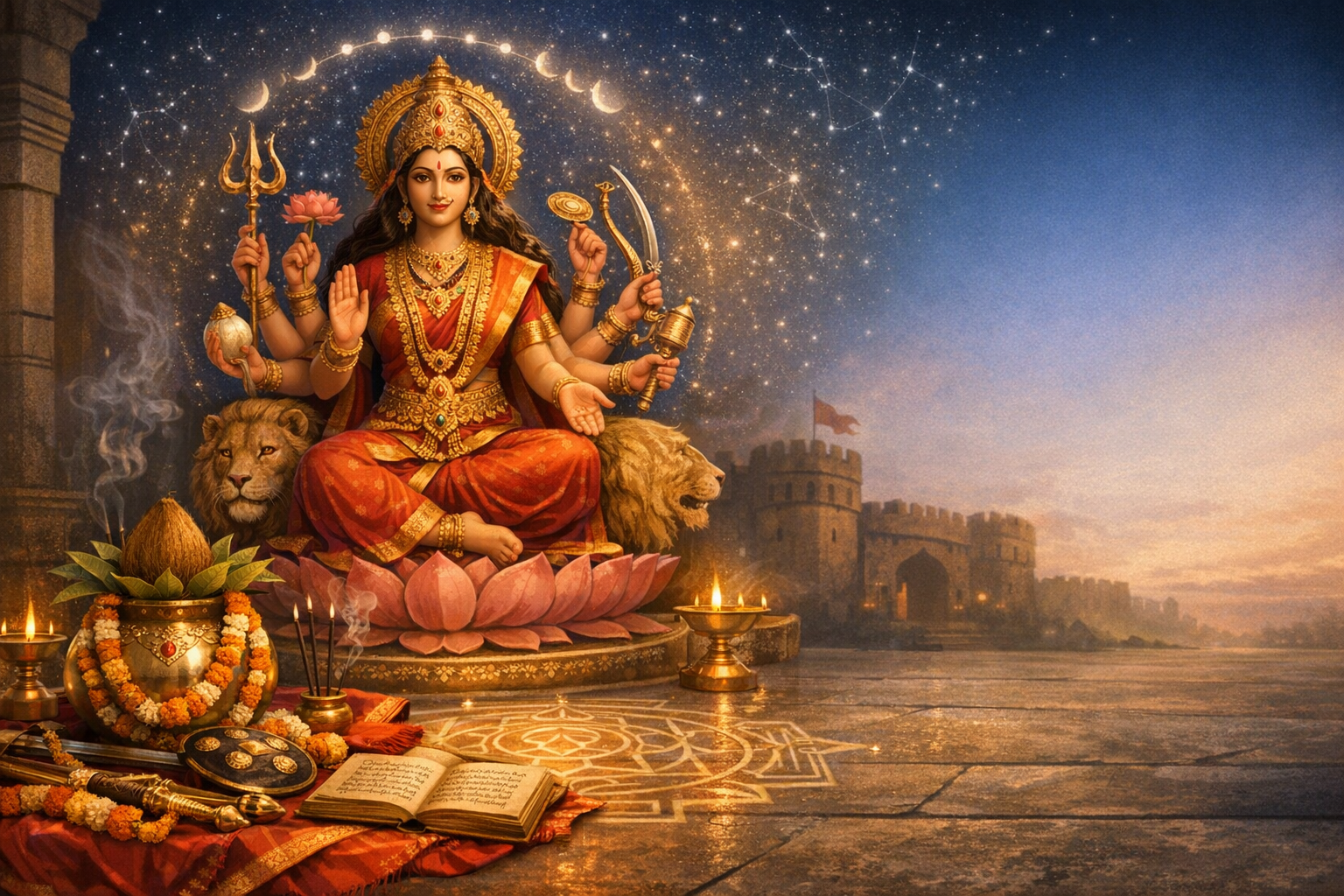
Within the broad Shakta continuum, Aparajita is both an epithet and a distinct devotional focus closely aligned with Durga and Mahishasuramardini. Iconographically, the victory goddess is envisioned with multiple arms, bearing astras symbolic of cosmic authority, bestowing abhaya (fearlessness) and varada (boon-granting) to adherents. In this capacity, Aparajita represents the rallying center where Kshatra Dharma, royal ritual, and social protection intersect.
Textual memory situates this worship within a longer arc: Ancient Hindu Texts and medieval ritual manuals emphasize the recitation of the Devi Mahatmya and victory hymns prior to expedition. Aparajita-puja appears in Smarta and Shakta paddhatis surrounding Navaratri and Dussehra, where victory (vijaya) over adharma is ritually rehearsed as a collective ethic before any exercise of force.
Strategically, royal statecraft integrated Aparajita worship with the canons of the Arthasastra. The ritual did not merely seek auspiciousness; it articulated a contract between sovereign power and Dharma: the use of arms is legitimate only when girded by restraints, public welfare, and transparent intent. Thus, piety and policy moved together, binding command decisions to the grammar of responsibility.
Historical practice unfolded in calibrated phases. Before departure, kings sought a propitious muhurta—often Abhijit or the short but potent Vijaya muhurta aligned to lunar and stellar supports (tara-balam and chandra-balam). Court astrologers weighed Choghadiya windows for regional calendars to minimize risk and to synchronize troop movement with ritual momentum.
The ritual core of Aparajita-puja followed the well-established grammar of Vedic and Tantric worship. A consecrated space was delimited; a sanctified kalasha represented the presence of Devi; and the sankalpa publicly stated the ethical objective: loka-samgraha (social stability), raksha (protection), and vijaya (righteous triumph) consonant with Dharma-Yuddha. This avowal of purpose functioned as moral mobilization for the forces.
Invocation proceeded through purification (acamana), prana-pratistha, and nyasa to align body, mantra, and intent. Practitioners offered the standard upacharas—gandha, pushpa, dhoopa, deepa, naivedya—while reciting victory verses from the Devi Mahatmya or Aparajita-oriented stutis known in regional lineages. The emphasis lay on clarity of intent and restraint of impulse—invincibility is framed as the conquest of inner disorder as much as of external threat.
Weapon sanctification (astra-puja) complemented Aparajita worship. Swords, bows, standards, and armor were anointed, garlanded, and blessed, sometimes accompanied by brief homa for raksha. This rite endowed matériel with ethical purpose, reinforcing that arms, by themselves, are inert; it is intention and discipline that make them instruments of dharma rather than engines of harm.
The seasonal apex of this theology appears during Navaratri and Vijaya Dashami (Dussehra). Regions observed Ayudha-puja, Shami worship, and, in several lineages, Aparajita-puja—venerating the unconquered goddess whose grace transforms raw strength into just protection. Communities enacted simollanghana (symbolic crossing of boundaries) to signal resolved courage, while returning leaves of Shami as auspicious tokens of shared victory and goodwill.
Ritual timing and battlefield ethics were paired with normative constraints taken from the epics and dharmashastras. From the Mahabharata’s just-war dicta to later nitisastras, rules against attacking the unarmed, night combat without declared cause, and the protection of noncombatants framed Kshatra Dharma. Aparajita worship gave these norms religious gravitas, placing restraint under the gaze of the victory goddess.
Viewed through the lens of the Arthasastra, this matrix formed a closed loop of strategy, morale, and legitimacy. The manual’s counsel—progressing from peace and diplomacy (sama, dana), to calibrated pressure (bheda), and finally force (danda)—aligns with Aparajita’s ethos: invoke power last, ethically; win first by stabilizing the field; secure victory through order, not chaos.
Moral psychology offers a complementary reading. Pre-battle Aparajita rites provided commanders with a structured pause, clarifying ends and means. The ritual quieted anxiety, synchronized units around a common story, and converted fear into disciplined vigilance. Victory, in this logic, is not brute accumulation but the restoration of balance that communities can recognize as just.
Epigraphic and regional memory echo the prominence of the victory goddess at fort gates, border shrines, and royal temples. Whether named Bhavani, Chamunda, Durga, or Aparajita, the functional role was consistent: enthrone Shakti as protector of polity and people. This continuity allowed local traditions to preserve distinct forms while sharing a pan-Indic grammar of righteous protection.
Household memory has long sustained the same arc in miniature. In many regions, elders recall polishing tools, garlanding implements, and kindling lamps during Dussehra, teaching younger generations that strength exists for service and stewardship. The intimate ritual becomes a civic classroom where Aparajita’s invincibility is recast as integrity under pressure.
Theologically, Aparajita embodies the synthesis of two horizons: outer victory and inner conquest. Shakti subdues chaos in the field and within the mind. The Devi Mahatmya’s narrative rhythm—facing fear, ordering confusion, and granting fearlessness—offered warriors and citizens alike a template for crisis navigation anchored in spiritual poise.
This integrative ethic resonates across Dharmic traditions. In Sikh heritage, compositions such as Chandi di Var valorize righteous courage subordinate to divine will. In Buddhist practice, protective invocations to Tara and other guardian deities uphold fearlessness joined to compassion. Jain teachings prize the superior conquest of the self, reminding that the most enduring victory is ahimsa-guided transformation. Diverse forms, one civilizational commitment: power must answer to dharma.
From a social standpoint, Aparajita worship stabilized transitions—mobilization, march, and return. Offerings of thanksgiving upon safe homecoming mirrored the departure rites, closing the ritual ledger with humility rather than triumphalism. Such closures mattered for public morale, for they reframed victory as restoration of everyday life.
Methodologically, Aparajita-puja integrated calendrical science (jyotisha), liturgy (paddhati), and governance (rajadharma). The alignment of muhurta selection with clear sankalpa, weapon consecration with public vows, and festival observances with community welfare illustrates a systems approach: ethics were not appended to war; they were embedded in its very architecture.
As a living practice, the Aparajita ethos endures in temples and homes during Navaratri, Ayudha-puja, and Dussehra. Many communities continue to honor Aparajita-Durga as a guardian of social order, dedicating their professional tools and public duties to the ideal of protection over aggression. The ritual continues to educate: invincibility is secured by aligning force with right purpose.
For historians, Aparajita worship illuminates how Ancient India embedded metaphysics within policy and military organization. For practitioners, it provides a contemplative spine for leadership under duress. For society, it preserves the civilizational intuition that victory is incomplete unless it safeguards dignity, minimizes suffering, and renews cohesion.
In sum, Aparajita—“the unconquered”—names a comprehensive discipline: calibrate intent, sanctify means, choose time wisely, act with restraint, and return responsibility to the people. That discipline unified diverse regional practices and Dharmic paths into a coherent vision of just strength. Its promise is enduring: the most meaningful triumph is ethical order restored under the watch of Shakti.
Inspired by this post on Hindu Blog.