The ardhoruka designates a distinctive form of lower garment in the canon of Hindu iconography, most evident in bronze sculpture from South India where it conveys concentrated energy, disciplined movement, and ascetic restraint. Short, closely fitted, and typically extending from the waist to mid-thigh, it contrasts deliberately with the longer, flowing antariya. By exposing the thighs and tightening the silhouette at the hips and lower abdomen, the ardhoruka produces a visual grammar of vigor appropriate to divine forms marked by kshatra (martial prowess), nrtta (dance), and tapas (austerity).
Formally, the ardhoruka is a short dhoti-like wrap engineered to emphasize structural clarity around the pelvis and legs. Sculptors articulate its edge, central fan, and lateral falls with crisp, shallow ridges; a beaded or plain mekhala (girdle) binds the waist, while subsidiary cordsoften read as the kati-sutra or nivistabilize the drape. The result is a dynamic, thigh-baring kilt that reads as both garment and kinetic device, allowing the viewer’s eye to follow the arc of the stanceabhangā or tribhangāwithout the visual interruption of long cascading cloth.
Textual tradition supports the category. Treatises associated with the Shilpa Shastras (for example, Manasara, Mayamata, and Shilparatna) and related iconographic manuals distinguish short and long lower garments, often prescribing the ardhoruka for specific forms of Shiva and attendant deities. Agamic sources for South Indian temple practice similarly specify costume codes in which the mekhala, udarabandha (stomach band), and controlled pleating of short drapes create a recognized typology. Although orthography varies (ardhoruka/ardhōruka), the functional meaning remains stable: a brief, tightly organized wrap that signals potency and purposeful motion.
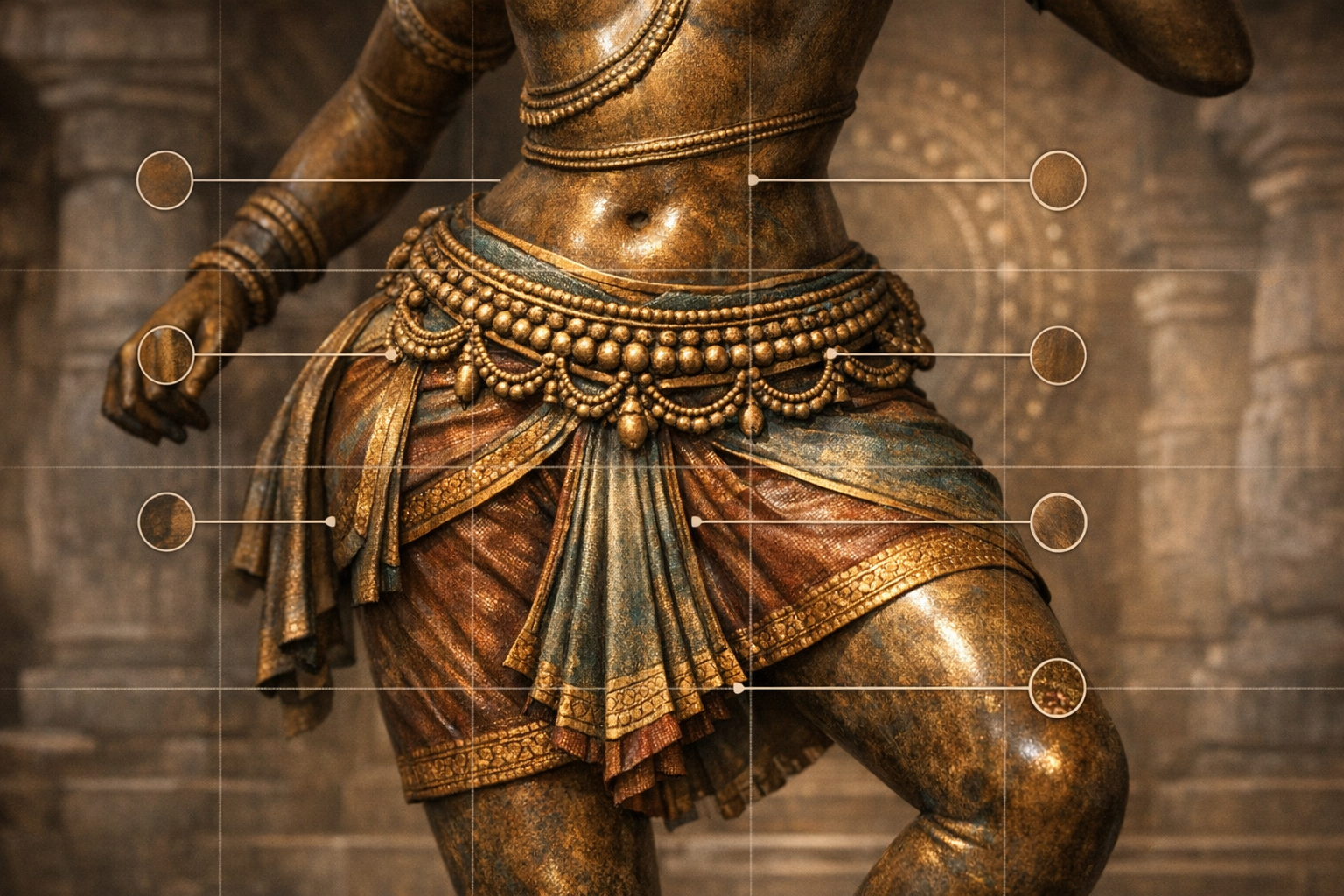
The technical construction of the ardhoruka is best read in three zones: the waist-binding system, the pleating scheme, and the terminal edge. The mekhala cinches the hips and anchors one or more overlaying ribbons, sometimes incised with beadwork; a short central fan may emerge from a tight nivi-knot; and the lower margin is often serrated through fine chisel work to intimate woven texture. Even in small bronzes, the drape’s weight and tension are rendered through differential modelingconvexities over the iliac crest, a taut belly-band, and a crisp hem that implies a fabric hand thicker than silk but lighter than leather.
Symbolically, the ardhoruka amplifies three intertwined values in Hindu art and culture. First, it enacts kshatra by exposing the muscularity of the thighs, the body’s principal levers for combat, stance, and leap. Second, it clarifies nrtta by freeing the lower limbs for depiction of rotation and weight-shiftthe visual heartbeat of images like Shiva Nataraja. Third, it registers tapas through garment austerity: a refusal of lavish length in favor of concentrated, monk-like economy. These meanings travel with the form across regions and centuries, making the ardhoruka as much a semantic cue as a sculptural motif.
Historically, short lower garments emerge in early Indian sculpture alongside long antariyas. Yakshas and dvarapalas in early Mathura and later Deccan contexts frequently exhibit thigh-length wraps, while Gupta-period divinities often prefer longer drapes that emphasize courtly grace. In South India, under the Pallavas and then the Cholas, bronze ateliers stabilized the ardhoruka as a canonical option for vigorous and ascetic forms, progressively refining the waist systems, pleats, and beaded belts that define the type.
Chola Dynasty bronzes (9th–13th centuries), central to the corpus of Hindu sculptures, demonstrate the ardhoruka’s classical maturity. In masterworks associated with Thanjavur and the devotional radiance of the Brihadeeshwara Temple milieu, lost-wax casting enables extraordinary textural nuance: delicately chased hems, knotted sashes that seem to “bite” into the flesh of the hips, and pleats that spread like a small, tense fan across the pelvis. The drape’s brevity concentrates attention on the kinetic grammar of the legs and the engineered asymmetries of stance that give Chola bronzes their poised vitality.
Shiva Nataraja exemplifies the ardhoruka’s expressive power. The garment’s shortness clarifies the torque between lifted and planted legs, the turn of the pelvis, and the pulsation of the abdomen beneath the udarabandha. Where tiger-skin motifs (vyaghra-carma) overlay the wrap, sculptors often hybridize texturesincising pelt patterning above a short, structured hemto signal both wild ascendancy and disciplined control. The ardhoruka thus mediates cosmic motion through sartorial economy: nothing superfluous, everything functional.
Other Shaiva forms employ the type with distinct emphases. Bhairava and Virabhadra often display tighter, more rugged versions that read as field gear for divine confrontation. Skanda (Murugan) in martial modes may wear a comparably short wrap to accentuate youthful virility and readiness. In certain Somaskanda ensembles, while longer antariyas are common, shorter variants appear in workshop traditions that favor kinetic clarity over purely courtly elegance. Even Vaishnava icons like Ugra-Narasimha may, in some regional idioms, adopt abbreviated drapes that underscore explosive energy.
Guardians and warriorsdvarapalas, ganas, and heroic figures on virakal (hero stones)also often wear ardhoruka-like kilts. In these contexts, the garment operates as a visual shorthand for readiness: thighs free, gait wide, weapon-bearing arms counterbalanced by a compact waist. Temple Architecture programs rely on this sartorial logic to differentiate placid divinities from wrathful guardians, contemplatives from martial protectors, using the drape to telegraph function and temperament.
Importantly, the ardhoruka’s logic participates in a broader, shared dharmic vocabulary across Hinduism, Buddhism, and Jainism, reinforcing unity rather than division. In Buddhist art, Vajrapani and certain lokapalas frequently wear short, thigh-revealing wraps that declare protective force; in Jain art, yakshas and guardians associated with Tirthankaras can adopt comparably abbreviated garments to signal vigor and stewardship. Across these traditions, the short drape operates as a common sign for dynamism and ethical protection, attesting to a civilizational continuum rather than sectarian difference.
Regional idioms widen the spectrum while preserving core semantics. South Indian bronzes prize compression and tensile pleating; Hoysala stone carving, though working in a different medium, achieves a similar effect through razor-fine hems and beaded mekhala relief. In Odisha, surface patterning sometimes intensifies the impression of woven texture; in Nepalese bronzes of the Malla period, layered belts cinch compact wraps with a jeweler’s intricacy. Beyond the subcontinent, Khmer sculpture at Angkor adapts related short-wrap forms (comparable to the sampot chong kben), their angled pleats and bold hems resonating with Indian prototypes without merely copying them. Such cross-pollination underscores ancient trade and artistic exchange routes linking Greater India and Southeast Asia.
From a technical standpoint, the lost-wax process (cire perdue) is decisive for rendering the ardhoruka’s tactility. Artisans model the wax drape as a single, tensioned membrane, pinching edges to define hems and pleats, then chase the cast surface with burins to imply threadwork or pelt. The mekhala is sometimes cast integrally, sometimes added as a separate element; in both cases, the intersection of belt and body serves as an anchor point for visual rhythm, countering the sweep of the torso and the spiral of limbs with a crisp horizontal accent.
Proportional canons in the Silpa Shastras further discipline the form. While specifics vary by text and lineage, the ardhoruka typically terminates near the mid-thigh when the leg is at rest, shortening visually when the knee is flexed. The width of the central fan often aligns to measured modules (angula-based subunits) keyed to hip-span and navel height, ensuring that even in dramatic poses the garment’s geometry harmonizes with the larger tala-based proportional system. This canonical scaffolding helps explain why the drape appears “right” even when the figure is in extreme rotation or imbalance.
Ritual practice adds another dimension. In living Hindu temples, bronzes are periodically adorned with real textiles during processions and festivals; yet the underlying sculpted ardhoruka remains legible, guiding priests in the placement of belts and sashes (alankaram) that echo the canonical waist systems. The dialogue between metal and cloth keeps the sculpture “alive,” preserving the integrity of iconographic prescriptions while accommodating seasonal and ceremonial variation.
For connoisseurship, recognizing the ardhoruka provides a practical tool for dating and attribution. The articulation of hems, the presence or absence of a distinct nivi-knot, the complexity of mekhala beading, and the relationship of pleat-fan to hip-angle can each signal regional schools and workshop hands. Chola ateliers, for example, often favor a taut, subtly convex lower edge with needle-sharp chasing, whereas later or different regional schools may thicken the hem or amplify ornamental surface at the expense of tensile clarity.
Museum visitors and temple pilgrims alike can learn to “read” the ardhoruka with a few cues in mind. First, trace the waist: does the mekhala sit above, at, or slightly below the anatomical waistline, and how does it interact with the udarabandha? Second, isolate the pleat-fan and its directionality: central, slightly off-axis, or expanded to one side to counter a lifted leg. Third, follow the hem’s line around the thigh to see how the sculptor manages depth, motion, and light. As this reading practice matures, the viewer’s experience deepensfrom seeing a divine figure in motion to understanding how motion is made credible through costume.
Viewed holistically, the ardhoruka is not merely a costume fragment but an index of civilizational intelligencean elegant, repeatable solution to the artistic problem of representing power, dance, and discipline in bronze and stone. Its recurrence in Hindu Temples, its analogues in Buddhist and Jain protective figures, and its echoes across South India and Southeast Asia demonstrate a shared dharmic sensibility. Far from isolating traditions, the garment’s form and semantics reveal a unifying visual language that honors diversity of practice while celebrating common ideals of protection, vitality, and spiritual purpose.
Inspired by this post on Hindu Blog.