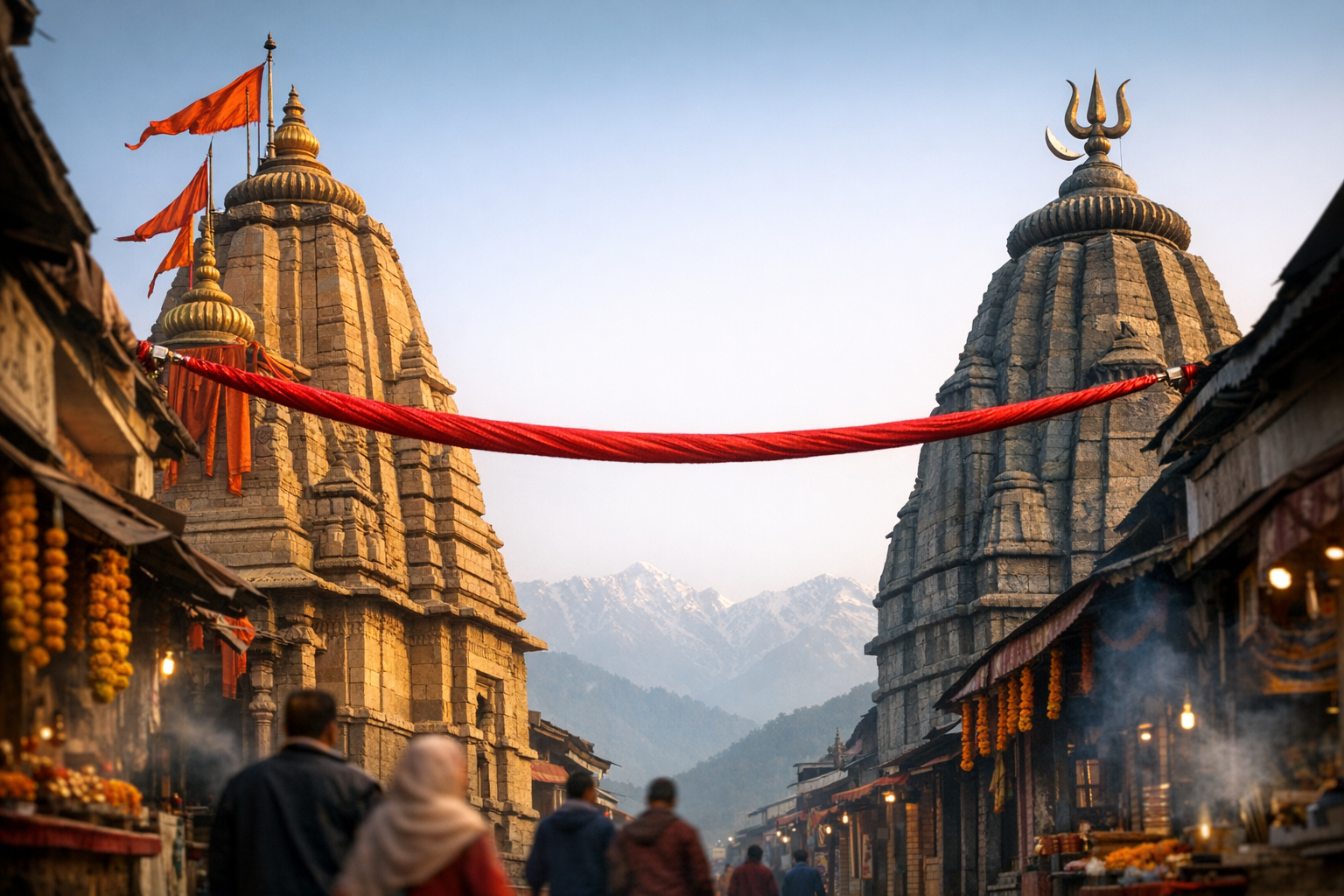
In the Kangra valley of Himachal Pradesh, the Brajeshwari Devi Shakti Peetha at Nagarkot and the shrine of Vaidyanath face one another in a striking visual dialogue of Shakti and Shiva. Between the two towering shikharas, a vivid red silken rope is traditionally stretched, transforming an ordinary street into a sacred axis. This single architectural gesture encapsulates a millennia-old metaphysics: that the dynamism of Devi (Shakti) and the stillness of Mahadeva (Shiva) are inseparable and mutually completing. The installation is at once ritual, symbol, and living pedagogyan embodied “sutra” (thread) that teaches without words.
Historically, “Nagarkot” is an older toponym for the Kangra region, renowned for its sacred geography and resilient temple culture. Brajeshwari (also spelled Bajreshwari) Devi is revered here as a preeminent Shakti Peetha, while Vaidyanathan epithet of Shiva meaning “Lord of Physicians”anchors a parallel Shaiva presence. Local tradition emphasizes their deliberate spatial alignment, rendering the townscape itself a mandala in stone, brick, and silk.
The red rope’s presence gains its force from a theological constant repeated across Purāṇic and Tantric sources: “Shiva without Shakti is shava,” a lifeless principle, and Shakti without Shiva lacks anchoring consciousness. The rope therefore serves less as ornament and more as a didactic axis, exteriorizing a non-dual philosophy into public space. What metaphysics conveys in aphorism, the town’s skyline now articulates in line and color.
In ritual logic, the red rope is the magnified counterpart of the mauli or kalava, the red-yellow “raksha-sutra” tied at the wrist for protection and auspiciousness. By cordoning the liminal space between the two sanctums, the rope signifies a protective vow scaled to the civic realman embrace that includes vendors, pilgrims, officiants, and passersby. Devotees often experience this as a gentle compulsion to visit both temples in a single circuit, internalizing the unity of Shakta and Shaiva worship as a single devotional itinerary.
Color is not incidental. In Indic semiotics, red connotes auspiciousness, fertility, courage, and embodied energyqualities attributed to Devi. In contrast, Shiva’s iconography leans toward ash, blue, and the unadorneda sign of stillness and transcendence. Spanning the space between their spires, the red silk performs a liturgical sentence in which Shakti’s rousing hue completes Shiva’s tranquil predicate, inviting viewers to contemplate balance rather than difference.
Sacred geography scholars have long noted that Himalayan temple towns often encode theology in spatial relationshipsthrough alignments, axiality, and ritual pathways. Nagarkot participates in this grammar alongside the celebrated Shakti triangle of Kangra traditionBrajeshwari, Jwalamukhi, and Chamundawhere enumerations vary regionally but the idea of an energetic network remains consistent. The rope, in this reading, is both line and link: a visible meridian in a subtle cartography of devotion.
The philology deepens the symbolism. “Sūtra” in Sanskrit denotes a thread but also a concise aphorism; “Tantra,” from the root “tan,” means expansion, loom, or framework. The red line between the temples reads as sūtra and tantra at oncean aphoristic line that frameworks a whole ritual ecology. Even “yoga,” from “yuj” (to yoke), is quietly present: the rope yokes two poles of one reality, making the town’s built environment a lesson in union.
Materially, silk adds its own valence. In temple arts, silk is a shuddha (pure) textilelustrous, resilient, responsive to wind, and visually emphatic from a distance. A red silken cord has the tensile dignity to serve as a ritual boundary and the ceremonial sheen to register as sacred rather than merely functional. Where local climate demands, a silk blend or reinforced core may be adopted; what remains constant is the sensorial rhetoric of purity and auspiciousness.
Ritual praxis (kriya) surrounding such an installation typically involves consecratory acts at both shrines: mantras, light smearing of kumkum or sandal paste at the anchoring points, and a quiet procession that carries the rope as if it were an offering. Oral testimonies in Himalayan temple towns describe seasonal renewalsoften around Navratri for Devi and Maha Shivaratri for Shivathough specific dates depend on temple management and local calendars. The renewal itself becomes a rite of re-affirmation, much like raising a dhwaja (temple flag) at festival onset.
Spatially, the rope demarcates a sanctified corridor. Pedestrians intuitively slow down; market noise softens at the crossing; and what is ordinarily thoroughfare becomes a sabha (gathering space), sabhya (refined) in conduct and sabdically softened in tone. Many pilgrims report a felt sense of enclosureprotected yet openakin to entering a temporary mandapa whose pillars are the town’s enduring spires.
Local lore often associates the rope with vows for protection and stability. In a region shaped by earthquakesincluding the devastating 1905 Kangra eventsuch vows are not abstractions. The rope, in this interpretive frame, is a civic raksha-sutra, a collective prayer woven into the skyline for the health, prosperity, and moral cohesion of the town. Regardless of the exact historical moment of its introduction, the symbol now carries the weight of communal memory.
From a comparative dharmic perspective, the motif of sacred threads and binding vows is shared widely. Hindu tradition employs the mauli as raksha and the yajnopavita as a lifelong discipline-marker; Tibetan Buddhist communities distribute blessed cords as protective amulets; Jain ritual includes auspicious threads in pratistha and vrata ceremonies; Sikh praxis venerates the saffron nishan sahibcloth that signals sacred presence and sovereign service. Diverse in idiom, these practices converge on a common grammar: cloth and cord as carriers of sanctity, solidarity, and ethical resolve.
Textually, the Tantric image of Kundalini-Shakti ascending the sushumna nadi to unite with Shiva at the sahasrara chakra offers another interpretive lens. The two templesdistinct yet conjoinedmap conceptually onto this yogic ascent. The rope’s linearity invites contemplation of an inner vertical: energy rising from movement toward stillness, from multiplicity toward clarity. For many practitioners, a paired visitfirst to Devi, then to Shiva (or vice versa)mirrors this inward pilgrimage.
Architecturally, the feasibility of a rope spanning two shikharas depends on anchoring at the kalasha or intermediate rings and careful attention to wind load, tension, and safety. Temple custodians typically treat the installation as both ritual and engineering, ensuring clearance for processions, emergency access, and visibility lines for the gopuram or shikhara crowns. In this, the practice exemplifies the classical Indian integration of art, devotion, and practical science.
Iconographically, the twin spires themselves are semantically dense. A Shakti shikhara often displays a dhwaja and ochre-red banners, while a Shiva shikhara may foreground the trishula and the crescent. The rope knits these semiotic fields, making a single statement across two lexicons. What a devotee sees in one glancea red line drawn from Devi’s crown to Shiva’scondenses volumes of theology into an image that even a child can grasp.
Festival cycles amplify this symbolism. During Navratri, Devi’s energy (shakti) is elaborated through daily alankarams, yagnas, and music; on Maha Shivaratri, vigil, austerity, and japa call attention to Shiva’s stillness. The rope, maintained or ceremonially renewed across these observances, presses home a single point: vigor and vigilance, compassion and contemplation, must dwell together in a mature spiritual life.
Ethically, the installation teaches shared stewardship. Merchants often align stall-front decor with the rope’s presence; visitors learn local etiquetteno tugging, no hanging offerings directly from the span unless instructed, no obstructing processional routes; and temple volunteers facilitate a smooth darshan flow to both sanctums. The ritual thus becomes an urban pedagogy, training civic behavior through sacred cues.
For pilgrims planning a visit, a practical sequence deepens the experience. A circumambulatory circuit that includes both Brajeshwari Devi and Vaidyanath, offered with a single sankalpa (intention), unifies devotion. Simple actsobserving a moment of silence at the midpoint beneath the span, accepting prasad from both shrines, tying a personal mauli on an authorized post rather than the rope itselfenhance reverence while preserving ritual integrity.
From the standpoint of intangible cultural heritage, the rope’s significance extends beyond spectacle. It sustains intergenerational memory, catalyzes seasonal volunteerism, and keeps alive a vocabulary of symbols that might otherwise recede under the pressure of hurried tourism. Documentation, periodic conservation assessments, and respectful visitor education ensure that the practice remains vibrant and safe.
Even in its apparent simplicity, the rope speaks to the philosophical heart of Sanatana Dharma: complementarity rather than conflict, plurality without fragmentation. The image of one cord joining two sanctums resonates with broader Dharmic values held across Hinduism, Buddhism, Jainism, and Sikhismdiverse disciplines converging on shared commitments to truth, compassion, self-cultivation, and service.
Crucially, the red silk does not erase the uniqueness of each shrine; it honors difference while articulating unity. Devi’s compassionate ferocity and Shiva’s serene renunciation remain distinct theological notes. The rope is the raga that makes them consonant, inviting practitioners to integrate active engagement with contemplative depth in both spiritual and civic life.
In summary, the red-colored silken rope stretched between the Nagarkot (Brajeshwari Devi) Mandir and the Vaidyanath Temple is a living exegesispart sacred engineering, part urban liturgy, and part philosophical shorthand. It binds space, time, and community into a single, intelligible sign. To stand beneath it is to enter a sentence written across the sky: Shakti and Shiva, movement and stillness, difference and unityheld together by a thread strong enough to carry a town’s devotion.
Inspired by this post on Hindu Blog.