Hurt is one word carrying a spectrum of meanings. Ask ten people what hurts most, and answers often range from the absence of love to a friend neglecting a birthday call, from an abrupt goodbye after years of warmth to a curt farewell that erases shared memories. Such diverse definitions are not trivial semantics; they shape experience, fuel conflict, and fragment collective peace. A dharmic and scientific view suggests that these many meanings can be honored without letting them divide communities, if the plurality is recognized, regulated, and transformed into shared understanding.
Language does not merely label pain; it constructs pain’s contours. Appraisals such as “betrayal,” “neglect,” or “disrespect” recruit specific expectations and memories, amplifying or softening sensations that are otherwise momentary. The process explains why identical events hurt one person deeply and scarcely register for another. When moral judgment fuses with private definitions of hurt, social friction intensifies, and the possibility of reconciliation recedes. A coherent path requires discerning the sources of hurt across body, mind, meaning, and communitythen engaging with humility and skill.
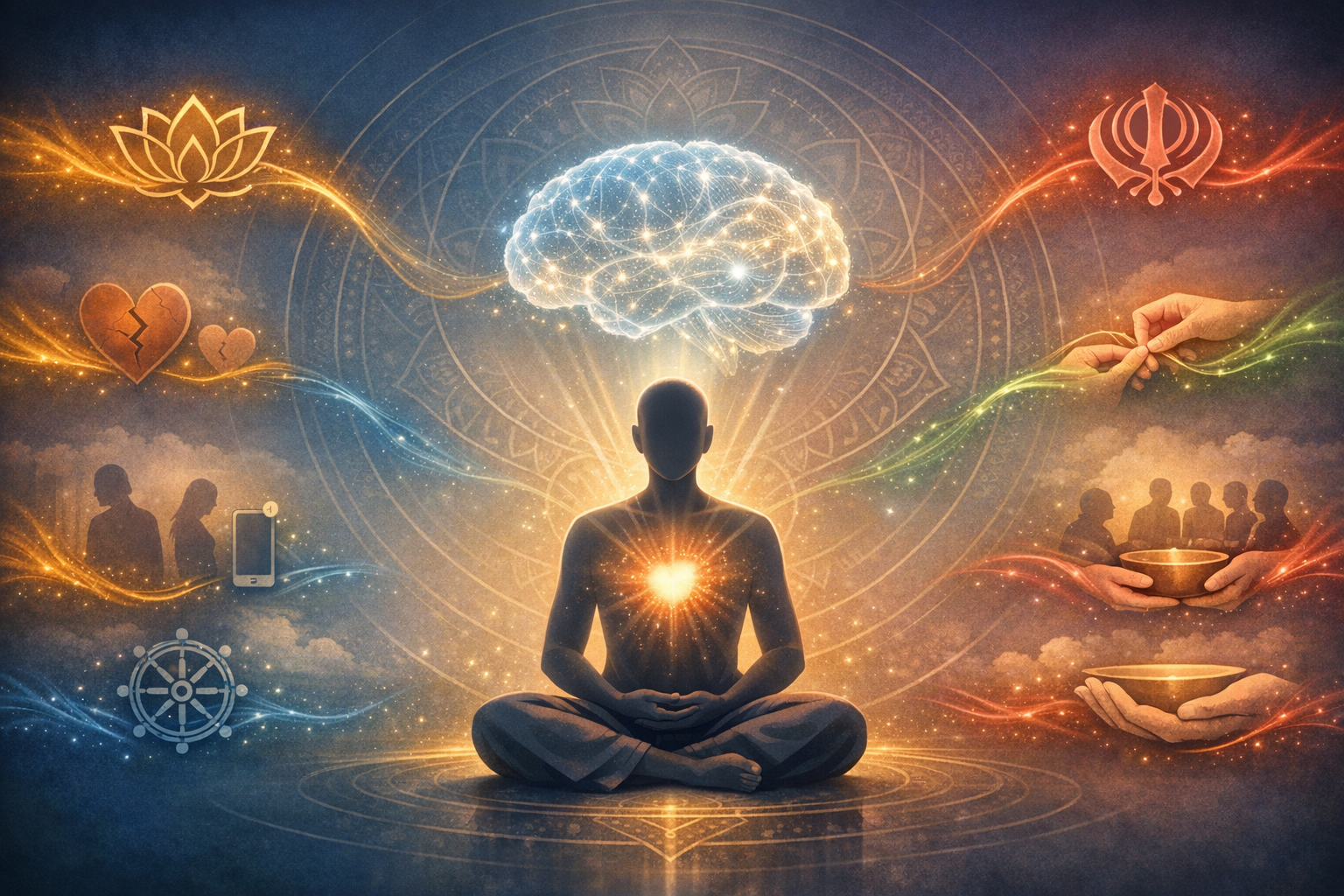
Across the dharmic traditionsthe streams of Hinduism, Buddhism, Jainism, and Sikhismthere is a shared commitment to reducing duḥkha (suffering) through clarity, discipline, compassion, and community. Differences in metaphysics do not preclude common ethical and contemplative tools. This unity in diversity offers a constructive response to plural pain: it neither erases individual experience nor elevates it into absolute truth. Instead, it cultivates discernment (viveka), non-harm (ahiṁsā), and a practical orientation toward peace (śānti) within and between persons.
In Hindu thought, pain is entangled with adhyāsa (misattribution) and misalignment with dharma. The Bhagavad Gita teaches that the sensations of pleasure and pain arise and pass like seasons; recognizing their impermanence builds steadiness (sthita-prajñā). Patañjali’s Yoga Sūtras locate suffering in the kleśasavidyā (misapprehension), asmitā (ego-identification), rāga (craving), dveṣa (aversion), and abhiniveśa (clinging to life). Practice (abhyāsa) stabilizes attention; non-attachment (vairāgya) loosens the grip of conditioned reactivity (saṃskāras). Together they reduce the frequency and intensity of mental affliction.
Upaniṣadic insights complement this framework by inviting witness-consciousness (sākṣī-bhāva). Instead of fusing with the story “I am hurt,” awareness observes the arising of sensation, emotion, and meaning as events in consciousness. This stance does not trivialize pain; it decouples identity from painful content, supporting wise action rather than reflexive retaliation.
Buddhist analysis centers on dukkha and its causes: craving (taṇhā), aversion, and ignorance. Mindfulness reveals feeling-tone (vedanā) and the reactivity that follows. Through insight into dependent origination (pratītyasamutpāda), experience is seen as contingent and conditioned, softening rigid narratives about hurt. Compassion practices (mettā, karuṇā) counteract defensive contraction and invite prosocial repair.
Jain philosophy contributes an explicitly plural lens through Anekāntavāda (Anekantavada), the doctrine that reality is many-sided. In interpersonal conflict, each perspective may hold a partial truth; language such as “in some respect (syāt)” promotes humility in asserting claims about pain and harm. Anger, pride, deceit, and greed (kaṣāyas) are recognized as accelerants of suffering and karmic bondage. Disciplines like pratikraman (periodic reflection and atonement) and aparigraha (non-possessiveness) reduce reactivity and foster reconciliation.
Sikh tradition frames hurt within hukam (divine order) and the problem of haumai (ego). Remembering the Name (Naam Simran) and channeling energy into seva (selfless service) transform pain into resilient optimism (chardi kala). Rather than fixating on subjective injury, attention returns to collective welfare, clarity of conduct, and equanimity amidst fortune and loss.
Contemporary science complements these insights. Pain is not purely sensory; it is constructed by predictive processing in the brain. Expectations, attention, and social meaning modulate nociception into the lived experience of “hurt.” The same neural circuits that encode physical pain encode social exclusion, which helps explain why a missed call can ache like a bruise. Catastrophizing, rumination, and identity threat magnify signals; mindfulness, reappraisal, and social support attenuate them. Physiological regulation (for example, slow breathing that improves vagal tone) can downshift defensive states and create bandwidth for wise response.
Why do subjective definitions of hurt fragment peace? When one definition is elevated to universality, disagreement over language becomes a disagreement over morality. Each side experiences harm as self-evident and the other’s protest as invalidation. The impasse worsens when communities inherit different saṃskāras, historical wounds, or norms about expression. A shared framework must therefore respect plural experience without surrendering to relativism; it needs practices that test and temper personal certainty.
A Dharmic Dialogue Protocol can operationalize this aspiration in homes, institutions, and sangha/sangat/satsang:
1) Name the hurt with humility. Using the Jain idiom of syād, statements begin with “In some respect, this felt like…” rather than “This is.” This small shift acknowledges partial perspective (Anekāntavāda) and invites additional facets.
2) Regulate physiology before interpretation. Three minutes of even-count breathing (for instance, inhalation 4, exhalation 6–8), brief mindfulness of breath, or gentle Naam Simran reduces sympathetic arousal. With the body settled, meaning-making becomes less defensive.
3) Reappraise using dharmic lenses. From the Gita’s perspective, sensations and emotions are transient; responding according to dharma matters more than vindication. From Buddhist analysis, observe craving/aversion loops without self-judgment. From Jain ethics, check kaṣāyas and attachments (aparigraha). From Sikh teaching, remember hukam and re-center on seva. Reappraisal here is not denial; it is ethical clarity.
4) Repair with courage and compassion. Practices akin to pratikraman, candid apologies, and commitments to changed behavior transform pain into trust. Loving-kindness (mettā), maitri-bhāva, and acts of service can metabolize resentment while protecting appropriate boundaries.
5) Commit to ahiṁsā in speech. Truth (satya) without cruelty, right speech (samyag-vāc), and restraint from gossip prevent secondary injuries that often exceed the original hurt. When dialogue risks escalation, agree to pause, regulate, and reconvene.
Evidence-informed tools support this protocol. A personal lexicon of hurt helps distinguish core injury (“not being valued”) from surface triggers (“a missed message”). Body-mapping sensations fosters interoceptive clarity, while brief pranayama and mindfulness reliably reduce arousal. Reflective journaling converts raw affect into narrative coherence. Community circles can adopt time-bounded sharing with active listening, summary-reflection, and a closing practice of gratitude or prayer, aligning with dharmic values of compassion and responsibility.
Consider three recurring scenarios. First, the missed birthday call. Initial appraisal might be “I do not matter.” After regulation and reappraisal, multiple explanations emerge: time zones, stress, simple oversight. The hurt is valid, yet the certainty of neglect softens. A gentle check-in replaces accusation, and the relationship strengthens.
Second, an abrupt goodbye after years of warmth. The nervous system encodes separation as threat; breath and grounding are essential first. With steadiness, one can see attachment and aversion at work, identify specific requests for closure, and pursue respectful communication or dignified letting go. Dignity becomes the practice of dharma under difficult conditions.
Third, the absence of love within a family. Here, the pain is chronic and layered. Anekāntavāda reminds that multiple truths can coexist: unmet needs, caregiver limitations, and systemic stress. Sikh seva and Buddhist compassion practices expand the circle of care beyond the immediate dyad, often creating new sources of belonging while boundaries protect against ongoing harm.
Measurement and feedback can be simple and humane. Track episodes of hurt each week, noting trigger, appraisal, bodily sensations, action taken, and outcome. Look for reductions in time-to-calm, increases in constructive requests, and improved mutual understanding. Communities may assess whether dialogues conclude with agreements, whether language remains non-violent, and whether reconciliation outweighs alienation over time.
Several pitfalls deserve attention. Spiritual bypassinginvoking impermanence or hukam to dismiss another’s painerodes trust. Sectarian superiority contradicts dharmic humility and the spirit of unity in diversity. False equivalence between minor slights and grave harms confuses ethics; proportionality remains vital. Finally, a demand for uniform definitions of hurt undermines the very pluralism that the dharmic traditions exemplify.
Embracing plurality does not mean surrendering to chaos. It means aligning personal narratives of hurt with shared ethical commitments: ahiṁsā, truthful speech, disciplined mind, compassion, and service. When these commitments guide practice, individual meanings of pain become sources of insight rather than division. The shared horizon is harmonylokasaṃgraha in the Gita’s languagesustained by perspectives that differ yet cooperate.
Hurt will always carry personal color. The promise of a dharmic, science-supported approach is not to bleach that color, but to render it intelligible and workablewithin oneself and with others. By bringing together Hindu, Buddhist, Jain, and Sikh wisdom with contemporary understanding of mind and body, communities can honor many truths while walking a common path toward peace. In that convergence, the fragmentation of hurt gives way to the integration of insight, and the possibility of lasting śānti becomes practical rather than utopian.
Inspired by this post on Hindu Blog.