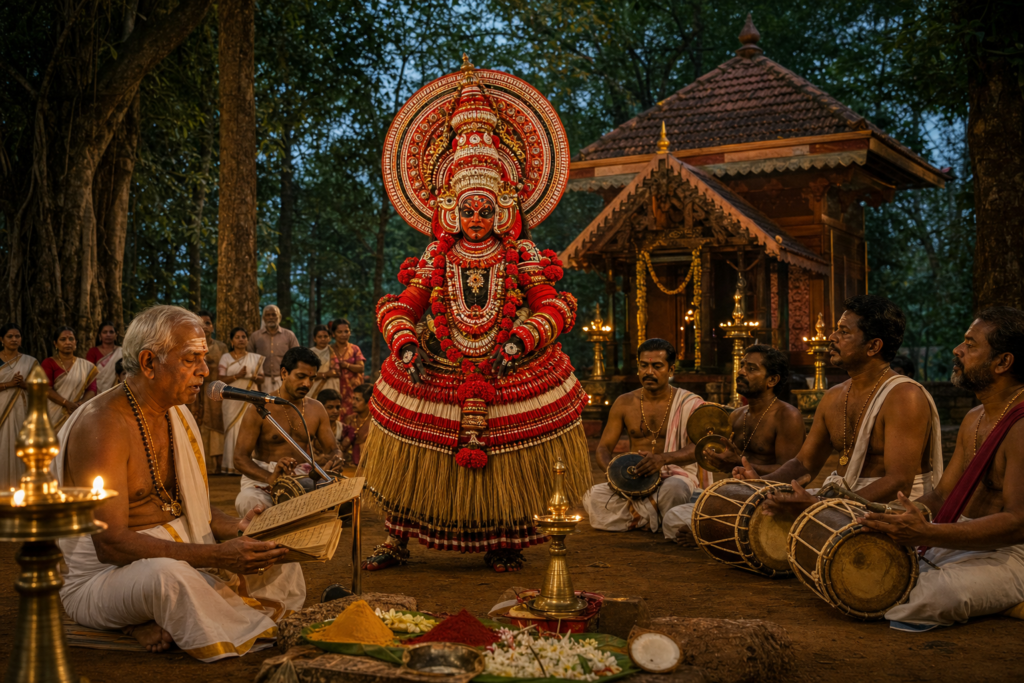
Wednesday, April 22, 2026, in the Hindu Panchang marks a transition day in the lunar cycle. Shukla Paksha Panchami prevails until 5:47 AM (IST) on April 22, after which Shukla Paksha Sashti governs the remainder of the day across most regions. This shift occurs during the light, or waxing, phase of the Moon and is significant for devotional practice, study, and well-planned beginnings, with regional calendar conventions (Amanta and Purnimanta) offering minor naming variations of the lunar month.
Understanding how to read this day correctly is essential. When a tithi ends at 5:47 AM, it means that rituals and observances prescribed for Panchami are ideally concluded before that time. From 5:47 AM onward, the Sashti observances are appropriate. Because tithi boundaries are independent of the civil clock and can end at any time, sunrise-to-sunrise assumptions should be avoided for accuracy.
Tithi fundamentals provide the technical basis for this calendar reading. A tithi is defined by the angular separation between the Sun and Moon, with each tithi spanning 12 degrees of elongation. There are 30 tithis in a synodic month, and an average tithi lasts approximately 0.9483 of a solar day, so the exact end time varies daily and by geography. On April 22, 2026, the change from Panchami to Sashti at 5:47 AM (IST) reflects this astronomical calculation rather than a fixed clock routine.
Shukla Paksha Panchami, situated in the ascending lunar energy of the fortnight, is often associated with clarity, learning, and gentle auspiciousness. Many households reserve this span for study, scriptural recitation, and refined beginnings. Shukla Paksha Sashti that follows is traditionally aligned with commitment, discipline, and the valor principle; monthly Sashti is widely revered for worship of Subrahmanya (Skanda/Kartikeya) in many regions. Both tithis, positioned back-to-back on this date, create a continuummorning refinement moving into steadfast actionuseful for those planning phased tasks across the day.
Nakshatra and Rashi determine the qualitative tone of the Moon during the day. Nakshatra is the lunar mansion (among the 27 nakshatras) occupied by the Moon, derived from its exact ecliptic longitude; Rashi is the Moon’s zodiac sign in Vedic astrology. As these depend on precise planetary positions and local time zones, authoritative regional almanacs or trusted panchang software should be consulted for the specific nakshatra and Moon-sign (Chandra Rashi) operative at one’s location on April 22, 2026. Practitioners commonly match major decisions with a conducive nakshatra and neutral or supportive Moon-sign to optimize outcomes.
Auspicious windows (Shubh Muhurat) on any given weekday are derived from a combination of sunrise, sunset, daily yogas, karanas, and divisional time systems. Three universally referenced anchors help structure the day regardless of city-specific sunrise times: Brahma Muhurta, Abhijit Muhurta, and the avoidance spans of Rahu Kalam, Yamaganda, and Gulika Kalam.
Brahma Muhurta is the pre-dawn contemplative window beginning roughly 1 hour 36 minutes before local sunrise and ending about 48 minutes before sunrise. It is favored for japa, dhyana, svadhyaya (self-study), and sankalpa formulation because the mind is comparatively calm and receptive. This time supports practitioners across dharmic traditionsHinduism, Buddhism, Jainism, and Sikh households that value early meditation and scriptural reflectionby offering a quiet, sattvic atmosphere for inner alignment.
Abhijit Muhurta centers around local solar midday (the midpoint between sunrise and sunset). Where traditions accept it as auspicious, it is preferred for time-sensitive actions when morning windows are missed. The exact span varies with season and latitude; many panchang sources provide a start and end time specific to one’s city. Because this muhurta is calculated from local solar noon rather than the civil clock, verifying it with a reliable almanac is prudent.
Rahu Kalam, Yamaganda, and Gulika Kalam are avoidance spans during daylight, each determined by dividing the time from sunrise to sunset into eight equal segments and applying a weekday-specific mapping. For Wednesday (Budha-vara), the established mapping places Rahu Kalam in the fifth segment of the daylight span, Gulika Kalam in the fourth, and Yamaganda in the second. As a simple illustration only: if sunrise were exactly 6:00 AM and sunset 6:00 PM, each segment would be 90 minutes, yielding Yamaganda 7:30–9:00 AM, Gulika Kalam 10:30 AM–12:00 PM, and Rahu Kalam 12:00–1:30 PM. Actual local times will differ and must be recalculated using the day’s true sunrise and sunset.
Weekday influence further nuances the day’s profile. Wednesday is associated with Budha (Mercury), traditionally benefiting communication, commerce, accounting, analysis, study, and diplomacy. Tasks emphasizing careful documentation, negotiations, correspondence, and intellectual work often prosper when aligned with a supportive nakshatra and free from major avoidance spans. Simple, time-tested observancesclean green attire, focus on clarity and fairness in trade, recitation of stotras to Saraswati or Vishnu, or worship of Subrahmanya on Sashtiare common across many lineages.
Regional calendars should also be noted. North Indian (Purnimanta) and South/Western (Amanta) traditions organize months differently, even while sharing the same tithi mechanics. Consequently, local naming of the month (for example, Chaitra or Vaishakha in different regions) can vary for the same civil date. This does not change the tithi’s astronomy; it simply reflects historical calendrical schools preserved across the subcontinent’s cultural geography.
For those seeking practical guidance on April 22, 2026, a two-part approach works well. First, honor Shukla Paksha Panchami observances before 5:47 AM (IST) where feasiblegentle beginnings, learning, and refined intentions suit this window. Second, after 5:47 AM (IST), schedule more assertive or deliverable-driven tasks under Shukla Paksha Sashti, selecting a slot that avoids Rahu Kalam, Yamaganda, and Gulika Kalam, and that ideally coincides with Abhijit Muhurta or a locally favorable nakshatra quality.
Nakshatra quality can be read through its classical attributesdeity, guna, tatva, and inherent motivation (chara/kshipra/mridu/ugra etc.). When the active nakshatra supports communication and learning (for example, kshipra or mridu types), Wednesday’s Budha influence often amplifies constructive outcomes in study, language work, financial planning, and technology. When the nakshatra is stern or fierce (ugra or tikshna), the day may favor decisive removal of obstacles, legal formalities, or disciplined trainingagain, provided key avoidance spans are respected.
Moon’s Rashi (Chandra Rashi) adds a psychological hue to the day. Water-sign placements may favor introspection and relationship sensitivity; earth signs, practical project steps; air signs, communication and networking; fire signs, leadership, initiative, and motivation. Matching the task flavor to the Moon’s signwhile honoring the Panchami-to-Sashti transitionrefines timing decisions made by householders and professionals alike.
This Panchang reading also speaks to a shared civilizational habitus across dharmic traditions. While specific rites and canonical calendars differTheravada Buddhist communities observe uposatha days; Jains time key vratas and paryushan by tithi; many Sikh households preserve regional observances tied to familial traditionthe underlying principle of aligning inner intent with the sky’s rhythms is widely appreciated. The day’s quiet Brahma Muhurta, the mindful selection of auspicious spans, and the ethic of restraint during avoidance windows cultivate a pan-dharmic discipline of attention and reverence.
Suggested home practices for April 22, 2026 include: a short pre-dawn meditation; recitation of stotras or mantras aligned with one’s Ishta Devata; brief study from the Bhagavad-Gita, Dhammapada, Tattvartha Sutra, or other respected texts in one’s tradition; and a self-audit of speech and transactions to honor Budha’s clarity. Where family traditions observe Subrahmanya worship on Sashti, simple offerings and heartfelt prayer after 5:47 AM (IST) align well with the day’s arc.
Key cautionary notes ensure accuracy and utility. Panchang elementstithi end times, nakshatra, yoga, karana, Abhijit Muhurta, and the exact spans of Rahu Kalam, Yamaganda, and Gulika Kalamare location-dependent and may shift noticeably across time zones and latitudes. The 5:47 AM (IST) transition from Panchami to Sashti provided here is for most regions using Indian Standard Time; those outside IST or at extreme longitudes should validate with a reliable, region-specific almanac before fixing important undertakings.
In summary: Wednesday, April 22, 2026 proceeds from Shukla Paksha Panchami (until 5:47 AM IST) to Shukla Paksha Sashti. Use the day’s Budha-vara qualities for study, finance, communication, and orderly execution. Favor Brahma Muhurta for contemplative disciplines, reserve Abhijit Muhurta for action where acceptable, and avoid Rahu Kalam, Yamaganda, and Gulika Kalam by calculating them from local sunrise and sunset. Confirm nakshatra and Moon’s Rashi for one’s city to fine-tune decisions, and let the spirit of unity across Hindu, Buddhist, Jain, and Sikh traditions guide practice with mutual respect and shared purpose.
Inspired by this post on Hindu Blog.