Demography is often described as destiny because it shapes culture, economics, and geopolitics for generations. In that spirit, projections of the global Hindu population to 2050, viewed through the lens of South Asia and India, offer a rigorous, evidence-based picture of how Sanatana Dharma and the broader dharmic family of traditions—Hinduism, Buddhism, Jainism, and Sikhism—are likely to evolve across societies. Drawing primarily on the Pew Research Center’s global religious projections that employ standard demographic methods, this analysis synthesizes the most salient trajectories and translates them into practical insights for inclusive policy, social cohesion, and diaspora engagement.
Pew’s widely cited projections use a cohort-component model, the workhorse of demographic analysis. This method starts with a baseline population disaggregated by age and sex, then applies religion-specific assumptions about fertility, mortality, and migration to estimate future size and composition. The approach is transparent and replicable, yet it is sensitive to data availability and quality, especially where censuses or surveys do not record religion consistently. The results should therefore be read as a structured, mid-range scenario rather than an immutable forecast.
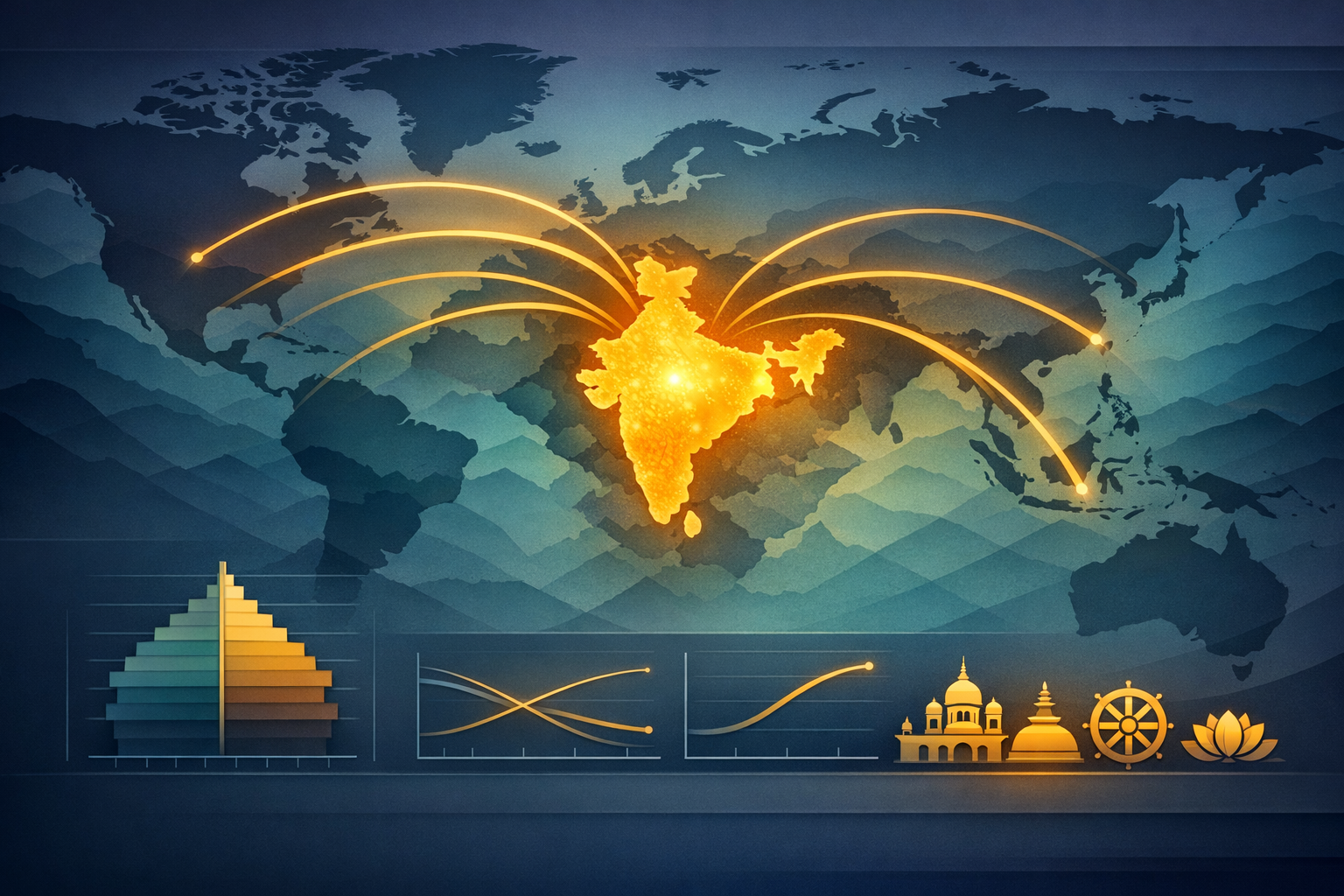
At the global level, Hindu numbers are projected to rise substantially by 2050 even as the overall share of Hindus in the world population remains broadly stable. In absolute terms, Hindus add hundreds of millions, driven by population momentum in South Asia and steady diaspora growth. In proportional terms, the Hindu share holds its ground because other large religious populations—especially Muslims—are expected to grow faster worldwide. This dual dynamic of rising counts and stable share is central to interpreting the future map of Hindu communities.
India remains the anchor of global Hindu demography throughout the projection horizon. By 2050, India continues as the primary home of Hindus worldwide and remains a Hindu-majority nation while also being the planet’s most populous country. The projected religious composition in India reflects converging fertility patterns across communities and a sustained decline in overall fertility following decades of gains in women’s education, child survival, and urbanization. Within this long-run convergence, variations persist across states and districts, underscoring the importance of subnational policy action.
Recent Indian demographic evidence complements the global picture. India’s total fertility rate has fallen to around replacement level or lower, with NFHS-5 (2019–21) indicating a national TFR near 2.0. Among dharmic traditions, fertility levels generally cluster at or below replacement in many states. Ongoing improvements in girls’ schooling, maternal health, and access to family planning continue to narrow historical gaps. These structural forces—education, incomes, urban employment, and health—exert a stronger influence on fertility decline than theology, and they do so across religious lines.
The age structure is equally decisive. A youthful base, combined with falling fertility, produces a demographic transition that raises the median age and slows future growth. As the 2050 horizon approaches, India’s Hindu population remains large and youthful enough to maintain significant demographic weight but is steadily moving into a phase where quality of human capital—skills, health, and opportunities—matters more than sheer numbers. This shift has profound implications for social policy, economic strategy, and interfaith harmony.
Migration connects Indian demography to global Hindu distribution. The diaspora expands through high-skilled migration to North America, Europe, and Oceania; family reunification; student pathways; and circular labor flows to the Gulf and Southeast Asia. Although many Gulf migrants do not gain permanent residency or citizenship, their temporary presence materially raises local counts and reshapes transnational networks. Over time, permanent-settlement destinations—such as the United States, Canada, the United Kingdom, Australia, and New Zealand—see gradual increases in Hindu populations due to immigration and second-generation growth.
Within South Asia, India, Nepal, Sri Lanka, Bangladesh, and Pakistan define a contiguous civilizational zone in which dharmic traditions have coexisted for centuries. Pew’s projections indicate that Nepal continues as a Hindu-majority society by 2050, with a slight softening of the Hindu share commensurate with broader fertility declines. Mauritius, while outside South Asia, remains among the countries with one of the world’s highest proportions of Hindus; the share may edge down slightly due to low fertility, but the community’s institutional depth and civic presence remain strong.
In Sri Lanka, Hindus retain a stable and culturally significant minority, deeply interwoven with Tamil heritage and shaped by migration and post-conflict socioeconomics. Bhutan sustains a predominantly Buddhist profile with a longstanding Hindu minority, and cooperative cultural ties across the Himalaya remain a hallmark of the region’s religious pluralism. These countries illustrate how dharmic interconnections—between Hindu, Buddhist, Jain, and Sikh communities—express themselves through language, art, pilgrimage, and shared ethical norms.
Bangladesh’s Hindu share is projected to decrease by 2050 relative to 2010 levels, reflecting differential fertility, out-migration, and age-structure effects. In absolute terms, counts need not fall; rather, the rate of increase may be lower than the national average, leading to a smaller proportional footprint. The historical ebb and flow of migration along with socio-economic differentials explains much of this pattern. Policy commitments to minority rights, women’s education, and inclusive development are critical determinants of whether projected outcomes tilt toward resilience or attrition.
Pakistan’s Hindu population remains a small proportion of the national total through 2050, with localized concentrations in Sindh. As with other South Asian contexts, the key drivers are regional fertility patterns, internal migration, and economic opportunity. In Afghanistan and the Maldives, Hindu numbers remain very small, shaped predominantly by historical emigration and narrow migration corridors.
Beyond South Asia, a diversified Hindu footprint is projected to become more visible by 2050. In North America, immigration remains the primary driver. In the United States, the Hindu share has hovered around the 1 percent mark in recent surveys, with growth fueled by high-skilled migration and family formation. In Canada, the 2021 national census recorded a notable rise in the Hindu share, consistent with sustained immigration from India and other South Asian origins. The diaspora’s professional clustering in STEM, healthcare, and entrepreneurship translates into robust community institutions—temples, gurdwaras, viharas, and community centers—often collaborating across dharmic lines.
Europe exhibits uneven but steady gains. The United Kingdom remains a major hub, reflecting historical migration from India and East Africa, with census data in England and Wales showing a gradual increase in Hindus over recent decades. The Netherlands, Italy, Germany, and Spain also record visible Hindu communities with distinct migration streams—from Suriname to the Netherlands, from India and Sri Lanka to Italy, and from multiple South Asian origins to Germany and Spain. These communities are expected to mature demographically, with second-generation identity, language retention, and inter-dharmic collaboration shaping their long-run trajectories.
In Oceania, Australia and New Zealand record some of the fastest proportional increases, propelled by international education pipelines and skilled migration. As these cohorts settle, the balance between ethnic retention and civic integration determines institutional growth—temples, cultural schools, language classes, and multi-faith platforms—thereby reinforcing the pluralistic ethos of the region. Pew-style projections typically capture the numerical aspect; ethnographic and policy research illuminate how numbers translate into lived pluralism.
Southeast Asia presents a layered profile. In Singapore and Malaysia, Hindus form longstanding minorities with vibrant public expressions through festivals and service organizations. In Indonesia, Hindus are concentrated primarily in Bali, preserving a distinctive cultural and ritual landscape within a plural national framework. Thailand and Cambodia host small but visible Hindu communities within broader Theravada Buddhist majorities, underscoring shared civilizational touchpoints between dharmic traditions.
The Gulf Cooperation Council nations host large numbers of Hindu migrant workers and professionals, many on fixed-term visas. While these populations may not result in large citizen counts by 2050, their economic and cultural links to India and Nepal reinforce transnational networks of remittances, philanthropy, and religious life. Community institutions adapt to host-country legal contexts, often collaborating in multi-faith service efforts, reflecting a practical model of religious coexistence grounded in work, welfare, and shared spaces.
In Africa and the Caribbean, historical Indo-diaspora centers continue to evolve. South Africa, with its deep Indian heritage, sustains sizable Hindu communities whose growth rates depend on internal migration, urban economics, and intermarriage. In East Africa—Kenya and Tanzania—Hindus remain civically active, though absolute numbers are modest. In the Caribbean—Guyana, Trinidad and Tobago, and Suriname—Hindu shares have generally trended downward over many decades due to emigration and differential fertility, yet institutions remain resilient and culturally generative.
Understanding why projections move as they do requires examining the demographic drivers in detail. Fertility declines with women’s education, household incomes, urban residence, and access to reproductive health. Mortality improvements raise life expectancy and alter the age pyramid, dampening future growth as cohorts age. Migration redistributes populations across borders, with selection effects by age, education, and occupation. Religious switching—net gains or losses from conversion—has been limited for Hindus at the global level in most datasets used by Pew, suggesting that fertility, mortality, and migration dominate the 2050 outcomes.
India’s specific trajectory adds policy-relevant nuance. As fertility converges and the median age rises, the question shifts from how many to how well—how well families are educated, how well communities are connected to opportunity, and how well the social fabric fosters dignity and trust across lines of faith. Dharmic traditions in India—Hinduism, Buddhism, Jainism, and Sikhism—share a civilizational grammar of pluralism that has historically allowed diverse practices to coexist. Effective policy can harness this inheritance to support equitable development while safeguarding freedom of worship and belief.
Measurement issues deserve careful attention. In many countries, religion is not recorded in every census round or is tabulated differently over time. In others, large foreign-resident populations are counted separately from citizens. In still others, survey sample sizes for small minorities are thin, increasing uncertainty around estimates. These realities do not invalidate projections; rather, they place a premium on transparent assumptions, sensitivity analysis, and humility in communication. Pew’s methodology is explicit about these constraints, which strengthens the credibility of the overall narrative.
Scenario thinking can help policymakers stress-test choices. If immigration to North America and Oceania accelerates, Hindu counts and shares in those regions could exceed mid-range projections by 2050. If student-to-skilled migration pathways narrow, the growth curve may flatten. If fertility in South Asia converges faster than anticipated, the Hindu share in India could stabilize at a slightly different level, while the age structure shifts more rapidly toward older cohorts. In each case, the direction is driven less by religious doctrine and more by socioeconomic and policy variables.
For India and the broader South Asian region, several strategic actions align demographic realism with social harmony. First, investing in timely, high-quality population data—including the consistent recording of religion in censuses and surveys—improves planning for education, health, and urban infrastructure. Second, enhancing women’s and girls’ capabilities across all communities sustains healthy fertility transitions and broad-based prosperity. Third, supporting inter-dharmic collaboration—among Hindu, Buddhist, Jain, and Sikh institutions—reinforces a civic culture that can absorb demographic change without social friction.
Diaspora engagement offers another practical lever. As Hindu communities expand in the United States, Canada, the United Kingdom, Australia, and elsewhere, partnerships with Indian institutions in higher education, research, social entrepreneurship, and heritage preservation can multiply benefits on both sides. Collaborative initiatives across temples, viharas, gurdwaras, and Jain derasars—already visible in community service, disaster relief, and cultural festivals—model the spirit of Unity in religious diversity that has long defined the dharmic world.
At the everyday level, demographic trajectories are experienced through family stories and community spaces. In Indian cities, temple festivals, gurpurab sevas, and Buddhist and Jain observances share streets and calendars. In North American suburbs, weekend language schools and classical arts classes welcome children from across dharmic traditions. In the Gulf, co-workers organize collective celebrations around major observances within host-country norms. These lived realities are the social fabric behind the projections, reminding observers that numbers serve people, not the other way around.
Several country snapshots consolidate the 2050 outlook. India remains the demographic heart of the global Hindu community and a stable Hindu-majority nation within an increasingly plural society, with continued convergence in fertility across groups. Nepal retains a Hindu-majority profile, albeit with gentle proportional adjustment consistent with regional transitions. Bangladesh sees a declining Hindu share primarily due to differential fertility and migration, underscoring the importance of inclusive development. Pakistan’s Hindu population remains a small but locally significant minority. Sri Lanka and Bhutan sustain their established religious profiles with recognizable Hindu communities. Outside South Asia, the largest gains in counts emerge in North America and Oceania, with steady maturation in Europe and institutional resilience in Africa and the Caribbean.
Three takeaways summarize the strategic horizon. First, Hindu population counts will be substantially higher by 2050, but proportional stability means the community’s global influence will depend increasingly on human capital, institutions, and alliances rather than size alone. Second, South Asia remains central, yet the diaspora will be more consequential, making immigration policy and transnational networks critical variables. Third, the dharmic ethos of pluralism provides a comparative advantage in navigating change; nurturing it through fair laws, equal opportunity, and shared civic life converts demographic shifts into durable social capital.
In essence, the Pew-style projections to 2050 describe a world in which Hindus are more numerous, more geographically distributed, and more interdependent with other communities than ever before. This is less a narrative of rise or decline than one of distributed resilience, where India’s choices—amplified by the Hindu Diaspora in US, Europe, Oceania, Africa, and Southeast Asia—shape a future grounded in dignity, opportunity, and the dharmic promise of peaceful coexistence. With realistic data, thoughtful policy, and a commitment to Religious pluralism in India and beyond, demographic change can become a shared opportunity for the entire civilizational family of South Asia.
Inspired by this post on Struggle for Hindu Existence.