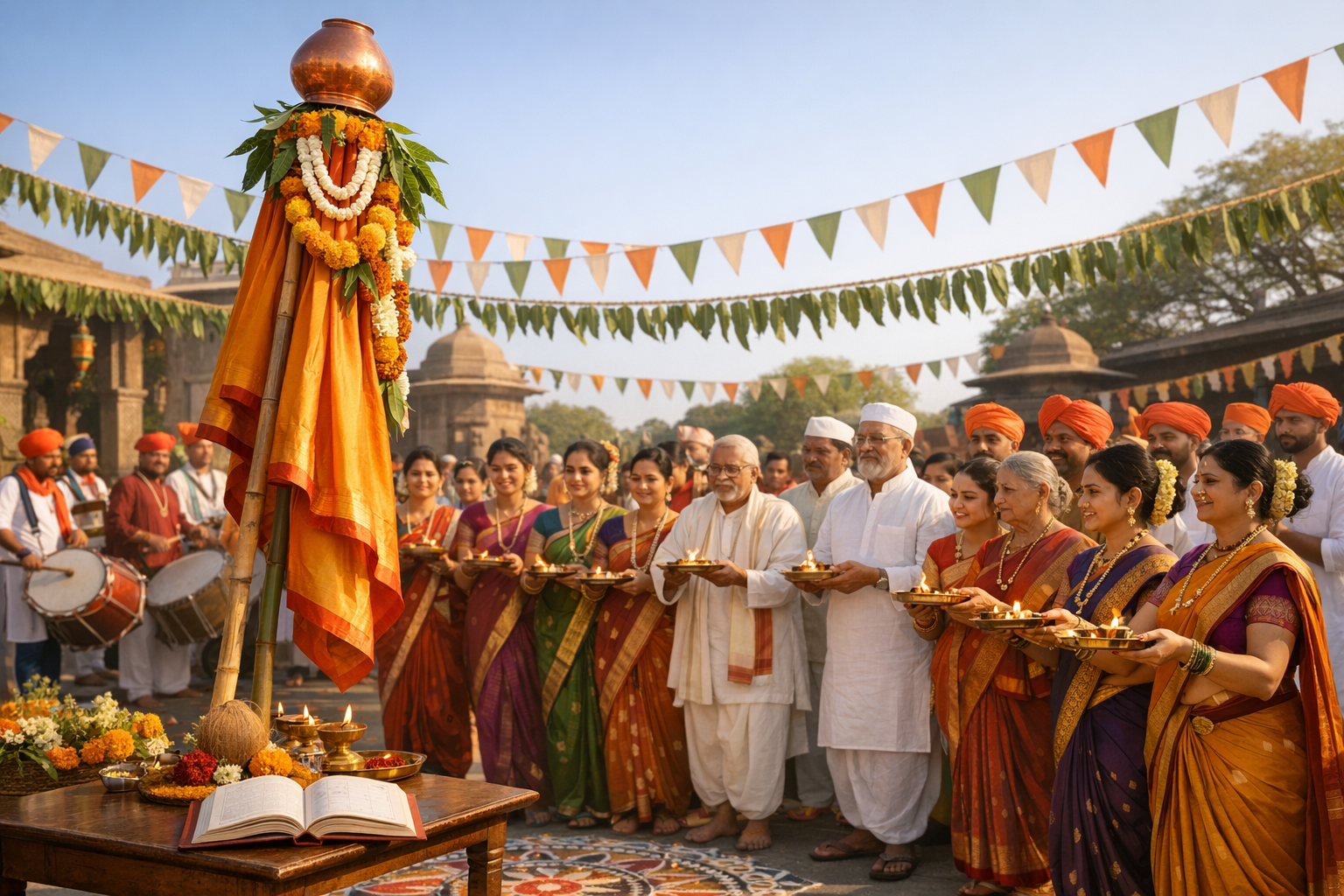
Gudhi Padwa, the auspicious commencement of the Hindu New Year, unfolded across Maharashtra with striking cultural vibrancy as coordinated collective gudhi pujan ceremonies took place at multiple locations statewide under the stewardship of Hindu Janajagruti Samiti (HJS) and allied community groups. In towns and cities alike, the erection and worship of the saffron-clad gudhiadorned with an inverted kalash, neem-mango leaves, and sugar garlandscreated a shared ritual space that blended devotion, heritage, and civic solidarity.
Anchored in the Hindu lunisolar calendar, Gudhi Padwa corresponds to Chaitra Shukla Pratipada, the first tithi of the waxing fortnight following the new moon that concludes Phalguna. In the amanta tradition prevalent in Maharashtra, this day inaugurates the Shalivahana Shaka year, aligning religious observance with calendrical precision that has guided agrarian cycles, social customs, and spiritual practices for centuries. Panchang shravan (almanac reading) on this day contextualizes the new year through tithi, nakshatra, yoga, and karana, reinforcing the intimate link between ritual time and celestial motion.
The gudhi itself functions as a compact theological and cultural statement. A bamboo or wooden pole draped in a silk (often saffron or green) cloth, crowned with an inverted copper or silver kalash, and decorated with neem and mango leaves, marigold flowers, and sugar crystals (gathi), it is placed traditionally on the right side of the main entrance. Textual and oral traditions variously interpret the gudhi as Brahma-dhwaja (the banner of creation and wisdom), as a symbol of Shri Rama’s victory and homecoming, andwithin regional memoryas an emblem of sovereignty and renewal resonant with the legacy of Chhatrapati Shivaji Maharaj.
Typical household and community gudhi pujan procedures begin with shuddhi (space purification), rangoli or muggulu at thresholds, and toran installation, followed by abhyanga snana (ritual bath), lighting of a deepa, and the application of haldi-kumkum to the gudhi. Offerings include akshata, flowers, and naivedya; devotees often distribute neem-based preparations alongside sweets to embody a philosophical acceptance of life’s varied rasasbitter, sweet, astringent, sour, pungent, and saltysuggesting resilience and balance at the start of the year.
The statewide emphasis on “samuhik” (collective) gudhi pujan amplified the festival’s communitarian dimension. Organized across public squares, temple courtyards, and neighborhood mandals, the ceremonies brought together intergenerational cohorts, with elders explaining iconography and calendar conventions while youth coordinated logistics, music, and decor. Participants commonly described an experience of shared dignity and continuity, noting how the collective aarti around a single, towering gudhi transforms individual devotions into palpable social cohesion.
HJS’s facilitationworking alongside local mandals, temple trusts, and civic volunteersprioritized open access and clarity of practice: simple procedural notes for gudhi erection, pujan sequencing, and panchang highlights were disseminated to ensure uniformity without compromising local variations. Observers noted that this standardized yet inclusive approach allowed first-time participants to engage confidently while respecting hereditary customs sustained by families and priests.
Seen through a wider dharmic lens, the celebration also conversed with cognate new-year observances across the subcontinent. On the same lunisolar marker, Ugadi is honored in Andhra Pradesh, Telangana, and Karnataka; Navreh among Kashmiri Hindus resonates closely; and Cheti Chand among Sindhi communities follows soon after. Sikhs welcome the Nanakshahi New Year in mid-March and commemorate Vaisakhi in mid-April, while Buddhist and Jain communities observe their own liturgical calendars. Together, these observances signal a civilizational ethic of seasonal renewal, plural forms of worship, and unity in diversity among dharmic traditions.
The culinary custom of distributing neem-based chutneys or bittersweet mixtures on Gudhi Padwaparalleling the Bevu-Bella ethos of Ugadiexpresses a practical metaphysic: beginning the year by mindfully tasting life’s full spectrum. Nutritionists sometimes point to the healthful properties of neem and seasonal herbs, while cultural historians read the practice as an embodied pedagogy of equanimity and foresight embedded in the Hindu way of life.
Panchang shravan during collective ceremonies offered a succinct briefing on the year’s astronomical and ritual landscape. Priests and scholars outlined how intercalary months (adhika masa) are inserted to synchronize lunar months with the sidereal solar cycle, why Chaitra Shukla Pratipada holds primacy for year reckoning in Maharashtra, and how festival dates derive from precise calculations of tithi and sunrise. This pedagogic moment elevated the event from celebration to civilizational literacy, reminding participants that Hindu festivals are inseparable from observational astronomy and mathematical calendrics.
Historical references integrated into speeches and displays illuminated multiple interpretive strands: the Shalivahana Shaka as an era marker within Indian chronology, Puranic narratives linking the day to cosmic beginnings, and Maratha-era remembrances that read the gudhi as a banner of righteous sovereignty (rajadharma). Rather than enforcing a single narrative, the ceremonies foregrounded interpretive plurality, mirroring the broader Hindu philosophical comfort with multiple meanings held in creative tension.
Processions accompanying the pujan showcased regional artsdhol-tasha, lezim, and devotional kirtanalongside tableaux on Chaitra Navratri, underscoring how Gudhi Padwa inaugurates nine nights of Devi worship in many communities. Families reported that children, captivated by the spectacle, asked informed questions about symbols and stories, indicating the role of public ritual in transmitting intangible cultural heritage.
Civic coordination underpinned the scale of participation. Organizers liaised with municipal authorities for route permissions, first-aid booths, drinking-water kiosks, and traffic regulation. Volunteer teams managed crowd flows, prioritized safe gudhi installation (secure anchoring, stable base plates), and encouraged the use of reusable metal kalashas and natural-fiber cloths to minimize wastealigning celebration with contemporary sustainability goals.
Increasingly, communities adopt eco-sensitive practices: biodegradable floral decor, cloth buntings in place of plastic, and responsible disposal of offerings. This environmental ethic draws from classical dharmic precepts of ahimsa and stewardship (seva to the natural world), reframing festivals as opportunities to model sustainable citizenship without diluting devotional intensity.
The diaspora dimension was also visible through parallel gatherings shared over digital platforms, enabling families separated by geography to synchronize gudhi pujan and panchang readings. That translocal extensionMumbai to Melbourne, Pune to Philadelphiaillustrates how Gudhi Padwa functions as a portable ritual grammar of identity, resilient to distance and adaptive to new civic contexts.
Overall, the collective gudhi pujan across Maharashtra reaffirmed Gudhi Padwa as both religious liturgy and social contract. By aligning precise calendrical knowledge with inclusive public worship, the celebrations strengthened community bonds, encouraged intergenerational learning, and signaled solidarity across dharmic traditions. As the gudhi caught the morning light over courtyards and chowks, it stood not only as a marker of the Hindu New Year, but as a banner of cultural confidence, ethical renewal, and shared belonging.
Inspired by this post on Hindu Jagruti Samiti.