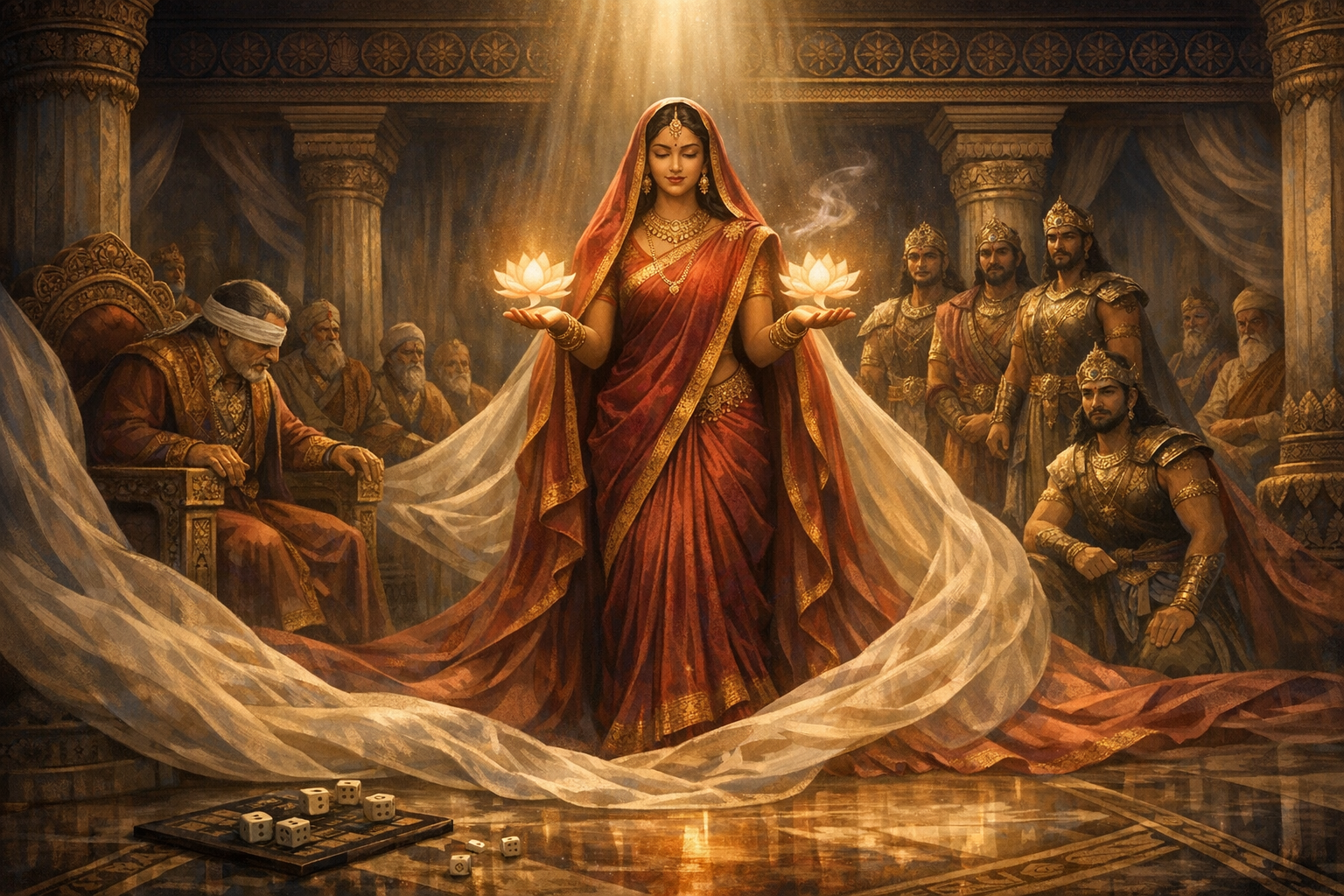
The Kuru court in the Mahabharata’s Sabha Parva (Dyuta and Anudyuta) presents one of the most ethically charged moments in epic literature: Draupadi, queen of Indraprastha and wife of the five Pandavas, is dragged into the Dyuta Sabha following Yudhishtira’s catastrophic gambling losses orchestrated by Shakuni. The scene lays bare a crisis of dharma and governance as elders remain silent, power overwhelms principle, and one woman’s clarity restores the moral axis of the assembly.
The background is stark. In the dice game, Yudhishtira first loses his wealth, then his brothers, then himself, and finally stakes Draupadi. This sequence precipitates the central legal and ethical question that Draupadi places before the Kuru Sabha: can a person who has already forfeited his own freedom validly stake another? Her inquiry is not merely rhetorical indignation; it is a precise challenge to capacity and consent framed in the idiom of dharma and vyavahara (legal procedure).
When Draupadi’s question reaches the court, the responses reveal the sabha’s paralysis. Vidura invokes the higher demands of dharma and admonishes the court. Bhishma, embodying the tragic wisdom of the elder, concedes that dharma is subtle (sukshma) and that the norms governing such a wager are not straightforward. This admission, while honest, underscores a failure of collective guardianship: when power seeks expediency, silence becomes complicity.
The attempted outrage that followsDushasana’s assault and the infamous vastraharanis recorded across recensions with variations. In most traditions, Draupadi’s dignity is preserved through divine grace, and the inexhaustible garment becomes a living symbol that adharma ultimately defeats itself. The moral force of the moment, not the spectacle of power, resets the course of deliberation.
Alarmed by ominous portents, Vidura’s censure, and the swelling recognition of injustice, Dhritarashtra offers Draupadi boons. The textual core, consistent across the narrative tradition (including the Kisari Mohan Ganguli translation and broadly reflected in the critical tradition), is unambiguous: Draupadi accepts two boons and refuses a third. First, she asks for Yudhishtira’s release from bondage. Second, she asks for the freedom of Bhima, Arjuna, Nakula, Sahadeva, and for her own liberty and dignity to be restored. When invited to ask for a third boon, she declines.
Draupadi’s refusal is the fulcrum of the episode. She explicitly rejects avarice and impropriety, signaling that dharma is not a ledger to be maximized but a standard to be upheld. She will not ask for wealth or political advantage, trusting that the Pandavas can, by kshatra dharma and righteous effort, secure what is rightfully theirs. This restraintself-limitation in the face of limitless temptationconverts a royal grant into a moral victory.
Dhritarashtra, moved by the gravity of the moment, proceeds to restore the Pandavas’ status and property to avert immediate conflict. Yet structural weakness soon reasserts itself: in the Anudyuta Parva, a second invitation to the dice game is issued, leading to the Pandavas’ exile for twelve years and one year of ajñāta-vāsa. The sabha’s failure to institutionalize dharma beyond a moment of crisis becomes the seed of a much larger reckoning culminating at Kurukshetra.
From a jurisprudential lens, Draupadi’s enquiry centers on capacity and consent. If Yudhishtira, having lost himself, is no longer a legal agent with svatantrya (independent capacity), then his attempt to stake Draupadi is void ab initio. The court’s inability or unwillingness to resolve this point demonstrates a breakdown of vyavahara (due process) under political pressure. Draupadi, by contrast, restores due order not by arguing for punitive redress but by securing the minimal, principled restoration necessary for justice to breathe again.
The ethical architecture of her choice resonates across dharmic traditions. In Hindu thought, the preference for righteousness over windfall gains exemplifies an inner alignment with dharma. Jainism’s aparigraha (non-accumulation) illuminates her refusal of the third boon as an affirmation of self-restraint. Buddhism’s Middle Way offers a parallel to her calibrated askneither capitulation to humiliation nor overreach for recompense. Sikh insights on nishkam seva (selfless action without greed) similarly converge on the same value of principled self-limitation. The unity of these dharmic perspectives highlights a shared civilizational ethic: power is most legitimate when it is ethically tethered.
Equally important is the lens of governance. Vidura-niti, scattered throughout the Mahabharata, insists that rajadharma demands courage, clarity, and compassion from rulers. Dhritarashtra’s boons, though remedial, also underscore the risk of personalistic decision-making in place of institutional standards. Draupadi’s stance demonstrates a governance insight of lasting relevance: sustainable order arises when justice is restored with restraint, not merely redistributed through largesse.
For many contemporary readers, the Dyuta Sabha evokes visceral outrage and helplessness. This response can be channeled into constructive reflection: Draupadi turns a total power asymmetry into a dharmic advantage by asking the right question at the right time and by seeking only what is necessary to re-establish moral balance. In modern terms, her approach mirrors restorative justice rather than purely retributive impulses, aiming to repair legitimacy and dignity without exacerbating the cycle of harm.
Her wisdom also exposes the sabha’s systemic failure. The elders’ silence, Duryodhana’s obstinacy, Dushasana’s violence, and Dhritarashtra’s vacillation reveal how institutions collapse when fear, favoritism, and factionalism eclipse dharma. Draupadi’s two boons, precisely because they stop short of advantage-seeking, shame the court into recognizing its own abdication of duty.
Scholarly traditions note textual variations in diction and emphasis across recensions, yet the throughline remains consistent: two boons accepted, a third refused, and a decisive moral example established. The episode’s technical concernscapacity, consent, due processcoexist with spiritual subtleties about self-mastery, the limits of power, and the supremacy of ethical clarity over opportunism.
In sum, the Dyuta Sabha becomes a study in contrasts. Adharma shouts; dharma stands firm. Coercion multiplies; conscience quiets it. Draupadi’s restraint, not Dhritarashtra’s generosity, becomes the pivotal force that reorients the assembly. By taking only two boons and refusing the third, Draupadi affirms that the measure of power is not in what it can seize, but in what it chooses, on principle, to forgo.
This is why, in the Mahabharata’s long arc from Sabha Parva to Kurukshetra, the episode endures as a touchstone for Dharma and Adharma, Kshatra Dharma, and Vidura-niti. The lesson travels well beyond epic history: institutions fail when they forget that justice is not a transaction but a trustand that real strength lies, as Draupadi shows, in principled restraint.
Inspired by this post on Hindu Blog.