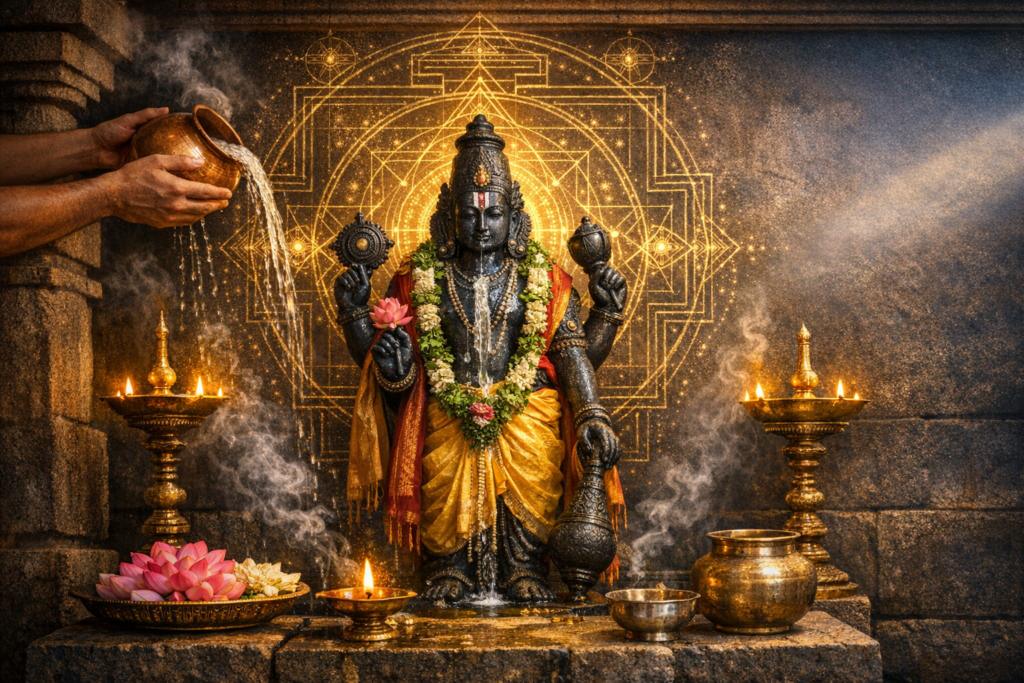
Drawing on a class inspired by Ananga Mangari Devi Dasi, this study examines Śrīmad-Bhāgavatam 3.32.22–36, where the development of love of God is shown to begin with faithful hearing about Kṛṣṇa. Within this Vaiṣṇava synthesis, bhakti-yoga emerges as the integrating force through which knowledge and action are purified and oriented toward moksha. The discussion interweaves three practical strands: the transformative power of attentive śravaṇa, the liberating simplicity of minimalist living aligned with vairāgya, and the philosophical clarity that comes from recognizing the seer as distinct from body and mind. The result is a coherent pathway that is devotional in its core commitment yet methodical, ethical, and broadly resonant across dharmic traditions.
Textually, these verses belong to the dialogue of Lord Kapila and Devahūti in the Third Canto, where Sāṅkhya categories are elucidated and then suffused with devotion. The unit 3.32.22–36 emphasizes that liberation arises when consciousness is steadily reoriented through bhakti, and that this turn begins with hearing about the Supreme with śraddhā. In this theological frame, bhakti is indispensable for release from entanglement; at the same time, its practice is practical, repeatable, and verifiable through changes in conduct and cognition.
Śravaṇa functions as a first principle. Hearing about Kṛṣṇa, accompanied by reverence and concentration, gradually reshapes memory, desire, and attention. Repeated exposure to sacred narratives, names, and qualities creates stabilizing impressions that displace compulsive patterns formed by contact with the guṇas. When nurtured in sat-saṅga and supported by kīrtana, śravaṇa becomes a living discipline that refines both understanding and affection, moving knowledge from abstraction to heartfelt orientation.
The verses also imply a social and ethical ecology for practice. Association with the devoted recalibrates habits, speech, and priorities. Kīrtana converts private conviction into shared celebration; seva grounds ideals in tangible benefit to others. Together, these practices redirect life-energy from restless consumption toward steady offering, softening egoic resistance and anchoring purpose.
Minimalism and vairāgya give bhakti its stable footing. Reducing needless possessions and overstimulation lessens the pull of rajas and tamas, supports sattva, and frees time for śravaṇa-kīrtana. This is not world-denial; it is intelligent restraint—an ethical design for living that privileges clarity over clutter. The convergence with aparigraha is notable: minimizing grasping aligns with Dharma not as austerity for its own sake but as the removal of friction in the pursuit of the highest good.
Philosophically, Kapila’s Sāṅkhya clarifies the identity of the draṣṭā, the witnessing self (ātman), as distinct from the body-mind complex shaped by prakṛti. Ahaṅkāra, manas, and buddhi constitute the instrumental machinery of experience; misidentification with these instruments perpetuates bondage. Bhakti reorients this machinery toward the Divine, converting cognition into contemplation and action into offering. In this sense, devotion both utilizes and transcends Sāṅkhya analysis—its telos is love that disentangles.
Bhakti’s agency is also described in terms of the guṇas. While sattva refines perception, bhakti is said to pierce even sattva’s subtler veils by attaching consciousness to the Supreme. The practices of śravaṇa, kīrtana, smaraṇa, and seva, done with steadiness and humility, loosen the knots of habit. Over time, the perceiver awakens to an identity inseparable from service and compassion, in which the presence of Kṛṣṇa becomes the axis of meaning.
A practical sādhanā framework follows naturally: establish a daily period of śravaṇa of Śrīmad-Bhāgavatam; complement it with kīrtana or mantra-japa; anchor the day with a concrete act of seva; and close with reflective svādhyāya that notes shifts in reactivity, intention, and gratitude. Periodic retreats into deeper silence and study reinforce the habit architecture. Such design transforms aspiration into rhythm, and rhythm into realization.
Minimalist choices amplify this rhythm. Streamlining digital inputs, simplifying wardrobes and spaces, and practicing mindful consumption reduce background noise and return attention to what nourishes devotion. Many practitioners report that even modest reductions in sensory surplus yield disproportionate gains in mental clarity and calm, making śravaṇa more vivid and kīrtana more heartfelt.
These insights resonate across dharmic traditions committed to inner freedom. In Buddhism, hearing the Dhamma, cultivating mindfulness, and embodying compassion parallel the rhythm of śravaṇa and seva. In Jainism, aparigraha and ahiṃsā provide an ethical minimalism that lightens karma and clarifies awareness. In Sikhism, nām-simran and kirtan cultivate loving remembrance as the center of life. While Śrīmad-Bhāgavatam places bhakti at the heart of moksha, the shared commitments to restraint, remembrance, and compassion reveal a family resemblance that strengthens unity among Hindu, Buddhist, Jain, and Sikh paths.
Common obstacles are predictable: restlessness (rajas), lethargy (tamas), doubt, and distraction. Effective remedies include disciplined time-blocks for practice, regular sat-saṅga, simple dietetic and sleep hygiene that support sattva, and periodic “digital fasts” that restore attention. Tracking practice in a brief journal helps convert vague intent into accountable habit, while cultivating humility guards against comparison and spiritual pride.
Indicative outcomes are experiential and ethical. Reduced reactivity, steadier attention, spontaneous gratitude, and a widening circle of empathy signal progress. Service begins to feel less like duty and more like delight; consumption loses its charm relative to contemplation. Above all, a subtle but decisive shift in identity appears: the seer stands forth as witness and servant, and life coheres around love rather than lack.
Śrīmad-Bhāgavatam 3.32.22–36 thus offers a precise and compassionate roadmap: begin with śravaṇa about Kṛṣṇa; stabilize the heart through kīrtana, seva, and sat-saṅga; simplify life through vairāgya and aparigraha; and realize the draṣṭā as distinct from the body-mind. In this integrated vision, bhakti-yoga is not an exclusive slogan but a unifying discipline that harmonizes knowledge, ethics, and devotion, advancing both personal liberation and social concord across the dharmic family.
Inspired by this post on Dandavats.