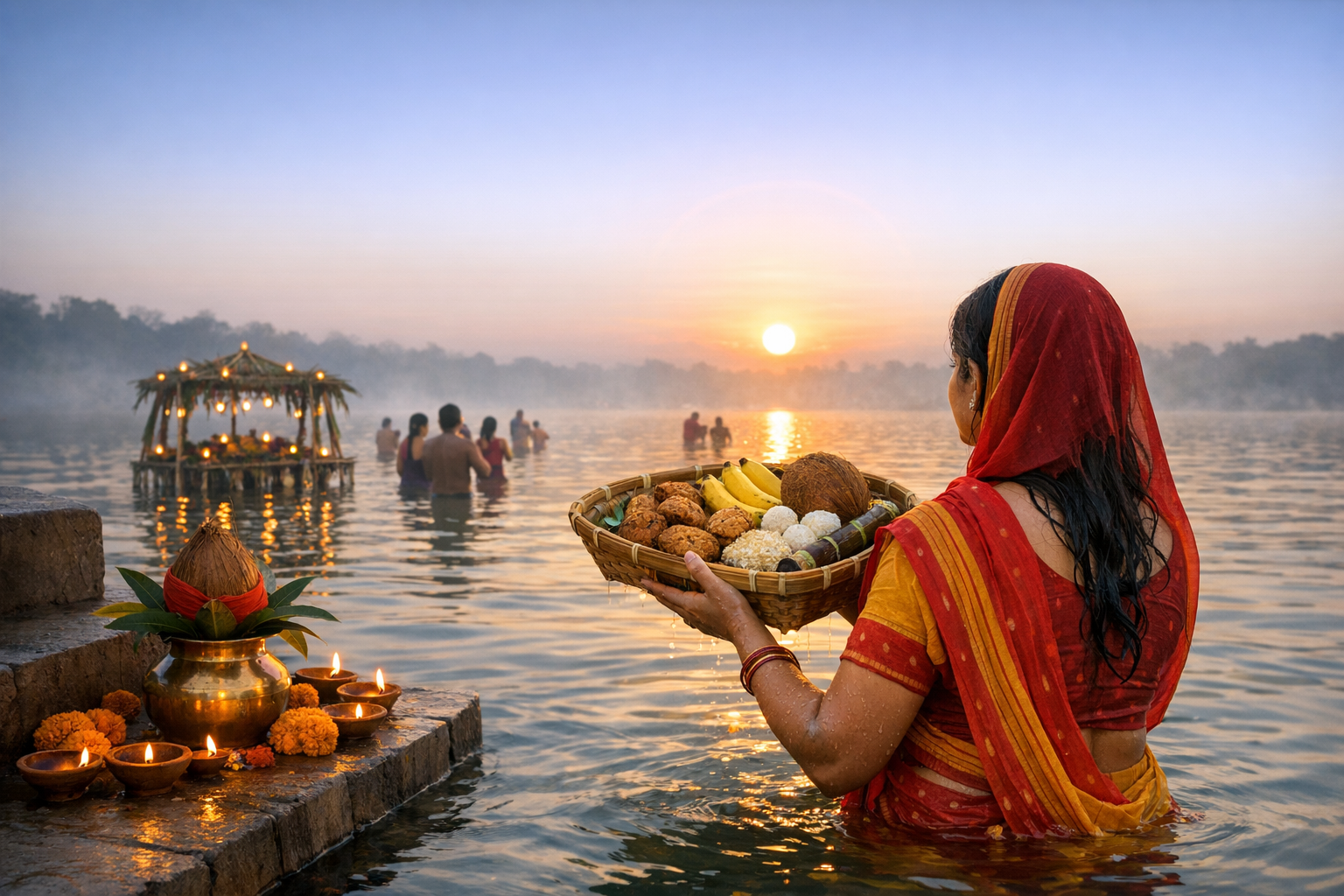
Chaiti Chhath, also known as Chath Puja in the Chaitra month, is a four-day solar festival dedicated to Surya (the Sun) and re-vered as Chhathi Maiya (Devi Shashthi) across Bihar, Jharkhand, eastern Uttar Pradesh, and the Mithila–Terai belt. In 2026, the observance spans 22 March, 23 March, 24 March, and 25 March. It mirrors, in structure and sanctity, the better-known Kartik Chhath held after Deepavali, while retaining a distinct spring-time ambience immediately following the Vikram Samvat Nav Varsh in many North Indian calendars.
Anchored in the Hindu calendar’s Chaitra month, Chaiti Chhath centers on Chaitra Shukla Shashthithe sixth lunar tithi of the bright fortnightwhen Surya’s life-sustaining radiance is propitiated for familial well-being, health, fertility, and social harmony. The observance unfolds as a rigorous vow (vrata) emphasizing purity, discipline, and gratitude, and is marked by simple, sattvik food, abstention from onion and garlic, meticulous household cleanliness, and collective worship at riverbanks and water bodies.
The 2026 schedule maps as follows: Day 1 Nahay-Khay (22 March 2026), Day 2 Kharna (23 March 2026), Day 3 Sandhya Arghya (24 March 2026), and Day 4 Usha Arghya with Parana (25 March 2026). Local sunrise and sunset govern the two central offerings (arghya) to the setting and rising sun; practitioners consult a regional Panchang to ensure alignment with the prevailing Shashthi tithi.
Day 1 (Nahay-Khay) begins with a purificatory bath, deep cleaning of the kitchen and puja spaces, and the preparation of a single, strictly sattvik meal. Many families cook lauki-bhat (bottle-gourd with rice) and chana dal in pure ghee, maintaining utensil purity (often preferring bronze, brass, clay, or iron). This first day sets the sankalpaan inner resolvefor the vrata, centering the household on simplicity, hygiene, and devotion.
Day 2 (Kharna) observes a day-long fast that culminates after sunset with a modest prasad, typically gur ki kheer, chapati smeared with ghee, and bananas. With Kharna, many devotees enter a 36-hour nirjala phaseabstaining from both food and wateruntil the Usha Arghya on Day 4. The atmosphere is one of quiet concentration, with devotional songs and collective preparation for the public offerings at the ghat.
Day 3 (Sandhya Arghya) centers on the offering to the setting sun. Devotees proceed to rivers, ponds, lakes, or the seashore, carrying bamboo soop filled with prasad such as thekua, seasonal fruits, and rice laddus. In many households, kosi bharna is observed at night: oil lamps are lit beneath a sugarcane canopy, symbolizing gratitude for nurture and protection. The evening arghyaperformed with hands cupped or via a kalashaembodies reverence for the cosmic order as day transitions to night.
Day 4 (Usha Arghya) welcomes the rising sun with the final offering, performed at dawn when the sky’s first light appears. This moment, charged with collective emotion, is followed by Paranathe ceremonial conclusion of the fastand the distribution of prasad to family, neighbors, and the broader community. The emphasis on sharing reflects the festival’s social ethic: personal discipline blossoms into communal harmony.
Devotional focus in Chaiti Chhath rests on Surya’s visible gracelight, warmth, vitalityand on Chhathi Maiya, the protective and nurturing aspect venerated in folk and Puranic traditions. The vrata is often undertaken for children’s health, protection during pregnancy, and the overall prosperity of the household. Its psychological texture is as significant as its ritual grammar: austerity clarifies intention, purity steadies attention, and gratitude opens the heart to the interdependence of human life and nature.
Scriptural and historical resonances of Chaiti Chhath are broad. Vedic hymns to Surya, Savitri, and Ushas (dawn) celebrate the cosmic rhythm of light; the Aditya cycle underscores Surya’s role in timekeeping and well-being. Puranic references to Devi Shashthi (Chhathi Maiya) associate the goddess with fertility, motherhood, and protection. Over centuries, especially in the Magadha–Mithila region, these ideas crystallized as a disciplined domestic–communal ritual that remains remarkably non-iconic and nature-centric.
Astronomically, Shashthi is defined by the Moon–Sun elongation falling between 60° and 72°, with each tithi spanning 12° of relative lunar motion. Aligning the arghya with local sunrise and sunset within the valid tithi window is the central calendrical rule; where the Shashthi tithi straddles two sunsets or sunrises, communities follow established regional Panchang conventions to preserve uniformity. This synthesis of astronomy, timekeeping, and worship typifies the elegance of the Hindu calendar.
Geographically, Chaiti Chhath is most prominent along the Ganga, Son, Kosi, and Gandak river systems, and in the Nepal Terai and Mithila plains. In metropolitan centers such as Mumbai, Delhi, and Kolkata, devotees adapt by using lakes and seafronts; abroad, growing diaspora communities in the US, UK, Middle East, Fiji, and Mauritius recreate the ritual ecology at local water bodies, retaining the bamboo soop, earthen lamps, and folk songs that carry memory across generations.
Cultural expression is central to the festival’s experience. Chhath geet in Maithili, Bhojpuri, Magahi, and related dialects preserve oral histories and devotional poetics. The soundscapedholak, jhal, and unison congregational singingunfolds alongside silent contemplation. Families recount how elders conveyed vrata discipline through story and song, making Chaiti Chhath both a spiritual practice and a living archive of community identity.
Puja samagri typically includes bamboo soop and daura, earthen diyas, thekua (a jaggery–wheat delicacy), fruits (banana, coconut, sugarcane), rice flour sweets, kalasha, flowers, and a clean red or yellow cloth. Many households intentionally choose biodegradable dona-pattal (leaf plates) and clay utensils, reflecting an ecological ethic integral to Chhath: honoring Surya requires honoring rivers, soil, and living landscapes by minimizing pollution and plastic waste.
The vrata foregrounds social ethics as much as individual practice. Households emphasize cleanliness, truthful speech, and non-injury (ahimsa). Abstention from intoxicants, onion, and garlic during the observance supports a sattvik disposition, while simplicity in dressoften handloom saris and dhotismirrors the vow’s spirit. Sharing prasad without barriers of caste or creed exemplifies the festival’s inclusive impulse.
Health and safety considerations have become increasingly prominent for large ghats. Communities organize barricades and lighting, maintain first-aid stations, and distribute information about safe entry and exit points. Those observing nirjala fasting often plan rest periods, avoid excessive exertion, and resume hydration slowly after Parana. These measures preserve the festival’s devotional intensity while protecting the collective.
While Kartik Chhath (post-Deepavali) enjoys wider national visibility, Chaiti Chhath is equally authoritative in ritual sequence and intent. The two form a seasonal dyadautumnal and vernalframing the agricultural cycle and reminding communities to renew gratitude and discipline at key turning points of the year. Many families observe both, perceiving a continuity of vow and blessing across the seasons.
For 2026 planning, devotees commonly assemble puja samagri in advance, clean and set apart a sanctified cooking space, and coordinate ghat logistics with local groups. Consulting a regional Panchang for tithi validation and local sunrise–sunset ensures precise timing, while neighborhood initiativespre-cleaning ghats, arranging waste disposal, providing water and seating for elderstransform devotion into civic care.
The festival’s ethos aligns with a broader dharmic unity. Reverence for the sun as a universal life-principle, the practice of self-discipline, and the ethic of gratitude resonate across Hinduism, Buddhism, Jainism, and Sikhism. Beyond doctrinal distinctions, Chaiti Chhath highlights a shared civilizational value: the light that sustains is also the light that unites, calling communities to coexistence, ecological responsibility, and mutual respect.
Chaiti Chhath 2026 thus offers a comprehensive pathwaycalendar-accurate, ritually rigorous, and culturally expansivefor households and communities to renew inner steadiness and communal cohesion. With Nahay-Khay on 22 March, Kharna on 23 March, Sandhya Arghya on 24 March, and Usha Arghya on 25 March, the cycle of restraint, offering, and sharing once again affirms an ancient insight: in honoring Surya and Chhathi Maiya, society honors life itself.
Inspired by this post on Hindu Pad.