Goddess Shivani is venerated as a luminous expression of the Sacred Feminine within the Hindu way of life, signifying the generative, sustaining, and liberating dimensions of Devi Shakti that awaken divine consciousness. In Shakta and Shaiva traditions, the name Shivani functions as a revered epithet closely aligned with Pārvatīsignaling the inseparability of Shiva and Shaktiand points to a living philosophy in which consciousness and energy are co-essential, mutually revealing, and cosmically creative.
Philologically, Shivani denotes “the feminine of Shiva” or “that which belongs to Shiva,” a devotional naming practice that emphasizes the compassionate yet sovereign aspect of the Divine Mother. While regional practices may develop distinctive narratives around the name, the devotional and philosophical gravitas rests on her identity as DeviMahāśaktiwhose presence harmonizes transcendence with immanence, and metaphysics with daily ethics.
Hindu philosophy often articulates Shivani’s essence through the non-duality of Shiva (pure consciousness) and Shakti (dynamic power). Kashmir Shaivism captures the relationship with the axiom that without Shakti, Shiva is inert; without Shiva, Shakti has no luminous ground. This inseparability is not a metaphysical abstraction alone; it is a contemplative insight repeatedly realized in meditative stillness, ritual praxis, and ethical action.
Classical cosmology frames Divine activity through the five cosmic functionssṛṣṭi (emanation), sthiti (sustenance), saṁhāra (re-absorption), tirobhāva (veiling), and anugraha (grace). As Shivani, Devi Shakti is the catalyst and balance-point of these processes, the quiet intelligence by which order emerges from potentiality and compassion softens the rigors of karma.
Equally formative is the triad of śakti-sicchā (will), jñāna (knowing), and kriyā (manifesting)which inform how intention becomes knowledge, and knowledge becomes world-shaping action. Interacting with the guṇas (sattva, rajas, tamas), these śaktis illuminate why the practice of discernment, devotion, and selfless service can reshape inner tendencies and outer outcomes, aligning the practitioner with dharma.
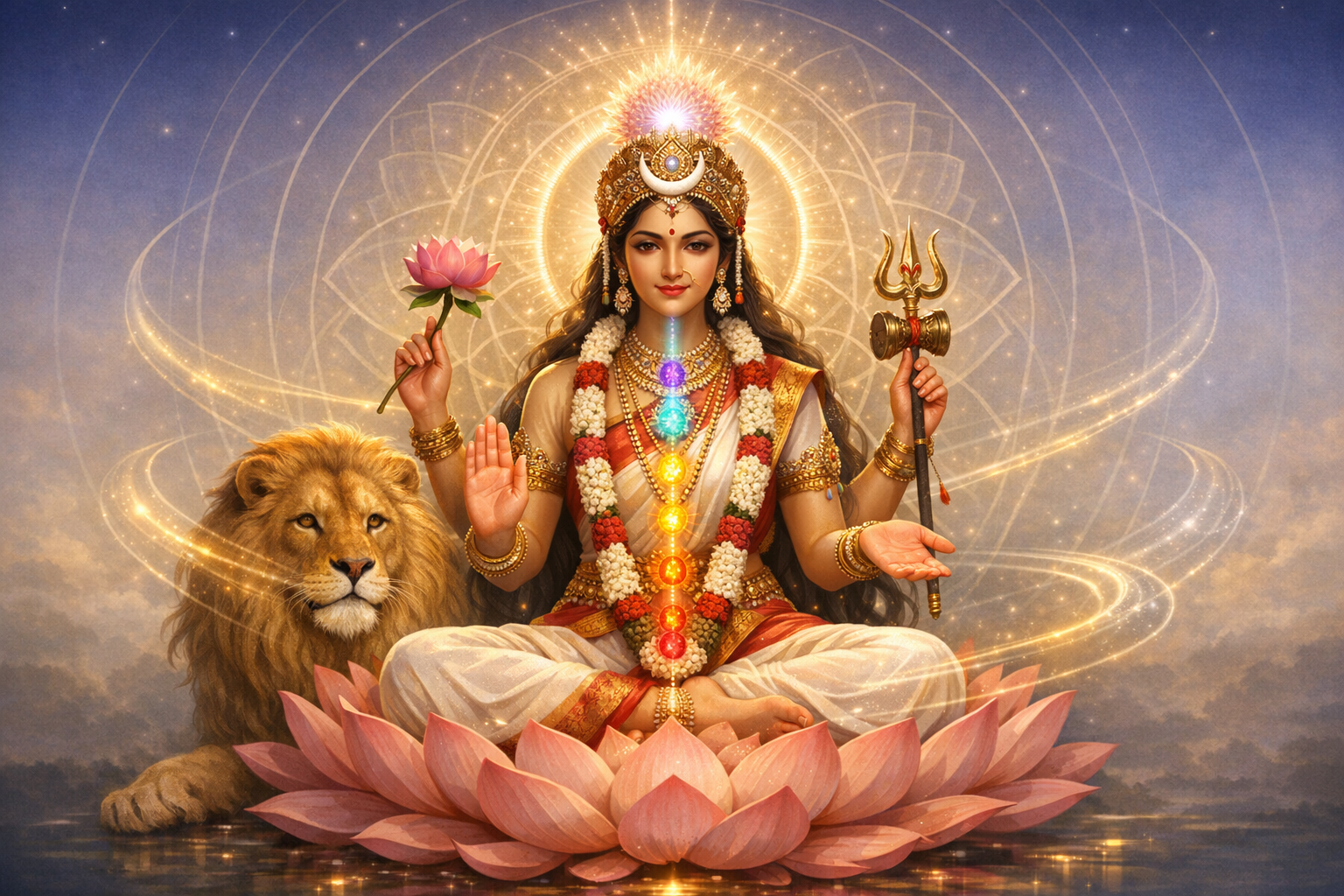
In iconography, Shivani’s symbolism draws on the shared visual language of the Goddess: the lion or tiger as vahana expressing sovereign courage; the lotus as purity beyond contingency; Abhaya and Varada mudras announcing fearlessness and compassionate generosity. Weapons, when present, are not instruments of cruelty but emblems of discernment that sever bondage and protect the vulnerablea visual grammar of justice aligned with ahimsa.
The trident signifies agency across the threefold time and the triadic patterning of nature; the crescent evokes the mind’s waxing clarity under yogic discipline; the garlanded form portrays the victory of insight over fragmentation. Read in this way, Shivani’s form becomes a pedagogical diagraman elegant syllabus of Symbolism that transmits metaphysical principles without a single spoken word.
Shivani’s awakening power is also articulated as a yogic science. In the language of Kundalini, the coiled potential at the muladhara ascends through the sushumna nadi, sanctifying the energy centerssvadhishthana, manipura, anahata, visudha, ajnauntil the thousand-petaled sahasra-dala padma blossoms in quiet effulgence. This ascent is not merely energetic; it is ethical and contemplative, braided with steadiness, compassion, and insight.
As practitioners mature, the anahata center unfolds as a sanctuary of maitri (loving-kindness) and karuna (compassion), while the visudha center refines speech into truthful, beneficent resonance. The integration of breath and awareness clarifies perception at ajna and stabilizes presence, allowing the auspicious union of Shiva and Shakti to be intuited not as dogma but as lived realization.
Practically, japa, dhyana, and pranayama cultivate one-pointedness while inviting grace to act upon effort. These disciplines lend both subtlety and strength to character, preparing the ground for inner transformation. In many households, simple daily offeringswater, light, and gratitudeperform the same essential work as more elaborate worship, reminding that the Hindu way of life treasures sincerity over spectacle.
Rituals that honor the conjoint mystery of Shiva and Shakti are central to this vision. Shivalinga Puja and Abhishekam recall the sanctity of formlessness pervading all forms; Navaratri celebrates the myriad expressions of the Devi; Maha Shivaratri offers vigil to the Absolute whose stillness births all motion. In each festival, Shivani’s presence is a thread that binds practice to principle, joy to wisdom.
Scriptural voices are resoundingly concordant. Upanishadic insights into Brahman and Maya, the Devi Mahatmya’s luminous hymns, the Devi Upanishad’s ontology of Shakti, and the poetic philosophies of Saundaryalahari variously affirm that consciousness and power are one, and that the Divine Mother bears the universe as a compassionate responsibility.
Kashmir Shaivism further nuances this understanding through the doctrines of spanda (vibrational dynamism) and pratyabhijna (recognition). Shivani, as Parāśakti, is the ever-present pulse through which the finite self recognizes its infinite ground. Such recognition does not erase daily duties; rather, it sacralizes them, infusing lokasangrahacare for the common goodinto ordinary choices.
Sound is a privileged vehicle in this tradition. Bija syllables associated with the Goddess condense metaphysical currents into mantric seeds. Properly approached with humility and guidance, sacred sound becomes a laboratory of attention where the mind learns stillness and the heart learns spaciousness, allowing devotion and enquiry to converge.
Ethically, Shivani’s presence is experienced as protective and nurturing in equal measure. The “fierce” dimension signals not anger but the uncompromising protection of truth and the vulnerablecomplementing the maternal embrace through which communities heal. Within Jain thought, meditative refinement from arta and raudra to dharma and shukla dhyana offers a parallel ascent; both streams affirm that inner violence must give way to clarity and compassion.
Dharmic unity emerges naturally when these insights are read across traditions. In Buddhism, Prajnaparamita“Mother of the Buddhas”and the figure of Tara embody wisdom and compassionate rescue. Jain traditions honor Ambika and Padmavati as protectors and exemplars of ahiṁsa. Sikh scripture and later compositions acknowledge Shakti as divine power, with reverence for courage yoked to righteousness. The shared grammar is unmistakable: wisdom, compassion, fearlessness, and service.
Within such a tapestry, the Ishta principle safeguards plurality: each soul may approach the Infinite through a chosen form or ideal without diminishing others. Under this vision, honoring Shivani uplifts rather than excludes, cultivating respect for diverse sadhanas and harmonizing the dharmic familyHinduism, Buddhism, Jainism, and Sikhismaround common ethical horizons.
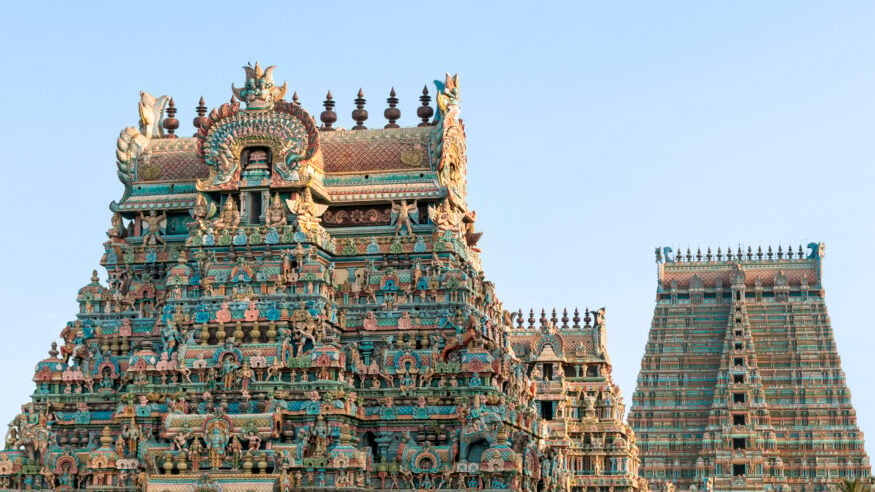
Across sacred geographyfrom Himalayan shrines to coastal templesDevi iconography encodes a living curriculum. The lion and tiger recall disciplined strength; the lotus teaches untainted presence; the haloed radiance around the Goddess suggests purity born of inner fire. Each shrine becomes a university of the senses, inviting contemplation that matures into insight.
In daily life, devotees frequently describe Shivani’s touch as an increase in steadiness under stress, tenderness in relationships, and moral clarity in difficult decisions. Such testimonies, while personal, are remarkably convergent across regions and lineages. They reveal how symbolic forms and contemplative practices translate into emotional balance and social responsibility.
Education through story remains a powerful pedagogy. Episodes that feature the Goddess protecting seekers, guiding kings toward justice, or dissolving the pride of the arrogant are less about miracle and more about moral psychology. They show how devotion can disarm fear, how humility invites wisdom, and how courage must be tempered by compassion.
From an integrative perspective, Shivani’s worship is a complete practice: reflective (philosophical inquiry), meditative (dhyana and breath), devotional (japa and puja), and ethical (seva and ahiṁsa). The synthesis is its genius; each strand fortifies the others, ensuring that spiritual ascent does not bypass the obligations of justice, kindness, and truthfulness.
Festivals intensify this synthesis. During Navaratri, communities celebrate the ascent of inner energy and the victory of discernment over confusion. On Maha Shivaratri, the vigil into silence honors the ground of being from which Shakti dances. These observances, woven into family and community rhythms, keep the flame of remembrance alive across generations.
For students of comparative religion and seekers alike, Goddess Shivani offers a rigorous, compassionate framework for understanding how consciousness becomes culture. She is a unifier of knowledge streamsVedic, Upanishadic, Puranicwhile remaining deeply accessible in the home altar, in the breath, and in everyday kindness.
In sum, Shivani symbolizes the equilibrium of power and love, insight and action. As the Divine Catalyst of creation and balance, she invites a renewal of inner divinity that radiates outward as social harmony. Honoring her is thus both a contemplative act and a civilizational ethican affirmation that the Sacred Feminine, in all its names, sustains the quest for truth and the practice of compassion.
Inspired by this post on Hindu Blog.