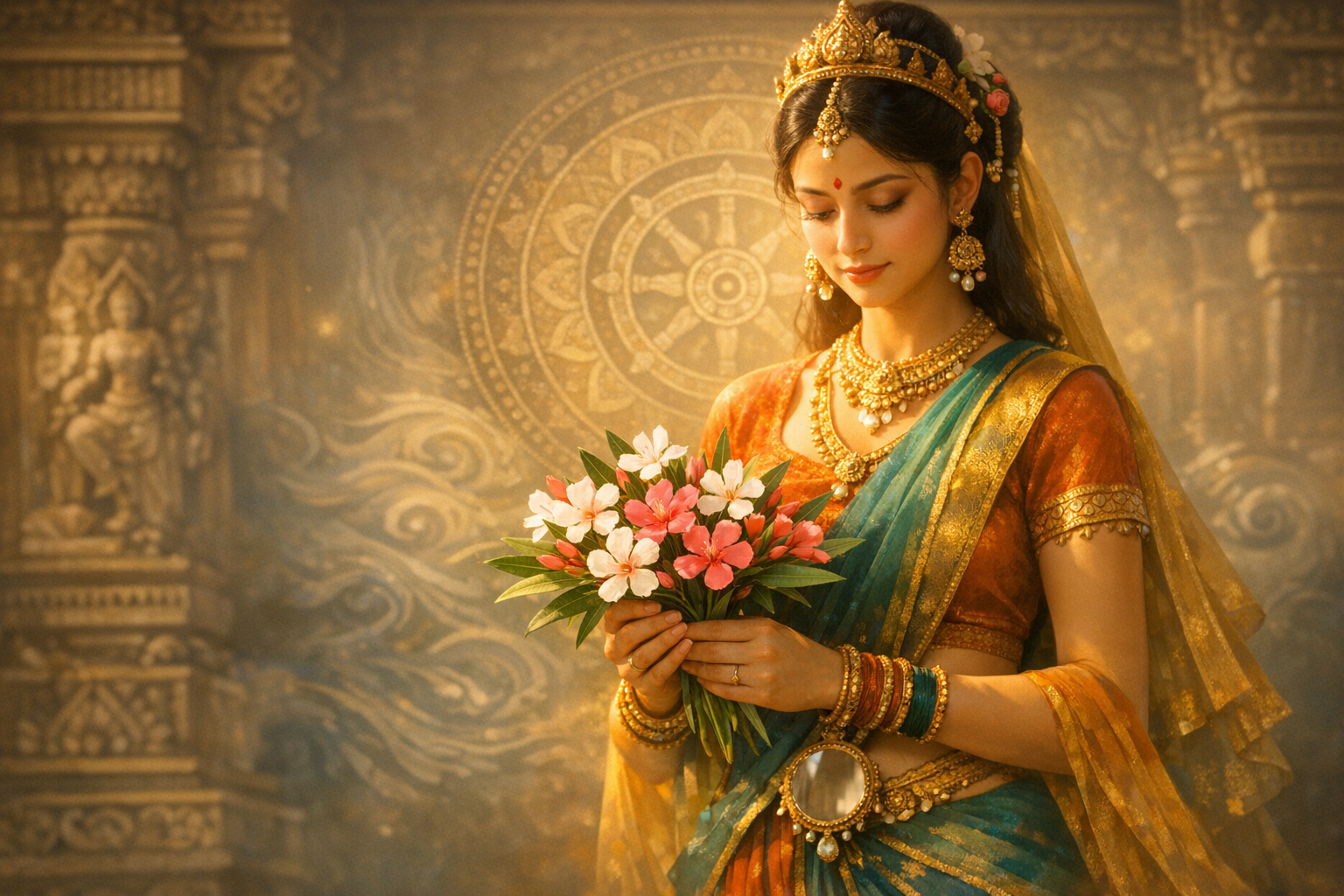
Across Hinduism’s sacred imagination, the image of Apsaras bearing blossoms encapsulates a profound paradox: beauty that uplifts and beauty that tests. When those flowers are identified as Karavīra (oleander), an evergreen renowned for striking color and concealed toxicity, the symbolism deepens into an ethical meditation on allure, discernment, and dharma. This motif invites readers of Hindu mythology and Puranic literature to contemplate how grace, art, and desire can either refine consciousness or divert it, depending on inner alignment.
In Puranic cosmology, Apsaras are celestial performers who arise in the narrative milieu of Samudra Manthana (the Churning of the Ocean), and they populate Indra’s court in Svarga. Their roles range from bearers of auspicious beauty to agents who test ascetics’ vows of tapas. Far from being simplistic figures of seduction, they function as instruments of cosmic equilibrium: when spiritual power (tapas-śakti) accumulates imbalanced by humility and compassion, a test reveals whether that power is anchored in dharma.
Classical narratives illustrate these tests with moral nuance. The account of Viśvāmitra and Menakā frames a pivotal caution: brilliance in austerity can be undermined by subtle self-regard. Menakā, dispatched from Svarga, does not merely tempt; she catalyzes self-inquiry in the sage, culminating in a more integrated discipline. Likewise, in the Mahābhārata, Arjuna’s encounter with Urvaśī in Indra’s heaven dramatizes principled refusal. By addressing Urvaśī as mother, Arjuna reframes kāma (desire) into filial reverence, and even transforms her curse into a strategic boon during his ajñātavāsa as Bṛhannalā. These episodes underscore that the true contest is internal: the governance of the senses (indriya-nigraha) rather than the demonization of beauty.
Karavīra (Nerium oleander) intensifies this moral theatre through its botany and cultural presence. Oleander is evergreen, proliferates with dramatic blossoms, and thrives in challenging environments, symbolizing resilience and abundance. Yet it contains potent cardiac glycosides (e.g., oleandrin) and is toxic if ingested, epitomizing a dual naturevisually radiant, inwardly perilous. This duality mirrors the archetypal arc of allure in Hindu symbolism: that which delights can elevate when ritualized and rightly related to, or harm when appropriated without discernment.
Ritually, Karavīra appears in certain regional paddhatis (liturgical manuals) as an offering, with variations across Śaiva and Śākta practices. Its inclusion underscores an interpretive principle in Hindu worship: materials are not inherently auspicious or inauspicious; their meaning is shaped by intentionality (saṅkalpa), context, and scriptural guidance. The use of a flower known for both brilliance and risk makes explicit a devotional hermeneuticsacralize the senses, do not suppress them; sublimate rasa, do not be subdued by it. As with all ritual materials, practical caution applies: Karavīra is toxic and should be handled knowledgeably and never ingested.
Iconographically, Apsaras frequently hold lotuses (padma), garlands, or bouquets; in textual and regional visual culture the bouquet may be read, by association, as jasmine (mallikā), lotus, or Karavīra depending on locale and liturgical memory. Sculptural programs at Khajuraho, Konark, and Hoysala temples (e.g., Halebidu) teem with bracket figures (śilābalikās, often identified as Apsaras or madanikās) who display flowers and mirrors, signal refined aesthetics, and enact the sanctification of worldly grace. Because stone rarely specifies botanical species, identifying oleander in sculpture is interpretive rather than definitive; nevertheless, the symbolic readingradiant beauty carried into sacred spaceremains consistent.
Read through the lens of rasa theory and the Nāṭyaśāstra, Apsaras carrying blossoms embody the disciplined elevation of śṛṅgāra (the aesthetic of love and beauty). In Hindu spirituality, śṛṅgāra becomes a gateway: sublimated, it matures into bhakti-rasa (devotional savor); untethered, it devolves into agitation. The flower thus mediates between the senses and spiritfragrance and form inviting mindful attention, the stalk and sap reminding that form is transient and demands wise engagement.
Ethically, this symbolism resists reductive, gendered readings. Apsaras function as personifications of allure, artistry, and impermanence rather than as proxies for women in general. Hindu scriptures repeatedly place responsibility on the aspirant’s mastery of mind, not on external blame. Beauty is honored as śaktia powerwhose trajectory is determined by inner intention and disciplined practice.
Parallels in other Dharmic traditions illuminate a shared ethic of self-mastery. In Buddhism, the drama of Mārasometimes represented with daughters who personify temptationtests the Bodhisattva’s equipoise; Buddhist art across Ajanta and Dunhuang depicts celestial dancers in ways that recall Apsara iconography. Jain Dharma emphasizes indriya-saṁyama (sense-restraint) and vows such as brahmacarya, framing allure as a field for cultivating samyak cāritra (right conduct). Sikh tradition names the “five thieves”kāma, krodha, lobha, moha, ahaṅkāraand prescribes simran and seva to transmute them. All four pathways affirm that aesthetic power must be yoked to virtue.
Cross-cultural manifestations further attest the durability of this symbol. The bas-reliefs of Angkor Wat temple Cambodia preserve one of the world’s most celebrated Apsara corpuses, translating Sanskritic motifs into Khmer aesthetics. Their poised gestures, floral adornments, and rhythmic repetition teach a visual grammar: beauty stabilized by balance, ornament chastened by structureart as ethics embodied in stone.
From the standpoint of Dharma, Karavīra-in-hand dramatizes three intertwined disciplines. First, viveka (discernment): distinguish between what merely pleases and what purifies. Second, vairāgya (dispassion): enjoy form without bondage to it. Third, abhyāsa (repeated practice): convert fleeting inspiration into stable character. The Apsara’s blossom becomes a mnemonic for these interior arts.
Classical stories deepen the practical teaching. Menakā and Viśvāmitra show that austerity without humility is brittle; Urvaśī and Arjuna show that reverence can redirect desire without vilifying it. In both, the test is not designed to humiliate but to illuminate the aspirant’s blind spots, so that future tapas is grounded rather than grandiose.
Within temple culture, floral offerings are more than decoration; they are liturgical language. Karavīra’s year-round bloom evokes steadiness in worship, its toxicity warns against heedless indulgence, and its vibrant petals mirror the aspirant’s aspiration to bring the world’s color into the sanctuary of consciousness. The Apsara who bears such a flower signifies the priesthood of the sensesbeauty anoints, but does not enthrone, the ego.
This reading also aligns with a broader Hindu hermeneutic that avoids strict moral binaries. The guṇa-based psychology of sattva, rajas, and tamas suggests that the same stimulus can refine or degrade depending on the mind’s prevailing quality. Thus, the symbol does not condemn the senses; it instructs their orchestration.
In contemporary life, the Apsara-and-oleander motif maps readily onto digital allure, consumer aesthetics, and the economies of attention. Like Karavīra, platforms and products often bloom with brilliance while concealing potent effects on cognition and emotion. A dharmic response is not withdrawal but wise design of habitritualizing engagement, curating inputs, and nurturing communities that convert attention into insight rather than compulsion.
Educationally, the symbol bridges art history and scriptural studies. Students can trace Apsara iconography from early Indic caves to medieval nāgara and dravida temples, and on to Southeast Asian masterpieces, while reading Puranic episodes for ethical subtext. Such integrative study advances cultural literacy and spiritual clarity together.
Taken as a whole, Apsaras carrying Karavīra crystallize a central teaching of Sanātana Dharma: power without purity is perilous, and purity without appreciation impoverishes. Beauty is a trust. When consecrated by discernment, it becomes a vehicle for bhakti and wisdom; when seized by craving, it becomes its opposite. The symbol invites the perennial practice of self-mastery, shared across Hinduism, Buddhism, Jainism, and Sikhism.
Ultimately, the flower in the dancer’s hand is an ethical mirror. It asks whether one’s gaze sanctifies what it sees, whether one’s art refines what it touches, and whether one’s devotion can welcome the world’s radiance without being ruled by it. In that quiet inquiry lies the promise of freedom: to let beauty serve dharma, and to let dharma beautify life.
Inspired by this post on Hindu Blog.