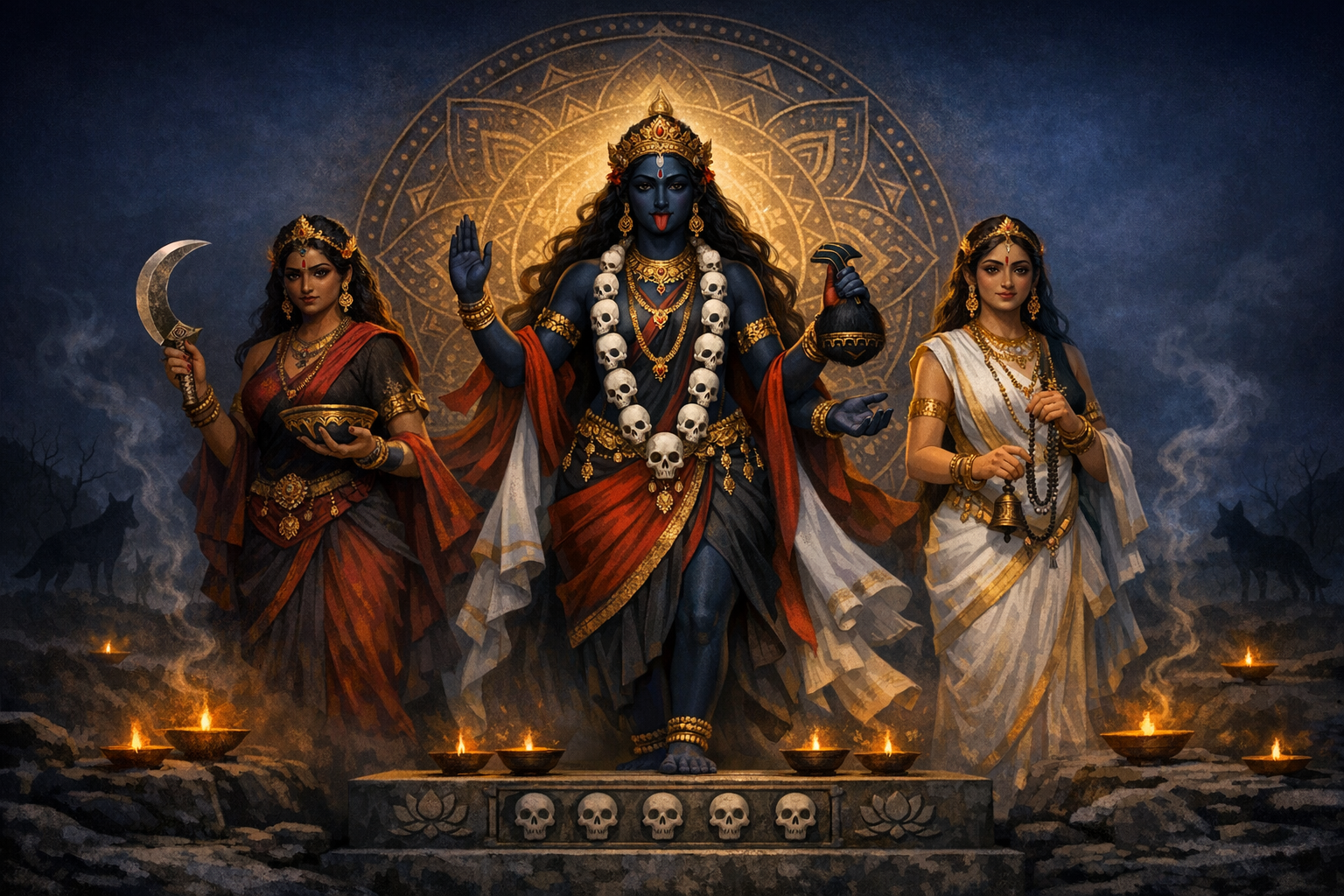
On the moonless night of Kali Puja, two fierce feminine presencesDakini and Yoginioften flank the idol of Goddess Kali. Their appearance is not decorative pageantry but a deliberately encoded teaching. In a single tableau, the altar offers a complete meditation on the conditions of human existence: birth and decay, impulse and insight, terror and trust, bondage and release.
In Shakta iconography, Dakini and Yogini stand as liminal guardians at the thresholds of perception. Emaciated or radiant, skull-garlanded or ash-smeared, bearing the kartrika (ritual chopper) and kapala (skull-bowl), they situate the devotee in the śmaśānathe cremation ground symbolic of time’s uncompromising truth. Jackals, flames, and a darkened sky frequently complete the scene, aligning the senses to impermanence and awakening the resolve to seek liberation while living.
Texts across the Shakta Tantric corpus reference these attendants with notable consistency. The Kalika Purana (associated with the Kamarupa region), the Yogini Tantra, the Kaulajnana Nirnaya, and early Tantric strata such as the Brahmayamala describe circles of yoginis and dakinis as āvaraṇa-devatāprotective and transformative forces invoked around the deity or mandala. Parallel material culture affirms this scriptural memory: the Chausath Yogini temples at Hirapur (Odisha), Bhedaghat (near Jabalpur), Khajuraho, and Mitawali preserve the circular yogini cakra in stone.
Etymology and cross-traditional currents deepen the picture. Yogini (from the verbal root yuj, to yoke or integrate) conveys method, discipline, and embodied power. Ḍākinī, richly elaborated in Vajrayana Buddhism as the “sky-goer” (Tibetan mkha’ ‘gro ma), functions as a wisdom emissary who cuts delusion with uncompromising clarity. These lineagesHindu Shakta Tantra and Vajrayana Buddhismshare an Indic matrix that privileges experiential realization, offering a fertile space of mutual recognition within the broader dharmic family that also includes Jain and Sikh wisdom traditions oriented to fearlessness, ethical clarity, and liberation.
Placed beside Kali, Dakini and Yogini enact a triadic pedagogy. Kali embodies kāla (Time) and the ground of reality that devours names and forms. Dakini represents the incisive, wrathful intelligence (raudra-jñāna) that severs clinging. Yogini manifests applied method (kriyā-śakti)the disciplined integration of body, breath, speech, and mind. Together they signal that transcendence is not flight from life but a lucid passage through it.
Philosophically, the pair dramatizes an inner alchemy. They transmute tamas (inertia) and rajas (agitation) into sattva (clarity), not by avoidance but by metabolizing the very energies that bind. Read through Advaita, they expose superimpositions upon the Self; through Yoga, they stabilize praxis; through Tantra, they harness intensity for illumination. Across these lenses, the instruction converges: face, refine, and realize.
The cremation ground motif is a precise psychological map. Mortality-awareness removes the anesthesia of habit, revealing priorities otherwise obscured by routine desire. Devotees frequently attest that a few contemplative minutes before the triad during Kali Puja invoke both unease and unexpected reliefthe mind resists impermanence, yet the heart recognizes truth. That recognition is the beginning of fearlessness (abhaya).
Severed heads and skulls, often unsettling to the uninitiated, are deliberate symbols. The head stands for the ego-knot and conceptual pride; its severance is not violence but release from tyranny of false identification. The skull-bowl is a reminder to “drink” direct experience without the filters of projection and denial. Parallel Mahavidya streams, such as Chinnamasta’s iconography, carry the same message: truth consumes untruth; what is essential remains.
Ritual implements widen this hermeneutic. The kartrika does not lacerate the world; it cuts fixation. The kapala does not glorify death; it receives insight stripped of ornament. In yogic anatomy, practitioners occasionally map the attendants to iḍā and piṅgalā (complementary pranic currents), with Kali presiding as suṣumṇāthe central current of awakening. While such correspondences are interpretive rather than dogmatic, they sharpen sadhana by aligning imagery, breath, and attention.
Kali’s Pañcamūṇḍī Āsana (seat of five skulls) encountered in some shrines adds another layer. Whether read as the five elements (pañca-bhūta), five aggregates (skandha), or five sheaths (pañca-kośa), the seat proclaims sovereignty over limiting composites. Within that sovereignty, Dakini and Yogini serve as functionaries of discernment and integration, ensuring that transcendence is embodied rather than abstract. This resonates with Panchamundi Asana symbolism preserved in regional practice and literature.
Other Shakta forms echo the same grammar. Goddess Chamunda’s jackals, for instance, patrol the boundary where fear prowls; their presence converts dread into vigilance and vigilance into wisdom. Tripura Sundari symbolism, conversely, reveals the serene, harmonizing face of the same Shakti. Between Kali’s midnight and Lalita’s dawn, the spectrum of the Divine Feminine teaches that terror and tenderness, when comprehended, are one continuous pedagogy.
Ritually, many Kali Puja sequences include āvaraṇa-pūjā, where yoginis create a protective and energizing circumference around the altar. Practitioners perform nyāsa (installations), bhūta-śuddhi (elemental purification), and mantra-japa synchronized with breath. As accounts from Bengal, Assam, and Odisha attest, the felt sense is of containment and clarity: the mind steadies, the heart opens, and the nervous system settles as attention repeatedly returns to Kali’s abhaya (fear-dispelling) and varada (boon-giving) mudras.
This interior process speaks to contemporary psychological insight as well. Consciously engaging “frightening” imagery within a safe ritual container can reduce avoidance, improve affect regulation, and convert diffuse anxiety into focused courage. Shakta sadhana effectively becomes an early science of exposure and integration: encounter the shadow, anchor the breath, name the fear, reclaim agencythen proceed to gratitude and surrender.
The unity of dharmic traditions is visible here in method and outcome. Hindu Shakta Tantra emphasizes transmutation through Shakti; Vajrayana frames the ḍākinī as prajñā’s messenger; Jain teachings cultivate unwavering non-violence and detachment as the ground of fearlessness; Sikh practice calls for steadfast courage and remembrance of the One amid impermanence. Divergent languages, convergent destination: an unafraid, ethical, and liberated human life.
For many devotees, lived experience confirms the theory. Standing before the murti, the senses register darkness, flame, metal, and mantra; within minutes, breath deepens, and the body’s bracing softens. The triad’s grammarKali, Dakini, Yoginirepositions attention from compulsion to clarity. What first appears “fearful” becomes strangely intimate, as if reality, unmasked, were less hostile than habit imagined.
Regional forms enrich this tapestry. In Bengal’s Kali Puja, the midnight stillness amplifies interior listening. In western India’s Kali Chaudas on the eve of Deepavali, cremation-ground motifs challenge the festival’s brightness to include its necessary counterpoint: without night, dawn is not discerned. Across these practices, the message is consistentwholeness, not partiality, liberates.
Iconographic precision guards against misreading. The forms neither celebrate cruelty nor recommend harm; the violence is metaphorical, aimed at avidyā (ignorance) and bandhana (bondage). Where the Tantric tradition uses the language of intensity, it couples it with strict ethic and method. Sadhana undertaken with guidance, scriptural literacy, and compassion for all beings aligns the rite to its liberating purpose.
A practical contemplation during Kali Puja might proceed in three arcs. First, remember impermanence without dramatization: “Everything changes, and I can meet change.” Second, identify one attachment to cut with the inner kartrikaan unhelpful belief, speech pattern, or habit. Third, install a sustaining method with the help of the inner yoginibreath awareness, mantra discipline, or an act of service. In returning to Kali’s fearless presence, the mind learns stability in motion.
Seen in this light, Dakini and Yogini beside Kali are mirrors, not monsters. They reflect the raw materials of human life and the disciplines that refine them. The cremation ground is the curriculum; the implements are the tools; the attendants are the instructors; Kali is the truth that outlasts time. In their company, devotion becomes lucid, courage becomes gentle, and freedom becomes near.
Inspired by this post on Hindu Blog.