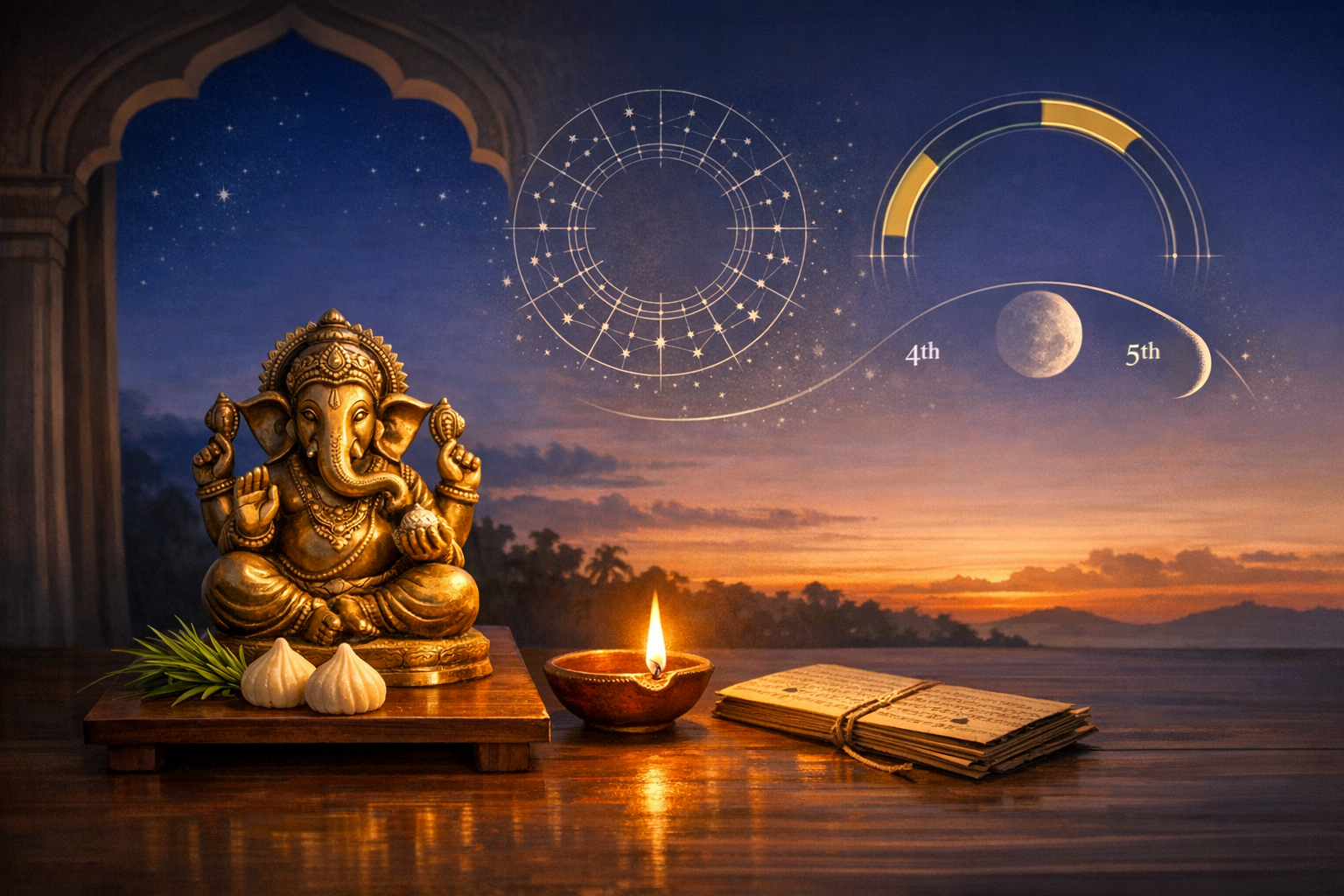
In the Hindu calendar (Panchang), Saturday, March 7, 2026, observes Krishna Paksha Chaturthithe fourth lunar day of the waning phaseuntil 6:28 PM, after which the tithi transitions to Krishna Paksha Panchami in most regions. This precise tithi change is central to daily dharmic planning, festival observances, and personal sankalpa rituals, and it underscores the Panchang’s careful synchronization of astronomical calculation with spiritual practice.
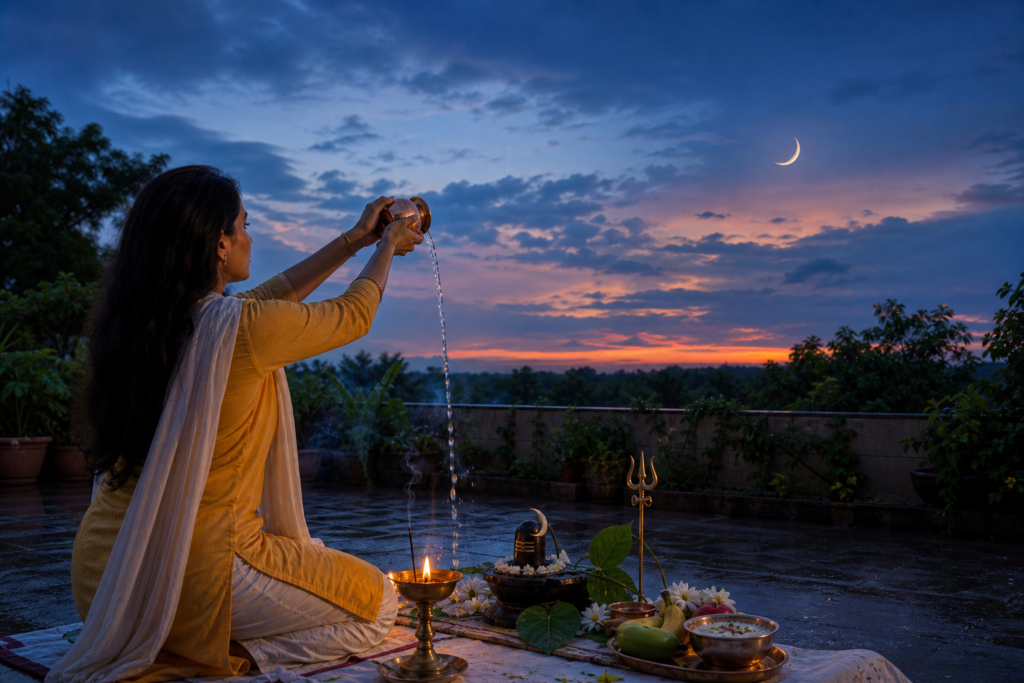
Krishna Paksha Chaturthi holds special significance across Bharat’s spiritual landscape. In many Hindu traditions, this day aligns with Masik Sankashti Chaturthi, when devotees worship Bhagavan Ganesha to seek removal of obstacles (vighna) and cultivate inner steadiness. Households often maintain a simple vrata (fast), offer durva grass and modaka where customary, and conclude observances at moonrise (Chandrodaya) or upon the close of the tithi, guided by their sampradaya and local calendar. As the evening of March 7 progresses, the arrival of Panchami after 6:28 PM marks the next phase of practice for those who track tithi-bound rituals closely.
Technically, a tithi is defined by the relative geocentric longitudinal separation of the Moon from the Sun, divided into 30 equal segments of 12° each. Chaturthi corresponds to the interval in which this separation lies between 36° and 48°, and it ends the moment the separation exceeds 48°, ushering in Panchami. This astronomical frameworkshared across most traditional Panchang computationsensures that March 7, 2026, correctly reflects Krishna Paksha Chaturthi until 6:28 PM before transitioning to Panchami, while allowing for minor regional variation due to locale-specific sunrise and time-zone adjustments.
For devotees observing Sankashti Chaturthi, the practical rhythm is clear yet nuanced. Many follow the conventional pattern of fasting during the day, worshipping Ganesha in the evening, and breaking the fast after sighting the Moon and offering arghya. If local Panchang guidance indicates that Chaturthi ends before moonrise (as may occur when the tithi changes in the early evening), some traditions permit completing the vrata as the tithi concludes, while others emphasize moonrise where feasible. In all cases, adherence to one’s parampara and local almanac guidance remains the most authentic and harmonizing approach.
Good time (Shubh Muhurat) selection on March 7, 2026, may be approached through well-established Panchang tools. Practitioners commonly consider Abhijit Muhurat (a mid-day auspicious window), evaluate day and night Choghadiya for favorable segments such as Labh and Shubh, and avoid inauspicious periods like Rahu Kalam, Yamaganda, and Gulika where local custom advises. Because these windows are sensitive to geographical coordinates and sunrise, local Panchang, temple bulletins, or regional almanacs should be consulted to derive accurate Muhurat for puja, daana, travel, or important decisions.
Nakshatra and Rashi on a given date add another layer of refinement to spiritual planning. Nakshatra reflects the Moon’s position against the stellar backdrop, shaping the tonal quality of sankalpa and recommended practices, while the Moon’s Rashi (zodiac sign) can guide personal introspection in a Vedic astrology context. Because both Nakshatra and Rashi change with precise lunar motion, it is prudent to reference a reliable regional Panchang to confirm the operative Nakshatra and the Moon’s Rashi at the time of one’s observance on March 7, 2026.
Regional variation is an integral feature of the Hindu calendar. The phrase “in most regions” recognizes that sunrise, local timekeeping conventions, and school-specific guidelines (such as Smarta, Vaishnava, Shaiva, and Shakta traditions) can yield small but meaningful differences in observance. Diaspora communities similarly align their Panchang to local geography, ensuring that rituals remain both astronomically precise and spiritually resonant.
This Panchang note also speaks to a broader unity among dharmic traditions. Jain communities employ the tithi framework extensively for their own vratas and parvas; Buddhist communities in several regions observe lunar phases for uposatha-like practices; and Sikh commemorations have historically engaged the Bikrami calendar while many gurdwaras today follow the Nanakshahi system. Recognizing the shared lunar cadence nurtures mutual respect and deepens the ethos of unity in spiritual diversity, a value cherished across Hinduism, Buddhism, Jainism, and Sikhism.
In day-to-day life, families often weave these insights into simple, meaningful routines. A quiet Brahma Muhurta meditation before sunrise, a short Ganesha dhyana before evening chores, lighting a diya at dusk, or a sattvic meal offered with gratitude can transform the calendar’s precision into inner poise. Many also set aside time for daana and seva, aligning the karmic intent of the day with compassionate actionpractices that help translate Panchang knowledge into lived well-being.
In summary, March 7, 2026, presents a clear Panchang profile: Krishna Paksha Chaturthi persists until 6:28 PM, followed by Krishna Paksha Panchami for the remainder of the night, subject to minor regional adjustments. Thoughtful use of Shubh Muhurat, Choghadiya, Nakshatra, and Rashiverified through a local, reputable Panchangsupports accurate and heartfelt observance. When approached with reverence and inclusivity, the Hindu calendar becomes a bridge that connects personal practice with the wider, shared rhythm of dharmic traditions.
Inspired by this post on Hindu Blog.