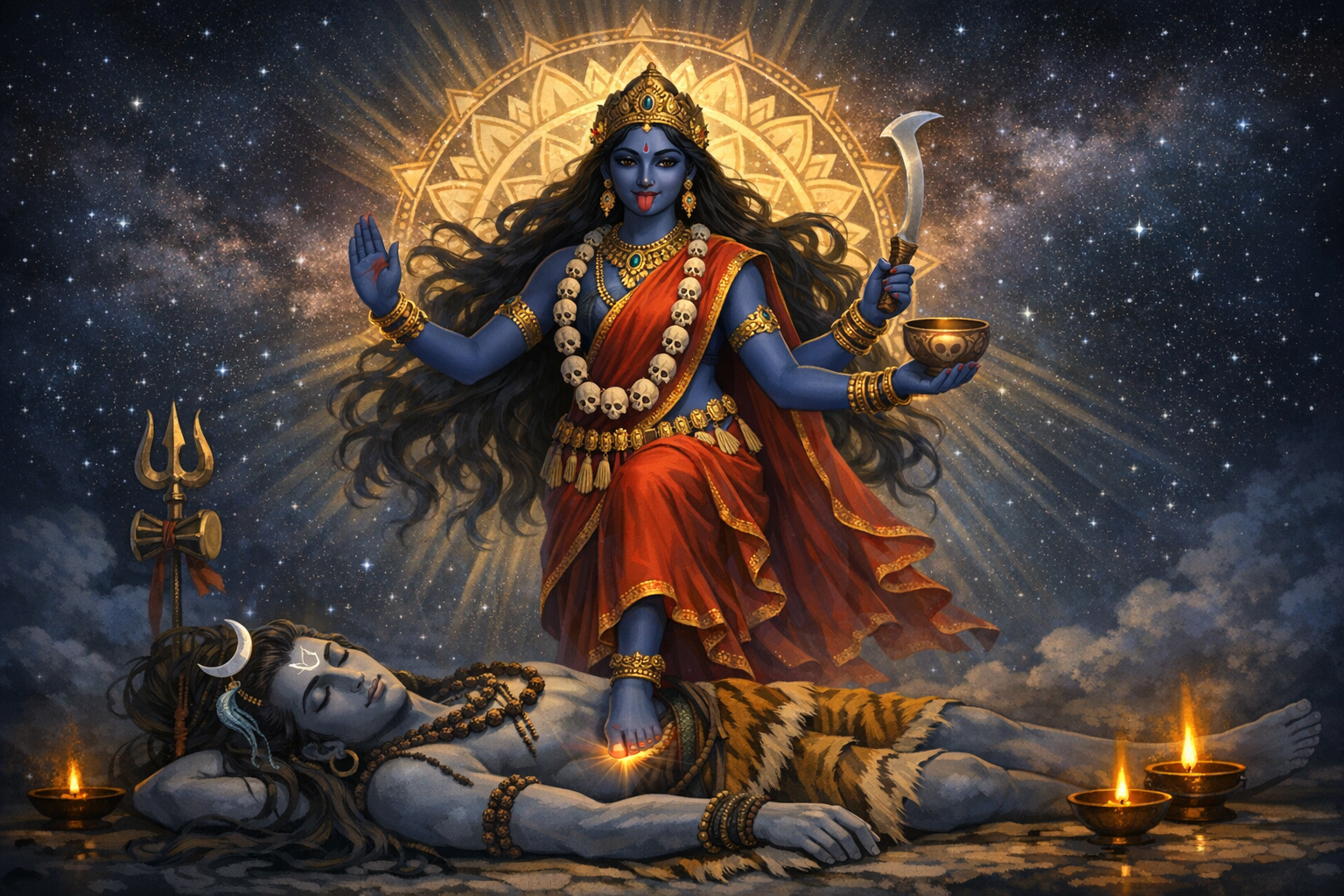
The image of Mother Kali standing upon the reclining form of Lord Shiva is among the most potent and debated motifs in Hindu iconography. Far from depicting subjugation or discord, it is a rigorous visual theology that encodes the profound non-duality of consciousness and energy. Read through the lenses of Shaktism, Shaivism, Tantra, Vedanta, and Kashmir Shaivism, this tableau illuminates how reality unfolds as the inseparable dance of Shiva (pure awareness) and Shakti (dynamic power).
At its core, the symbolism asserts that consciousness without energy is inert, while energy without consciousness is directionless. In the idiom beloved by practitioners, without Shakti, Shiva becomes shava (a corpse); with Shakti, Shiva is the ever-auspicious, self-luminous ground of being. The icon thus refuses simplistic binaries and insists on complementary unityan interpretive key that is essential to Hindu traditions and deeply resonant with the broader dharmic family.
The celebrated Sanskrit punśava versus śivacaptures this insight succinctly. Remove the energizing principle (symbolized by the phonetic element that differentiates śiva from śava), and consciousness appears lifeless. Restore it, and the universe awakens. This philological play undergirds a sophisticated metaphysics: the world is neither sheer materiality nor mere thought, but the indivisible rhythm of awareness expressing itself as power.
Mythic narratives crystallize this lesson. The Devi Mahatmya recalls the Goddess’ fierce formsKali arising to quell unbridled forces such as Raktabijawhose proliferating violence must be transmuted rather than merely opposed. In many regional tellings, Shiva lies down as a compassionate, conscious ground. When Kali steps upon him, she recognizes her Beloved, moderates the roudra (terrible) surge, and her lolling tongue signifies a sudden self-recognition and restraint. The image, then, is a pedagogy about the containment and consecration of power by awareness.
Tantric literature, including the Kalika Purana, Kularnava Tantra, and Mahanirvana Tantra, reads this as a soteriological diagram. Kali’s kinetic blaze is the great current of life; Shiva’s stillness is the witness that renders that current intelligible and liberative. The Goddess stands upon the Lord not to conquer, but to reveal that the highest peace (śānti) is born when power finds its axis in consciousness.
Iconographic details reinforce the teaching. Kali’s complexion is the color of deep spacebeyond attributesimplying the boundlessness of Shakti. Her garland of skulls and girdle of severed arms are not morbid trophies, but reminders that time (kāla) devours forms and returns them to essence. The cremation-ground setting dramatizes impermanence and the necessity of spiritual transformation. These motifs have cohered historically in Bengal and the greater Shakta world, becoming central to Kali Puja and temple art such as Kalighat paintings.
Shiva, by contrast, is shown supine, ash-smeared, serene, and utterly unthreateneda shava only in the sense of perfect stillness (sthiti). This posture does not signify defeat; it is the yogic equipoise of Mahayogi, the substratum on which Shakti’s play can be witnessed, purified, and divinized. The icon instructs that unanchored vitality can become frenzy, while rooted energy becomes wisdom-in-action.
Philosophically, the image aligns with Sāṅkhya’s Purusha–Prakriti dyadawareness and naturewhile also transcending it through non-dual insight. In Advaita Vedanta, Brahman appears as the world through Maya-Shakti; in Shaktism, Shakti is Brahman’s own self-expression. The Kali–Shiva union affirms both perspectives: there is no ontological rift, only modalities of the One.
Kashmir Shaivism offers further precision. Reality vibrates (spanda) as Shiva–Shaktia single pulse whose apparent two-aspect expression is awareness (cit) and its power (śakti). In this view, Kali’s foot upon Shiva tells not of hierarchy but of oscillation: when power surges, consciousness relaxes into sheer witnessing; when witnessing intensifies, power refines into clarity. Liberation (moksha) arises when the practitioner intuits this non-separation at all times.
The cosmic dance (tandava–lasya) frames the same truth. As Nataraja, Shiva choreographs the five actscreation (srishti), maintenance (sthiti), dissolution (samhara), concealment (tirobhava), and grace (anugraha). In Kali’s roudra dance, the dissolutional power peaks; Shiva’s repose introduces anugraha. Together, they complete the cycle, suggesting that every ending, rightly understood, is a gate to grace.
Another layer is temporal. Kali, cognate with kāla (time), measures and unmakes forms; Shiva as Mahākāla transcends time. Their embrace articulates the paradox of spiritual life: to act skillfully within time while abiding in the timeless. When Kali pauses upon Shiva, time rediscovers eternity; when Shiva receives Kali’s step, eternity blesses time.
Regional iconography distinguishes Dakshina Kali (often with the right foot forward) from Smashana Kali (often with the left). The former tends toward protective, world-engaged benevolence; the latter toward radical renunciation and transformation in the cremation ground. In both, the foot on Shiva communicates the same metaphysical lesson: energy is auspicious when established in awareness.
The Goddess’ protruding tongue is interpreted in multiple, non-contradictory ways. It can index sudden self-restraint, the shock of recognition, or the immediate sublimation of ferocity into compassion. Devotional readings in Bengal cherish the intimacy of this moment: in recognizing Shiva, Kali recognizes herself, and wrath softens into love. The icon thereby teaches ethical vigilance and spiritual humility.
For practitioners, the tableau functions as a contemplative map. Meditating on Kali’s dynamic presence while resting attention in Shiva-like witnessing can quiet reactivity and channel vitality into discernment. Many report that such contemplation dissolves inner conflict: breath steadies, the mind clears, and strong emotions convert into luminous resolve. The symbol thus speaks as much to psychological integration as to theology.
Tantric physiology (kundalini, chakras, nāḍīs) offers a microcosmic correlate. Shakti ascends as kundalini through the central channel (sushumna), while Shiva-consciousness pervades as the silent witness. Without grounding awareness, energetic arousal can scatter; without awakened energy, practice can stagnate. The icon of Kali and Shiva models the balance that mature sadhana seeks.
Ritually, simple and safe devotions echo this grammar of unity: steady japa of Om Namah Shivaya for inner stillness; reverent salutation to the Mother through Om Krim Kalikayai Namah for courage and transformation; and mindful breathing to harmonize prana. Traditional texts emphasize guidance and ethical preparation for advanced rites; the icon itself reminds that power without purity is perilous, and purity without power is incomplete.
Historically, the Kali–Shiva motif flourished under the Pala–Sena milieu in eastern India and spread through Shakta, Tantric, and folk currents. Temple imagery at Kalighat, Dakshineswar, and across eastern India exemplifies its devotional centrality, while philosophical commentaries in Shaiva and Shakta traditions furnished its doctrinal depth. The continuity of form and meaning across centuries attests to its canonical status in Hindu art and thought.
Across the dharmic spectrum, cognate principles appear. Vajrayana Buddhism’s yab–yum symbology unites upaya (skillful means) and prajna (wisdom), parallel to Shakti and Shiva. Jain philosophy’s emphasis on jnana (knowledge), shuddhi (purity), and virya (spiritual energy) likewise seeks the harmonization of clarity with disciplined vitality. Sikh tradition venerates the One (Akal Purakh) while honoring shakti in scriptural and martial devotion, affirming the union of courage and compassion. Each tradition, in its own idiom, prizes the inseparability of insight and power.
This cross-traditional consonance serves the contemporary need for unity in diversity. The icon of Kali upon Shiva does not privilege one path over another; it instructs that any authentic path must integrate awareness and energy, wisdom and action, love and strength. Such a reading supports harmony among Hinduism, Buddhism, Jainism, and Sikhism without erasing their distinct teachings and practices.
Crucially, the tableau resists modern misreadings that project conflict, gender antagonism, or gratuitous violence onto it. Within Hinduism, the Goddess and the Lord are not rivals but reflections; Shakti is Shiva, and Shiva is Shakti. The apparent asymmetry of posture functions pedagogically, not politically, guiding practitioners from literalism to liberation-centric understanding.
In ethical and social life, the symbol inspires a poise that is both firm and gentle. When intensity arisesanger, fear, urgencylet Kali’s step remind that energy must find ground in Shiva-like clarity before acting. When quietism temptswithdrawal, indifferencelet Shiva’s hospitality to Kali recall that awareness must consent to power to serve the world. The dharma of balance becomes actionable and humane.
From the vantage of Hindu iconography, every element in the image is an interpretive cue: the cremation ground is the field of impermanence; the skulls, the syllabus of time; the weapons, the faculties that cut through ignorance; the abhaya gesture, a covenant of fearlessness; and Shiva’s serene body, the throne of stillness. Together they compose an integral spiritual curriculum in visual form.
Comparatively, placing this motif beside Shiva Nataraja clarifies its logic. Where Nataraja subdues Apasmara (forgetfulness) under his dancing foot, Kali’s foot upon Shiva subdues excess dynamism within consciousness itself, preventing compassion from curdling into chaos. Both scenes are performative metaphysics, dramatizing how freedom is won when awareness masters ignorance and energy serves truth.
The takeaway for seekers and scholars alike is precise and practical. Kali upon Shiva is a rigorous teaching in Hindu symbolism: energy needs anchoring; awareness needs activation; liberation needs both. Read with care, the image offers a contemplative method, an ethical stance, and a civilizational vocabulary for unity across dharmic traditions.
Thus, the so-called “sacred dance” is not an episode but an equation: Shiva = consciousness, Kali = power, and their union = reality as such. To understand this icon is to read Hinduism’s spiritual physics at a glancesubtle, comprehensive, and compassionate. It invites a life in which clarity steadies courage, and courage animates clarity, for the good of self and society.
Inspired by this post on Hindu Blog.