
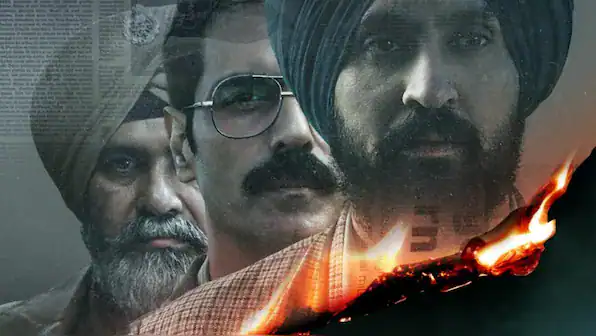
A film has become a contest over public memory. Honey Trehan’s Satluj, originally titled Punjab ’95, dramatizes the life, investigation, abduction and killing of human-rights activist Jaswant Singh Khalra. Its brief release on ZEE5 and abrupt removal transformed a biographical drama into a national argument about censorship, counter-terrorism, historical accuracy and the ownership of Punjab’s past. A Firstpost critique published on July 9, 2026 warned that the film’s selective frame could displace the memory of those murdered by Khalistani militants. That concern deserves serious examination, but so does the judicially documented history at the centre of the film. The relevant question is not whether cinema may concentrate on one life. It is whether a concentrated narrative is subsequently mistaken for a complete history of Punjab’s terror years.
The most defensible conclusion begins by holding two propositions together. Khalistani militant organizations committed sustained violence against Hindu and Sikh civilians, police personnel, journalists, elected representatives and dissenting religious figures. State agencies, while confronting that insurgency, also committed grave violations that included illegal detention, torture, enforced disappearance, staged encounters and unauthorized cremations. Recognizing both records is not false equivalence. Armed organizations and constitutional authorities possessed different powers, obligations and standards of accountability. Militants bore direct responsibility for terrorism; the state bore the additional duty to protect life and enforce the law without becoming lawless itself. Any account that erases either dimension converts historical memory into political advocacy.
The release controversy intensified the film’s authority. Satluj began streaming on July 3, 2026, after a certification dispute lasting several years. Reports stated that the Central Board of Film Certification had proposed 127 changes for the theatrical version, while the filmmakers maintained that the digital release was uncut apart from its changed title. ZEE5 removed it in India within roughly 48 hours and subsequently withdrew it from international territories as well. The release chronology and the later global removal are independently reported. Regardless of anyone’s intent, withdrawal made the film more culturally potent: a suppressed work is easily received not merely as art, but as forbidden evidence.
This amplification was visible almost immediately. Associated Press reporting from Punjab described community screenings in gurdwara compounds and village spaces, where elderly survivors watched beside people born after the insurgency. Such gatherings demonstrate that the film touches living grief rather than a remote controversy. They also reveal the danger of substituting prohibition for public reasoning. Removal does not establish that every scene is historically accurate, just as official approval would not have established that every interpretation was correct. It chiefly increases curiosity, hardens competing identities and encourages audiences to treat a dramatic work as an archive that authorities fear.
What Satluj chooses to show is real and specific. The film follows Khalra as he traces disappeared people through cremation registers and other official records, confronts institutional intimidation and persists despite threats. Its emotional centre lies with families denied bodies, death certificates and final rites. That is a legitimate biographical focus. A film about one investigator is not automatically obliged to become an encyclopaedia of the entire Khalistan movement, Operation Blue Star, the 1984 anti-Sikh massacres and the counterinsurgency. Yet the closer a production adheres to real names, dates, institutions and judicial cases, the more likely viewers are to receive its dramatic frame as a historical verdict. The responsibility for context therefore extends beyond the screen to reviews, classrooms, public discussions and accompanying archival material.
Cinema and historiography operate differently. A feature film builds identification through a protagonist, compresses time, combines incidents and narrows perspective. Historical inquiry compares hostile sources, distinguishes allegation from adjudicated fact, explains uncertainty and resists a single moral camera angle. A film can be truthful about what it depicts while remaining seriously incomplete about what surrounds that depiction. Conversely, incompleteness does not by itself prove fabrication. This distinction provides the soundest framework for evaluating Satluj: its treatment of Khalra must be tested against courts and official records, while its representation of the wider era must be assessed against what it includes, what it omits and what conclusions those omissions invite.
Punjab’s crisis did not begin with the police campaign of the 1990s. Its origins lay in an unstable interaction among constitutional demands, centre-state conflict, electoral competition, religious mobilization and escalating political violence. Disputes concerning Chandigarh, river waters, linguistic identity and federal authority were not inherently secessionist. Many were advanced through democratic parties and mass protest. Academic analysis must therefore distinguish regional grievances and the Anandpur Sahib Resolution from the later armed campaign for Khalistan. Treating every demand for autonomy as terrorism distorts history; treating terrorism as the inevitable or legitimate expression of those demands distorts it in the opposite direction.
The Firstpost essay treats the political elevation of Jarnail Singh Bhindranwale as a foundational failure associated with Congress strategy. Scholarship and contemporary reporting support a more careful formulation: Congress figures appear to have initially regarded Bhindranwale as a useful counterweight to the Akali Dal. An academic study of Sikh politics discusses that early alignment, while accounts of responsibility differ over the knowledge and roles of Indira Gandhi, Sanjay Gandhi and Giani Zail Singh. Political cultivation, opportunism and miscalculation are therefore credible explanations, but the entire conflict cannot be reduced to one patronage decision. Akali strategy, militant agency, state repression, failed negotiations and external assistance also shaped the escalation.
Militant violence preceded Operation Blue Star. Assassinations, communal targeting and attacks on public transport had already altered daily life by 1983 and early 1984. Rajya Sabha member and Panjab University professor V. N. Tewari, the father of Manish Tewari, was shot dead during a morning walk on April 3, 1984, months before the Army entered the Sri Harmandir Sahib complex. His death is documented in contemporary parliamentary material and later biographical reporting. The October 1983 killing of Hindu bus passengers at Dhilwan had already demonstrated the use of religious identity as a selection criterion. These events matter because any chronology beginning only with June or November 1984 conceals the fear that had already taken hold.
Operation Blue Star in June 1984 marked a catastrophic turning point. Armed militants had fortified positions within the complex of Sikhism’s holiest shrine, presenting the state with a genuine security crisis. The decision to use the Army, the timing of the operation during a major religious observance, civilian deaths, the loss of soldiers and the severe damage to the Akal Takht produced a profound and enduring Sikh trauma. Both realities must remain visible: sacred premises had been militarized by armed actors, and the state’s military response inflicted devastation at a site of extraordinary religious significance. Collapsing either fact into the other prevents understanding of why the operation was defended as necessary by some and experienced as an assault on the Panth by many Sikhs.
Indira Gandhi’s assassination by two Sikh bodyguards on October 31, 1984, was followed by mass violence against Sikhs, particularly in Delhi. Collective punishment of an entire community for the crimes of two individuals was indefensible. Government records cited by the Press Information Bureau list 3,325 deaths across India, including 2,733 in Delhi. The Justice Nanavati Commission and related inquiries examined police failures and evidence concerning the involvement of individual political leaders; they did not establish institutional guilt for every Hindu organization or for Hindus collectively. These anti-Sikh massacres, often described as pogroms, are indispensable to the history because they deepened alienation, damaged confidence in the state and supplied militant recruiters with powerful propaganda.
The insurgency that intensified after 1984 was neither a spontaneous uprising of all Sikhs nor a conflict created solely from outside India. It drew on domestic anger, political breakdown and cycles of retaliation, but it also acquired cross-border and diaspora dimensions. Militant factions received varying forms of sanctuary, training or material assistance from Pakistan, while overseas networks internationalized separatist messaging and finance. The most devastating transnational example was the June 1985 bombing of Air India Flight 182. The attack killed all 329 people aboard, most of them Canadians, and remains the deadliest terrorist attack in Canadian history, according to Public Safety Canada. The victims included people from Sikh, Hindu and other backgrounds; extremist violence did not respect the community it claimed to defend.
The numerical record conveys the scale but requires caution. The South Asia Terrorism Portal’s provisional compilation for 1981–2000, derived from news reports, lists 11,782 civilian deaths, 1,753 security-force deaths and 8,095 militant deaths, for a total of 21,630. Its security category is broader than Punjab Police alone, so the frequently cited shorthand of approximately 1,800 slain policemen should not be treated as an exact occupational count. Other official and scholarly datasets use different periods and classifications. None of these aggregate figures reliably identifies every victim’s religion or attributes every disputed encounter. Sound historical writing should disclose those limitations rather than converting a total civilian count into an unsupported communal figure.
The absence of perfect data does not obscure the documented pattern of militant attacks. In July 1987, gunmen hijacked a bus near Lalru and killed 38 passengers, most of them Hindus travelling toward Rishikesh, according to contemporary reporting. On June 25, 1989, attackers opened fire on an RSS gathering at Nehru Park in Moga and then detonated explosives. The Moga district administration’s memorial account records 25 deaths, including 21 RSS workers, a civilian couple and two security personnel. Markets, buses, trains and workplaces became sites of terror precisely because ordinary routines offered vulnerable targets. Remembering these victims is not a partisan concession; it is a basic obligation of historical accuracy.
Hindus were deliberately targeted in numerous attacks, but militant coercion was not confined to Hindus. Sikh political moderates, Namdharis, public servants, suspected informants, journalists and villagers who rejected separatist commands were also threatened or killed. Militant organizations attacked election candidates and sought to prevent voting through intimidation. Human Rights Watch’s contemporaneous account documented assassinations of civil servants, candidates and journalists, violence against both Hindu and Sikh civilians, indiscriminate attacks and criminal activity involving extortion and arms trafficking. Thousands of Sikhs refused to equate their faith with armed separatism, sometimes at mortal risk. Their courage is central to Sikh history and to the restoration of peace.
The press and police families carried a distinct burden. Newspaper owners, editors, reporters, distributors and hawkers were attacked in efforts to control language and reporting. Relatives of police personnel, including people with no operational role, were targeted as a method of revenge and intimidation. Such tactics sought to create a society in which the militant organization, rather than the elected state or independent press, determined acceptable speech and conduct. This coercive environment is essential context for understanding why large sections of Punjab’s population ultimately withdrew cooperation from armed factions and why local intelligence became decisive in the counterinsurgency.
The sacrifices of police personnel should not be reduced to a statistic. Each death represented a household suddenly deprived of a parent, spouse, sibling or child. Many officers served while their homes were threatened and their families required protection. The force did not stand outside Punjab’s social fabric; it included Punjabis and Sikhs confronting militants who also claimed to speak for Punjab and the Sikh community. Recognizing approximately 1,750 security-force fatalities does not require granting immunity to officers who committed crimes. It means acknowledging that lawful service and unlawful abuse could exist within the same institution, and that individual conduct must be judged individually.
K. P. S. Gill and Chief Minister Beant Singh occupy the most contested part of this memory. Gill is widely credited with reorganizing and energizing the Punjab Police, shifting the initiative away from armed factions and helping restore public order. He is also associated with a counterinsurgency system accused of encouraging staged encounters, disappearances and impunity. Beant Singh’s elected government supplied political backing during the decisive phase of the campaign; on August 31, 1995, a suicide bombing killed him and 17 others, as summarized by DD News. Neither hagiography nor demonization is adequate. Gill’s operational effectiveness and the serious abuses committed under the broader security apparatus are both parts of the historical record.
The rule-of-law question cannot be answered by outcomes alone. Defeating an armed insurgency is a legitimate and necessary state objective. Arresting suspects, protecting witnesses, penetrating militant networks and using proportionate force against armed resistance fall within that objective. Torturing detainees, killing people already in custody, falsifying encounters or denying families their dead do not. The distinction is not sentimental legalism. Once rewards, secrecy and weak oversight make unlawful killing administratively useful, innocent people, personal enemies and low-level suspects can be swept into the same machinery. A counter-terrorism campaign may restore physical order while leaving unresolved damage to institutional legitimacy.
Jaswant Singh Khalra’s importance rests on evidence, not merely cinematic emotion. His investigation examined cremation-ground records and alleged that people taken into custody had been killed and disposed of as unidentified bodies. The ensuing legal process did not validate every estimate ever associated with Punjab’s disappearances, but it established that the underlying issue was neither invented nor trivial. Khalra’s work forced public institutions to confront records that bereaved families had been unable to access. For a family waiting at a gate for someone who never returned, the difference between an allegation and an official identification was not abstract: it determined whether mourning, ritual and legal recognition were possible.
The most reliable figures concerning the cremations should be stated precisely. In 2012, the National Human Rights Commission recommended monetary relief for the families of 1,513 deceased persons identified from 2,097 bodies referred to it by the Supreme Court. The final group included 195 people considered to have been in deemed police custody and 1,318 others whose bodies were cremated by state authorities without adherence to applicable rules and humanitarian requirements. Another 532 bodies remained unidentified. The finding concerning improper cremation does not automatically prove that all 2,097 people were innocent or extrajudicially executed. It does prove a large-scale failure of identification, custody safeguards, procedure and respect for the dead.
Khalra’s own fate was adjudicated separately. He was abducted in September 1995 and killed while unlawfully detained. In 2011, the Supreme Court upheld life sentences imposed on Punjab Police personnel. The Supreme Court judgment concluded that Khalra had exposed police misconduct involving the killing of innocent people under the description of terrorists and their cremation without identification or ritual; it also found that police officials had threatened and abducted him so that he could be murdered. These conclusions form a firm factual core for Satluj. Criticism of the film’s wider framing cannot ethically proceed by minimizing Khalra’s work or treating his murder as unproven.
The film’s central story is therefore not a fabrication. Its depiction of an investigator following cremation records, facing threats and being killed by police rests on litigation, convictions and official proceedings. It is reasonable to debate characterization, chronology, composite figures and dramatic emphasis. It is not reasonable to dismiss the entire narrative merely because separatist networks may exploit it. A fact does not become false when a hostile actor cites it. National confidence is better served by demonstrating that India’s courts eventually convicted police officers and that the NHRC recognized violations than by appearing afraid of the documentary record.
At the same time, a viewer unfamiliar with the period could leave Satluj with an incomplete causal map. A tightly focused account of police crimes may allow the counterinsurgency to appear as violence without an insurgency, as though officers entered an otherwise peaceful society and began abducting people without the preceding years of assassinations, bombings, extortion and communal targeting. That is the strongest form of the historical-revisionism critique. The remedy is not to declare Khalra’s story illegitimate. It is to insist that a biographical truth be located within the larger record of militant terror, political manipulation, anti-Sikh mass violence, security-force sacrifice and state abuse.
The Firstpost argument also uses counterfactuals: had political leaders not helped elevate Bhindranwale, Indira Gandhi, V. N. Tewari, Beant Singh, police personnel and thousands of civilians might have survived. Such statements communicate moral urgency but cannot be verified like dates, convictions or casualty records. V. N. Tewari was killed before Operation Blue Star; Beant Singh was assassinated eleven years later; each death emerged from a distinct chain of choices. The academically defensible conclusion is narrower. Political opportunism and delayed institutional action contributed to escalation, but armed perpetrators retained direct agency, later government decisions introduced new consequences, and no single decision explains every death across a conflict lasting more than a decade.
Historical memory should not become a competition in grief. The mother of a disappeared Sikh youth, the widow of a murdered police constable, the survivor of a bus attack, the family of an RSS swayamsevak killed at Moga and the Sikh household burned during the 1984 massacres do not cancel one another. Each suffered an irreducible loss. Selective remembrance becomes dangerous when sympathy is made conditional on the victim’s usefulness to a present political camp. A mature national memory records who acted, what evidence exists, which claims remain disputed and what remedies followed, without assigning inherited guilt to an entire religious community.
The censorship dispute should be separated from the accuracy dispute. Government sources cited security concerns and the possibility that separatist or hostile information networks could use portions of the film. The Information and Broadcasting Ministry initiated review under the Information Technology Rules, while the long-running CBFC dispute concerned theatrical certification. A useful legal explanation of the distinct regulatory routes shows why terms such as ban, certification and platform withdrawal should not be used interchangeably. None of those administrative processes, by itself, constitutes a judicial determination that the historical events depicted are false.
A prohibition is also a weak instrument for correcting a partial narrative. It prevents lawful viewers from examining the work while leaving decontextualized clips, unofficial copies and emotionally charged commentary to circulate without annotation. A more proportionate response would combine age classification, a clear statement that the film is a dramatized biographical account, publication of the specific objections, access to the filmmakers’ reply and freely available links to judgments, commission reports and casualty data. If particular scenes are alleged to defame living people or invent material facts, those claims should be identified and tested. Vague suppression encourages mythology; precise rebuttal strengthens public knowledge.
The reported village screenings reveal a deeper social need. Older Punjabis carry memories that younger generations often encounter only through family fragments, commemorations or politicized social media. A film can open a conversation that official silence postponed, but intergenerational emotion also makes contextualization more urgent. Screenings devoted to Khalra’s courage could be followed by discussions of militant massacres, the 1984 anti-Sikh violence, police casualties and the NHRC proceedings. Such a format would neither dilute Khalra’s sacrifice nor excuse terrorism. It would transform spectatorship into historical inquiry.
A reliable method for studying Punjab’s terror years requires a hierarchy of evidence. Judicial findings should be distinguished from commission conclusions; commission conclusions from documented allegations; documented allegations from memoir; memoir from political speech; and all of these from cinematic invention. Casualty totals should name their period, source and category. Oral histories should preserve Hindu, Sikh, police, militant-family and survivor testimony without assuming that memory is error-free. The Ministry of Home Affairs archive of inquiry reports, the Supreme Court record, NHRC proceedings, contemporary human-rights reports and independently maintained incident datasets provide a stronger foundation than viral clips or communal slogans.
Dharmic unity requires truth without collective blame. Hinduism, Sikhism, Buddhism and Jainism are doctrinally distinct traditions, yet their ethical vocabularies repeatedly emphasize disciplined conduct, compassion, service, restraint and the dignity of life. Dharma cannot mean excusing terrorism when the victims are Hindu, excusing unlawful state violence when the victims are Sikh, or overlooking the suffering of police families because the institution contained offenders. Ahimsa does not forbid lawful protection of society, but it does reject cruelty and vengeance as ends in themselves. Seva requires attention to the bereaved without first testing their political identity.
Punjab’s Hindu and Sikh communities are bound by language, locality, kinship, shared sacred geographies, military service, migration and the trauma of Partition. Violent separatist organizations cannot be made synonymous with Sikhism or with Sikhs. Anti-Sikh mobs cannot be made synonymous with Hinduism or with Hindus. Punjab Police abuses cannot be attributed to every officer, and the sacrifice of honest officers cannot erase crimes committed by colleagues. These distinctions are not rhetorical moderation; they are necessary for preventing historical analysis from reproducing the communal logic used by militants and mobs.
Future films on the period would benefit from a broader mosaic. Separate works could document the Lalru and Moga massacres, the murder of journalists and political moderates, the intimidation of voters, Air India Flight 182, Operation Blue Star, the anti-Sikh massacres, police families under attack, Khalra’s investigation and the long pursuit of accountability for disappearances. No single protagonist can carry every history. A plural body of cinema, accompanied by transparent sourcing, would serve public memory better than demanding that one film contain the entire archive or attempting to make one film disappear.
The enduring lesson extends beyond Satluj. The source essay’s phrase, “The fight for Punjab was a fight for Bharat,” captures the national importance of defeating armed secessionism. Yet Bharat is defended in two inseparable ways: by protecting citizens and constitutional integrity from terrorism, and by holding state power to the law it exists to enforce. Punjab’s peace was secured through public courage, police sacrifice, political action, intelligence work and the population’s rejection of militancy. Its moral repair also depends on acknowledging unlawful killings, honouring Khalra’s evidence and remembering the Sikh, Hindu and other victims whose stories fall outside any single film. History is not protected by erasing one bank of the river. It is protected by seeing both banks clearly.
Inspired by this post on Hindu Post.









Leave a Reply
You must be logged in to post a comment.