Mahabharata stands as the most influential itihasa (sacred history) of the Indian subcontinent, revered across generations as a civilizational mirror for ethics, governance, devotion, and the human condition. For readers seeking a Mahabharata in short while preserving depth, this brief summary presents the epic’s architecture, narrative arc, and living wisdom with clarity and care.
Traditional accounts affirm that Veda Vyasa is the author of Mahabharata, with Lord Vinayaka serving as the divine scribe who inscribed the text as Vyasa dictated. In scholarly usage, Vyasa remains the recognized composer, while the sacred scribe tradition honors the epic’s sanctity and its transmission as revealed wisdom.
Textually, Mahabharata comprises 18 parvas (major books) and an extensive khila (appendix) known as Harivamsa. With roughly 100,000 shlokas (couplets) in predominantly anustubh meter, it is one of the world’s longest epics. The narrative is framed as a recitation by Vaishampayana to King Janamejaya during the sarpa-satra (snake sacrifice), further transmitted by Ugraśrava Sauti, creating a layered, oral-aural tradition that ensured continuity and authority.
Historical-critical scholarship situates the composition and redaction of Mahabharata between approximately 400 BCE and 400 CE, with earlier cores and later accretions. Distinct Northern and Southern recensions evolved, and the Bhandarkar Oriental Research Institute (BORI) produced a widely cited Critical Edition to map textual variants. This long textual journey underscores how the epic integrates philosophy, statecraft, devotion, and lore into a single canvas of dharma.
The epic’s narrative begins with the Kuru lineage. King Shantanu of Hastinapura marries Ganga, and their son Devavratalater known as Bhishmavows lifelong celibacy to secure his father’s union with Satyavati. Satyavati’s sons die childless, and to preserve the dynasty, Veda Vyasa begets three heirs through niyoga: Dhritarashtra (born blind), Pandu, and Vidura. This pivotal act, ethically debated yet dharmically framed, sustains lineage while raising enduring questions about duty, consent, and the legitimacy of sovereign power.
Dhritarashtra weds Gandhari, mother of the hundred Kauravas led by Duryodhana; Pandu weds Kunti and Madri. Due to a curse, Pandu cannot consummate marriage and retires to the forest. Through a mantra of invocation, Kunti bears Yudhisthira (Dharma), Bhima (Vayu), and Arjuna (Indra); Madri bears Nakula and Sahadeva (Ashvins). The Pandavas and Kauravas are raised together, trained by Kripacharya and Dronacharya, and forged in the fires of archery, polity, and kshatra-dharma (the ethics of responsible power).
Early rivalries flare. Duryodhana resents the Pandavas’ talents, and tests of prowesssuch as Arjuna’s unmatched archerydeepen tensions. The Ekalavya episode critiques exclusion in knowledge systems and highlights the complexity of guru–shishya bonds and the cost of perfection within rigid codes. Bhima’s strength, Yudhisthira’s truthfulness, Arjuna’s focus, Nakula and Sahadeva’s quiet skill, and Draupadi’s luminous presence will later become touchstones of character across dharmic storytelling.
When a palace of lac (Lakshagraha) is engineered to destroy the Pandavas, they escape incognito. During exile, Bhima slays the demon Baka and unites with Hidimbi; their son Ghatotkacha will play a decisive role in war. At Draupadi’s swayamvara in Panchala, Arjuna wins her hand through peerless archery. A domestic mishapKunti’s instruction to share “what has been won”is honored literally, and Draupadi becomes wife to all five Pandavas, a choice ritually sanctioned and ethically debated within the text’s own conversations on dharma.
A compromise partitions the Kuru realm: the Kauravas retain Hastinapura; the Pandavas build Indraprastha, transform arid land into a radiant capital, and commission the Maya Sabha, an architectural wonder whose illusions later unsettle Duryodhana. Yudhisthira’s Rajasuya sacrifice proclaims sovereignty, but Shishupala’s blasphemy and Krishna’s subsequent slaying of him entwine kingship with moral restraint and the boundaries of forbearance.
Jealousy erupts in the infamous dice game. Duryodhana and Shakuni lure Yudhisthira to gamble away wealth, kingdom, brothers, and Draupadi. An attempted disrobing of Draupadiaverted through divine gracebecomes a civilizational memory of injustice and a call to protect dignity. The settlement mandates a 13-year exile for the Pandavas, including one year in incognito; a second gambling loss repeats the sentence, amplifying the sense of adharma and the urgency of redress.
Exile deepens the epic’s spiritual arc. Arjuna undertakes severe tapas to obtain celestial astras; the Yaksha-prashna episode tests Yudhisthira’s discernment on life, duty, and truth; Draupadi endures harassment by Kichaka, whose death by Bhima reaffirms protection of the vulnerable. The Pandavas complete their incognito year in Virata’s court, with Arjuna (as Brihannala) training the prince and defending the kingdomdemonstrating that just power remains protective, not predatory.
As war looms, Udyoga Parva chronicles a monumental diplomatic effort. Krishna, as shanti-duta, seeks peaceeven a token settlement of five villages. Duryodhana refuses conciliation. Kshatriya alliances congeal; Karna learns his birth secret yet stands with Duryodhana on grounds of gratitude and personal honor. The world’s great dharma-yuddha (righteous war) becomes unavoidable, yet the epic insists that war is the last resort after exhausting peace.
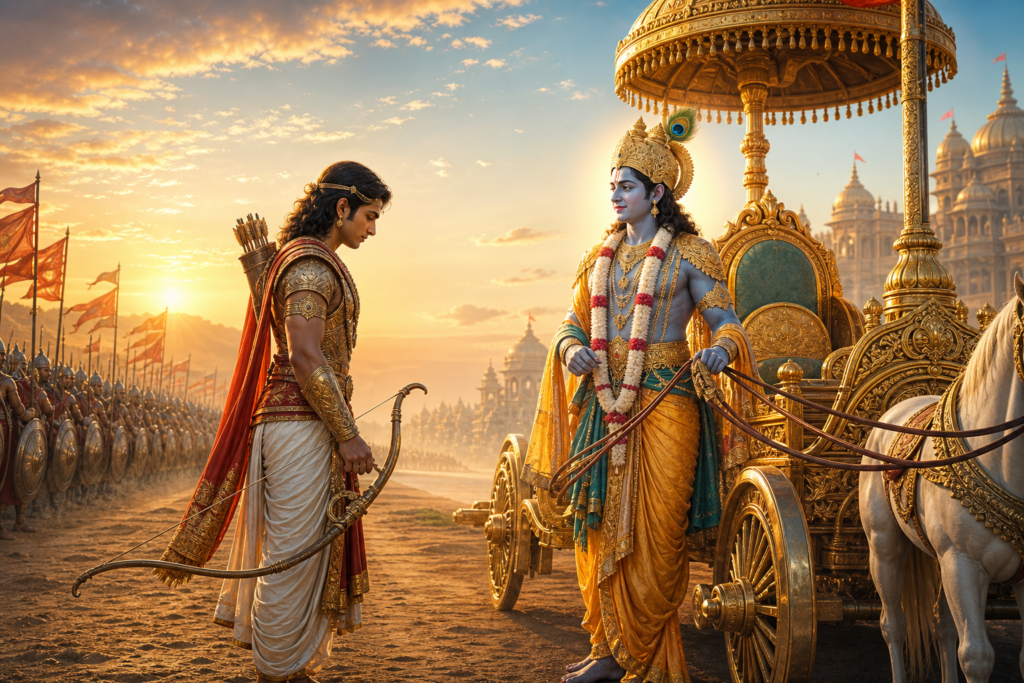
On the eve of battle, Bhagavad Gita unfolds. Arjuna, paralyzed by compassion and moral doubt, receives from Krishna a synthesis of jnana (knowledge), karma (action), and bhakti (devotion). The teaching reframes action without attachment, establishing the Gita as a foundational text of Hindu philosophy, and a resonant ethical compass across dharmic traditions seeking non-violent minds and responsible action amid conflict.
The 18-day Kurukshetra War proceeds with precise, escalating ferocity. Under Bhishma’s command, the Kauravas dominate, yet Bhishmapledged not to fight a womanfalls when Arjuna uses Shikhandi as a shield. Bhishma’s voluntary lying on the bed of arrows inaugurates a second, luminous life: his post-war teachings on rajadharma (statecraft), apaddharma (ethics in crisis), and moksha-dharma (liberation) will become the intellectual and spiritual summit of the epic.
Drona’s command sees grievous losses, including Abhimanyu’s heroic breach of the chakravyuha and his brutal deathan ethical nadir that the text does not conceal. Yudhisthira’s strategic proclamation that “Ashvatthama is dead” (true of the elephant) breaks Drona’s spirit, revealing the hazardous edges of warcraft where expediency must still face moral accounting.
With Karna in command, destiny tightens. A chariot wheel mired in earth and an invoked curse converge as Arjunabound by warrior code but pressed by Krishna’s counsel and the memory of Abhimanyuslays Karna. The epic honors Karna’s daana (generosity) and loyalty, even as it confronts the tragic arc of pride, estrangement, and untimely revelation.
On the eighteenth day, Bhima fulfills his vow in the mace duel by striking Duryodhana’s thightechnically against the rules, but framed as reciprocal justice for earlier humiliations. That night, Ashvatthama’s ferocity culminates in the Sauptika slaughter, destroying the sleeping Pandava forces except the core five. The moral wreckage after victory underscores the epic’s stark realism: in adharma, everyone loses something irretrievable.
After the war, Stri Parva records the lamentations of women, refusing triumphalism. Bhishma’s Shanti and Anushasana teachings then become a civilizational university: duties of rulers and citizens, economics of justice, charity without condescension, forgiveness with discernment, and the gradients of dharma from personal virtue to public policy. Vidura-niti distills counsel on integrity, prudence, and self-mastery, widely cited as a handbook for ethical statecraft.
Succession follows with Parikshit, saved in utero by Krishna from the Brahmastra. The Ashvamedha Yajna affirms Yudhisthira’s sovereignty while exploring the rightful use of power and the limits of conquest. The epic’s gaze remains unflinching: righteous rule demands continuous self-scrutiny and service-minded restraint.
In Mausala Parva, internecine strife destroys the Yadavas; Dvaraka sinks; Balarama and Krishna withdraw from the world. The cosmic wheel turns; even avatars conclude their manifest play, instructing that all formations are impermanent, and that alignment with dharma outlasts any single epoch or empire.
Finally, in Mahaprasthana and Swargarohana, the Pandavas renounce the throne, embarking on the great ascent. Yudhisthira refuses heaven without his faithful dogthen revealed as Dharmateaching that loyalty and truth are non-negotiable. A visionary passage through apparent hell and heaven exposes the fruits of action, culminating in reconciliation and luminous repose.
Harivamsa, often treated as the epic’s appendix, narrates cosmology, genealogies, and Krishna’s early life, linking Puranic themes to the epic’s ethical center. It completes a civilizational arc from origins to conduct, from polity to transcendence.
Across its vast canvas, Mahabharata examines layered domains of dharma: family vows and unintended consequences; duties of rulers under scarcity and abundance; diplomacy before war; rules of engagement during war; compassion after war; and the final inner settlement that alone ends enmity. It holds a mirror to all, warning that adharmahowever expedientextracts generational costs.
Mahabharata’s influence traverses Hinduism, Buddhism, Jainism, and Sikhism through shared ethical sensibilities: compassion linked with courage, truth held with humility, and righteous strength serving the common good. While each dharmic tradition articulates its own path, the epic’s moral grammarduty, non-cruelty, self-restraint, responsibility, and devotioncreates an inclusive foundation for unity in diversity.
Technically, the epic’s narrative complexity is a masterclass in framing devices, dialogue-as-philosophy, and law embedded in story. Its didactic segmentsBhagavad Gita, Shanti and Anushasana teachings, Vidura-nitifunction as normative texts on leadership, social welfare, jurisprudence in crisis (apaddharma), and spiritual liberation (moksha-dharma). Many readers and scholars thus regard Mahabharata as a living constitutional imagination for society rather than a closed chronicle of the past.
In contemporary life, the epic’s lessons map onto governance ethics, conflict resolution, organizational leadership, family responsibilities, and personal resilience. Its central insightthat right action is context-sensitive yet principle-anchoredguides decision-makers who must balance compassion with clarity, and vision with accountability.
In short, this Mahabharata summary clarifies how a single epic integrates political realism with spiritual aspiration. It begins with lineage and ends with liberation; it journeys from dice and deceit to dharma and discernment; and it offers, for all paths within the dharmic family, a shared vocabulary of wisdom to live byfirm, nuanced, and enduring.
Inspired by this post on Hindu Pad.