
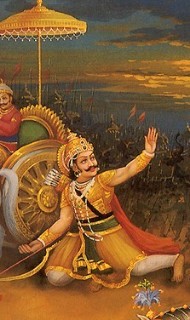
A capacity audience at Princeton University for a lecture on “Tragic Hero? Lessons from the life of the Mahabharata character Karna” offered a timely reminder: epic literature continues to illuminate contemporary ethical dilemmas across cultures. Interest from both pan-Indian and non-Indian attendees underscored how the Mahabharata’s nuanced portrayalsespecially Karna’sbridge scriptural wisdom with practical concerns such as friendship, loyalty, identity, and justice. This analysis synthesizes textual evidence and cross-disciplinary insights to clarify Karna’s complex legacy while drawing out lessons that resonate with the dharmic traditions of Hinduism, Buddhism, Jainism, and Sikhism.
A rigorous approach requires attention to sources. The Critical Edition of the Mahabharata (BORI) and canonical parvasAdi, Udyoga, Bhishma, Drona, Karna, and Shantiform the textual backbone for reconstructing Karna’s arc. Regional retellings enrich the narrative but can diverge in detail; therefore, wherever variations exist, the interpretive lens remains anchored in widely attested episodes and intertextual corroboration. This helps separate compelling but later accretions from the core ethical and philosophical questions the epic poses.
Karna’s birth and early life define his existential paradox. Born to Kunti through Surya and set afloat to avoid social stigma, he is adopted by Adhiratha and Radha and raised as a Suta. The fracture between biological lineage and social identity shapes his inner world: Kshatra by birth but denied its recognition, esteemed by personal prowess yet constrained by social labeling. The Mahabharata consistently invites readers to contemplate Dharma and Adharma not merely as rules but as lived tensions between intention, duty, consequence, and context.
Training under Parashurama elevates Karna into a warrior of formidable skill. Yet the decision to conceal his birth status from his preceptor becomes a critical fault line. When Parashurama discovers the concealment, he curses Karna that the vital knowledge will fail in the moment of utmost need. Additional misstepssuch as the accidental killing of a cow and the ensuing curse by its ownerforeshadow a tragic convergence of fate (daiva) and choice (purushakara). The epic frames these as moral and metaphysical consequences rather than random misfortune.
The public arena sharpens the rivalry with Arjuna. At the archery exhibition, Karna’s prowess asserts parity, if not supremacy, in popular memory; the textual corpus, however, balances admiration with reminders about the social and pedagogical structures that nurtured Arjuna’s skill. Duryodhana’s immediate coronation of Karna as king of Anga is both a challenge to caste-bound gatekeeping and a strategic investment in power politics. This coronation births one of the epic’s most debated bonds of friendship.
The Duryodhana–Karna alliance thrives on reciprocity, gratitude, shared ambition, and mutual legitimation. Psychologically, it showcases how status deprivation and the deep human need for respect can produce fierce loyalties. Contemporary social psychology recognizes this dynamic in phenomena such as identity threat, reciprocity bias, and loyalty binds. The Mahabharata anticipates these insights, demonstrating that affirmation without ethical guardrails exposes individuals to manipulation by those who “seem” to offer respect while steering them toward Adharma.
Karna’s ethical record, like most major characters in the Mahabharata, resists simplification. There are moments of luminous virtuevalor in battle and unmatched generosity in danaalongside grave moral lapses. His role in the humiliation of Draupadi during the dice-sabha stands out as a watershed of Adharma, a choice later shaded by remorse in various dialogues but never fully absolved. Epic ethics insists that excellence in one dimension does not offset failure in another; Dharma demands integrity across domains.
The Udyoga Parva stages an extraordinary moral negotiation. Krishna reveals Karna’s birth and offers reconciliation with the Pandavas, even a path to sovereignty. Karna acknowledges the truth but refuses to abandon Duryodhana, framing his refusal as fidelity to gratitude and friendship. He does, however, pledge to Kunti that her five sons will survivehe will spare all except Arjuna. This episode epitomizes the epic’s tragic architecture: noble intentions fettered to an unjust cause.
Indra’s test of Karna’s character, disguised as a brahmana seeking the kavacha-kundala, culminates in the famed exchange. Karna parts with his natural armor and earrings, receiving the Vasavi Shakti in return. The transaction reflects both superlative generosity and strategic miscalculation: the single-use Shakti, later expended on Ghatotkacha, saves Duryodhana’s army in the near term but removes Karna’s last insurance against Arjuna. In philosophical terms, the episode probes the difference between virtue as inner disposition and virtue as prudential wisdom aligned with Dharma’s ends.
Karṇa’s battlefield record after Bhishma’s fall is formidable. He breaks several Pandava formations, neutralizes elite warriors, and famously slays Ghatotkacha with the Shakti when the rakshasa’s night-fighting prowess threatens to turn the tide. He participates in the encirclement of Abhimanyuwhere the code of war collapseswith Dushasana’s son delivering the final blow. Ultimately, on the seventeenth day, Karna’s chariot wheel sinks at a fated moment, his memory fails to recall crucial mantras, and Arjuna, at Krishna’s insistence, strikes decisively.
Debates about battlefield fairness often isolate Karna’s end without situating it in the broader erosion of rules throughout the Kurukshetra War. The epic narrates prior breaches by multiple sides, rendering the contest a study in escalating norm breakdown. The philosophical conclusion is not relativism but realism about war’s moral entropy: once Adharma is normalized tactically, it corrodes the very expectations of reciprocity that codes attempt to protect.
Is Karna a tragic hero? In a classical sense, yes: a towering figure whose hamartiaidentity insecurity transmuted into uncompromising loyaltyaligns with adverse circumstances and prior curses to produce catastrophe. Yet the Mahabharata is not content with tragedy as spectacle; it weds tragedy to pedagogy. It suggests that fate constrains, but choice defines.
A contemporary lens clarifies these lessons. Research on self-esteem, self-determination theory (competence, autonomy, relatedness), and identity-based motivation converges on a principle the epic dramatizes: unmet needs for recognition can bind individuals to alliances that feel noble yet drift ethically. When honor is outsourced to another’s approval, discernment dims. The antidote is inner dignity rooted in Dharmaclarity of purpose, right association (satsanga), and the courage to recalibrate loyalties when they conflict with moral truth.
Across dharmic traditions, this insight recurs with different emphases. Hindu texts point to viveka (discrimination) and vairagya (detachment) as safeguards against manipulation by praise or blame. Buddhist frameworks warn against the kleshasespecially moha (delusion) and upadana (clinging)that cloud judgment. Jain teachings on samyak darshan (right view) and aparigraha (non-attachment) counsel inner steadiness over external validation. Sikh wisdom orients seekers toward sangat (ethical community) and seva (selfless service), centering dignity in righteous action rather than status. The shared ethic: cultivate inner worth to avoid being steered by flattery.
Several popular claims invite careful correction. First, textual evidence varies on whether Karna was barred from Draupadi’s svayamvara solely on status grounds or whether he participated and failed; the Critical Edition weighs in cautiously, reminding readers to separate later embellishments from core strands. Second, the view that Karna was the “only rightful heir” because he was Kunti’s firstborn neglects juridical and political realities within the epic world, where legitimacy, public recognition, and vows shape succession. Third, valor does not erase complicity: the same Karna who exemplified dana also endorsed the dice-sabha outrage. The Mahabharata’s ethic insists on comprehensive accountability.
Leadership and civic life can draw precise lessons. Institutions should recognize excellence without instrumentalizing it; conferring honor to purchase loyalty breeds fragile coalitions and ethical drift. Individuals navigating careers and communities should prize mentors and peers who elevate conscience over convenience. Ethical friendship supports growth; transactional friendship exploits insecurity.
The Princeton discussion’s cross-cultural engagement reflects a robust pedagogical opportunity. When presented with textual rigor and psychological clarity, Karna’s story equips students, professionals, and community leaders to ask better questions about power, gratitude, merit, and justice. The Mahabharata thus serves not merely as heritage but as a living manual for moral reasoning under pressure.
In sum, Karna’s life affirms that dharma is not reducible to status, sentiment, or skill; it is an alignment of intention, means, and ends. Admiration for courage and generosity must coexist with honest reckoning of moral error. The unity of dharmic traditions is well served by this balanced reading: honor what is noble, learn from what failed, and commit to inner dignity that resists manipulation. When recognition arises from Dharma rather than dependency, friendship becomes a force for justice, and fate finds less room to narrow the arc of choice.
Inspired by this post on Dandavats.
