For decades, ISKCON Wellington has served as a luminous center of community life, offering vibrant kīrtana, insightful spiritual discourse, free vegetarian prasādam, youth development, festivals, and devotional gatherings that knit together diverse families across the city. In June 2024, the closure of its previous premises due to structural and legal challenges created a sudden vacuum in communal and spiritual life. This analysis documents the path forwardhow a dedicated community can responsibly reestablish a sacred home for Krishna in Wellington while meeting contemporary legal, structural, and social standards, and while strengthening unity across dharmic traditions.
Temples in diaspora contexts function as more than houses of worship; they are cultural anchors, informal social-safety nets, and learning environments where children, youth, and elders build trust and shared purpose. ISKCON Wellington’s history reflects this pattern: regular kīrtana, study circles, festivals, and prasādam distribution fostered a sense of belonging that scholars often identify as essential for migrant well-being and intergenerational continuity. The temporary absence of a dedicated space underscores the centrality of such institutions and the urgent need for a legally and structurally robust revival.
Reports of “structural and legal challenges” typically reflect a confluence of building safety, planning, governance, and insurance factors common to assembly-use facilities in high-seismic regions. In Wellington, where seismic risk is material, responsible stewardship requires rigorous attention to engineering standards, life-safety systems, fire protection, accessibility, and planning rules. Reestablishing a temple therefore entails a disciplined project that aligns spiritual aspirations with building code compliance, transparent governance, and sustainable community operations.
From a technical standpoint, assembly occupancy imposes strict obligations. Any new or adapted premises must demonstrate compliance with the New Zealand Building Code under the Building Act framework, including (1) structural performance, (2) fire safety and egress, (3) protection from moisture, (4) internal environment and ventilation, (5) access and facilities for people with disabilities, and (6) durability. Where a change of use is proposedfor example, converting a warehouse or office into a devotional hallformal approvals and, often, building consent are required before public gatherings can lawfully occur.
Seismic performance is a linchpin in Wellington. Professional structural assessment (e.g., an initial or detailed seismic evaluation by chartered engineers) typically determines a building’s percent of the New Building Standard (%NBS) and whether it is earthquake-prone under statutory criteria. For a high-occupancy hall used for kīrtana, festivals, and cultural programs, prudent governance seeks a robust %NBS outcome and, where necessary, a practical, staged strengthening plan. Transparent communication with congregants about seismic status and upgrade timelines strengthens trust and supports informed participation.
Fire safety is equally critical. A compliant design addresses detection and alarm systems, safe egress capacity relative to peak occupancy, emergency lighting, evacuation planning, and integration with local fire and emergency response protocols. Given the rhythmic intensity of kīrtana and the congregation’s dynamic movement, clear exit signage, appropriate door swing, and unobstructed egress paths become non-negotiable aspects of the fit-out.
Accessibility is a moral and legal imperative. A temple that is truly inclusive ensures barrier-free routes from arrival to all key spaceshall, classrooms, kitchen servery, toilets, and sanctumalong with accessible sanitary facilities. Proper gradients, door widths, maneuvering clearances, and tactile indicators make spiritual life safer and more welcoming for elders, wheelchair users, parents with prams, and people with sensory differences.
Planning and resource considerations typically include compliance with local district plan rules regarding land use, hours of operation, crowd capacity, parking, and noise. Kīrtana can be acoustically vivid; consequently, appropriate insulation, sound-limiting strategies, and responsible scheduling protect neighborly relations and reduce the risk of regulatory conflict. Early, open dialogue with local authorities and neighbors usually yields durable goodwill.
Vegetarian prasādam service, long a hallmark of ISKCON Wellington, benefits from a kitchen that meets contemporary food safety standards. Registration under an appropriate Food Control Plan, verified food-handler training, temperature control, allergen management, hygienic flow (separating raw and ready-to-eat processes), and traceability protocols are standard best practice. Vegetarian-only kitchens also document controls to avoid cross-contact, enabling the prasādam tradition to remain spiritually grounded and publicly accountable.
Integrated design improves both devotion and operations. Effective spatial planning allows a serene darśana experience near the altar while preserving broad, column-free congregational areas for kīrtana. Storage for instruments and footwear, shoe-change foyers, wash stations, and queue management zones all reduce congestion at peak times. A flexible multiuse hall (scriptural study, youth programs, cultural classes) multiplies the social value of every square meter.
Festival management requires additional rigor. Janmāṣṭamī, Gaura Pūrṇimā, Ratha-yātrā-related events, and major community gatherings can surge attendance beyond normal weekly volumes. Pre-event risk assessments, steward training, crowd counting, temporary wayfinding, overflow queuing, family reunion points, and medical response coordination markedly elevate safety. When planned well, the joyous intensity of festival kīrtana remains compatible with strict life-safety standards.
Under workplace health and safety expectations, event organizers owe a duty of care to volunteers and attendees. Documented risk registers, inductions for kitchen and festival volunteers, manual-handling guidance for moving instruments and furniture, and well-defined incident reporting are all part of mature operations. Child safeguarding policiesincluding screening of youth volunteers, clear ratios for children’s programs, and designated safe spacesalign with best practice and community expectations.
Transparent governance sustains confidence. In New Zealand, many temples operate via charitable trusts with constitutions that specify purpose, trustee duties, conflict-of-interest rules, financial reporting, and dissolution clauses. Regular, accessible financial statements; independent reviews or audits commensurate with scale; and published policies on privacy, grievances, and safeguarding build the shared confidence that underwrites long-term community participation.
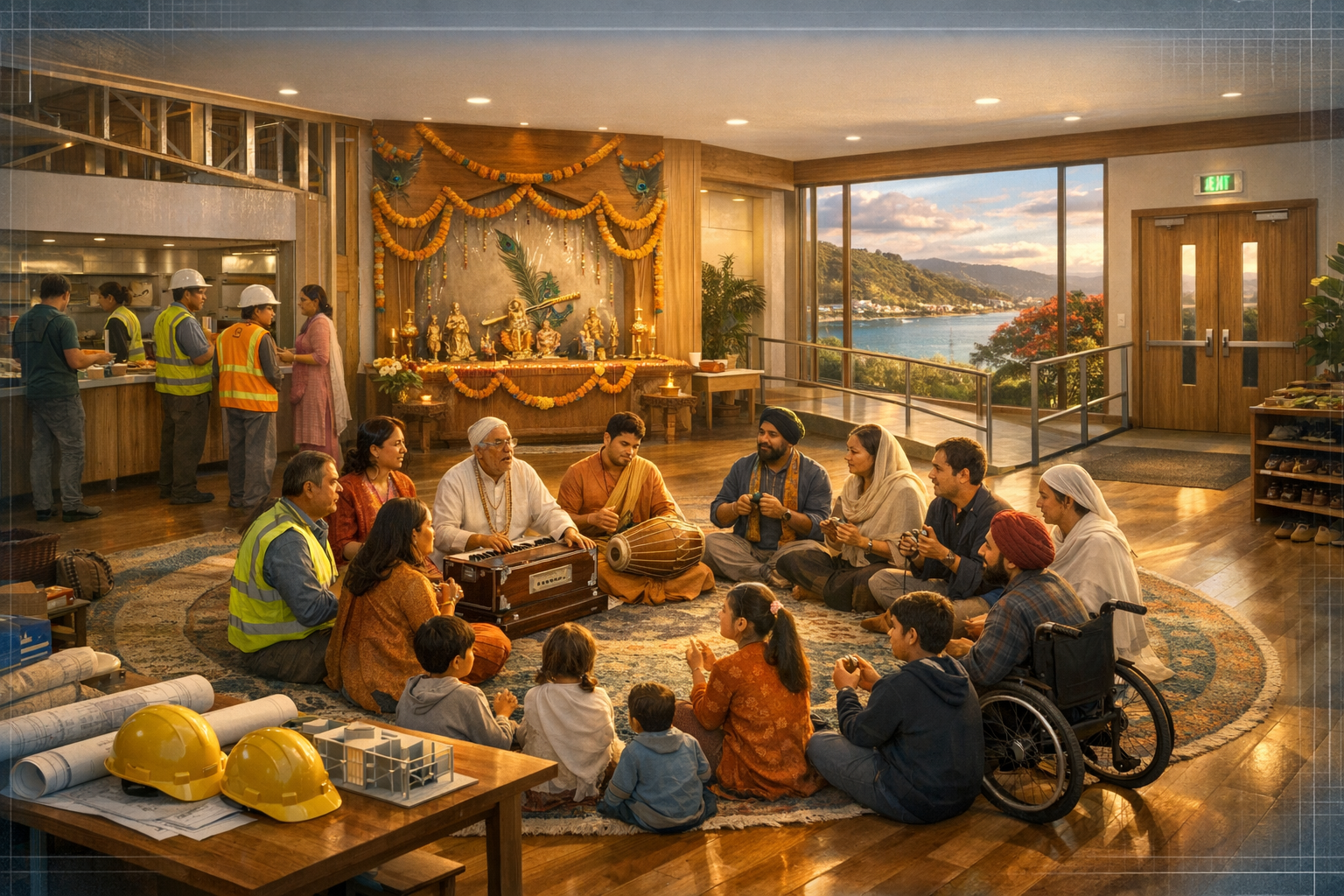
In the interim, distributed programs preserve momentum. Home-based satsanga, hired community halls, and hybrid formats ensure continuity of kīrtana, śāstra study, and prasādam even without a permanent base. Many congregants describe the warmth of living-room gatheringsthe mṛdaṅga’s cadence, the harmonium’s lift, children learning simple mantrasas a reminder that spiritual life thrives wherever devotion and care are present.
An inclusive programming portfolio supports diverse needs: youth mentorship, seniors’ companionship circles, family education on the practice of bhakti, and accessible introductions to the Bhagavad-gītā for newcomers. Practical workshops on vegetarian nutrition, mindful living, and stress management complement traditional study, making the temple a holistic learning hub rather than a venue for ritual alone.
Unity across dharmic traditions is foundational. Collaboration with local Buddhist, Jain, and Sikh communitieswhether through shared event spaces, coordinated cultural days, or service projectscultivates mutual understanding and affirms common values such as ahiṁsā, seva, and satsang. Such cooperation reflects a broader civilizational ethos: many paths, one commitment to compassion, knowledge, and communal harmony.
Culturally competent practice strengthens inclusivity. Multilingual signage and program materials, accessible explanations of rituals for first-time visitors, and open-house days that demystify temple life reduce barriers to participation. Diaspora temples excel when they honor tradition while speaking clearly to contemporary urban audiences in Wellington’s richly plural civic environment.
Sustainability principles can be integrated into the fit-out. Daylighting, natural ventilation where feasible, efficient HVAC, low-VOC finishes, careful incense management, acoustic treatments using recycled materials, water-saving fixtures, and robust waste segregation demonstrate stewardship of both sacred space and the broader environment. Sustainable design also improves long-run operating costs.
A disciplined risk-management framework anticipates issues before they arise. Common risks include consent delays, cost escalation, contractor coordination, neighborhood concerns about noise or parking, and volunteer burnout. Mitigations range from early technical due diligence and realistic budgeting contingencies to proactive neighbor engagement and well-paced volunteer rosters with clear role descriptions.
Financial sustainability follows from clarity of scope and scale. A right-sized facility aligned with actual attendance patterns, staged upgrades, and multiuse programming reduces fixed cost pressure. Where appropriate, limited hall use for compatible community classes, transparent fee-for-service arrangements for private functions consistent with temple values, and strong volunteer participation can stabilize operations without compromising devotional priorities.
Continuous evaluation supports learning and accountability. Balanced metricsattendance trends, volunteer retention, prasādam meals served, youth program completion, safety incident rates, neighborhood feedbackoffer a rounded picture of impact. Publishing highlights annually reinforces a culture of reflection and shared responsibility.
Experience from other diaspora centers suggests that successful revivals combine spiritual clarity with technical competence. Early engagement with engineers, planners, and compliance professionals prevents costly redesigns; equally, early engagement with congregants maintains cohesion and ensures the new space genuinely reflects community needs. When devotional intention and professional execution move together, timelines shorten and outcomes endure.
A pragmatic roadmap often unfolds in phases: (1) feasibility and site shortlisting, (2) due diligence and concept design, (3) consenting and detailed design, (4) procurement and fit-out, (5) commissioning, training, and soft opening, then (6) a calibrated expansion as programs grow. At each phase, transparent updates allow everyonelongtime participants and new well-wishers aliketo understand progress and contribute responsibly.
Beyond technicalities, the heart of this effort is communal resilience. Longtime participants often recall the subtle quiet after the closurethe moment the drumbeat paused and the conch fell silentand how quickly that silence transformed into house gatherings, shared meals, and renewed purpose. In this way, the service ethic that sustained ISKCON Wellington for decades continues to animate a careful, law-abiding, and inclusive return.
Reestablishing a sacred home for Krishna in Wellington is therefore more than a building project; it is the reconstruction of a neighborhood of care, a school of character, and a workshop for unity in spiritual diversity. With rigorous compliance, thoughtful design, transparent governance, and open-armed collaboration across Hindu, Buddhist, Jain, and Sikh communities, the city can once again host a temple that sings with kīrtana, nourishes with prasādam, and welcomes every seeker with dignity.
Inspired by this post on Dandavats.