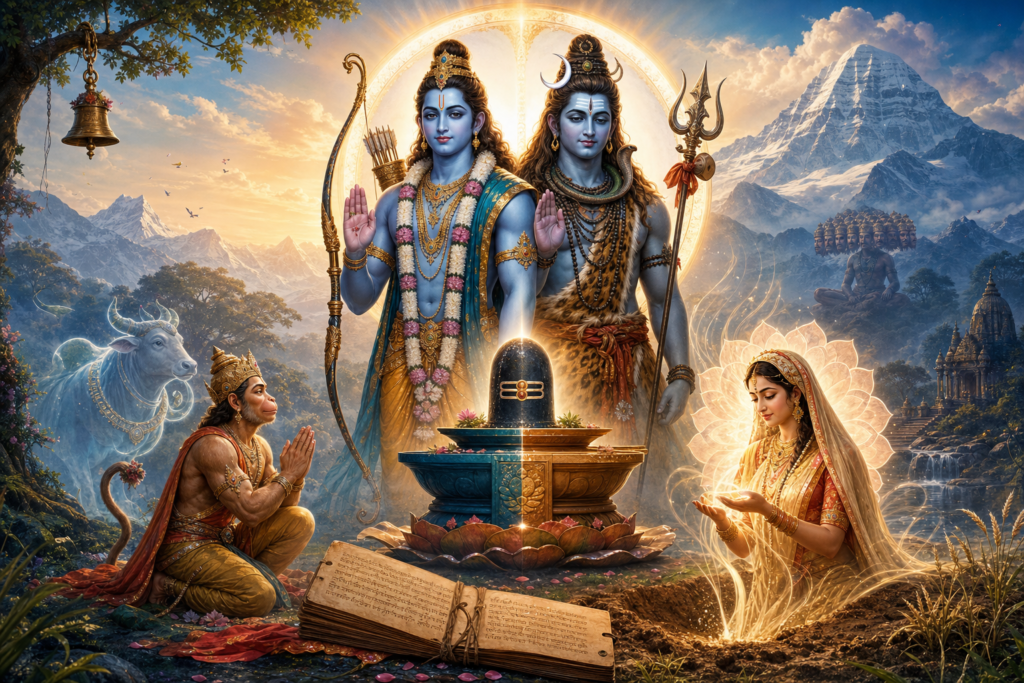
In Hindu Tantric traditions, Mahakala signifies far more than a fierce manifestation of Shiva. The entwined relationship between Mahakali and Mahakala is presented as a contemplative key to reality itself, where time, power, and consciousness interpenetrate. Iconography often depicts Kali standing upon Mahakala, a visual pedagogy that invites seekers to read the scene not as domination, but as a precise map of metaphysics, psychology, and sadhana.
Etymologically, kala denotes both time and the fathomless dark, while Mahakala is the “Great Time” that devours all cycles. Kali, identified with Shakti, embodies the kinetic, creative-dissolving power that reveals and renews the cosmos. In this framework, Mahakala is the still, absolute groundpure consciousnessupon which Kali’s transformative dynamism unfolds. The image communicates a non-dual insight: Shakti (Kali) is never apart from Shiva (Mahakala), and the dance of becoming rests upon changeless awareness.
Within Tantra, the notion of vahana (vehicle) extends beyond a literal mount to a deeper support or ontological basis. Calling Mahakala the “vahana” of Kali signals that time and consciousness provide the subtle support for Shakti’s play. Conversely, Shakti animates and expresses that very ground. The relationship is thus reciprocal and non-hierarchical, aligning with the broader Tantric understanding that the Absolute and its Power are inseparable.
Tantric iconography renders these insights with arresting clarity. Cremation-ground settings, skull garlands, and the still, supine body of Mahakala convey the fearless embrace of impermanence and the dissolution of ego (ahamkara). Kali’s poised stance, blade, and abhaya (fear-dispelling) gesture together indicate that transformative energy thrives on the stability of pure being. Many practitioners find that this imagery evokes surrender, moral courage, and the resolve to see through fear into compassion and clarity.
Philosophically, the scene echoes non-dual principles articulated across Shaiva-Shakta traditions: without Shakti, Shiva remains inert; without Shiva, Shakti lacks anchoring. In practice, this becomes a contemplative methodmeditating on breath, mantra, and the ebb and flow of thoughts while recognizing the stable witness beneath them. As attention settles into that inner stillness (sthira), emotional turbulence recasts as Kali’s dance (spanda), turning anxiety about change into insight about time’s refining power.
Seen through a broad dharmic lens, the symbolism resonates across related traditions. In Vajrayana Buddhism, Mahakala appears as a compassionate protector (dharmapala), advancing the same fear-transcending ethic that Tantra highlights. Jain and Sikh wisdom emphasize inner discipline, truthfulness, and the mastery of egocomplementary values that align with Kali’s cutting of delusion and Mahakala’s reminder of impermanence. Such convergences affirm unity in spiritual diversity and encourage mutual respect among Hinduism, Buddhism, Jainism, and Sikhism.
Historically and ritually, this pairing has flourished in Tantric and Agamic milieus across regions such as Bengal, Assam, and Nepal, and in cremation-ground yoginī lineages. While textual attributions vary by school, the philosophical throughline remains consistent: Mahakala functions as the timeless substratum; Kali manifests transformative energy. Kashmir Shaivism’s reflections on spanda (vibration) and the Absolute further illuminate why stillness and motion coexist without contradiction in a single, undivided reality.
Why, then, is Mahakala called the vahana or vehicle of Kali in Tantra? Because time and pure awareness bear and reveal power, while power animates and expresses that ground. The image of Kali standing upon Mahakala encodes non-duality, the sublation of fear, and the ethical imperative to live with courage, compassion, and clarity. Properly understood, it is not a statement of hierarchy, but a profound invitation to realize the one reality in which stillness and motion, Shiva and Shakti, Mahakala and Mahakali, are ever one.
Inspired by this post on Hindu Blog.